GST on Works Contract: Definition, Applicability & Key Changes
This guide explains GST treatment of works contracts and how they differ from composite supplies. You will learn the practical definition of a works contract in the GST context, how GST rates and input tax credit (ITC) treatment can differ between a works contract and a composite supply, and which types of works-contract-related supplies attract specific rates or exemptions as reflected in the notifications. Understanding these distinctions matters because classification affects the applicable GST rate, availability of ITC to the recipient, and the tax treatment of sub-contracting or government contracts. The guide also summarises landmark notification entries that list categories of works contract supplies and the rates prescribed for them. Whether you are a contractor, sub-contractor, project owner, or tax professional advising construction-sector clients, this article provides a concise, practical reference to help you identify which rules apply and why they lead to different tax outcomes for otherwise similar commercial transactions.
What is a works contract and how it contrasts with composite supply
In GST parlance a works contract is treated as a supply (often as a composite supply) that typically bundles goods and services into a single transaction. The exact legal definitions are contained in the Act and rules, but the practical distinction rests on the principal element of the transaction, whether the dominant element is the provision of service or the supply of goods.
A composite supply, by contrast, is where multiple goods or services are supplied together and one element is the principal or predominant supply. For example, a carpenter’s principal supply is his service; therefore, the whole transaction is considered a service when that is the principal element. The GST rate applicable to a composite supply is the rate of the principal supply that dominates the transaction.
The classification matters because it determines not only the rate of tax but also the availability of input tax credit (ITC) for the recipient. While a composite supply will generally follow the rate of the principal supply, a works contract can have specific GST rates prescribed separately and may have different ITC consequences.
From a practical viewpoint, businesses must examine their contracts, the value composition of goods versus services, and the principal element to determine the correct classification. Misclassification can affect tax liability and the recipient’s ability to claim ITC.
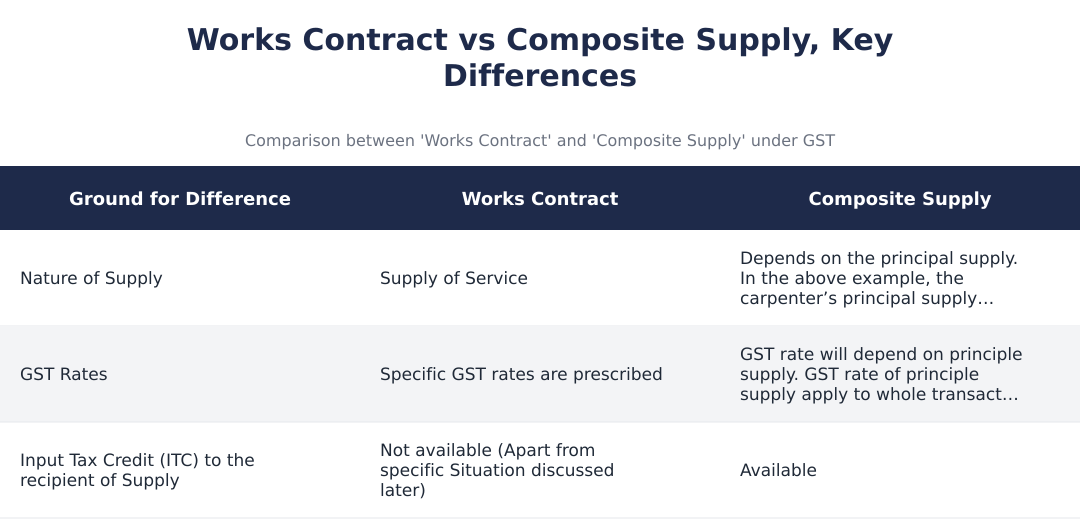
Key differences: Works contract vs Composite supply
| Ground for Difference | Works Contract | Composite Supply |
|---|---|---|
| Nature of Supply | Supply of Service | Depends on the principal supply. In the above example, the carpenter’s principal supply is his service. Therefore, the whole transaction will be considered as service. |
| GST Rates | Specific GST rates are prescribed | GST rate will depend on principle supply. GST rate of principle supply apply to whole transaction value. |
| Input Tax Credit (ITC) to the recipient of Supply | Not available (Apart from specific Situation discussed later) | Available |
Selected notified items for works contract supplies and rates
| Item / Heading | Description (summary) | GST Rate (%) | Notes / Conditions |
|---|---|---|---|
| 3, Heading 9954 (Construction services) | Composite supply of works contract supplied to Central/State/UT/local authority or Government Entity by way of construction, erection, commissioning, installation, completion, fitting out, repair, maintenance, renovation, or alteration of historical monuments, archaeological sites of national importance, canal, dam, irrigation works, pipeline/conduit/plant for water supply, water treatment or sewerage treatment or disposal. | 6 | Where supplied to a Government Entity, services should have been procured by that entity in relation to a work entrusted to it by Government/local authority. |
| Item (iv) | Composite supply of works contract supplied by way of construction, erection, commissioning, installation, completion, fitting out, repair, maintenance, renovation, or alteration of roads, bridges, tunnels, terminals for public road transport; civil structures under certain national urban missions; pollution control/effluent treatment plant (except when part of a factory); or structures meant for funeral/cremation. | 6 | Condition for Government Entity procurement for applicability. |
| Item (v) | Composite supply of works contract for original works pertaining to railways (including monorail and metro), a single residential unit not part of a residential complex, specified low-cost houses up to 60 sq. metres carpet area in approved projects, post-harvest storage infrastructure including cold storage, and mechanised food grain handling systems excluding alcoholic beverages. | ||
| Item (vi) | Composite supply of works contract provided to Government bodies for construction, erection, commissioning, installation, completion, fitting out, repair, maintenance, renovation, or alteration of civil structures meant predominantly for non-commercial use, or structures meant predominantly for educational, clinical, art or cultural establishments, or residential complexes predominantly meant for self-use or employee use. | 6 | Condition for Government Entity procurement for applicability. |
| Item (vii) | Composite supply of works contract involving predominantly earth work (constituting more than 75% of the value of the works contract) provided to Government entities. | 2.5 | Provided it was procured by the Government Entity in relation to a work entrusted to it. |
| Item (ix) | Composite supply of works contract provided by a sub-contractor to the main contractor providing services specified in item (iii) or (vi) to Government entities. | 6 | Condition for Government Entity procurement for applicability. |
| Item (x) | Composite supply of works contract provided by a sub-contractor to the main contractor providing services specified in item (vii) to Government entities. | 2.5 | Condition for Government Entity procurement for applicability. |
ITC and practical compliance implications
The availability of input tax credit differs between works contracts and composite supplies. Where a supply is treated as a composite supply and the principal supply is a service with ITC entitlement for the recipient, the recipient can claim ITC as permitted under GST rules. For transactions classified specifically as works contracts, the recipient’s ability to claim ITC is restricted in many cases, subject to the specific situations and conditions laid down in notifications or rules.
For contracts involving government entities, many notification entries prescribe rates (for example 6% or 2.5%) and also attach procurement conditions, notably that the services should have been procured by the Government Entity in relation to a work entrusted to it by the government or local authority. These conditions matter for both rate applicability and for downstream compliance such as GST invoicing and documentation.
Sub-contracting relationships also have defined treatment in the notified entries: sub-contractors providing services to a main contractor for certain government projects are explicitly covered and assigned specific rates. Contracting parties must therefore ensure contracts and procurement records reflect the nature of the project and the entity procuring the services in order to apply the correct rate and follow compliance requirements.
In practice, contractors should maintain clear break-ups of goods and services value where relevant, retain procurement orders and government entrustment documentation when claiming notified rates, and monitor whether the contract is predominantly earth work (more than 75% of contract value) as that can change the rate applicable.
Definition note: Governmental Authority
The term “Governmental Authority” in the notified extracts means an authority, board or any other body that is either set up by an Act of Parliament or a State Legislature, or established by any Government with 90% or more participation by way of equity or control.
This definition is important because multiple notification entries grant specified rates and conditions only where the recipient is the Central Government, State Government, Union territory, a local authority, a Governmental Authority or a Government Entity. Determining whether an entity qualifies as a Governmental Authority under the stated criteria affects rate applicability and the conditions for procurement-related exemptions or reduced rates.
Correct classification between works contract and composite supply is critical for applying the right GST rate and understanding ITC consequences. Use the notification summaries in this guide to identify common scenarios and prescribed rates, especially for government-related contracts and sub-contracting. For each project, document the principal supply, procurement records and the value composition of goods versus services to support the tax position.
Frequently asked questions
What is a 'works contract' under GST law now?
A 'works contract' under GST law is a supply of service that relates to work undertaken for an immovable property. The GST definition has been narrowed to contracts concerning immovable property (construction, erection, commissioning, renovation, repair, etc.), unlike older VAT/service tax definitions that covered movable property too. This means activities like building or renovating a house, road or bridge are treated as works contract for GST purposes, and specific GST rules and rates for works contracts apply. Note that tax treatment (rate, ITC availability) may still vary depending on whether the supply qualifies as a works contract or as a composite supply with a principal supply of goods or services.
How do I tell the difference between a works contract and a composite supply under GST?
A works contract is treated as supply of service, whereas a composite supply is taxed according to the principal supply within the bundle of goods and services. For example, if a carpenter’s main element is his service, the whole transaction is treated as service (works contract); if the principal supply is goods, the composite supply rate of that principal supply applies to the entire transaction. The distinction matters for applicable GST rates and input tax credit, ITC is generally not available to the recipient for a works contract (except in specific situations) but is available when the transaction is a composite supply whose principal supply allows ITC.
What GST rates apply to different types of works contracts supplied to government entities?
GST rates for works contracts supplied to government entities vary by the nature of the project and range from nil to 6% and higher depending on classification. For instance, construction services for historical monuments, canals, pipelines, roads, bridges and certain public-use civil works supplied to government bodies can attract 6% (or 2.5% for predominantly earthwork contracts exceeding 75% of contract value), while some pure services related to Panchayat/Municipality functions can be nil-rated. Each category has conditions (like procurement for works entrusted by Central/State/local authorities) and specific notifications that specify whether 6%, 2.5% or nil rates apply.
Is input tax credit (ITC) available on works contract supplies?
Generally, input tax credit is not available to the recipient of a works contract supply, except in specific situations where the law or notifications allow it. The GST framework treats works contract as a supply of service for which ITC to the recipient is restricted, while composite supplies (where principal supply permits ITC) typically allow ITC. Recipients should check the exact category (works contract vs composite supply) and applicable notifications because some government-supplied works or certain project types may have different ITC rules.
What GST rate applies to low-cost houses and small residential units under works contract rules?
Construction of certain low-cost houses and single residential units can attract concessional GST rates or specific classification under works contract notifications. For example, original works involving a single residential unit (not part of a residential complex) and low-cost houses up to 60 square metres in approved affordable housing projects are covered under notifications that may attract specified lower rates or exemptions. The concessional treatment is subject to conditions such as project approval by competent authorities and inclusion under notified housing schemes like the Pradhan Mantri Awas Yojana or state affordable housing schemes.
How are sub-contractors treated under GST for works contracts on government projects?
Sub-contractors providing works contract services to a main contractor on notified government projects are covered by specific GST rates and conditions, often similar to those applicable to the main contractor. For instance, sub-contracting services for works covered under items (iii) or (vi) of the notification attract 6%, while sub-contractors for predominantly earthwork projects tied to government contracts may attract 2.5%, subject to the condition that the original work is procured for a government entity. The reduced or specific rates apply only when the supply meets notification conditions, including procurement by the government entity for entrusted works.
Are road, bridge and public transport terminal constructions taxed differently under GST works contract rules?
Yes, construction of roads, bridges, tunnels and terminals for road transportation intended for public use are treated under specific works contract notifications and generally attract the prescribed rate (often 6%) subject to notification conditions. These items are listed explicitly in GST notifications as composite supplies of works contract and may qualify for concessionary rates when supplied to government entities or under certain housing and urban renewal schemes. The concessional treatment requires that the services be procured by the government/entity in relation to works entrusted by the government or local authority as specified in the notification.
Can earthwork-dominated works contracts get a lower GST rate?
Yes, works contracts that involve predominantly earthwork (more than 75% of the contract value) supplied to government entities are eligible for a lower GST rate of 2.5% under specific notifications. The reduced 2.5% rate applies only when earthwork constitutes over 75% of the works contract value and the services are supplied to the Central/State/Union Territory/local authority or government entity, often with the condition that procurement relates to works entrusted by the government. Contractors should document cost breakup to substantiate the >75% earthwork threshold to claim the reduced rate.
What conditions must be met for works contract supplies to government entities to get notified GST rates?
To get notified GST rates on works contract supplies to government entities, the services must be supplied to Central/State/Union Territory/local authorities or specified government entities and, in many cases, must be procured in relation to works entrusted to those entities by the government. The notifications list specific project types (historical monuments, irrigation works, roads, low-cost housing, educational/clinical structures, etc.) and may require that the procurement be tied to schemes like JNNURM or PMAY; only when these conditions are satisfied will the specified rates (nil, 2.5%, 6%, etc.) apply. Taxpayers should retain relevant tender/award documents and procurement evidence to substantiate the applicability of the notified rate.
Need help staying GST compliant?
MoneyGence's AI Finance OS tracks your compliance, wallet share, and finances in one place, built for agencies and growing businesses.
Get started with MoneyGence