GST Rates on Tobacco and Pan Masala 2026, Changes from 1 Feb
This guide explains how a government decision to restructure GST treatment for tobacco and pan masala products can affect businesses across the supply chain. You will learn what practical compliance changes to expect, how pricing, accounting and inventory practices might need to adapt, and what steps firms should take to limit disruption. Even when exact rate or notification details are being awaited, preparation, especially in bookkeeping, invoicing, and communication with suppliers and customers, reduces risk and helps maintain cash flow. The guide is aimed at manufacturers, traders, distributors, retailers and tax professionals who handle excisable or consumer products that may be impacted by changes in indirect tax treatment. We cover the operational implications of a GST restructuring, the key internal controls to implement, how to update ERP and invoicing systems, and best-practice communications with stakeholders. The objective is to help you move from uncertainty to an actionable readiness plan so that once formal notification and rates are published, your business can implement the changes quickly and accurately. The sections that follow break down compliance tasks, accounting and pricing considerations, documentation and recordkeeping, and practical steps for transitional handling of stock and contracts.
Understand the likely operational impact
When tax treatment for a product category is altered, the immediate operational effects are typically felt in pricing, cash flow and invoicing. Businesses need to map which of their SKUs fall within the affected categories and identify where tax computation logic in sales and billing systems will require updates. Failure to update these systems promptly can lead to incorrect invoices, disputes with customers, and potential compliance notices.
Supply-chain partners should be engaged early. Changes that affect the tax burden on intermediaries can alter margins at each stage, manufacturers, distributors and retailers should assess contract terms and consider whether pricing or supply arrangements need to be renegotiated. Practical readiness includes ensuring that point-of-sale systems and e-commerce platforms apply the revised tax treatment consistently across channels.
Accounting, invoicing and ERP updates
Accounting teams must be ready to implement new tax rates or classification codes as soon as they are officially notified. This means updating chart of accounts, tax ledgers, and GST master data in the ERP. Reconciliations should be planned around the effective date to ensure returns and ledgers reflect the revised treatment.
Invoicing templates and tax computation modules should be tested in a sandbox environment before going live. Particular attention is needed for invoices issued on or around the transition date: businesses should define rules for which rate applies to supplies invoiced before but delivered after the change, and ensure system enforcement of those rules to prevent manual errors.
Documentation, recordkeeping and audit trails
Stronger documentation is critical during a change in tax treatment. Maintain clear records that justify GST classification for each product, product specifications, formulations, import/export codes where relevant, and supporting technical descriptions help defend classification choices in the event of queries from tax authorities.
Retain audit trails that show when ERP and invoicing changes were implemented, with approvals and test results. If transitional provisions apply, preserve documents that support the timing of supply, delivery challans, and payment receipts, as these will be important to establish the correct tax treatment for borderline transactions.
Practical readiness checklist (high level)
Create an SKU-level list of items that may fall under the restructured tax treatment and flag them in your inventory system.
Prepare ERP, billing and e-commerce platforms for quick configuration changes once formal details are published.
Inform suppliers, distributors and key customers about potential changes and how you will handle pricing or contract implications.
Decide and record rules for supplies crossing the effective date, and keep supporting paperwork for deliveries, invoices and payments.
Managing reputational and compliance risk
Public-facing communications should be carefully managed. If prices change materially as a result of tax restructuring, prepare consumer-facing messaging and internal FAQs so front-line teams can explain why prices have changed and when. Clear communication reduces controversies and customer complaints.
From a compliance perspective, maintain a conservative stance when classification is uncertain, document the rationale for tax treatment and consider obtaining an expert opinion for high-value or high-risk items. Timely voluntary disclosure and correction of any errors identified early can limit penalties and demonstrate good faith to authorities.
A restructuring of GST treatment for a product group requires prompt, coordinated action across operations, finance, IT and sales. By identifying affected SKUs, updating systems, strengthening documentation and communicating proactively, businesses can reduce disruption and meet compliance obligations efficiently once official details are issued.
Frequently asked questions
From when do the restructured GST rates for tobacco and pan masala apply?
The restructured GST rates apply from 1st February 2026. Notification No. 19/2025–Central Tax (Rate), dated 31st December 2025, effects the change and becomes applicable from 1‑2‑2026 as per the notification header. Taxpayers dealing in tobacco and pan masala should adopt the new classification and rates for supplies and invoices issued on or after that date to ensure compliance.
What GST rate will apply to biris after the restructuring?
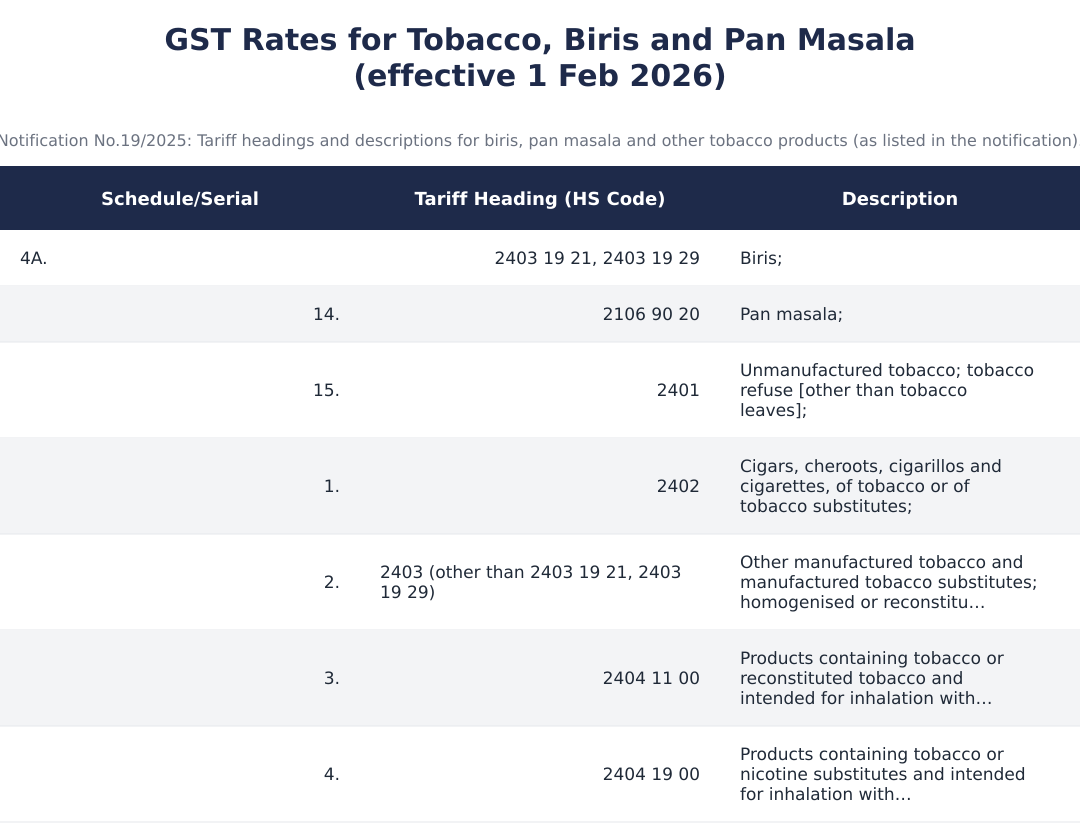
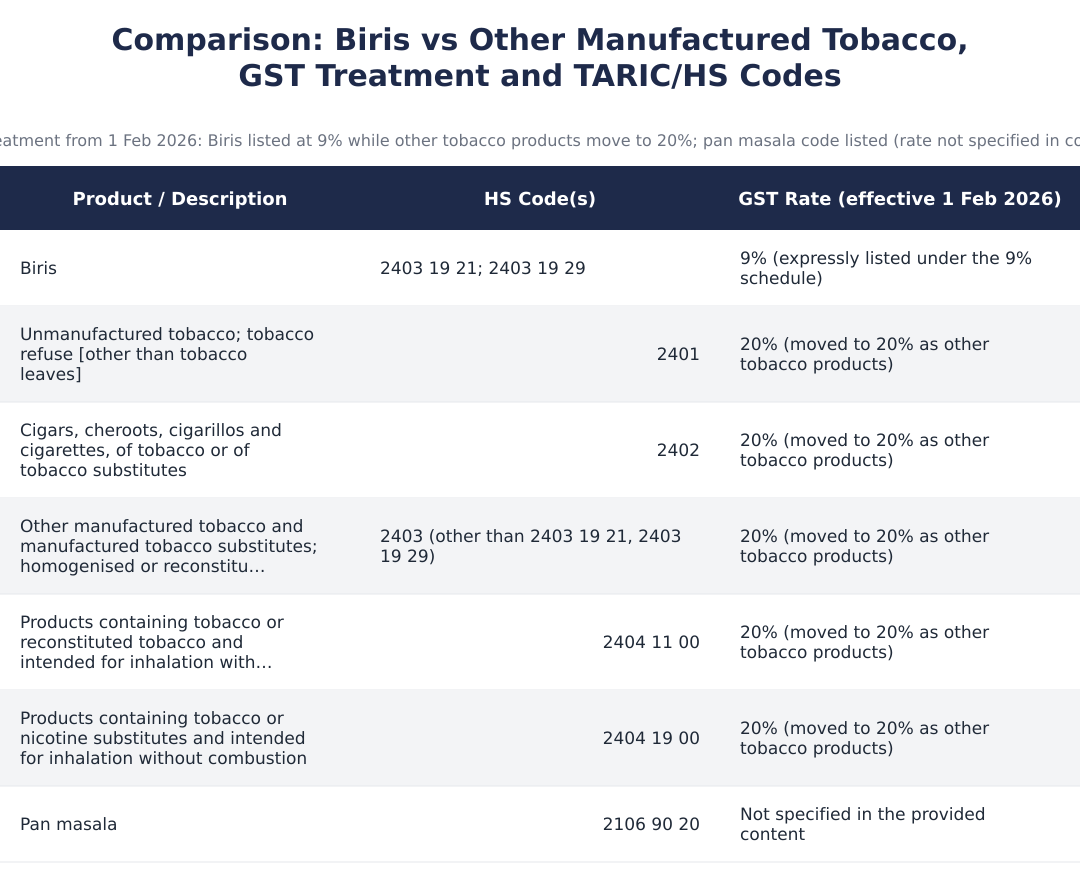
Biris are expressly assigned to the 9% GST schedule under HS codes 2403 19 21 and 2403 19 29. The notification specifically lists "Biris" under those tariff lines and therefore supplies of biris attract 9% GST from 1st February 2026. Businesses manufacturing or selling biris must classify goods under these exact subheadings to claim the 9% treatment and update product master data accordingly.
What happens to GST rates for other tobacco products (other than biris)?
Other tobacco products (other than biris) are moved to a 20% GST rate under the restructured schedule. The notification separates biris from the rest of manufactured tobacco (HS 2403 excluding 2403 19 21/29) and places those remaining tobacco products in the 20% bracket effective 1st February 2026. This means cigarettes, other manufactured tobacco, tobacco extracts/essences and similar items must be billed and reported at 20% GST unless separately specified otherwise in the notification.
Is pan masala covered by this notification and how is it referenced?
Yes, pan masala is explicitly listed in the notification under tariff heading 2106 90 20. The notification includes an entry for "Pan masala" (2106 90 20) as part of the restructured GST schedule effective from 1st February 2026, so supplies of pan masala must follow the treatment specified for that entry. Sellers of pan masala should ensure their products are classified under 2106 90 20 on invoices and returns to reflect the notification's treatment.
Do the HS/tariff codes in the notification matter for GST billing and returns?
Yes, the notification uses specific HS/tariff codes (for example 2403 19 21/29 for biris and 2106 90 20 for pan masala) and taxpayers must use these classifications for correct GST billing and return filing. Correctly mapping products to the exact tariff sub‑headings listed in the notification determines whether a product attracts 9% or 20% (or the specified treatment) and ensures compliance with the tax authority’s intent. Misclassification can lead to notices, ITC denial, or the need for rectification applications with authorities such as GSTN or tribunals.
What should businesses do if they claimed the wrong tax head or ITC before this change?
If ITC or tax was claimed under the wrong tax head, businesses can file rectification or adjustment applications as guided by GST mechanisms (Madras HC has allowed rectification in some cases, and GSTN also enables appeals against zero or NIL demand orders). The article mentions judicial outcomes allowing rectification of ITC for wrong tax head and procedural avenues like GSTN appeals, so affected taxpayers should prepare documentation, correct invoices, and consider filing rectification/appeal before the proper authority promptly. Professional tax advice is advisable because timelines, evidence requirements and the interplay with Rule 86A (ITC blocking) can affect the success of such rectifications.
Are there any judicial or GST procedural updates mentioned alongside the notification that traders should note?
Yes, the content references several judicial and procedural updates, including Madras High Court rulings allowing ITC rectification for wrong tax head, upholding ITC blocking under Rule 86A, GSTAT restricting anti‑profiteering relief to HIG units, and GSTN enabling appeals against NIL/zero demand orders. These developments affect enforcement, availability of ITC, dispute resolution, and anti‑profiteering claims, so traders in tobacco and pan masala should monitor such rulings as they may influence compliance strategies and the handling of disputes arising from the new rate structure. Companies should coordinate tax teams to ensure records, appeals and compliance positions reflect both the notification and relevant case law.
Do I need to change invoicing or e‑way bill practice because of the restructured rates?
Yes, you must update invoice templates, GST rate fields, product descriptions and HS/tariff codes to reflect the new classification (for example biris under 2403 19 21/29 at 9% and other tobacco under 20%) for supplies on or after 1st February 2026. The article also notes e‑way bill and internal stock transfer principles, for instance, absence of an e‑way bill for internal transfer can affect penalty exposure, so ensure e‑way bill rules and declared tax rates match the revised schedule. Test and deploy these changes in billing and logistics systems before 1 Feb 2026 to avoid compliance errors and downstream reconciliation issues.
Need help staying GST compliant?
MoneyGence's AI Finance OS tracks your compliance, wallet share, and finances in one place, built for agencies and growing businesses.
Get started with MoneyGence