GST Refund Process: Eligibility, Time Limit & Status Check
This guide explains who can claim GST refunds in India, what documents are needed, how to file refund applications on the GST portal, the different refund categories, and how to track the status after submission. You will learn which taxpayers are eligible (including exporters, zero-rated suppliers, those with excess electronic cash ledger balances, and those facing inverted duty situations), the standard supporting documents to attach, and the key forms used in refund processing. The guide also describes the sequence of portal actions and officer communications that typically follow after a refund application is filed. Understanding the process matters because refunds can release blocked working capital (especially for exporters and those with unutilised ITC) and because incorrect claims or incomplete documentation cause delays and rejections. By following the documented steps and ensuring your returns (GSTR-1 and GSTR-3B) are up to date, you reduce the chances of queries or deficiencies from the tax officer. This article uses the official forms and portal steps that govern refunds so you can prepare an accurate application and monitor its progress on the GST Dashboard.
Latest updates on GST refund
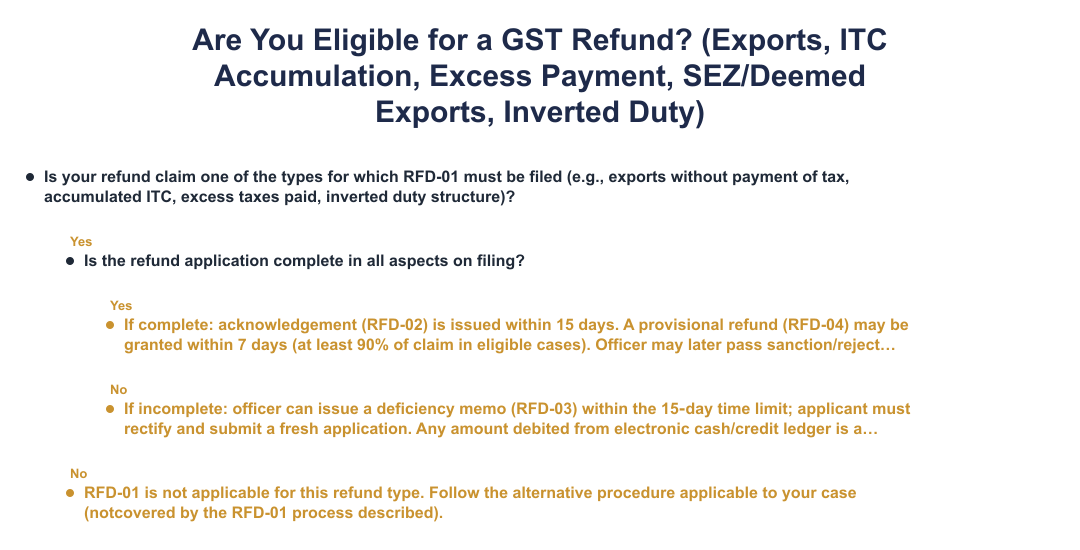
Most refund claims across categories must be filed through Form RFD-01 on the GST portal. This centralised filing requirement covers a wide range of situations such as exports without payment of tax, accumulated input tax credit (ITC) claims, excess tax payments and refunds arising from inverted duty structures.
Filed refund applications appear on the dashboard of the tax officer/refund processing officer as pending work items to be verified and scrutinised. Applicants can track the progress of their refunds online using the 'Track Application Status' option under Refunds on the GST portal.
Who is eligible for a GST refund?
| Eligible category |
|---|
| Exporters of goods and services |
| Suppliers making zero-rated supplies without tax payment |
| Taxpayers under inverted duty structure |
| Taxpayers who erroneously made excess tax payments |
| Recipients of advances for supplies not yet made |
| Taxpayers with excess balance in the electronic cash ledger |
Documents required for GST refund
| Document |
|---|
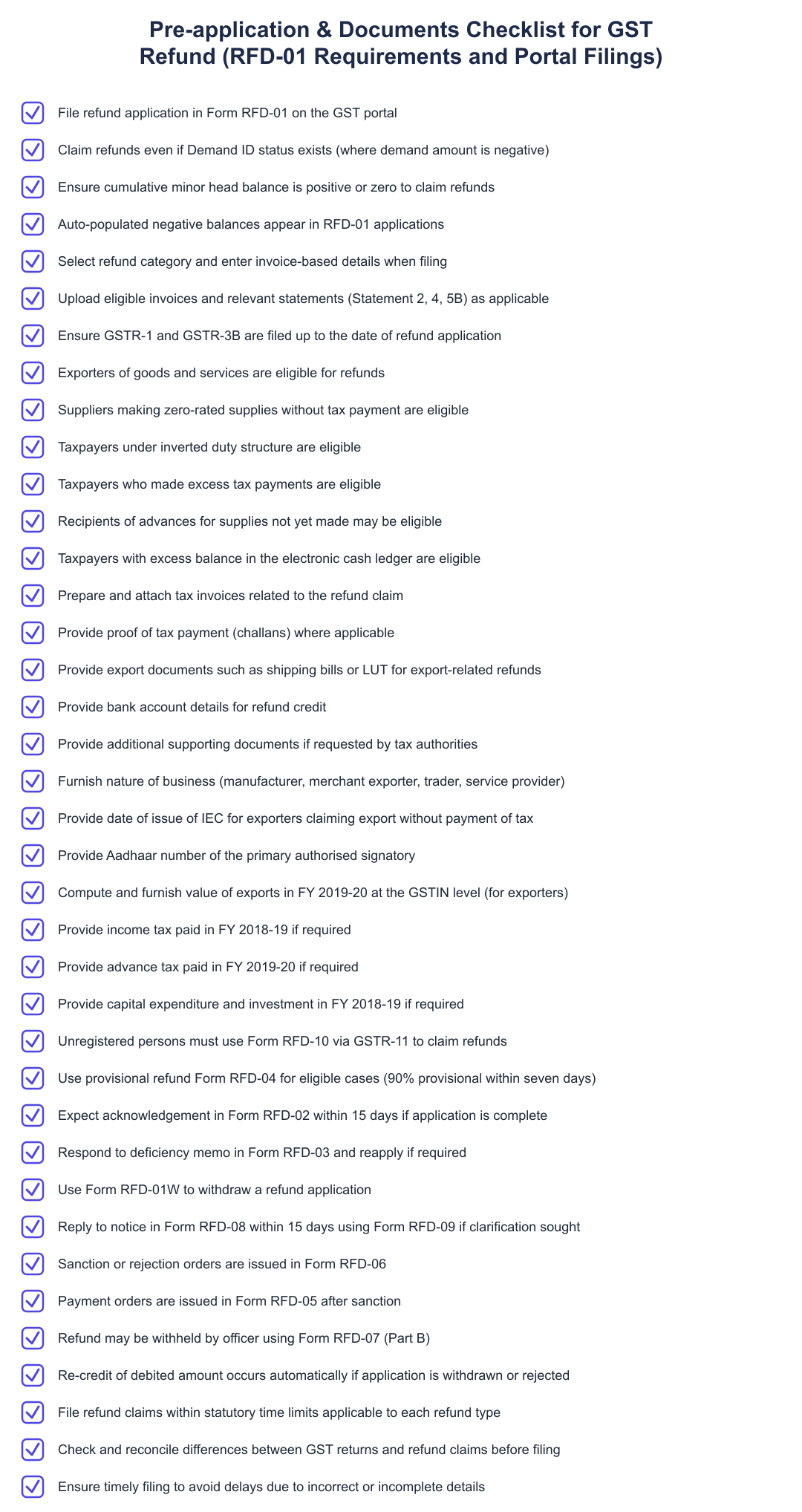
| Form RFD-01 (refund application) |
| Relevant tax invoices |
| Proof of tax payment (challans) |
| Export documents (shipping bills or LUT) |
| Bank account details for refund credit |
| Additional documents as required |
Time limit for claiming the GST refund
While timelines and cut-offs can vary by specific provision or case, the practical requirement to successfully file a refund application is to ensure compliance of returns and to prepare supporting documents before making the claim. A key compliance prerequisite is that GSTR-1 and GSTR-3B up to the date of the refund application must have been filed on the GST portal.
Because refund processing is handled by the tax officer and appears as a pending work item on their dashboard, applicants should submit complete documentation to avoid deficiency memos or notices which prolong processing. Tracking the application on the portal helps you respond promptly when the officer seeks clarifications.
How to submit a GST refund (RFD-01) on the portal
For most refund types, the taxpayer must file Form RFD-01 on the GST portal. Before starting the refund application, confirm that GSTR-1 and GSTR-3B have been filed up to the date of application, gather the required supporting documents (invoices, shipping bills or LUT where applicable, challans and bank details), and ensure you have prepared any additional documents the officer may require.
After submitting RFD-01 online, use the 'Track Application Status' under Refunds on the GST portal to monitor progress. The refund application will show up as pending work for the refund processing officer, who will verify and scrutinise the claim and communicate deficiencies or decisions through the prescribed forms.
Types of refunds that can be claimed (overview)
| Refund type |
|---|
| Excess cash balance in electronic cash ledger |
| Excess tax paid through GSTR-3B |
| Accumulated ITC due to exports of goods and services without payment of tax |
| Accumulated ITC due to supplies made to SEZ unit/SEZ developer (without payment of tax) |
| ITC accumulated due to inverted tax structure |
| Refund by the recipient of deemed exports |
| Tax paid on supplies made to SEZ unit/SEZ developer (with payment of tax) |
| Tax paid on an intrastate supply later held as interstate supply and vice versa |
| Refund by the supplier of deemed exports |
| Refund of IGST paid on export of services (with tax payment) |
| On account of assessment or provisional assessment or appeal or any other order |
| Refund on 'any other ground' |
Refund processing sequence and officer actions
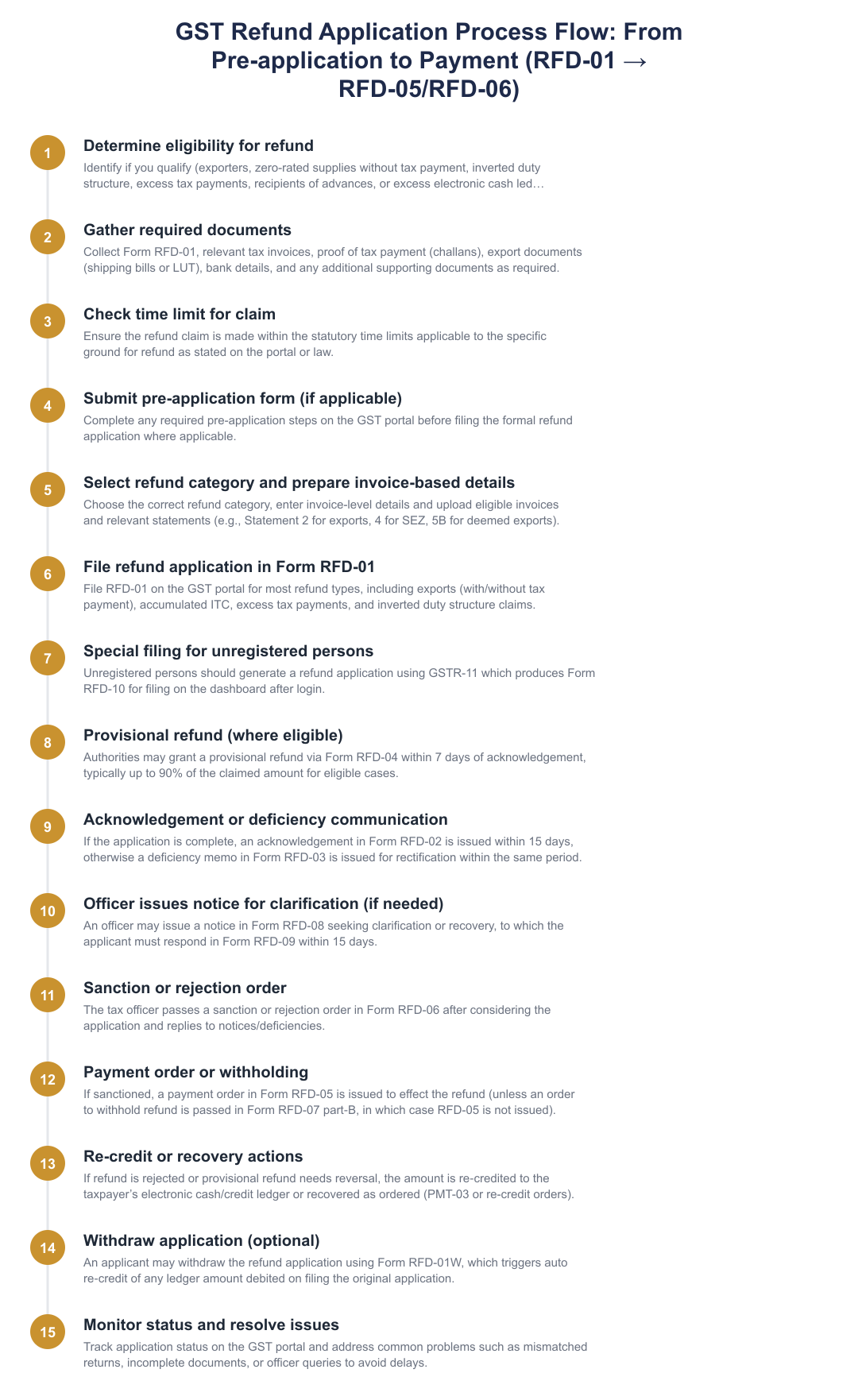
Taxpayer files the refund application on the GST portal using Form RFD-01 for most refund categories.
The officer issues an acknowledgement for a complete refund application; the claim then appears for verification on the officer's dashboard.
For certain refund types, a provisional refund may be granted using Form RFD-04 during processing.
If the officer finds deficiencies in the application or documents, a deficiency memo is issued requiring the applicant to rectify them.
If further clarification or recovery action is required, the officer issues a notice and the applicant responds through the prescribed reply form.
After verification, the officer passes a sanction or rejection order in RFD-06; if sanctioned, a payment order in RFD-05 is issued (RFD-05 may sometimes follow RFD-04).
Refund claim by unregistered persons, embassies and international organisations
Unregistered persons and entities with a UIN such as embassies and international organisations use a different route. Refund applications for such persons are generated through GSTR-11 and result in Form RFD-10 on the GST portal. Applicants should obtain the RFD-10 form from their dashboard after generating it through the GSTR-11 process.
This specialised route ensures that persons who are not registered in the regular manner under GST can still claim refunds where eligible, using the prescribed portal workflows.
Common reasons for delay or rejection and how to avoid them
Refunds are often delayed or rejected because the application contains incorrect or incomplete details, the refund claim does not reconcile with filed GST returns, or the claim is filed after required documents are missing. Preparing accurate invoices, export documents and payment challans before filing RFD-01 reduces the risk of receiving a deficiency memo or notice.
Keeping GSTR-1 and GSTR-3B filed up to the date of application and responding promptly to any portal notices or officer queries via the prescribed forms helps accelerate processing and avoids rejections.
Claiming a GST refund requires the correct form (usually RFD-01), supporting documents, and up-to-date returns (GSTR-1 and GSTR-3B). Use the GST portal’s tracking facilities and be prepared to respond to deficiency memos or notices during officer scrutiny. For unregistered claimants and UIN holders, refunds flow through GSTR-11 and RFD-10. Following these documented steps and attaching complete evidence reduces delays and increases the chances of a timely sanction and payment.
Frequently asked questions
Who can claim a GST refund under the GST law?
Eligible persons include exporters of goods and services, suppliers making zero-rated supplies without payment of tax, taxpayers under an inverted duty structure, those who paid excess tax, recipients of advances for supplies not made, and taxpayers with excess balance in the electronic cash ledger. These categories cover refunds such as IGST on exports (with or without payment), accumulated input tax credit (ITC) due to zero-rated supplies or supplies to SEZs, refunds arising from inverted duty structure, and excess cash or tax payments. Unregistered persons can also claim refunds in specific situations (for example, of taxes paid on import), following separate procedures. Always support the claim with required documents like invoices, shipping bills, proof of payment and bank details when filing form RFD-01 or RFD-10 as applicable.
What documents do I need to file a GST refund claim?
You must submit the GST refund application (usually form RFD-01) along with tax invoices related to the claim, proof of tax payment (challans), export documents such as shipping bills or LUT, and bank account details for credit of the refund. Additional supporting documents may be required depending on the refund type, for example, IEC details and export value for zero-rated exports, statement 2 for exports, statement 4 for SEZ supplies, and statement 5B for deemed exports. The Aadhaar number of the primary authorised signatory is mandatory and returns (GSTR‑1/GSTR‑3B) must be up to date till the date of filing the claim. Keep copies of orders, demand IDs or statements showing the electronic cash/credit ledger balances if the claim arises from excess ledger balances or demand adjustments.
What is the time limit to claim a GST refund?
A GST refund must be claimed within two years from the date on which the tax became refundable, subject to specific provisions and exceptions under GST law. This two-year limitation generally applies to common grounds such as excess payment, exports, or inverted duty credits, but particular categories (like refunds arising from orders or appeals) may have different timelines set by notifications or judicial precedents. Claimants should compute the two-year period carefully from the relevant event date (for example, date of export, date of payment, or date of order) and retain documentary proof to avoid rejection on limitation grounds. When in doubt, file the claim early and consult the GST rules or a tax advisor for category‑specific timelines.
How do I submit a GST refund pre-application form on the GST portal?
To submit a GST refund pre-application, log in to the GST portal and generate the refund application using the appropriate form (for exporters RFD-10 via GSTR-11 or RFD-01 for most taxpayers), upload invoice-based details and required statements (like statements 2, 4, or 5B), and attach supporting documents before submitting. The portal now allows filing without declaring tax periods, you select the refund category, provide invoice-level details and upload eligible invoices, and ensure GSTR-1 and GSTR-3B are filed up to the date of application. After submission the portal debits the electronic credit/cash ledger if applicable and issues an acknowledgement (RFD-02) or provisional refund (RFD-04) depending on case and timelines. Keep the acknowledgement and application reference number to track status under “Track Application Status” in Refunds.
How do I claim a refund of excess cash balance in the electronic cash ledger (Type 1)?
File form RFD-01 on the GST portal selecting the category 'excess cash balance in electronic cash ledger', provide ledger details and supporting payment challans, and attach any relevant invoices or documents before submission. The portal auto-populates negative minor head balances into the RFD-01 application and suggests the most recent demand order related to negative balances, but you can claim irrespective of Demand ID status if cumulative balance conditions are satisfied. After filing, the officer may issue RFD-02 acknowledgement within 15 days, grant provisional refund RFD-04 (within 7 days at up to 90% in eligible cases), or raise a deficiency memo (RFD-03) for correction; if rejected, the debited amount is re‑credited to the respective ledgers. Maintain records of the electronic ledger and ensure returns are reconciled to avoid processing delays.
How is refund of accumulated ITC for zero-rated exports (without payment of tax) processed?
For accumulated ITC due to zero-rated exports without payment of tax, file RFD-01 with invoice-level details and statement-2 (exports) showing ineligible and eligible credits, plus export-related documents like shipping bills and IEC details; the refund claim is processed after verification and reconciliation with returns. The portal requires export value at GSTIN level, GSTR-1/GSTR-3B to be filed till date of application, and may ask for additional documents or clarifications, provisional refund can be sanctioned in eligible cases. If discrepancies or deficiencies are found, the officer issues RFD-03 or RFD-08 (notice), and final sanction/rejection is given in RFD-06 followed by payment order RFD-05 when approved. Ensure the Aadhaar of the primary authorised signatory and accurate computation of accumulated ITC to avoid delays or re-credit actions.
Can unregistered persons claim a GST refund and what is the procedure?
Yes, unregistered persons can claim GST refunds in certain cases (for example, taxes paid on import or refunds due to supply reclassification) by generating a refund application through form RFD-10 via the GSTR-11 or following the procedure laid down on the GST portal for unregistered claimants. The unregistered applicant should log in to the portal, use the GSTR‑11 mechanism where applicable, obtain RFD‑10 on the dashboard, attach required supporting documents like invoices, payment proofs and bank details, and submit the claim. The refund processing timelines, possible provisional refund (RFD‑04), deficiency memos (RFD‑03) and final orders (RFD‑06/RFD‑05) remain broadly similar to registered taxpayers, though identification and verification steps differ. Keep in mind specific documentation (such as import documents) will be necessary to substantiate the claim by an unregistered person.
How are refunds for IGST paid on export of goods/services (with payment of tax) processed?
Refunds of IGST paid on export of goods or services where tax was paid are claimed through RFD-01 (or RFD-10 for certain exporters) on the GST portal with shipping bills, copies of invoices, proof of payment (challans) and export documents; the claim is verified and processed by the tax officer. The portal allows filing invoice-wise details and requires reconciliation with GSTR-1/GSTR-3B and export documents; provisional refund RFD‑04 may be issued (within seven days and up to 90% where applicable) and an acknowledgement RFD‑02 should follow within 15 days if the application is complete. If deficiencies are found the officer issues RFD‑03 to rectify them or RFD‑08 seeking clarification; once sanctioned an RFD‑05 payment order is issued or the amount is credited to the bank account. Ensure the IEC, shipping bill data and ledger/payment proof match to avoid rejection or re-credit orders.
What happens after I file a GST refund application, what are the officer's possible actions and timelines?
After filing a GST refund application the officer will either acknowledge it in RFD-02 within 15 days if complete, issue a provisional refund in RFD-04 (within 7 days for eligible cases up to at least 90% of claim), raise a deficiency memo RFD-03 for corrections, issue a notice RFD-08 for clarification, or pass a sanction/rejection order in RFD-06 followed by a payment order RFD-05 upon sanction. If the officer finds the claim deficient, the portal auto re‑credits the debited amount to the taxpayer’s electronic cash/credit ledger and the applicant must rectify and refile; the applicant may also withdraw the application using RFD‑01W which re-credits the ledger. In cases of wrongful grant, the officer may issue RFD‑08 and recovery actions; for withholding refunds the officer can pass withholding order in RFD‑07 (part-B) where RFD‑05 is not issued. Track the application status under “Track Application Status” on the GST portal and respond to any notices within 15 days to avoid adverse orders.
Why are GST refund claims rejected or delayed and how can I avoid it?
Refund claims are commonly delayed or rejected due to incorrect/incomplete details or documents, mismatches between GST returns and refund claims, late filing, or issues flagged by tax officers during scrutiny. To avoid delays ensure all required documents (invoices, shipping bills, challans, bank details, IEC), accurate invoice‑level entries, and up‑to‑date GSTR‑1 and GSTR‑3B filings are submitted, and reconcile electronic cash/credit ledger balances before filing RFD‑01. Respond promptly (within 15 days) to deficiency memos (RFD‑03) or notices (RFD‑08), use the new invoice-based filing workflow if applicable, and consider professional help for complex claims like inverted duty structure or inter‑state reclassification. Proper documentation and reconciliation are the most effective ways to get prompt acknowledgement (RFD‑02), provisional relief (RFD‑04) where eligible, and final sanction (RFD‑06/RFD‑05).
Need help staying GST compliant?
MoneyGence's AI Finance OS tracks your compliance, wallet share, and finances in one place, built for agencies and growing businesses.
Get started with MoneyGence