GST Registration for E-commerce Collecting TCS | Guide
This guide explains the considerations around GST registration for e‑commerce participants when transactions involve tax collection at source (TCS) under GST. You will learn which kinds of market participants typically interact with TCS mechanics, what registration issues commonly arise for platforms and sellers, and practical implications for compliance and documentation. The goal is to help platform operators, marketplace sellers and service providers understand the registration-related choices they may face and the operational steps to make compliance smoother. The guide does not attempt to substitute professional advice but focuses on the structural relationship between e‑commerce activity, TCS obligations and registration. It highlights common scenarios, for example, differences between being a marketplace operator and being a seller using a marketplace, and explains why registration status matters for invoicing, reporting and reconciliation. Readers will come away with a clearer view of the registration questions to ask their tax advisor and the records to keep when dealing with TCS flows on e‑commerce transactions.
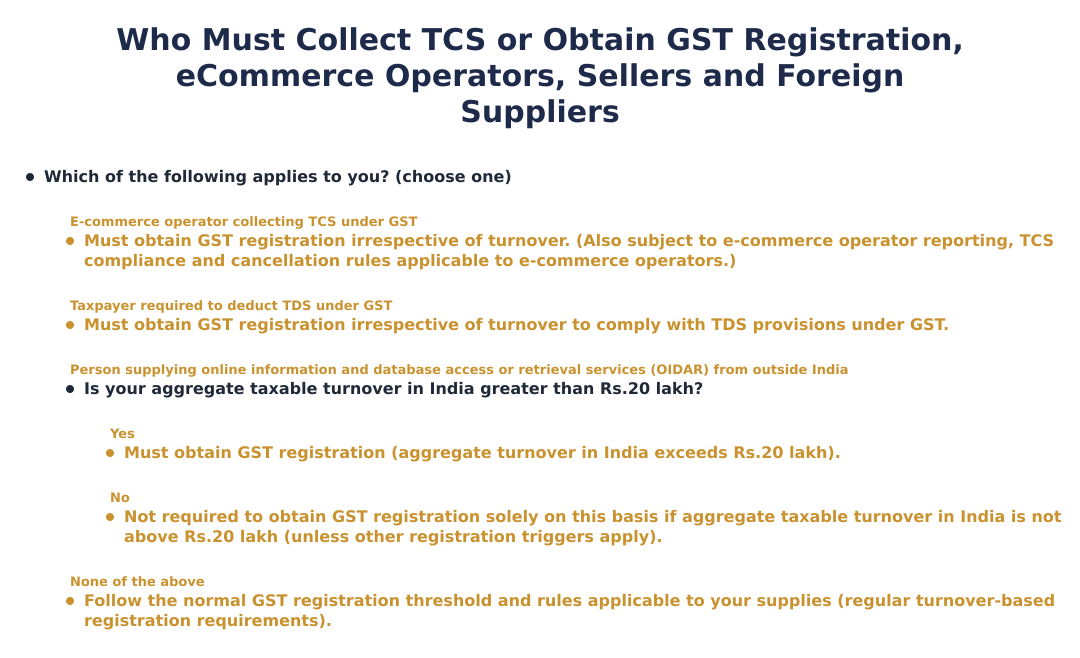
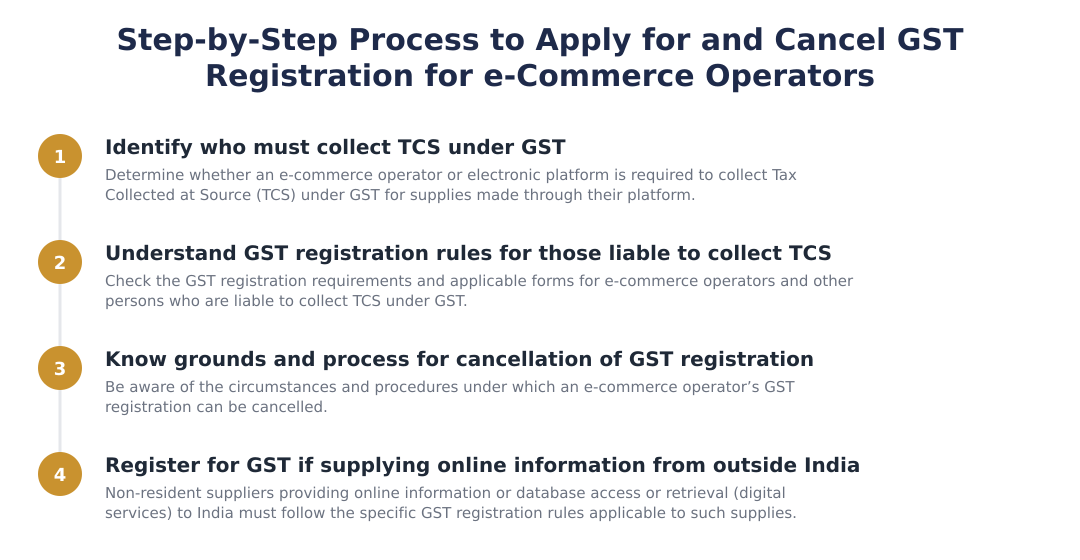
Who will Collect TCS under GST?
When e‑commerce transactions involve collection at source, one party in the transaction is typically designated to collect tax on behalf of the revenue authorities. In the context of online marketplaces and platforms, that role is commonly assigned to the platform or operator because they are the point of settlement between buyers and sellers. Whether a specific entity actually collects TCS depends on legal definitions and contract arrangements, which determine who is treated as the operator or facilitator of the supply.
Understanding who collects TCS matters because the collector has unique recordkeeping and reporting responsibilities. Collectors generally need systems to identify the taxable value subject to collection, capture customer and supplier details, and issue or record the necessary references for later reconciliation. For sellers, it is important to know whether the platform will collect TCS on their supplies so they can reconcile collections against their own returns and maintain accurate books.
In practice, different business models change how the collection duty plays out. A full‑service marketplace that holds funds or invoices on behalf of sellers will face different operational and compliance choices compared with a classifieds portal that merely connects buyers and sellers. Determining which model applies to your business is a necessary first step before addressing registration implications.
GST Registration Rules for those Liable to TCS
Liability to collect TCS is closely linked to how an entity is characterised under the GST framework, for example, whether it is treated as an e‑commerce operator, an aggregator, or a supplier. That characterisation affects whether an entity must register for GST, where registration triggers follow from the type and place of supplies, and how businesses should present themselves on invoices and in returns. Businesses should evaluate their contractual relationships and the flows of consideration that pass through the platform to determine registration requirements.
The practical implications of registration are primarily administrative and transactional: registered persons generally need to issue compliant invoices, maintain detailed records of supplies and collections, and file periodic returns. For a business that is required to collect TCS, registration enables it to correctly document the collection, communicate it to affected sellers and buyers, and reconcile amounts collected against the corresponding tax liabilities in the system.
Small sellers and service providers who operate only through marketplaces should consider how platform‑level collection impacts their own need to register. Even when a platform collects tax at source, sellers may still have independent registration obligations based on their overall business activity and the nature of their supplies. Consulting a tax professional helps align the seller’s registration position with the marketplace’s collection practices.
Cancellation of GST Registration for e-Commerce Operators
Cancellation of registration is a formal process that applies when a registrant no longer meets the conditions for registration or where registration was obtained incorrectly. For e‑commerce operators, this may arise if the business model changes so the entity is no longer acting in a capacity that triggers collection or reporting obligations, or if the operator ceases operations through the platform.
Operators contemplating cancellation should be mindful of the downstream effects: outstanding liabilities, pending reconciliations of collected amounts, and the need to communicate changes to sellers and buyers who rely on the operator for collection and reporting. Sudden de‑registration without completing these steps can create compliance exposure for both the operator and the sellers on the platform.
Before applying for cancellation, operators should ensure they have reconciled all collections, preserved required records for the statutory retention period, and informed counterparties and advisers. A considered exit process reduces the likelihood of disputes or enforcement action arising from unresolved collections or returns.
GST Registration for People Supplying Online Information from Outside India
Suppliers located outside the country who provide online information, database access, or similar digital services to domestic recipients face particular registration questions. The principal concern is whether the place of supply and the recipient type result in an obligation to register locally for tax purposes. Platforms and foreign suppliers need clear processes for determining when local registration is triggered and how to correctly document cross‑border digital supplies.
When foreign suppliers sell directly to domestic consumers or businesses, they must assess whether their supplies create a taxable event within the domestic tax framework. If registration is required, they must set up compliant invoicing and recordkeeping and determine whether any intermediary (such as an e‑commerce operator) will collect tax on their behalf. For foreign suppliers selling through domestic marketplaces, the marketplace’s arrangement to collect tax at source can alter the practical compliance burden for the supplier.
Foreign suppliers should coordinate with marketplaces, payment gateways and tax advisers to implement systems for tax collection, invoicing and refunds. Clear contractual allocation of responsibilities between the foreign supplier and any domestic intermediaries reduces the risk of disputed liabilities and eases reconciliation of amounts collected under TCS mechanisms.
GST registration in the context of e‑commerce collecting TCS involves understanding roles, contractual arrangements and the practical mechanics of collection and reconciliation. Operators, sellers and foreign suppliers should map responsibilities early, maintain clear records and consult tax professionals to confirm registration positions. Doing so reduces disputes, simplifies reporting and helps ensure that collections at source are properly reflected in the tax life cycle of each transaction.
Frequently asked questions
Who collects TCS (tax collected at source) under GST for ecommerce sales?
E‑commerce operators (marketplaces/aggregators) are required to collect TCS at the rate of 0.5% on the net value of taxable supplies made through their platform under Section 52 of the CGST Act. This means the operator deducts 0.5% from payments to the supplier for each transaction and deposits it with the government. The collected amount is reflected in the supplier’s electronic cash ledger and can be claimed against their output tax liability. Note that this TCS requirement applies irrespective of the supplier’s turnover threshold if they sell through a liable e‑commerce operator.
Do sellers who sell on ecommerce platforms need GST registration even if their turnover is below the threshold?
Yes, any supplier selling goods or services through an e‑commerce operator who is required to collect TCS must obtain GST registration even if their aggregate turnover is below the normal threshold limit. This registration is necessary so the supplier can claim credit for the TCS collected and to be compliant with GST reporting. The exception for small suppliers (like the general ₹20 lakh/₹40 lakh threshold for services/goods) does not apply when supplies are made via a TCS‑collecting e‑commerce operator. Failure to register can lead to inability to claim TCS credits and penalties for non‑compliance.
Can an e‑commerce operator opt for the GST composition scheme?
No, e‑commerce operators who are liable to collect TCS under Section 52 of the CGST Act are not permitted to opt into the composition scheme. The composition scheme is limited to specified categories of taxpayers and excludes those e‑commerce operators required to collect tax at source. This means such operators must comply with regular GST registration, return filing and tax collection obligations rather than the simplified composition route. The restriction ensures proper capture and reporting of TCS on platform transactions.
Which form do I use to get GST registration as an ecommerce supplier or operator?
You apply for GST registration through the GST portal using the registration application (commonly filed via GST REG‑01 on the portal). The applicant must provide required documents, bank details, and the details of business activities (including if the business operates as an e‑commerce operator or supplies through one). After verification, the tax authority issues a GST registration number which is needed to report TCS/TDS entries and claim credits. For cancellation or changes, correspondingly prescribed online forms on the GST portal must be filed.
What are the GST registration rules specifically for persons liable to collect TDS or deduct TDS under GST?
Entities who are required to deduct TDS under GST must obtain registration if they make taxable supplies or fall into categories specified by law and must comply with GST filing and reporting obligations applicable to deductors. Deductor obligations include issuing TDS certificates and uploading details of TDS deducted so that suppliers can claim credit. The requirement to register is triggered by the nature of transactions and statutory duties (like being a government agency or specified person), not merely turnover in many cases. Non‑registration when required can lead to penalties and disallowance of input credits linked to those transactions.
What happens if an e‑commerce operator wants to cancel its GST registration?
An e‑commerce operator can apply for cancellation of GST registration on the GST portal by filing the prescribed cancellation application and following the statutory procedure, after which the tax authority will process the request. Cancellation may be sought when the business ceases to exist, is sold, or no longer meets the conditions for registration (for example, stops operating as an e‑commerce platform). Until cancellation is approved, the operator remains liable for filing returns, depositing collected TCS and other compliance obligations; abrupt cessation without formal cancellation can attract penalties.
Do foreign suppliers of online information or digital services to Indian users need GST registration?
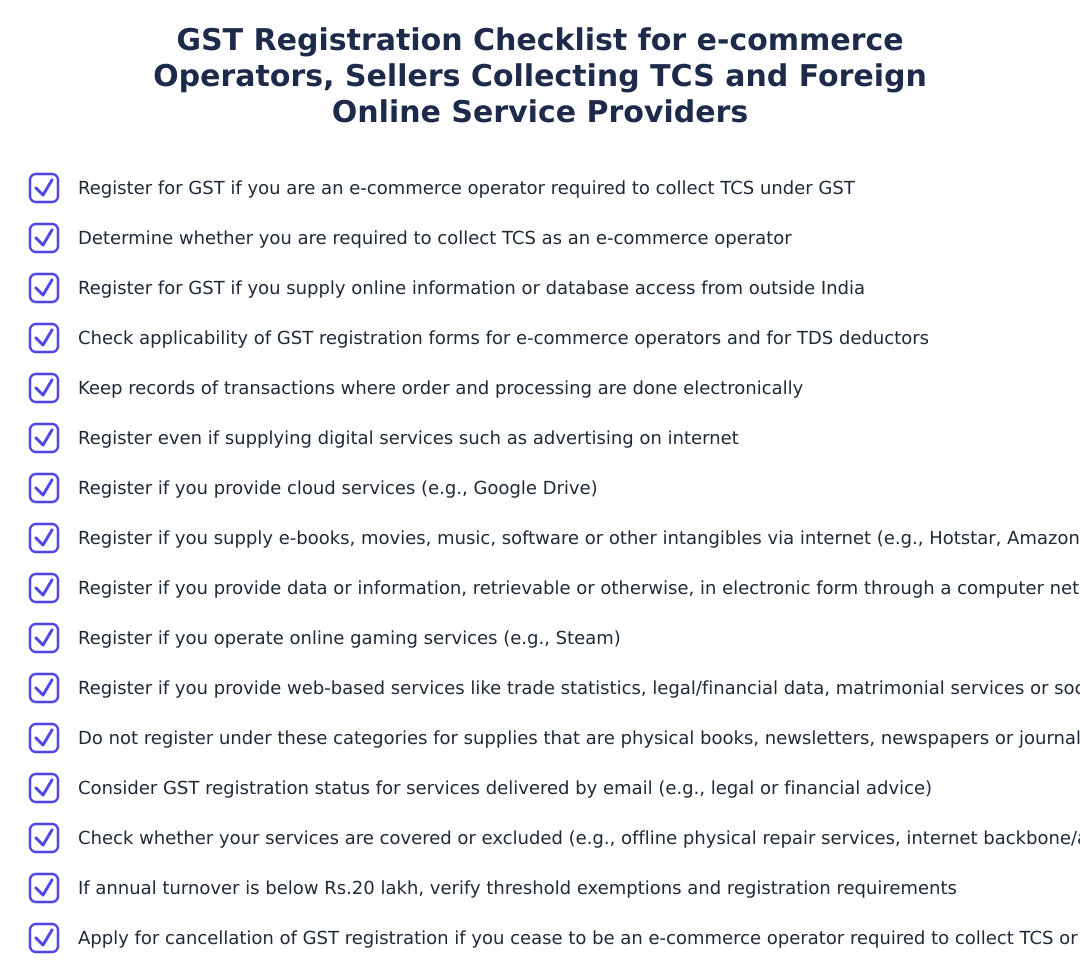
Yes, suppliers located outside India who provide online information, database access, or digital services to Indian recipients are required to obtain GST registration in India if their supplies are taxable and made to Indian consumers or businesses. Such supplies include advertising, cloud services, e‑books, streaming services, online gaming, data or information services, and other intangibles delivered electronically. Registration ensures these foreign suppliers can be brought within the GST net and enables proper tax collection, reporting and compliance; failure to register can lead to enforcement actions and denial of market access. In practice, many foreign suppliers appoint an Indian agent or register directly on the GST portal to comply.
What types of supplies are considered electronic or online supplies under GST?
Electronic or online supplies under GST include services such as internet advertising, cloud storage and software‑as‑a‑service, e‑books/movies/music/software delivered digitally, online gaming, and supply of data or information in electronic form (for example, trade statistics, legal/financial databases, social networking services). Also included are supplies where order and processing are done electronically even if goods are delivered physically, and services provided by a teacher over the internet. Supplies like offline physical repair, newspaper print advertising, or basic internet access (BSNL broadband) are generally treated differently and may fall outside typical online intangible supplies.
How does a supplier claim the TCS amount collected by an ecommerce operator in their GST returns?
A supplier can claim the TCS amount collected by the e‑commerce operator as credit by matching the TCS entries uploaded by the operator with the supplier’s electronic records in the GST portal and reflecting the credit in the appropriate returns. The operator uploads details of transactions and TCS collected, which appear in the supplier’s electronic cash ledger or TCS statement; suppliers must ensure these entries reconcile with their sales records before claiming credit. If there is a mismatch or delay in upload by the operator, the supplier should coordinate with the operator and maintain supporting invoices to resolve discrepancies and avoid rejection of the claimed credit.
Need help staying GST compliant?
MoneyGence's AI Finance OS tracks your compliance, wallet share, and finances in one place, built for agencies and growing businesses.
Get started with MoneyGence