GST Return: Types, Due Dates & How to File - Complete Guide
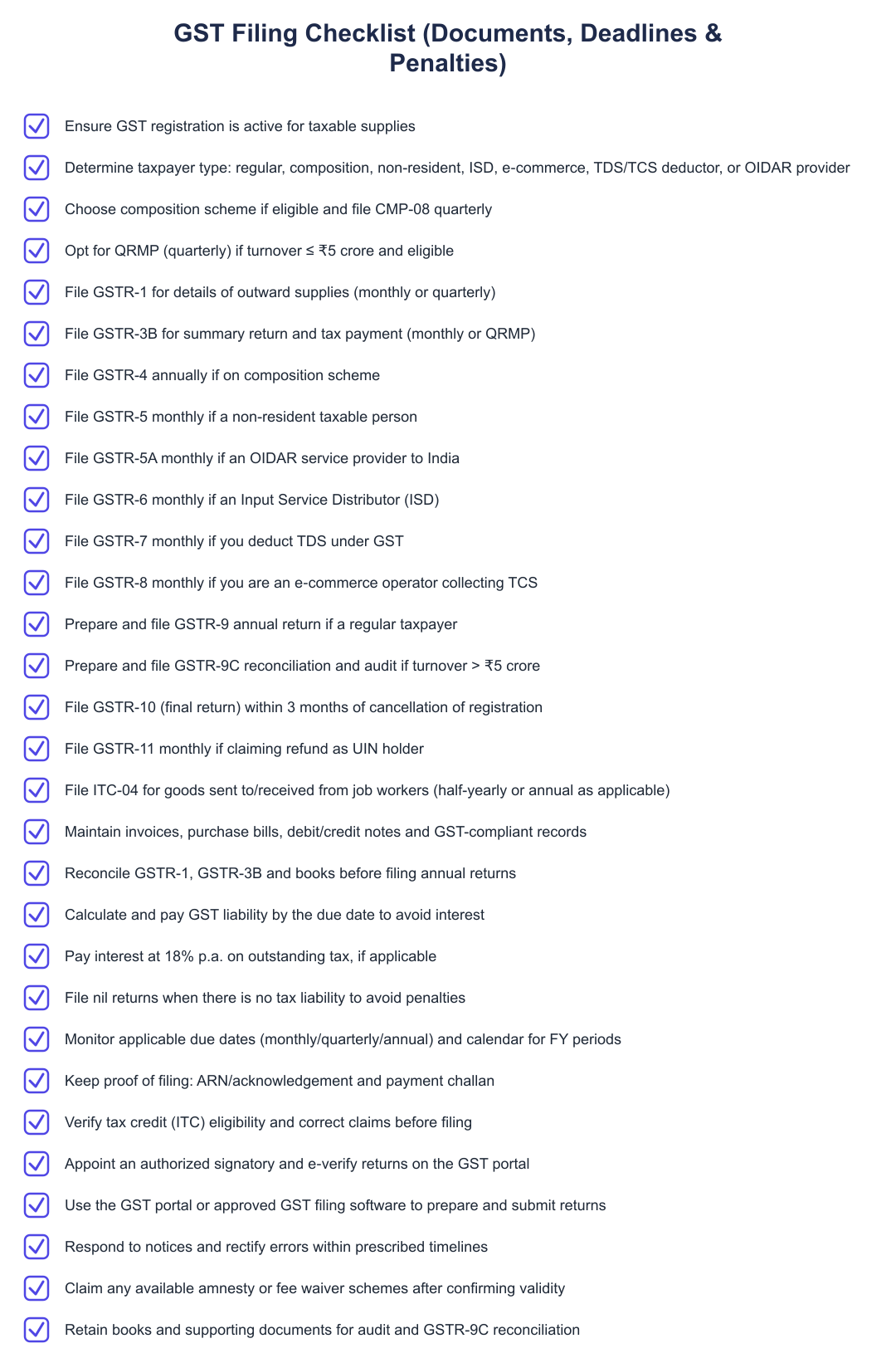
This guide explains GST returns in practical terms: what a GST return is, who must file, the common types of returns businesses encounter, how to prepare to file online, and what can happen if you do not file on time. You will not find a list of fixed deadlines or penalty amounts here; instead the guide focuses on the filing journey, documentation and controls you should put in place so filing is faster and more accurate. That approach helps whether you are a regular taxpayer, a small business using simplified filing options, an e-commerce operator, a non-resident supplier, or a composition scheme taxpayer. Understanding the different return types and the data they require will reduce errors, speed up refunds and ensure your input tax credit is claimed correctly. The guide also outlines the practical steps to prepare returns each month or quarter, how to reconcile your books with filed returns, and how to handle corrections or late filing. Finally, it highlights an important government update: occasional amnesty schemes may reduce or waive late fees for past periods, and you should check for their validity if you are dealing with historical non-filing. Read on to learn how to organise your records, prepare each return, and set up controls so GST compliance becomes a routine, low-risk task for your business.
What is a GST Return?
A GST return is a declaration submitted to the tax administration that records a taxpayer’s supply transactions, tax liability, input tax credits and tax payments for a specified tax period. Returns are the primary way the tax authorities reconcile what a business reports against the purchases and sales reported by its suppliers and customers.
Filing accurate returns ensures your business can legally claim input tax credits and stay compliant. Returns are also the mechanism by which refunds are processed and by which the administration identifies mismatches or non-compliance for further scrutiny.
Who Should File GST Returns?
Generally, any business with a GST registration must file returns for the periods it is liable to report. This includes regular taxpayers, composition scheme taxpayers, non-resident suppliers who register under GST rules, e-commerce operators with collection responsibilities, and entities required to deduct or collect tax at source.
Even when a taxpayer has no transactions in a period (a nil period), filing may still be required. Regular filing protects your GST registration from administrative complications and ensures continuity of input tax credit flows for your customers and vendors.
GST Return Types, an overview
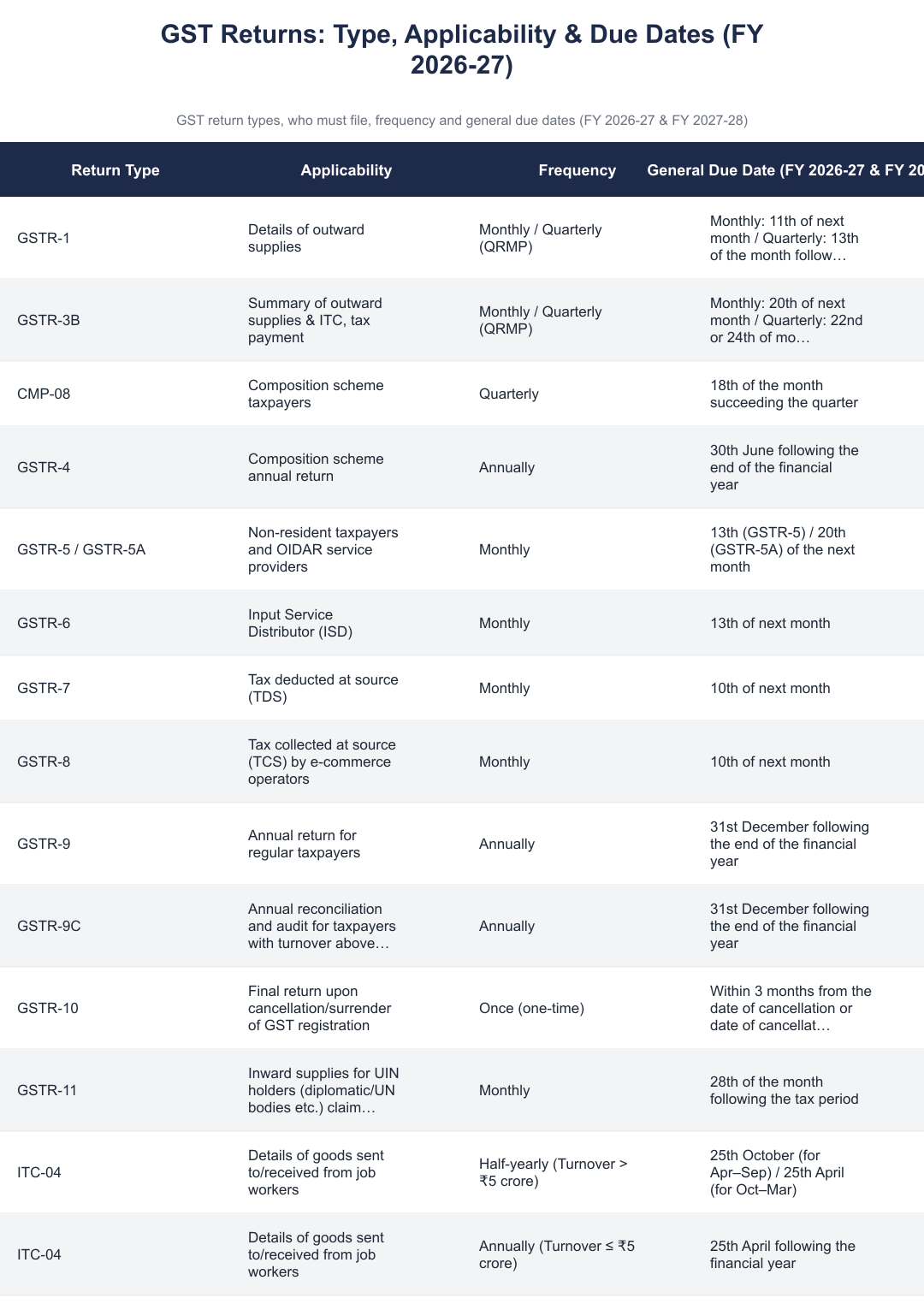
There are multiple return forms designed for different circumstances: returns that capture outward supplies, summary returns for tax payment and input tax credit, periodic statements for composition scheme taxpayers, special returns for non-resident suppliers and for online information database and retrieval (OIDAR) service providers, returns for input service distributors, for entities that deduct or collect tax at source, and annual reconciliation and audit returns for larger taxpayers.
Each return type collects different data points, for example, detailed invoice-level outward-supply information, a summary of tax payable, records of tax deducted or collected by others, and reconciliations between turnover declared in monthly/quarterly returns and annual financial statements. Businesses should identify which forms are applicable to their operations and maintain the records needed to populate those forms accurately.
How to File GST Returns Online
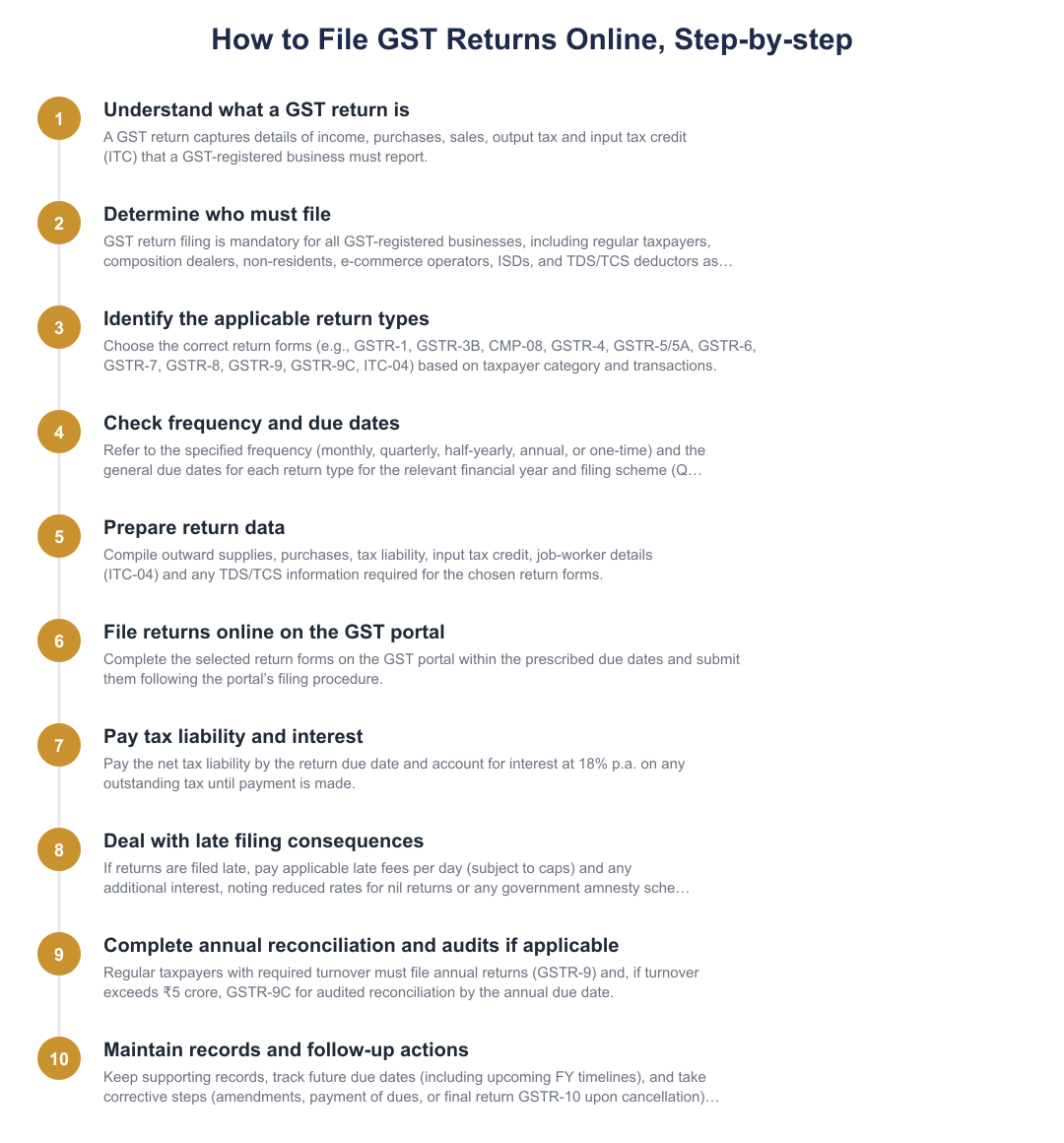
Filing is typically performed through the official GST portal or through authorised software that integrates with the portal. Before you start, make sure your registration details are current, your books and invoicing system are reconciled for the period, and that you have validated supplier and customer details where required.
Practical preparation steps include reconciling sales and purchase ledgers with electronic records, validating the input tax credit you intend to claim, resolving invoice mismatches with trading partners, and ensuring you have sufficient authorised payment instruments or electronic credit balance to discharge any tax liability before submission.
Penalties, Late Filing and Government Amnesty Schemes
Late filing or incorrect returns can lead to adverse administrative consequences, including the imposition of late fees, interest on outstanding tax and possible compliance actions. The impact of non-filing can be operational as well, delayed input tax credits, blocked refunds and strained supplier relationships.
Importantly, occasional government amnesty schemes may reduce or waive late fees for past periods; these must be checked for validity when relevant. If you have missed filings or face significant past-period liabilities, monitor official announcements or consult a tax professional to see whether any relief measures apply to your case.
Practical Compliance Tips
Automate invoice capture and reconciliation where possible so returns can be compiled quickly and with fewer errors. Establish a monthly or quarterly close checklist that includes supplier reconciliation, verification of exemptions and zero-rated supplies, and confirmation of payment or utilisation of input tax credit.
Maintain clear records for goods sent to job workers, supplies through e-commerce platforms, and any transactions with non-resident parties, these commonly trigger specialised reporting and may require additional documentary support at audit or assessment.
GST return compliance is an operational discipline: identify which returns apply to your business, keep your books aligned with electronic records, and build a repeatable filing process. Stay alert for official updates, including any amnesty schemes that may offer relief for past non-filing, and consult a tax advisor for complex situations such as cross-border supplies, high-value reconciliations, or audit requirements.
Frequently asked questions
What is a GST return and what does it show?
A GST return is a statement filed by a GST-registered taxpayer showing details of outward supplies (sales), inward supplies (purchases), output tax payable and input tax credit claimed. It records taxable transactions for a tax period so authorities can compute net GST liability and reconcile tax paid versus tax collected. GST returns can be periodic (monthly/quarterly/annual) and different forms capture different details, for example GSTR-1 lists outward supplies while GSTR-3B is a summary and tax payment return. Filing accurately is essential to claim ITC and avoid penalties or interest on unpaid tax.
Who must file GST returns and how often?
All entities with a GST registration must file GST returns, even if they have nil supplies, unless specifically exempted. Frequency depends on the taxpayer category: regular taxpayers (turnover above ₹5 crore) generally file monthly returns plus an annual return; small taxpayers (turnover up to ₹5 crore) may opt for quarterly filing under the QRMP scheme plus an annual return; composition dealers file quarterly CMP-08 and an annual GSTR-4; special categories like non-residents, ISDs, TDS/TCS deductors and e-commerce operators have specific forms and monthly/quarterly frequencies. Choice of monthly vs QRMP quarterly affects due dates and filing obligations, so assess turnover and registration type to determine applicable frequency.
What are the main GST return types I need to know?
The main GST return types include GSTR-1 (details of outward supplies), GSTR-3B (monthly/summary return & tax payment), CMP-08 (quarterly for composition dealers), GSTR-4 (annual for composition taxpayers), and special forms like GSTR-5/GSTR-5A for non-residents and OIDAR suppliers, GSTR-6 for ISDs, GSTR-7 for TDS deductors, GSTR-8 for e-commerce TCS, GSTR-9 and GSTR-9C for annual return and reconciliation, and ITC-04 for goods sent to job workers. Frequency varies by form, many are monthly, some quarterly or annual, and due dates differ accordingly. Knowing which forms apply to your GSTIN based on turnover and business type ensures correct compliance and avoids late fees.
What are the usual due dates for GSTR-1 and GSTR-3B?
GSTR-1 (outward supply details) is due monthly by the 11th of the next month or quarterly under QRMP by the 13th of the month following the quarter. GSTR-3B (summary return and tax payment) is due monthly by the 20th of the next month, or quarterly under QRMP with due dates of the 22nd or 24th of the month following the quarter depending on state category (Category X: 22nd, Category Y: 24th). These standard due dates apply for FY 2026-27/FY 2027-28 as specified, but always verify current notifications for any changes or state-specific categorisation.
How does the QRMP scheme affect return filing and due dates?
Under the QRMP (Quarterly Return Monthly Payment) scheme eligible taxpayers (normally with turnover up to the specified threshold) can file GSTR-1 quarterly and submit GSTR-3B either monthly or as a quarterly summary with specified monthly payment mechanisms. For QRMP in FY 2026-27 the quarterly GSTR-1/GSTR-3B due dates are typically the 13th (for certain periods) or the 22nd/24th of the month following the quarter depending on Category X/Y states; detailed monthly and quarterly calendars list exact dates (e.g., Apr–Jun quarter due 13 July 2026 or 22/24 July depending on category). QRMP reduces compliance frequency but requires monthly tax payments through the fixed sum or challan mechanisms for each month of the quarter.
What are the penalties and interest for late GST filing or late payment?
Interest on late tax payment is charged at 18% per annum on the outstanding tax until paid, and late fees are levied per day for delayed return filing. Typical late fee rates are ₹25 CGST + ₹25 SGST (total ₹50) per day for returns like GSTR-1 and GSTR-3B, subject to caps (commonly ₹10,000) while annual returns like GSTR-9 may attract higher per-day fees (₹100 + ₹100). Nil returns enjoy a reduced late fee in many cases (e.g., ₹10 per day per Act capped at ₹250), and some past amnesty or relief schemes may reduce or waive penalties, but those are time-limited and must be verified before relying on them.
How do I file GST returns online step-by-step?
To file GST returns online, log in to the GST portal using your GSTIN and credentials, go to the Return Dashboard and select the period and return form (e.g., GSTR-1 or GSTR-3B). Enter or upload details of outward and inward supplies (manual entry or JSON upload from accounting software), verify invoice-level or summary data, pay any tax due via challan (PMT-06) using net banking/NEFT/RTGS, and submit the return using DSC or EVC before downloading the acknowledgement for records. Ensure invoice reconciliation (to claim ITC) and check error messages on the portal; high-volume taxpayers often use ERP integrations or offline JSON tools to prepare and upload returns accurately.
What returns do composition scheme taxpayers file and when?
Composition scheme taxpayers file CMP-08 quarterly to declare self-assessed tax and pay tax and file an annual return GSTR-4 by 30th June following the end of the financial year. CMP-08 is due on the 18th of the month succeeding each quarter (for example Apr–Jun due 18th July 2026), and GSTR-4 is a one-time annual return declaring annual turnover and tax details. Composition taxpayers do not file regular GSTR-1 for each invoice but must maintain proper records and ensure timely CMP-08 payments to remain compliant under the simplified scheme.
When and who must file annual returns and reconciliation (GSTR-9/GSTR-9C)?
All regular taxpayers must file GSTR-9 annual returns and taxpayers with aggregate turnover above ₹5 crore must also file GSTR-9C (annual reconciliation and audit), both are due by 31st December following the end of the financial year for FY 2025-26 examples. GSTR-9 summarises the year’s outward/inward supplies and taxes while GSTR-9C is a reconciliation statement certified by a CA/Cost Accountant for specified turnover thresholds (above ₹5 crore). Late filing attracts higher fees and potential scrutiny, so ensure audited accounts and GST returns reconcile before filing these annual forms.
Need help staying GST compliant?
MoneyGence's AI Finance OS tracks your compliance, wallet share, and finances in one place, built for agencies and growing businesses.
Get started with MoneyGence