GSTR-2A Reconciliation: ClearTax Advanced Recon Tool Guide
This guide explains how to approach reconciliation between the GSTR‑2A (supplier-reported purchases) and your own purchase records, and outlines a practical, tool‑agnostic workflow you can adapt when using any advanced reconciliation product. Reconciliation ensures that input tax credit (ITC) is claimed correctly, reduces the risk of missed credits or duplicate claims, and helps identify discrepancies that may require supplier follow‑up or adjustments in your books. Below you will find what types of transactions to compare, why regular reconciliation matters for compliance and cash flow, and a clear, stepwise reconciliation workflow you can apply using reconciliation software or spreadsheets. If you want a vendor-specific checklist or step-by-step clicks for a particular product, share the vendor’s verified feature list or allow access to the tool’s official documentation so I can convert this framework into precise, actionable steps for that product. Until then, treat the steps here as a template, they describe the logical actions a reconciliation tool will automate or make easier, and are intended to help your accounting and tax teams standardize their month‑end procedures and vendor communications.
What to Reconcile Under GST?
Reconciliation under GST focuses on aligning supplier‑reported data (what appears in GSTR‑2A or equivalent supplier reports) with your organisation’s own purchase records and accounting entries. The primary goal is to ensure every outwardly reported supplier invoice that your business relies on for input tax credit is present and correctly reflected in your books, with matching invoice numbers, dates, taxable values, and tax components.
In practice this means comparing line items such as invoice reference, invoice date, supplier GSTIN, taxable amount, and tax heads (CGST/SGST/IGST where applicable). Reconciliation also picks up other items that affect ITC claimability, for example, credit/debit notes, advances adjusted to invoices, and any reversals or amendments issued by suppliers, so your purchase ledger and tax returns remain consistent.
Why is it Important to Reconcile Under GST?
Regular reconciliation reduces the risk of losing legitimate input tax credits and helps avoid disputes with suppliers. When supplier filings and your purchase register diverge, you may either miss claiming credit or claim credit on amounts not backed by supplier reporting, both of which create downstream problems during assessments or audits.
Beyond compliance, reconciliation improves financial accuracy. Differences uncovered during the process often point to operational issues such as missing invoices, timing differences, data‑entry errors, or uncommunicated supplier adjustments. Fixing these at source keeps your accounting records reliable, prevents surprise liabilities, and clarifies the timing and quantum of recoverable tax credits.
Steps to Reconcile in an Advanced Reconciliation Tool
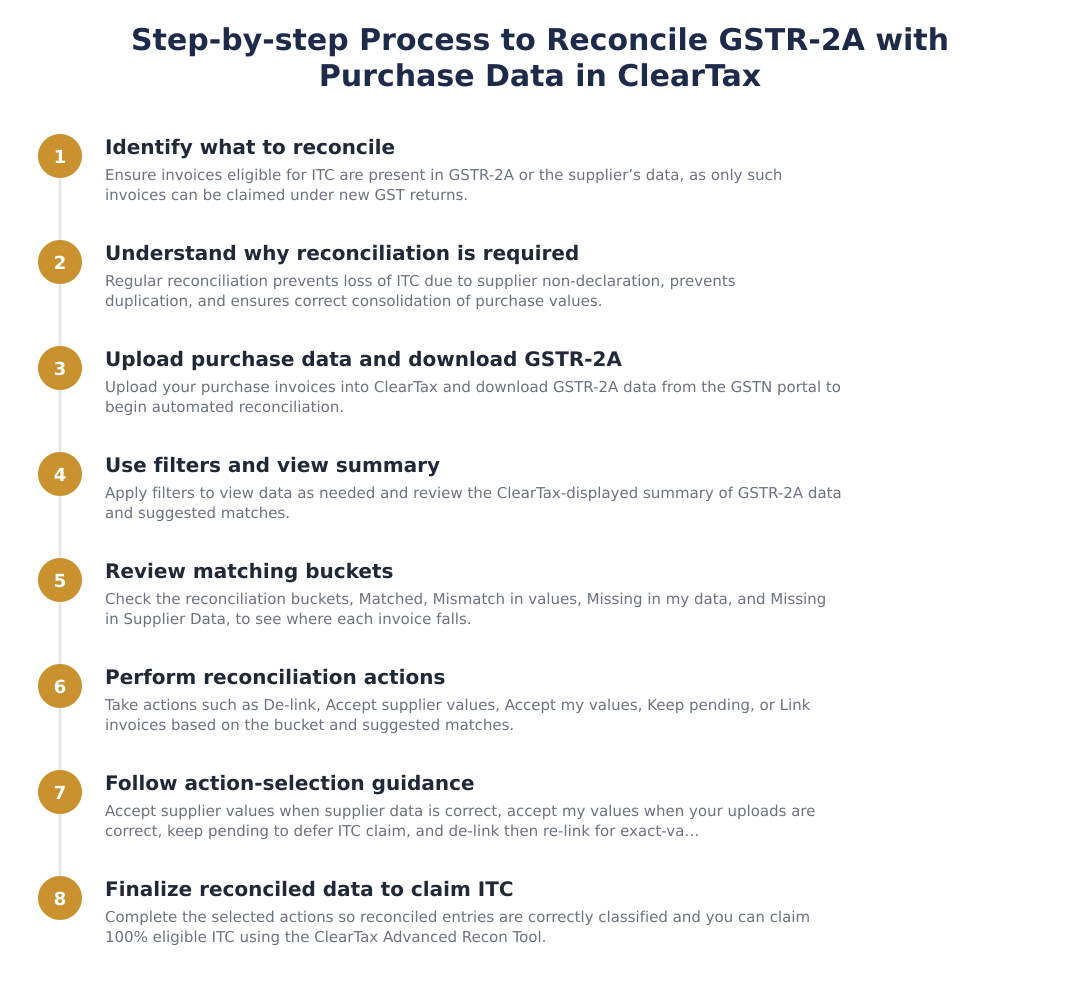
Download the supplier‑reported data from the tax portal or receive the supplier’s electronic extract and upload it into the reconciliation tool so the system has the source of truth for what suppliers have declared.
Upload your purchase invoices, credit/debit notes, and purchase journal entries from your accounting system or spreadsheets into the tool so both datasets are available for comparison.
Configure matching rules (for example, invoice number, supplier GSTIN, invoice date tolerance, and amount thresholds) and use filters to narrow down to specific suppliers, periods, or problematic buckets.
Examine items the tool matches automatically and review exceptions such as value mismatches, invoices missing on either side, or duplicate entries; prioritise exceptions that have immediate ITC impact.
For each exception choose the appropriate action: link matching invoices manually, accept supplier values or your ledger values where justified, mark items for follow‑up with suppliers, or keep certain invoices pending for the current period.
Record the rationale for reconciliations and any adjustments made, and initiate communications with suppliers for correction/issuance of credit notes where necessary so future filings are aligned.
Make reconciliation a recurring process (monthly or per return period) and lock the reconciled period after review to maintain an audit trail and avoid inadvertent changes.
Practical tips to streamline reconciliation
Standardise invoice reference formats and enforce consistent data entry in your purchase ledger to increase automated match rates. Small steps such as capturing supplier GSTINs in a consistent field, scanning and tagging invoices, and ensuring timely upload of inward documents greatly reduce manual review.
Use exception triage: focus on high‑value items, frequent suppliers, and invoices with tax‑type differences first. Automate communications by generating exception reports for suppliers and maintain a short SLA for supplier responses so corrections reflect in subsequent returns without material exposure.
Reconciliation between supplier‑reported data and your purchase records is an essential control for accurate ITC claims and clean accounting. Use the workflow above as a template and adapt the matching rules, exception actions, and cadence to your organisation’s volume and risk tolerance. If you want a step‑by‑step guide tailored to a specific reconciliation product, provide the vendor’s verified feature list or permission to access the product documentation and I will convert this framework into exact, clickable steps.
Frequently asked questions
What does ClearTax Advanced Recon Tool do for GSTR-2A reconciliation?
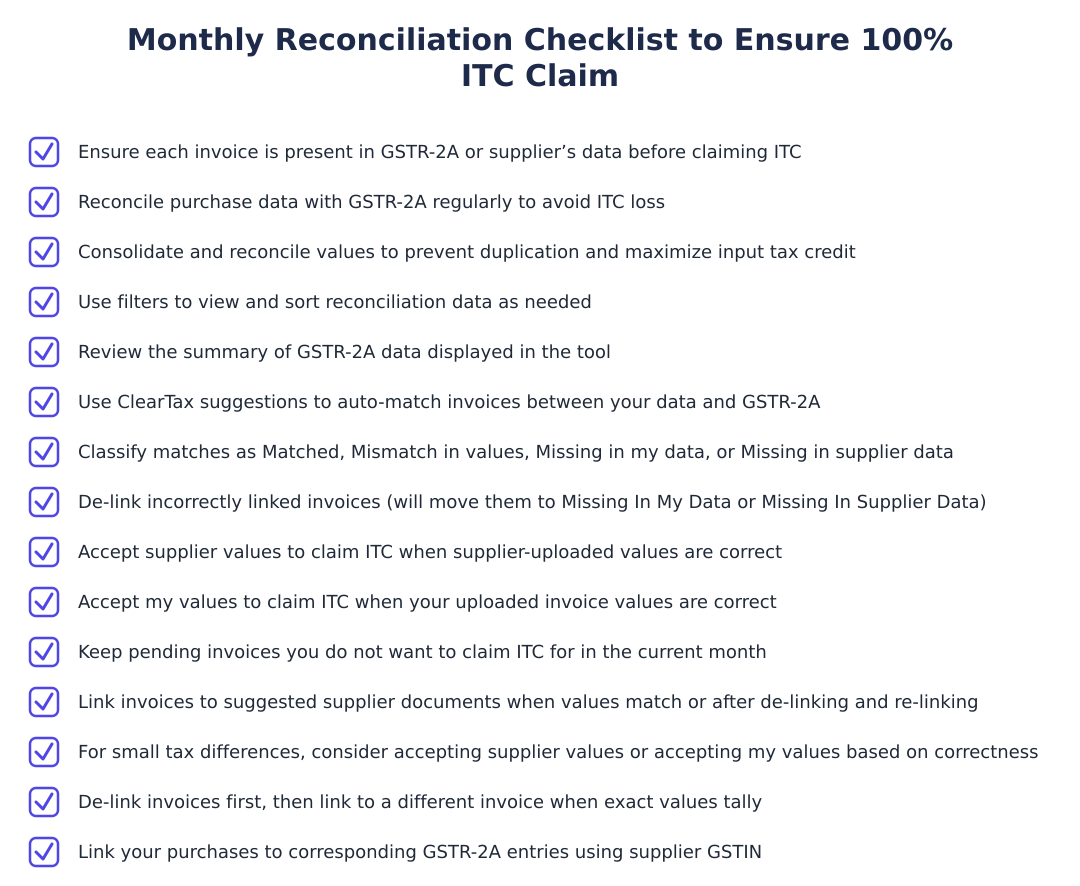
ClearTax Advanced Recon Tool automates and speeds up reconciliation between your purchase data and GSTR-2A, offering up to 5X faster reconciliation with intelligence to auto-identify and match entries. The tool downloads GSTR-2A from the GSTN portal, compares it with uploaded purchase invoices, displays a summary, and provides matching suggestions to help assure 100% eligible ITC claim. It also categorises outcomes into buckets like Matched, Mismatch in values, Missing in my data, and Missing in supplier data to simplify follow-up actions. Filters let you view and work on specific segments of data so you can prioritise exceptions efficiently.
What are the reconciliation categories or buckets in ClearTax and what do they mean?
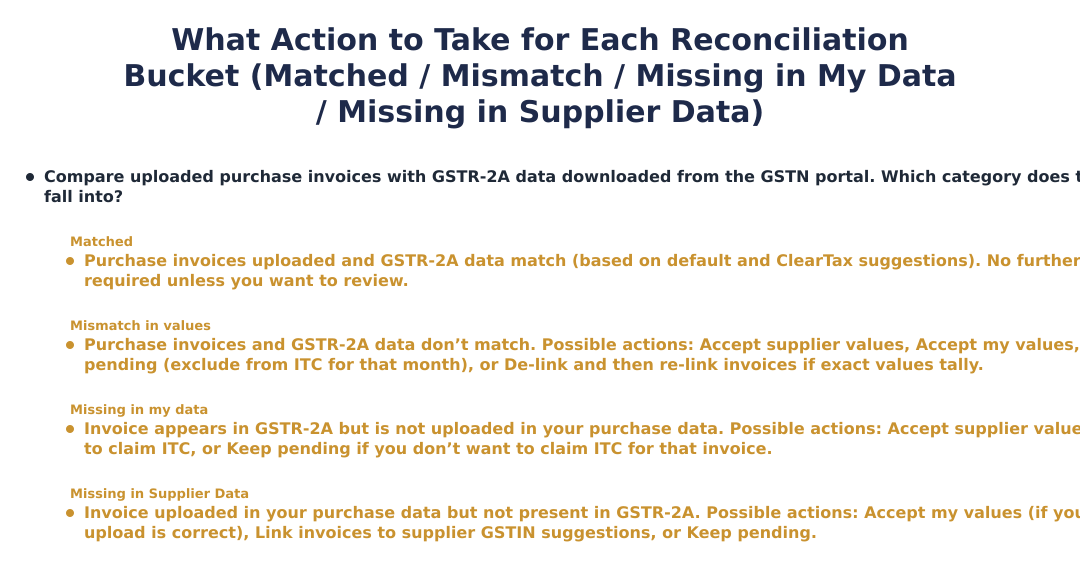
ClearTax organises reconciliation results into four buckets: Matched, Mismatch in values, Missing in my data, and Missing in supplier data, each indicating a specific reconciliation state. 'Matched' means the purchase invoice and GSTR-2A entry align based on default rules and ClearTax suggestions; 'Mismatch in values' means the invoice exists on both sides but totals/tax amounts differ; 'Missing in my data' means invoice appears in GSTR-2A but you have not uploaded it; and 'Missing in supplier data' means you uploaded the invoice but it does not appear in GSTR-2A. These buckets let you quickly apply corrective actions such as linking, accepting supplier values, or marking invoices pending.
How do I start reconciling purchase data in ClearTax GST software?
To start reconciling, upload your purchase invoices into ClearTax, download the GSTR-2A data from the GSTN portal within the tool, then use filters to focus on specific suppliers, months or exception types and review the summary shown by ClearTax. The tool will auto-suggest matches and highlight which invoices fall into Matched, Mismatch, Missing in my data, or Missing in supplier data buckets so you can take action quickly. You can then accept supplier values, accept your values, link invoices, keep invoices pending, or de-link linked invoices depending on the situation.
When should I use 'Accept supplier values' versus 'Accept my values'?
Use 'Accept supplier values' when the supplier has uploaded correct invoice figures in GSTR-2A and you want to align your records to claim ITC; use 'Accept my values' when your uploaded purchase invoice is accurate and you want to override the supplier's differing values. 'Accept supplier values' is typically chosen when the supplier’s GSTR-2A entry is complete and reliable, while 'Accept my values' is suitable when the tax difference is minor and you are confident in your records. Both actions update reconciliation status so you can proceed with claiming ITC or prompting supplier correction as needed.
What does 'Keep pending' mean and when should I use it?
'Keep pending' marks an invoice so it will not be available for claiming ITC in the selected month, effectively excluding it from current ITC claims until further action. You should use 'Keep pending' when you do not want to claim ITC for that specific invoice in the present period, for example, if the supplier’s details are disputed or documentation is incomplete. The invoice remains in the system for later review and will not be considered in the reconciliation for that month while pending.
How does de-linking invoices work and what are the limitations?
De-linking removes an existing link between a purchase invoice and a GSTR-2A entry, after which the invoice moves to either 'Missing in my data' or 'Missing in supplier data' depending on the side it belongs to. Note that you cannot de-link invoices in bulk if you have selected invoices across multiple buckets; bulk de-linking is restricted when selections span different reconciliation statuses. After de-linking, you can either re-link the invoice to a correct entry, accept values, or keep it pending as needed.
When should I link invoices manually in ClearTax reconciliation?
Manually link invoices when ClearTax suggests a potential match but the match is not exact or when you have identified the correct corresponding invoice on the other side and need to establish the connection. Linking is recommended when invoices present in your purchase data correspond to entries in GSTR-2A for the same supplier GSTIN or invoice number, and you want to clear exceptions to claim ITC. If values exactly match but were linked incorrectly earlier, de-link first and then re-link to the correct invoice.
Can ClearTax help if the supplier has not uploaded an invoice to GSTR-2A?
Yes, when a supplier has not uploaded an invoice and it appears only in your purchase records, ClearTax will place it in the 'Missing in supplier data' bucket so you can follow up with the supplier for amendment or take corrective action. From that bucket you can keep the invoice pending to avoid claiming ITC prematurely, or you can de-link and later re-link if the supplier updates their GSTR-1/GSTR-2A. This categorisation helps prevent wrongful ITC claims and ensures you reconcile proactively to avoid future disputes.
What quick actions does ClearTax provide to resolve mismatches during reconciliation?
ClearTax offers quick actions including 'Accept supplier values', 'Accept my values', 'Keep pending', 'Link invoices', and 'De-link' to resolve mismatches and exceptions revealed during reconciliation. You can use 'Accept supplier values' or 'Accept my values' to resolve small tax differences, 'Keep pending' to exclude invoices from current ITC claims, and linking/de-linking to correct association errors between your purchase data and GSTR-2A. These actions are available from the reconciliation interface and are designed to help you close exceptions efficiently and ensure accurate ITC claims.
Need help staying GST compliant?
MoneyGence's AI Finance OS tracks your compliance, wallet share, and finances in one place, built for agencies and growing businesses.
Get started with MoneyGence