GSTR-3B Guide: Due Date, Late Fee, Format & Filing Rules
This guide explains GSTR-3B, the self-declared summary GST return used by most registered taxpayers, and covers who must file it, filing frequency (monthly or quarterly under QRMP), late filing consequences and how it relates to other GST returns such as GSTR-1 and GSTR-2B. You will learn what information GSTR-3B contains, which categories of taxpayers are not required to file it, why reconciliation with suppliers' returns matters, and the practical implications of late filing. Understanding these points helps businesses stay compliant, avoid interest and penalties, and claim correct input tax credits. The guide focuses on the essential rules and compliance risks you must know so you can design internal processes that minimise notices and ensure accurate reporting every return period.
What is GSTR 3B?
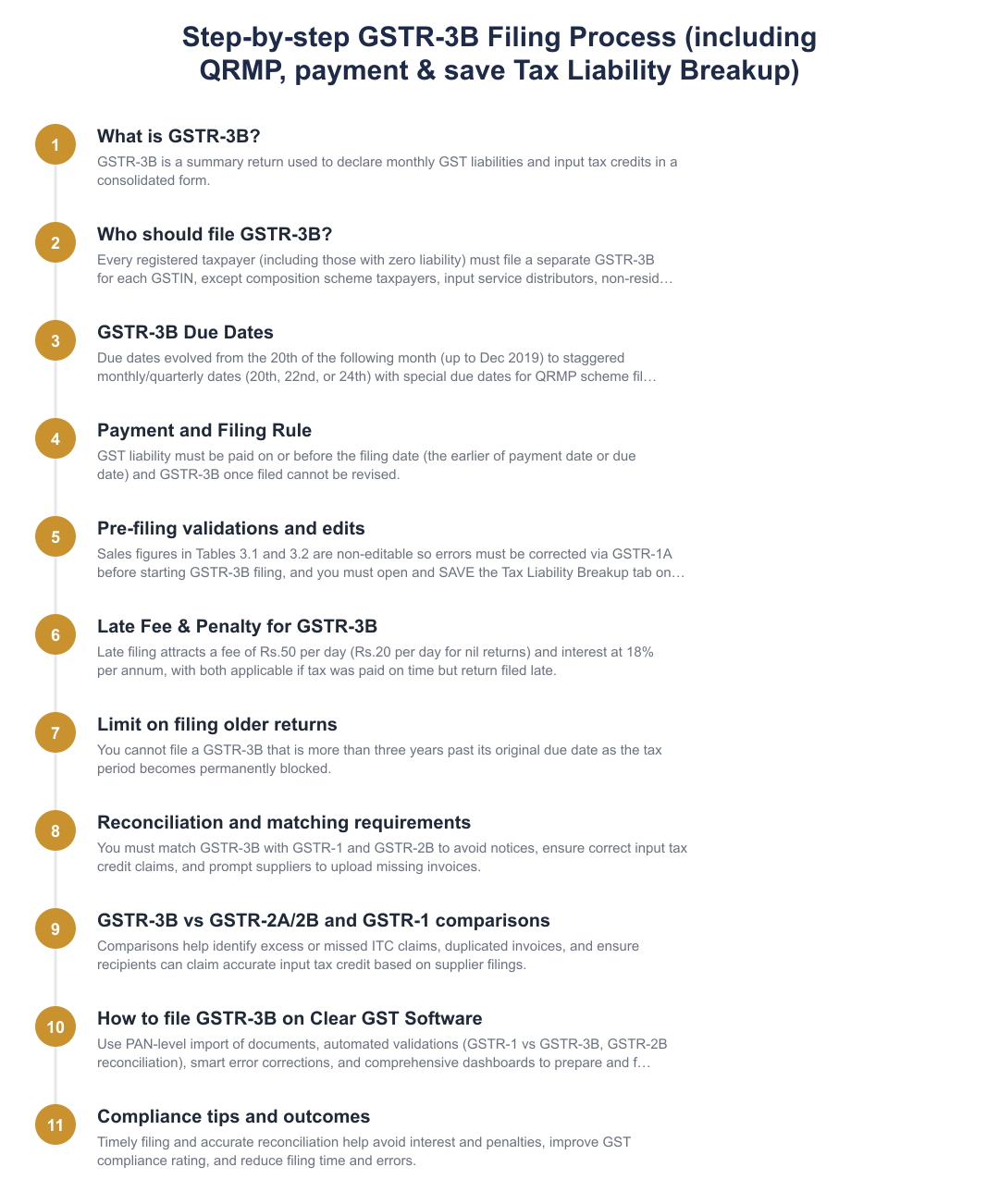
GSTR-3B is a self-declared summary GST return filed every month by most regular taxpayers, and quarterly by taxpayers who have opted for the QRMP scheme. The return captures summary figures of outward supplies (sales), input tax credit (ITC) claimed and the net tax payable for the tax period.
Because GSTR-3B is a summary return rather than an invoice-level return, it serves as a quick compliance statement that the taxpayer self-declares. That makes accurate aggregation of sales and purchase data critical: errors in summary figures can trigger downstream notices and mismatches with supplier returns.
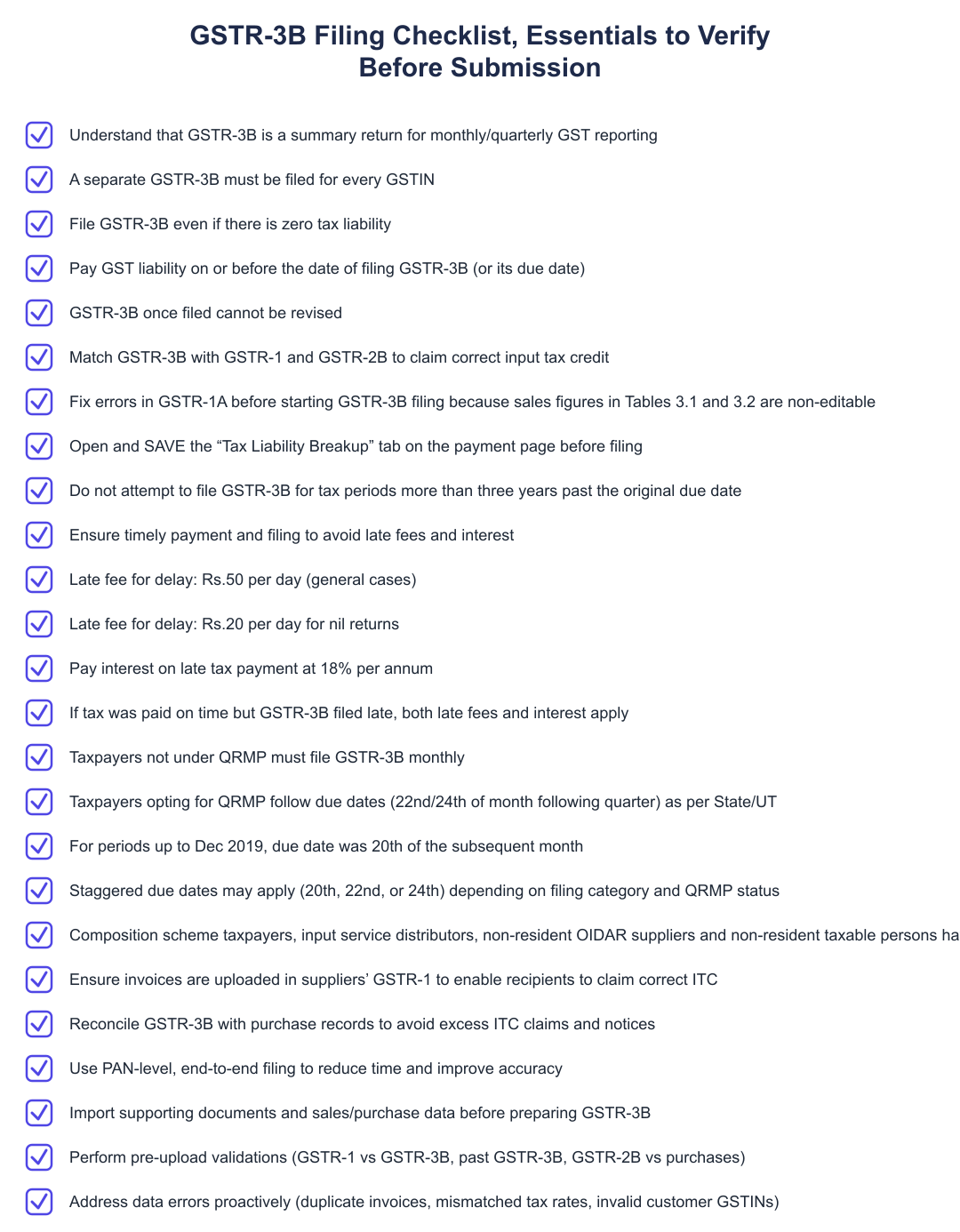
An important compliance characteristic is that once a GSTR-3B is filed it cannot be revised. This rule makes pre-filing validation and reconciliation important so that mistakes are caught before submission.
Even if a taxpayer has no tax liability for the period, filing a nil GSTR-3B is mandatory. This keeps records complete and ensures the taxpayer remains compliant with furnishing periodic returns.
Who should not file GSTR-3B (categories excluded)
| Category | Filing requirement |
|---|---|
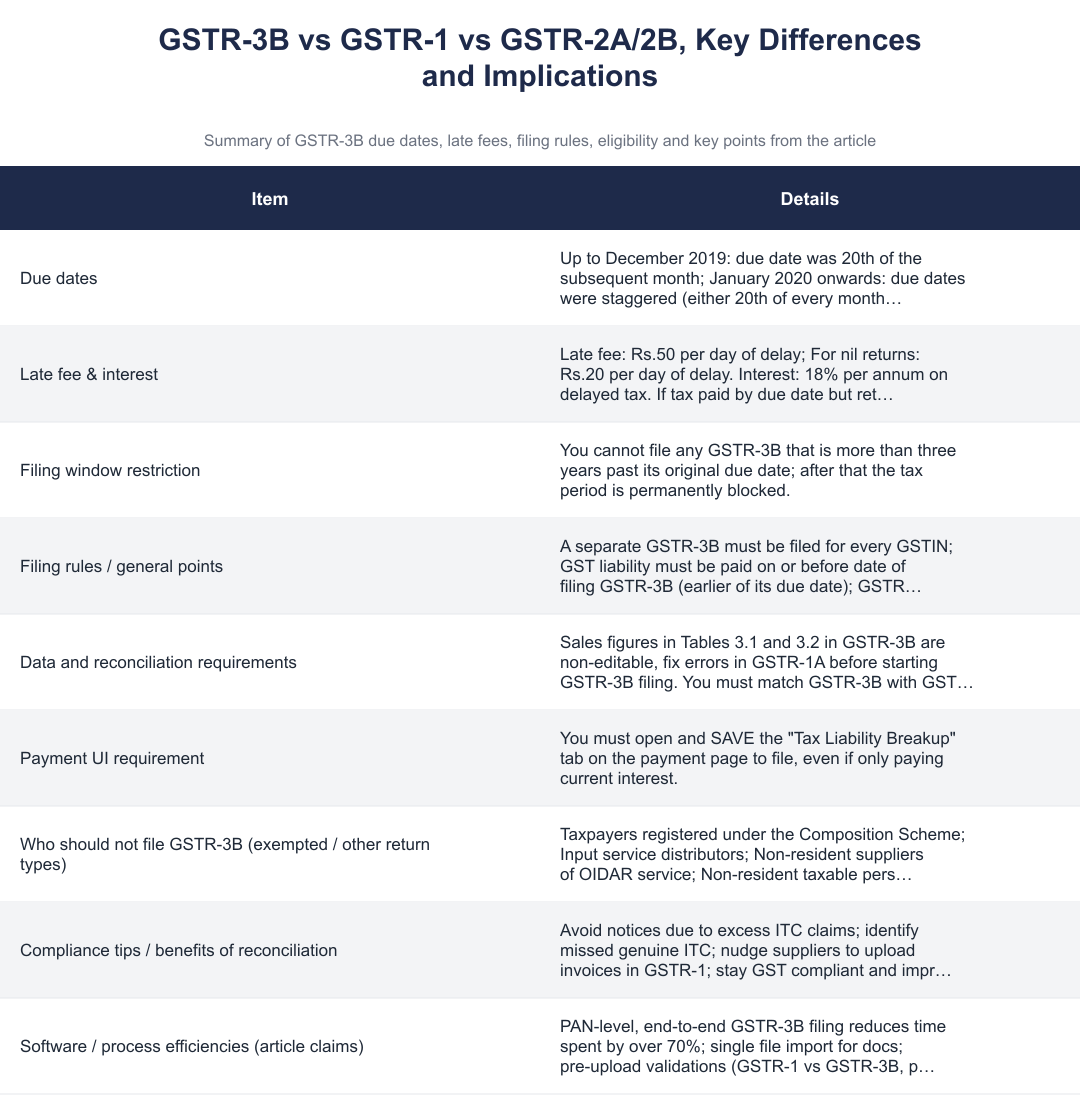
| Taxpayers registered under the Composition Scheme | Do not have to file GSTR-3B |
| Input service distributors | Do not have to file GSTR-3B |
| Non-resident suppliers of OIDAR service and non-resident taxable persons | Do not have to file GSTR-3B |
GSTR-3B Due Dates
GSTR-3B filing frequency depends on the taxpayer's filing category: it is filed monthly by most taxpayers and quarterly by those who have opted for the QRMP scheme. This means you must prepare summary figures at the cadence applicable to your registration so returns are submitted on time.
Because GSTR-3B cannot be revised after filing, calendars and internal checks must align with your chosen frequency. The monthly or quarterly cadence is significant for cash-flow planning and for ensuring timely capture of input tax credit entitlements.
Late Fee & Penalty for GSTR-3B
Late filing of GSTR-3B attracts a late fee and interest. Interest on delayed tax payment is applied at a rate of 18% per annum. Taxpayers should factor this cost when assessing the impact of missed or delayed returns.
If tax has been paid within the due date but the GSTR-3B return itself is filed after the deadline, both late fees and interest will apply. This rule creates two separate compliance obligations: timely payment of tax and timely submission of the return, and failing either can increase compliance cost.
Because the return cannot be revised after filing, any short payment or incorrect reporting discovered later may lead to additional interest and penalties. Maintaining proper records and reconciling before filing reduces the risk of such liabilities.
GSTR-3B vs GSTR-1 & GSTR-2B: why reconciliation matters
GSTR-3B is a summary self-declaration, while other returns like GSTR-1 and GSTR-2B contain details of outward supplies and auto-populated input tax credit information respectively. Reconciliation between these returns is essential because differences can lead to notices and incorrect ITC claims.
Taxpayers must match their GSTR-3B figures with GSTR-1 (suppliers' outward supplies) and GSTR-2B (auto-drafted ITC data). Regular reconciliation ensures that claimed ITC is supportable and alerts the taxpayer to missing or misreported invoices that suppliers need to correct.
Proactive matching reduces the risk of being subject to adjustment or enquiry by the tax authorities, and it also helps the recipient perfect their ITC claims. A disciplined reconciliation process should be part of every period-end checklist prior to filing GSTR-3B.
Practical steps before filing GSTR-3B
Prepare consolidated totals of outward supplies, ITC claimed and taxable liability for the return period to populate the GSTR-3B summary fields.
Match your summary figures against supplier-reported data and auto-populated ITC to identify missing or mismatched invoices before filing.
Submit the return according to your filing frequency, monthly for regular filers, quarterly if on the QRMP scheme.
Frequently Asked Questions
Is GSTR-3B editable after submission? No. Once filed, GSTR-3B cannot be revised, so ensure figures are correct before submission.
Do I have to file if I have zero tax liability? Yes. Filing a nil GSTR-3B is compulsory even when there is no tax liability for the period.
Are there taxpayers exempt from filing GSTR-3B? Yes. Taxpayers under the Composition Scheme, input service distributors, and certain non-resident categories (such as OIDAR suppliers and non-resident taxable persons) are not required to file GSTR-3B.
Why should I reconcile GSTR-3B with other returns? Reconciliation with GSTR-1 and GSTR-2B helps avoid notices and ensures you claim the correct amount of input tax credit.
GSTR-3B is a concise, self-declared summary return that must be filed monthly or quarterly (for QRMP filers). Because the return is non-revisable and nil filing is mandatory, disciplined preparation and reconciliation with GSTR-1 and GSTR-2B are essential to avoid interest, late fees and compliance notices. Build a repeatable pre-filing checklist and regular reconciliation process to reduce risks and ensure accurate GST reporting.
Frequently asked questions
What is GSTR-3B and why do I need to file it?
GSTR-3B is a self-declared summary GST return that taxpayers must file monthly (or quarterly under certain schemes) to report summary figures of outward supplies, input tax credit (ITC) claimed, and net tax payable. It is a simple summary form, not a detailed invoice-level return, and a separate GSTR-3B must be filed for every GSTIN held by the taxpayer. The tax liability must be paid on or before filing GSTR-3B, and the return once filed cannot be revised, so figures should be checked before submission. Even if there is zero tax liability, filing of GSTR-3B is compulsory for registered taxpayers unless specifically excluded by law.
Who is required to file GSTR-3B and who is exempt?
Every person registered under GST must file GSTR-3B except specific categories expressly exempted from filing this return. Exempt categories include taxpayers registered under the Composition Scheme, input service distributors, non-resident suppliers of OIDAR services, and non-resident taxable persons. Note that the requirement to file applies separately for each GSTIN, and even zero-liability taxpayers (not in exempt categories) must file. Certain special schemes like QRMP change frequency (monthly vs quarterly) but do not remove the filing obligation unless you fall in an exempt category.
What are the due dates for filing GSTR-3B?
The due date for GSTR-3B is generally the 20th of the month following the tax period for monthly filers, while quarterly filers (including many QRMP taxpayers) have staggered due dates, either the 22nd or 24th of the month following the quarter depending on the State/UT. Up to December 2019 the due date was uniformly the 20th, but from January 2020 some due dates were staggered, and taxpayers who opt for the QRMP scheme from 1 January 2021 follow the 22nd/24th schedule. Also note that returns cannot be filed if more than three years have passed from the original due date for that tax period (hard lock effective from July 2025 tax period filed in August 2025).
What is the late fee and interest for filing GSTR-3B late?
If you file GSTR-3B after the due date you are liable to pay a late fee and interest: the late fee is Rs.50 per day of delay (Rs.20 per day for nil returns) and interest is charged at 18% per annum on the outstanding tax. Both the late fee and interest apply even if the tax was paid on time but the return was filed late. These charges accrue from the day after the due date until the date of filing and payment, so timely payment and filing avoid both penalties and interest.
What happens if GSTR-3B figures don’t match GSTR-1 or GSTR-2B?
A mismatch between GSTR-3B and GSTR-1/GSTR-2B can trigger notices and disputes because GSTR-3B is the taxpayer’s self-declared summary of tax liability while GSTR-1 and GSTR-2B contain supplier-reported and auto-populated details; therefore taxpayers must reconcile these returns to avoid incorrect ITC claims or showstoppers in compliance. You should match and reconcile your GSTR-3B with GSTR-1 and GSTR-2B regularly and correct supplier-level issues via amendments in GSTR-1 (or GSTR-1A) so system-generated values align. Reconciliation helps you claim only legitimate ITC, avoid excess credit claims, and prompt suppliers to upload missing invoices in GSTR-1, reducing the risk of notices and adjustments later.
How do I correct errors in amounts that are auto-populated and locked in GSTR-3B?
If GSTR-3B values are auto-populated from GSTR-1/1A/IFF and are non-editable, you must correct errors by amending the source return, typically via GSTR-1 or filing a rectification through GSTR-1A for the same tax period, because the system enforces hard locking of certain fields. For example, since November 2025 auto-populated values in Table 3.2 for inter-state supplies to unregistered persons became non-editable and required source amendments. Also note that errors in sales figures in Tables 3.1 and 3.2 must be fixed upstream before filing GSTR-3B and you cannot file returns more than three years after the original due date.
Are there system requirements when paying tax or filing GSTR-3B on the portal?
Yes, when making payment or filing, you must open and SAVE the 'Tax Liability Breakup' tab on the GST payment page even if you are only paying current interest, because the portal requires this step for filing to proceed. Additionally, the GST liability must be paid on or before the date of filing GSTR-3B (or its due date), and you must file a separate GSTR-3B for each GSTIN. Failure to follow portal steps or pay timely can result in filing failure, late fees, and interest; ensure the payment breakup is saved to avoid submission errors.
Can I file GSTR-3B for periods older than three years?
No, you cannot file GSTR-3B for a tax period if more than three years have passed from its original due date; after that the tax period is permanently blocked and filing is not permitted. This hard lock became effective from the July 2025 tax period (filed August 2025) and means taxpayers must ensure timely filing or rectify within the three-year window. If you miss the window, you cannot submit the return for that period and should consult a tax professional about alternative rectification routes or implications.
If I have nil liability, do I still need to file GSTR-3B and what are the fees if late?
Yes, if you are a registered taxpayer (and not in an exempt category like composition dealers), you must file GSTR-3B even when you have nil tax liability. For late filing of a nil return the late fee is lower at Rs.20 per day of delay (compared to Rs.50 per day for non-nil returns), although interest at 18% per annum would apply only if tax was actually outstanding. Filing nil returns on time is important to maintain compliance status and avoid accumulation of late fees and potential notices.
Need help staying GST compliant?
MoneyGence's AI Finance OS tracks your compliance, wallet share, and finances in one place, built for agencies and growing businesses.
Get started with MoneyGence