GSTR-9C Reconciliation Statement: Complete GST Audit Guide
This guide explains GSTR-9C, the reconciliation statement that links a taxpayer's annual GST return with their audited financial statements. You will learn what GSTR-9C is, who must prepare and certify it, what information it contains, and where and how it must be filed. Understanding GSTR-9C is important because it ensures consistency between tax returns and financial records, helps identify discrepancies in turnover, tax paid and input tax credit, and provides an auditor’s observations on unreconciled items. For businesses subject to GST audit, correctly preparing and certifying GSTR-9C reduces the risk of notices or adjustments later and supports transparent tax compliance. The guidance that follows breaks the form into its two constituent parts (reconciliation and certification), lists the specific items that must be reconciled, describes who is responsible for certification, and summarises the filing route. If your business is within the scope of a GST audit, this article will help you organise the required documents and understand the role of the auditor in producing a compliant reconciliation statement.
1. What is a GSTR-9 C Reconciliation Statement?
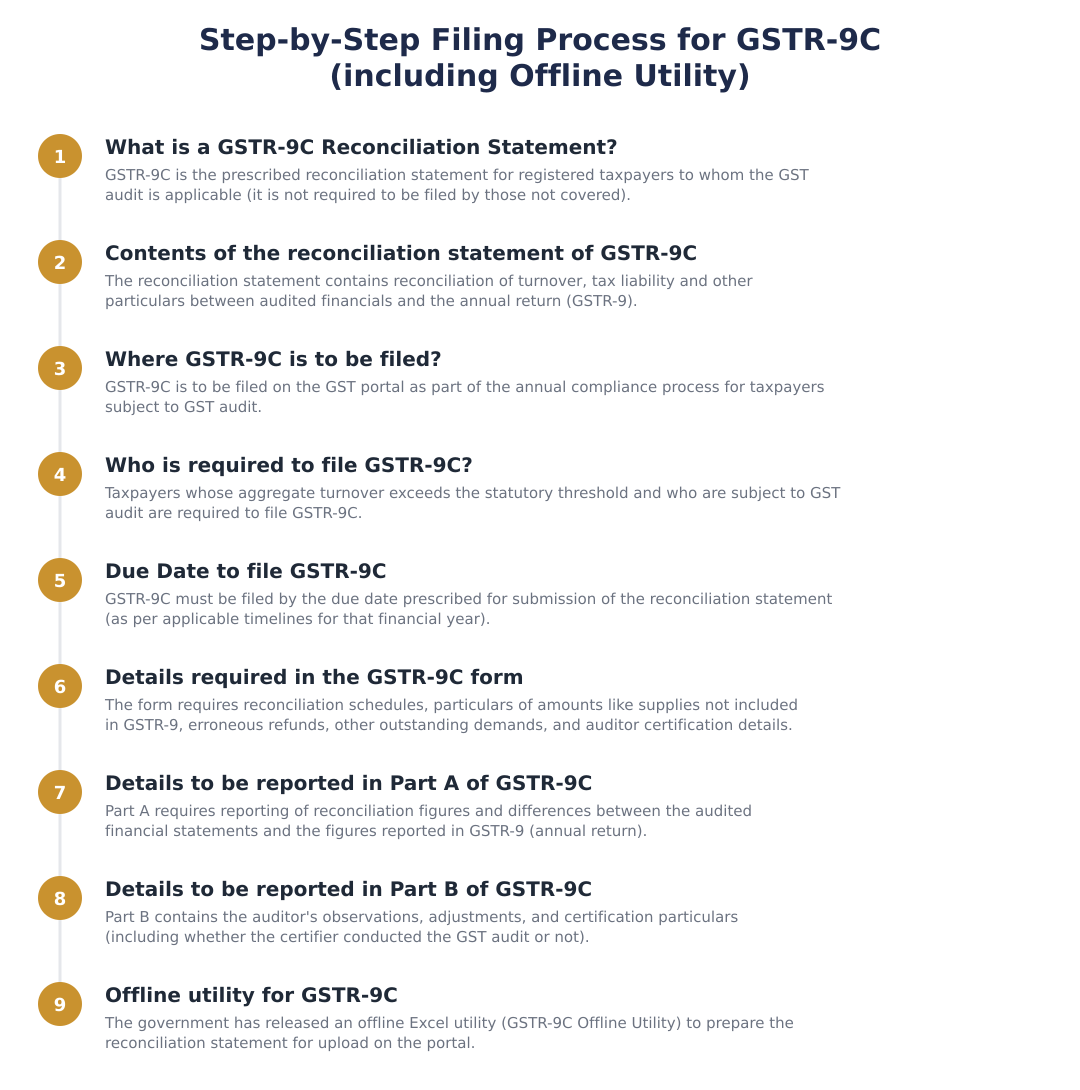
GSTR-9C is the reconciliation statement prescribed for registered taxpayers to whom the GST Audit is applicable. It serves as the formal bridge between the audited financial statements of a taxpayer and the figures reported in the annual GST return (GSTR-9).
Practically, GSTR-9C helps tax authorities and taxpayers verify that the turnover, tax liabilities and input tax credit reported in the annual return are consistent with the taxpayer’s audited books. Where reconciling items exist, the statement highlights differences and, where applicable, records the auditor’s recommendations.
Because it is part of the audit-related compliance framework, GSTR-9C is an important document in a taxpayer’s GST dossier and must be prepared diligently to reflect both accounting and return-based positions.
2. What are the contents of the reconciliation statement of GSTR 9C?
GSTR-9C reconciles information furnished in GSTR-9 (annual return) with information in the audited financial statements for the relevant financial year. The reconciliation focuses on key fiscal elements that can differ between accounting records and GST returns.
The statement covers reconciliation of turnover between the audited financials and GSTR-9, reconciliation of tax paid, and reconciliation of Input Tax Credit. In addition to numerical reconciliations, the form captures the auditor’s observations or recommendations on any unreconciled matters uncovered during the reconciliation process.
By bringing these points together in a single statement, GSTR-9C provides a clear audit trail for differences and supports both internal review and regulatory scrutiny.
7. What are the details required in the GSTR-9C form?
GSTR-9C consists of two parts: Part A (Reconciliation Statement) and Part B (Certification). Part A contains the substantive reconciliation work and narrative, while Part B contains the auditor’s certification.
Part A requires basic identification details such as the financial year, GSTIN, legal name and trade name, followed by the reconciliation schedules showing differences between audited accounts and the annual return. It also requires reconciliation of tax paid and of Input Tax Credit, and a section for auditor recommendations where any unresolved or unexplained variances can be recorded.
Part B must be completed by the auditor and contains the formal certification that the reconciliation has been carried out. The certification attests to the auditor’s review and conclusions about whether the statements reconcile, and it forms the auditor’s formal opinion on the consistency between accounts and the annual GST return.
8. What are the details to be reported in the Part A of GSTR 9C?
Part A of GSTR-9C requires reporting of basic details and the reconciliation schedules. Basic details explicitly include the financial year, GSTIN, legal name and trade name of the taxpayer. These identification items link the reconciliation to the specific return and audited accounts under review.
The reconciliation schedules in Part A compare turnover as per audited financial statements with turnover declared in GSTR-9, reconcile tax paid figures, and reconcile Input Tax Credit claimed. Any differences identified are to be explained or classified so that the causes of variance are transparent to reviewers and the taxpayer.
Additionally, Part A gives the auditor space to record recommendations on unreconciled matters. This section is important because it communicates the auditor’s professional view on discrepancies that require management action or further clarification.
9. What are the details to be reported in the Part B of GSTR 9 C?
Part B of GSTR-9C is the certification section and must be prepared and certified by a Chartered Accountant (CA) or a Cost Accountant (CMA). The auditor signs off in Part B to confirm that the reconciliation between GSTR-9 and the audited financial statements has been carried out as per applicable requirements.
The certification represents the auditor’s formal opinion on the completeness and correctness of the reconciliation entries and the explanations provided for any variances. This attestation adds professional accountability to the reconciliation process and is a mandatory element where GST audit obligations apply.
4. Where GSTR 9C is to be filed?
GSTR-9C is required to be filed along with GSTR-9 (Annual Return) and the Audited Financial Statements on the GST portal or through facilitation centres. Filing it together with the annual return and audited accounts ensures that the reconciliation is considered part of the same compliance submission.
Using the GST portal or designated facilitation centres provides taxpayers with standardised filing channels and ensures that the reconciliation statement is properly linked to the relevant annual return and audit documents in the tax authority’s records.
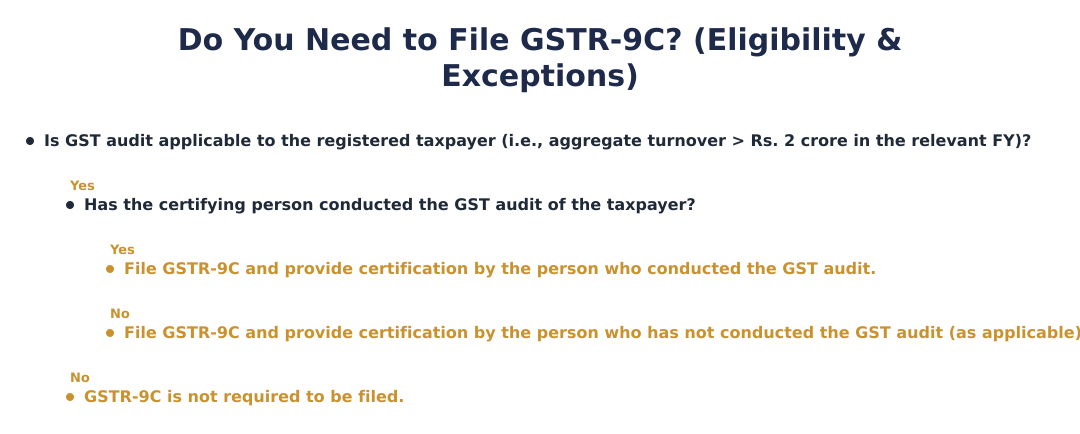
5. Who is required to file GSTR 9C?
The reconciliation statement (GSTR-9C) is required to be filed by taxpayers who are required to get their accounts audited under GST rules and regulations. In other words, where GST audit applicability exists, the reconciliation and its certification form a mandatory part of compliance.
If your business falls within the class of taxpayers required to undergo a GST audit, preparing GSTR-9C and obtaining the auditor’s certification is an essential step in closing the annual compliance cycle and demonstrating that return figures align with audited financial statements.
6. Filing process, key steps for GSTR-9C
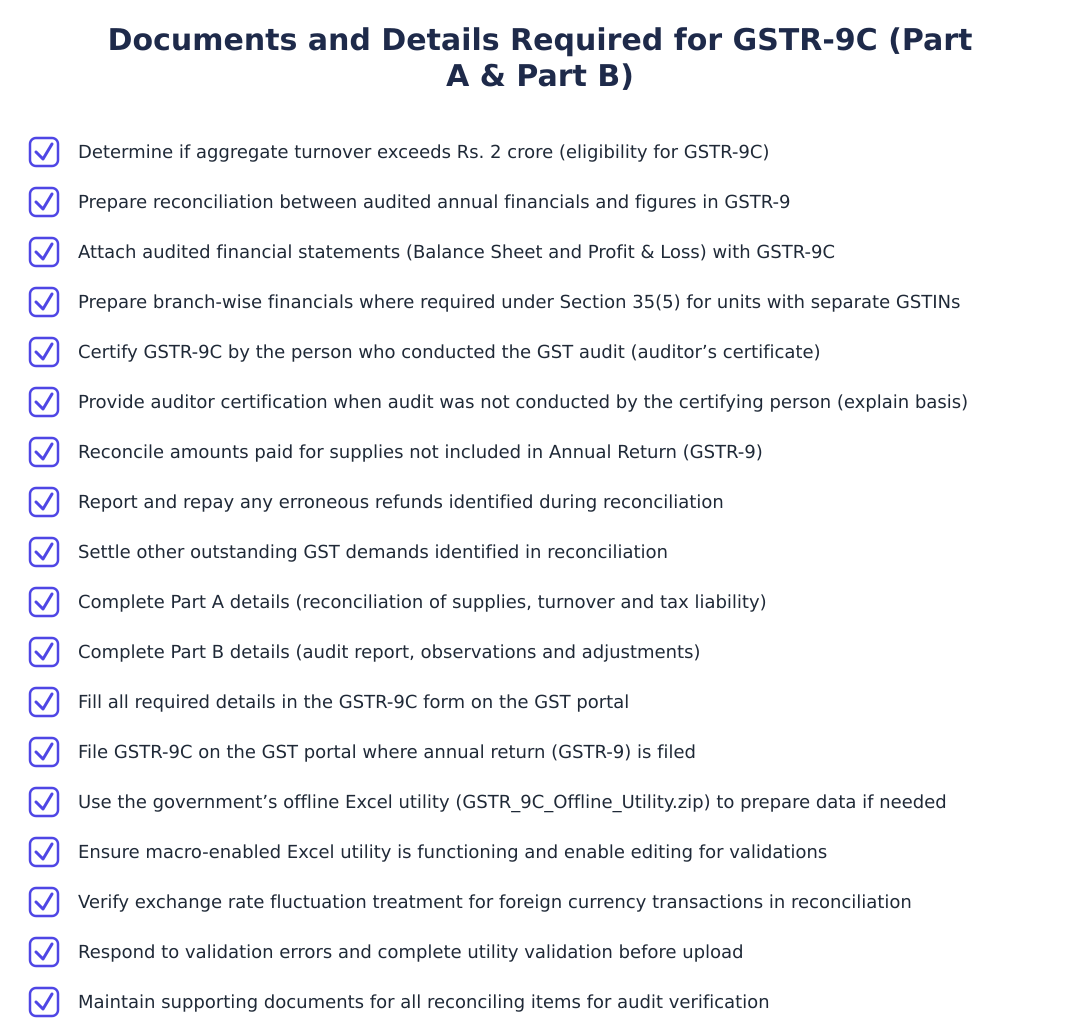
Complete the statutory audit or GST audit so that the audited financial statements for the relevant financial year are ready for reconciliation.
Fill in the annual return with the figures as per GST records; this is the return that will be reconciled with the audited accounts.
Develop the reconciliation schedules comparing turnover, tax paid and Input Tax Credit between audited accounts and GSTR-9, and note any unreconciled items with explanations.
Have a Chartered Accountant or Cost Accountant review the reconciliation and sign Part B, providing the required certification.
Submit GSTR-9 along with the audited financial statements and the certified GSTR-9C on the GST portal or through designated facilitation centres.
GSTR-9C is an audit-linked reconciliation statement that ensures alignment between a taxpayer’s annual GST return and audited financial statements. It must be prepared carefully, with Part A documenting reconciliations and auditor recommendations, and Part B containing the mandatory certification by a CA or CMA. If your accounts are subject to GST audit, include GSTR-9C with your GSTR-9 and audited accounts when filing on the GST portal or through facilitation centres to complete your annual compliance.
Frequently asked questions
What is GSTR‑9C and why do I need to file it?
GSTR‑9C is the reconciliation statement that taxpayers required to undergo GST audit must file to reconcile the figures in their audited financial statements with the figures reported in their annual GST return (GSTR‑9). It reconciles turnover, tax paid and input tax credit between the audited financials and GSTR‑9 and must be certified by a Chartered Accountant or Cost Accountant. GSTR‑9C is filed along with GSTR‑9 and the audited financial statements on the GST portal or via facilitation centres, and its purpose is to ensure consistency and spot discrepancies that may lead to liability or refunds.
Who is required to file GSTR‑9C?
Any registered taxpayer whose aggregate turnover in a financial year exceeds Rs. 2 crore and who is therefore required to get their accounts audited under GST rules must file GSTR‑9C. The requirement mirrors the threshold for GST audit and applies irrespective of the legal form of the taxpayer (company, firm, individual) if turnover crosses Rs. 2 crore. If turnover is below Rs. 2 crore, GSTR‑9C is not required even though GSTR‑9 (annual return) may still be applicable in some periods or cases.
What are the main contents of the GSTR‑9C reconciliation statement?
GSTR‑9C contains two main parts: Part A which is the reconciliation statement and Part B which is the auditor's certification. Part A requires basic details (FY, GSTIN, legal/trade name), reconciliation of turnover between audited financials and GSTR‑9, reconciliation of tax paid, reconciliation of input tax credit, and auditor recommendations on unreconciled items. Part B contains the certification by the auditor (CA/CMA) who conducted the GST audit or by a person who did not conduct the audit in limited circumstances, and must be accompanied by audited financial statements when filed.
What specific details must I report in Part A of GSTR‑9C?
In Part A of GSTR‑9C you must report basic identification details (financial year, GSTIN, legal and trade name), reconcile gross and taxable turnover as per audited financial statements with the turnover declared in GSTR‑9, reconcile tax paid as per books with tax paid in returns, reconcile Input Tax Credit claimed in books versus returns, and list any recommendations by the auditor on unreconciled differences. Each reconciliation should show figures from both sources and the net differences so that variances are clearly explained and quantifiable.
What does Part B (the certification) of GSTR‑9C require?
Part B of GSTR‑9C requires certification by a Chartered Accountant or Cost Accountant who has conducted the GST audit, confirming that the reconciliation statement is true and correct to the best of their knowledge. If the certifying person has not conducted the GST audit, there is a separate certification format to declare the limited scope of their certification. The certification must be signed and the reconciliation should be filed along with audited financial statements and GSTR‑9 on the GST portal or through facilitation centres.
Where and how is GSTR‑9C filed?
GSTR‑9C must be filed electronically on the GST portal along with GSTR‑9 (Annual Return) and the audited financial statements, or it can be filed through GST facilitation centres if required. The reconciliation statement and certification are uploaded via the GSTR‑9C form on the portal; supporting audited financial statements are also submitted. An offline Excel utility is available from the government website to prepare the return before uploading it to the portal.
What is the due date for filing GSTR‑9C?
The due date for filing GSTR‑9C is the same as the due date for filing GSTR‑9 (the annual return) for the relevant financial year and must be filed on or before that deadline; for example, the return for July 2017–March 2018 was extended to 30 June 2019. Because due dates have been revised in the past by GST Council decisions, taxpayers should check the current annual return deadline on the GST portal or official notifications for the specific financial year in question. Late filing can attract penalties and interest for any unpaid tax differences identified on reconciliation.
Is there an offline tool to prepare GSTR‑9C and where do I get it?
Yes, the government has released an offline Excel utility for preparing GSTR‑9C that taxpayers and practitioners can download from the GST tutorial/offline utilities section of the official GST website (for example, the GSTR_9C_Offline_Utility.zip link on tutorial.gst.gov.in). The offline utility helps populate the reconciliation and validation before uploading the JSON or prepared file to the GST portal, but taxpayers must still submit the final form online. Ensure macros and editing are enabled in Excel and you are using the latest version of the utility if you encounter validation or navigation issues.
What attachments and financials do I need to submit with GSTR‑9C?
You must attach the audited financial statements and the GSTR‑9 annual return when filing GSTR‑9C; the reconciliation is prepared by comparing these audited financials with figures in GSTR‑9. If a taxpayer has multiple branches with separate GSTINs, the reconciliations are prepared at the GSTIN level as per section 35(5) requirements, which may result in differences between statutory audit financials and branch‑wise audited statements; these differences should be explained in the reconciliation. The certifying CA/CMA must sign the GSTR‑9C and the attached audited financial statements to validate the reconciliation.
Need help staying GST compliant?
MoneyGence's AI Finance OS tracks your compliance, wallet share, and finances in one place, built for agencies and growing businesses.
Get started with MoneyGence