House Rent Allowance (HRA) Exemption 2026, Calculation & New Rules
House Rent Allowance (HRA) is a common salary component that helps taxpayers reduce their taxable income when they live in rented accommodation. This guide explains what HRA is, who can claim the exemption, how the exemption is computed under the law, and what changes matter for taxpayers evaluating the old and new tax regimes. You will learn the components used in the HRA calculation, the documentation and compliance steps to claim the exemption, and the alternative deduction available to those who do not receive HRA in their salary. The practical focus is on how to compute the exempt portion of HRA using the statutory tests, what to do if you pay rent to family members, and when Section 80GG applies for self-employed or salaried persons without HRA. By the end of this guide you should be able to determine whether you can claim HRA, estimate the exempt amount using the three statutory conditions, and follow the correct procedural steps to show the exemption in your income tax return.
What is HRA?
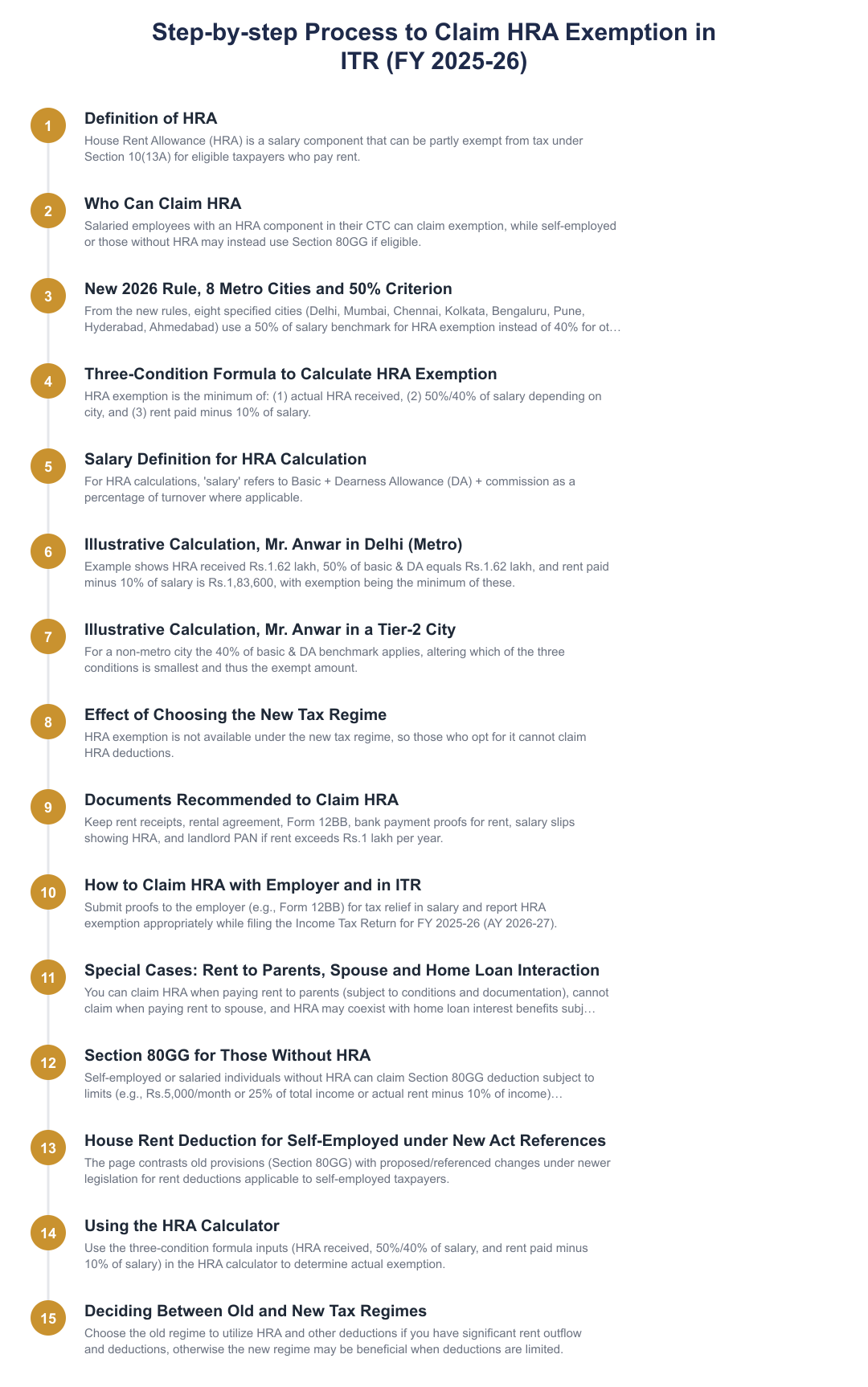
House Rent Allowance (HRA) is a component of salary that provides relief from income tax when an employee lives in rented accommodation. The legal basis for HRA exemption sits in the Income Tax Act under Section 10(13A), which lays down how much of the allowance is exempt from tax.
HRA is calculated by comparing three amounts and taking the least of them. The calculation relies on the definition of salary for this purpose (Basic + Dearness Allowance + commission as a percentage of turnover) and on whether the taxpayer lives in a metro or other city because the percentage threshold differs.
HRA Eligibility: Who Can Claim HRA Exemption?
HRA exemption is available to salaried employees who receive an HRA component as part of their salary package and who actually pay rent for accommodation. It is not available to persons who do not receive HRA in their salary.
Persons who opt for the new tax regime are not eligible to claim HRA exemption, because HRA is an exemption allowed only under the old tax regime. Self-employed taxpayers or those without an HRA component can explore Section 80GG instead, which is a separate rent-related deduction with its own conditions and limits.
How is HRA Exemption Calculated?
| Measure | Formula / Value |
|---|---|
| Actual HRA received | Actual HRA received from employer |
| Salary percentage (metro cities) | 50% of salary |
| Salary percentage (other cities) | 40% of salary |
| Rent paid component | Rent paid minus 10% of salary |
| Salary definition for HRA | Basic + Dearness Allowance + Commission as a percentage of turnover |
HRA Exemption Under New Tax Rules 2026
The HRA exemption is available only under the old tax regime. If you opt for the new tax regime, you are not eligible to claim HRA exemption because the new regime restricts the use of such exemptions.
Choosing between old and new regimes should factor in whether you receive HRA and other deductions. If you have significant rent outflow and HRA exemption under the old regime, that may affect which regime is more beneficial for your overall tax liability.
HRA Exemption Calculation (Practical Notes)
To compute HRA exemption you must calculate all three amounts described in the statute and take the least. Practically this means gathering: annual HRA paid by the employer, total annual rent paid, and the salary figure as defined for HRA (Basic + DA + applicable commission).
Because one of the tests uses a percentage that differs by city category (50% for metro, 40% for other cities), the city of residence affects the exempt amount. Also, the rent test requires subtracting 10% of salary from the annual rent paid and comparing that result with the other two measures.
Documents Required to Claim HRA Exemption
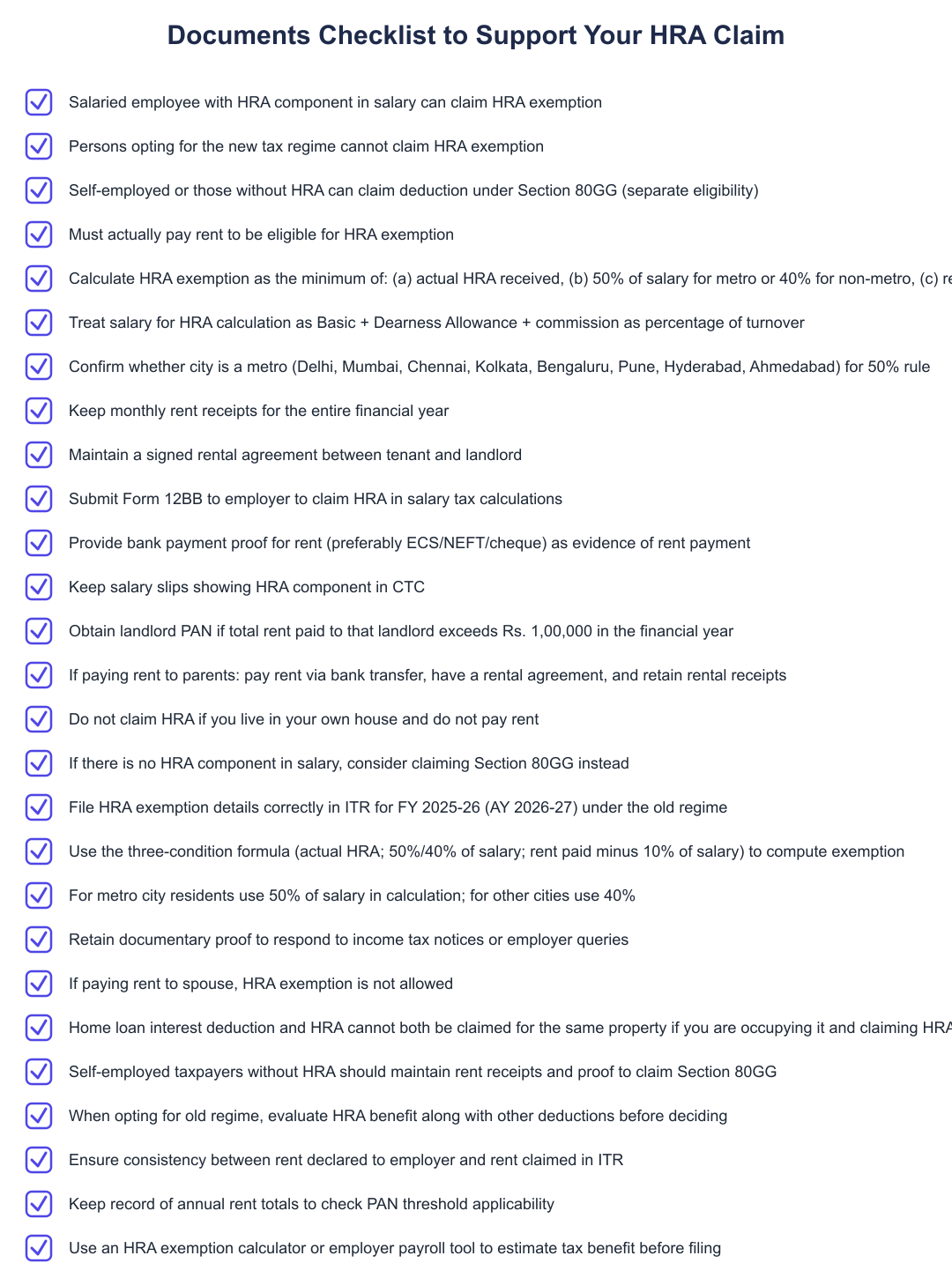
You do not need to submit all supporting documents with your income tax return, but you should provide proofs to your employer (so they can adjust TDS) and retain the documents to respond to any department queries. Typical proofs include rent receipts, the rental agreement, bank payment proofs for rent, and evidence showing HRA in the salary structure.
If rent is paid above specified monetary thresholds requiring landlord PAN in other contexts, you should keep that documentation too. Maintain these records for the relevant assessment year in case the tax department requests substantiation of the claimed exemption.
How to Claim HRA Exemption?
Provide rent receipts, rental agreement and other supporting documents to your employer so HRA exemption can be considered for TDS calculation during the year.
When filing your income tax return, compute the exempt portion of HRA and report it in the return; you must file your ITR within the specified due date to claim the exemption.
Keep all rent proofs and related documents to produce them if the tax department issues a notice seeking evidence for the claimed exemption.
Special Cases: Paying Rent to Family Members
Paying rent to parents can still allow you to claim HRA, but this is subject to conditions, the payment must be genuine and supported by adequate documentation so that the allowance qualifies for exemption. Evidence of rent paid and a valid rental arrangement will be important to substantiate the claim.
Conversely, payments to certain close relatives without a genuine rental arrangement may attract scrutiny and could be disallowed if the arrangement is not supported by documentation or appears contrived for tax benefit.
House Rent Deduction for Self-Employed Taxpayers: Section 80GG
Taxpayers who are self-employed or those who do not receive HRA as part of salary can seek a rent-related deduction under Section 80GG. This is a separate provision specifically for those without HRA in their pay structure.
The allowable deduction under Section 80GG is the least of three amounts: (a) Rs.5,000 per month (Rs.60,000 per year); (b) 25% of total income before allowing the deduction under this section; and (c) actual rent paid less 10% of total income before allowing the deduction. Claimants must also meet the other statutory conditions for Section 80GG to apply.
HRA can substantially reduce taxable salary for employees who rent accommodation, but the exemption is governed by precise statutory tests and is available only under the old tax regime. Compute the three statutory amounts carefully, submit and retain supporting documents, and if you don’t receive HRA consider Section 80GG. Always report the exempt amount correctly in your ITR filed within the due date so you can claim the benefit and be prepared to substantiate it if needed.
Frequently asked questions
What exactly is House Rent Allowance (HRA)?
House Rent Allowance (HRA) is a component of salary paid by an employer to help meet rental housing expenses and is eligible for partial tax exemption under Section 10(13A) in the old tax regime. It appears as a separate allowance in your salary structure and reduces taxable income only if you actually live in rented accommodation and receive HRA from your employer. HRA exemption is available only under the old tax regime, taxpayers who opt for the new regime cannot claim HRA. You can claim HRA along with a home loan interest deduction provided you satisfy specific conditions about actual rent and ownership occupancy.
Who is eligible to claim HRA exemption?
Salaried employees who receive an HRA component in their salary and live in rented accommodation are eligible to claim HRA exemption. Self-employed individuals or salaried taxpayers who do not have HRA in their CTC are not eligible under Section 10(13A) but may claim deduction under Section 80GG subject to separate conditions. Tenants paying rent to parents can claim HRA if rent is paid through bank and a rental agreement exists, while rent paid to spouse is not eligible. Taxpayers who choose the new tax regime cannot claim HRA exemption at all.
How do I calculate HRA exemption, what is the formula?
HRA exemption is the least of (a) actual HRA received, (b) 50% of salary (for specified metro cities) or 40% of salary (for other cities), and (c) rent paid minus 10% of salary. 'Salary' for this purpose means Basic + Dearness Allowance (DA) + commission (as percentage of turnover) where applicable. For example, if you receive Rs.1,62,000 HRA, pay annual rent of Rs.1,83,600 and your 50% salary limit is Rs.1,62,000, the exempt amount will be the lowest of these three figures. This calculation applies only under the old tax regime and not under the new tax regime.
Which cities qualify for the 50% (metro) rule for HRA in the new 2026 rules?
Under the clarified rule, eight cities qualify for the 50% of salary limit for HRA: Delhi, Mumbai, Chennai, Kolkata, Bengaluru, Pune, Hyderabad and Ahmedabad. Taxpayers residing in any of these eight metropolitan cities use 50% of Basic + DA as the second limb in the HRA exemption computation; all other cities use 40%. This ‘8-city 50% rule’ replaces broader definitions and is specifically applicable for FY 2025-26 (AY 2026-27) computations. Remember this only affects the limit; the other two limbs (actual HRA received and rent paid minus 10% of salary) still apply.
Can I claim HRA if I opted for the new tax regime?
No, you cannot claim HRA exemption if you opt for the new tax regime because HRA exemption under Section 10(13A) is available only under the old tax regime. The new regime offers lower slab rates but disallows most exemptions and deductions, including HRA. If you have significant rent outflow and HRA in your salary, the old regime may be more beneficial; conversely, if you have little HRA and few deductions, the new regime can be better. Always compare tax under both regimes before finalizing for the year.
What documents do I need to submit to claim HRA from my employer and in ITR?
To claim HRA you should maintain rent receipts, the rental agreement, Form 12BB (for employer proofs), bank payment proofs for rent, salary slips showing HRA and the landlord's PAN if rent paid exceeds Rs.1 lakh per year. Employers typically require proofs during the year to compute TDS correctly, while you do not have to attach all proofs with the ITR but must retain them to respond to any queries from the tax department. For rent paid to parents, ensure the rent is paid by bank transfer, a rental agreement exists and receipts are preserved to substantiate the claim. If landlord PAN is not provided when rent exceeds Rs.1 lakh, you may lose the exemption on that portion.
Can I claim HRA if I pay rent to my parents?
Yes, you can claim HRA if you pay rent to your parents provided the transaction is genuine, rent must be paid through bank transfers, a rental agreement should be in place and you should have rental receipts for the year. The employer or tax department may scrutinize such arrangements, so documentary evidence (bank statement showing rent outflow, receipts and agreement) is essential to substantiate the claim. If the arrangement is deemed not genuine (no payment trail or no agreement), the exemption can be disallowed. Also ensure the landlord (your parents) report this rent income in their tax return if applicable.
What if I don’t receive HRA, can self-employed people claim any rent deduction?
If you do not receive HRA (for example, you are self-employed or your salary has no HRA component) you cannot claim HRA under Section 10(13A), but you may claim deduction under Section 80GG subject to conditions and limits. Section 80GG allows the least of (a) Rs.5,000 per month, (b) 25% of total income before this deduction, and (c) actual rent paid minus 10% of total income before this deduction. To claim 80GG you must file Form 10BA and certify that you or your spouse or minor child do not own residential accommodation at the place of employment, among other conditions. Section 80GG rules differ from HRA rules and apply to those without an employer-provided HRA.
How do I show HRA in my ITR and what about TDS on salary?
You should report HRA exemption amount in the ITR under the exempt income section and ensure your salary details reflect actual HRA received and the exempt portion so taxable salary is correct. To reduce monthly TDS, submit rent proofs and Form 12BB to your employer during the year so they can compute lower TDS based on claimed exemption; keep originals and bank proofs for future verification. Even though you need not attach rent proofs with the ITR, retain them because the tax department may ask for evidence during assessment or scrutiny. File your ITR within the due date to claim HRA, late filing can complicate claims and refunds.
Need help staying Calculators compliant?
MoneyGence's AI Finance OS tracks your compliance, wallet share, and finances in one place, built for agencies and growing businesses.
Get started with MoneyGence