How to Calculate Days Sales Outstanding (DSO): Formula, Examples and Excel Method
DSO shows how many days it takes to collect after you invoice. Here is the formula, a worked example, an Excel method, and how to read the number against your payment terms.
Your books say you billed well last quarter. Your bank balance says otherwise. The usual reason is simple: customers are taking longer to pay than they used to, and nothing in a profit and loss statement shows that clearly.
Days Sales Outstanding, or DSO, is the number that does. It takes about two minutes to work out, and it is one of the few finance metrics a small agency or consultancy can calculate without any special tool.
What DSO tells you
DSO is the average number of days it takes you to collect money after you make a sale on credit. A DSO of 36 means that, on average, an invoice sits unpaid for about 36 days.
It is not a score with a "good" or "bad" label. It only means something when you compare it with your own payment terms. If you give clients 30 days and your DSO is 36, clients are paying about a week late on average. If your terms are 60 days, the same 36 is excellent.
The DSO formula
- Receivables: the total unpaid invoices at the end of the period.
- Credit sales: everything you invoiced in the period. Leave out cash or advance payments received at the time of sale.
- Number of days: 30 for a month, 90 for a quarter, 365 for a year.
A worked example
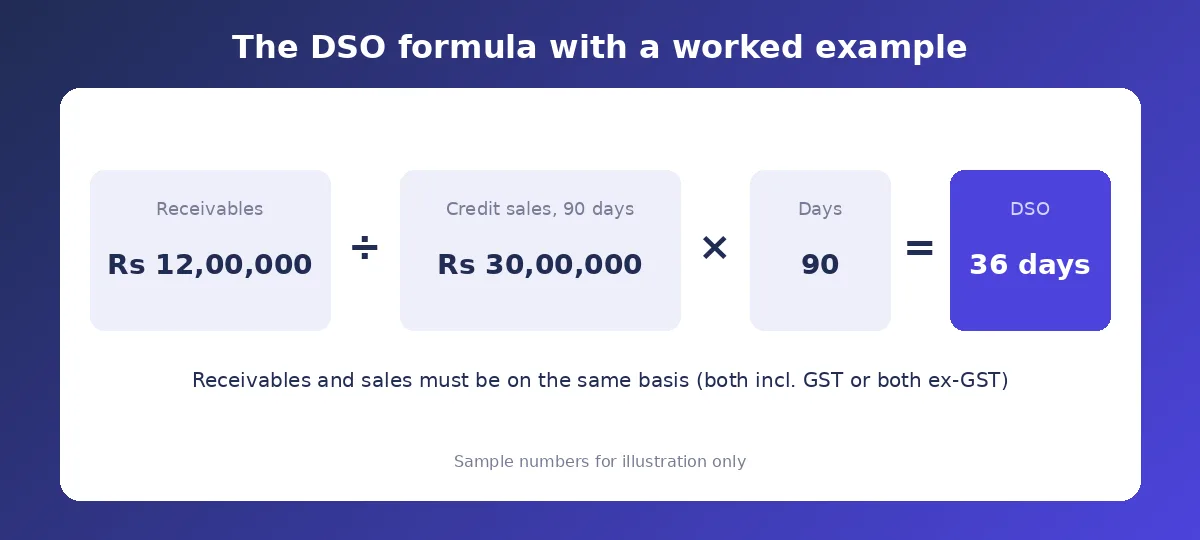
Say an agency has Rs 12,00,000 unpaid at the end of a quarter, and it invoiced Rs 30,00,000 during those 90 days.
- Divide receivables by credit sales: 12,00,000 / 30,00,000 = 0.4
- Multiply by the number of days: 0.4 x 90 = 36
The DSO is 36 days. If the agency's standard terms are 30 days, it is collecting about six days slower than it should.
Calculating it in Excel
Put receivables in cell B2, credit sales for the period in B3, and the number of days in B4. Then in B5:
=B2/B3*B4
That is the whole calculation. If you keep an invoice list, the receivables figure is simply the sum of the outstanding column, and the sales figure is the sum of invoice values for the period.
Keep GST on the same basis
This is where most Indian businesses get a wrong number. Invoice totals include GST, but many revenue reports show sales ex-GST. If receivables include GST and sales do not, DSO comes out too high by roughly the GST rate.
Work it out per client, not just overall
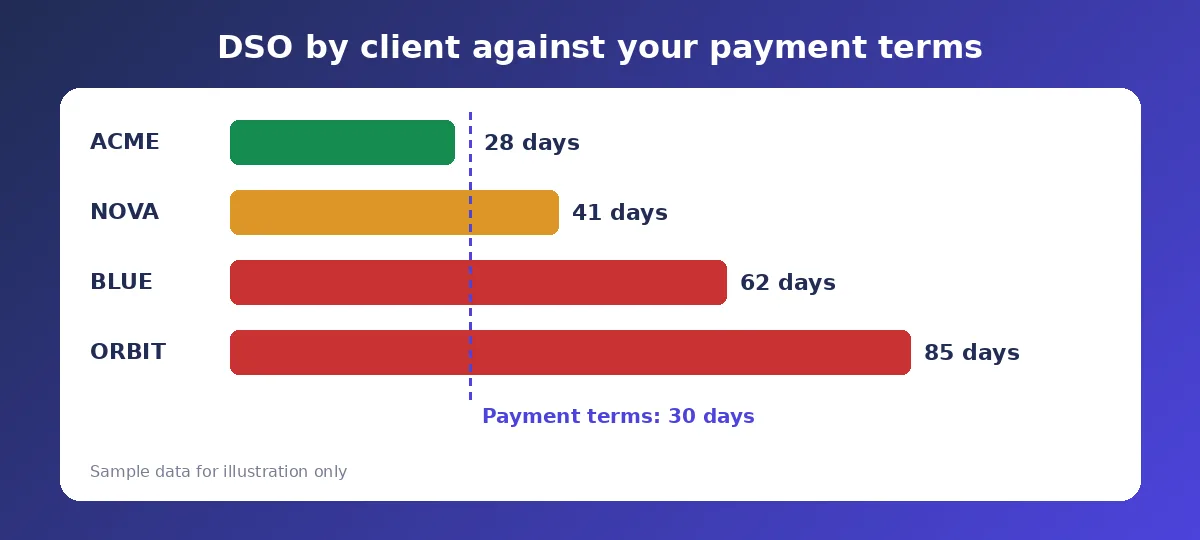
One overall DSO hides a lot. A company can show a comfortable 38 days because two good clients pay in 20, while one large client sits at 85 and quietly holds up your cash.
Run the same formula for each client, using only that client's receivables and that client's sales. The client-wise numbers are the ones you can actually act on: who to call, who to stop giving fresh credit to, whose terms need to be rewritten.
What counts as a good DSO
There is no single right answer, and generic industry benchmarks are not much use for a small service business. A rough rule of thumb is that a DSO within about 10 to 15 days of your payment terms is healthy, and a DSO that keeps rising month after month is a warning sign even if the level still looks fine.
Where DSO misleads you
- Lumpy billing. One very large invoice raised near period-end can push DSO up or down on its own.
- Seasonality. A quiet quarter followed by a busy one distorts the average.
- Advance and milestone billing. If a lot of your income arrives before work is done, it is not credit sales and can make DSO look better than reality.
- It is an average. It will not tell you that one invoice is 120 days old. Use an ageing view alongside it.
How to bring DSO down
- Invoice on the day work is accepted, not at month-end.
- Write payment terms on every invoice and quote.
- Follow up a few days before the due date, not after it.
- Ask for an advance or milestone payments on bigger projects.
- Review DSO monthly so a rise is caught early.
Tools that show client-wise receivables make the inputs quicker to pull. MoneyGence shows revenue and receivables per client on top of Tally or Zoho. The DSO calculation itself is simple enough to do yourself once you have those two figures.
Common Mistakes
- Mixing incl-GST receivables with ex-GST sales.
- Including cash sales in the sales figure.
- Using annual sales with a quarter's receivables, or the other way round.
- Judging the number against a generic benchmark instead of your own terms.
- Looking only at the overall DSO and never at individual clients.
- Calculating it once a year.
Frequently Asked Questions
[Normal -> Heading 3]
What is a good DSO for a service business?
One that sits close to your payment terms and is not climbing. If your terms are 30 days, a DSO in the mid-30s to low 40s is reasonable, and anything far above that deserves a closer look.
Should I include GST in the DSO calculation?
Either way works, as long as receivables and sales are both on the same basis.
How often should I calculate DSO?
Monthly is a good habit. Quarterly is the minimum if you want to catch trends in time.
Is DSO the same as the collection period?
Close enough for most purposes. Both describe how many days it takes to turn credit sales into cash.
Can DSO be too low?
Yes. A very low DSO can mean you are asking for too much upfront, or that most of your sales are cash or advance, which makes the metric less meaningful.
Official references
Need help staying Calculators compliant?
MoneyGence's AI Finance OS tracks your compliance, wallet share, and finances in one place, built for agencies and growing businesses.
Get started with MoneyGence