How to Do Bookkeeping: Step-by-Step Guide for Businesses
This guide explains how to do bookkeeping in a practical, step-by-step way for small businesses, freelancers and startups. You will learn what bookkeeping is, how it differs from accounting, and the main tasks that make up the bookkeeping process. The guide also covers common methods, from traditional physical journals to spreadsheets and dedicated bookkeeping software, so you can choose an approach that fits your business size, transaction volume and comfort with technology. Practical bookkeeping is the foundation for accurate financial reporting, tax compliance and better business decisions. Good bookkeeping means consistently recording transactions, organising documents, reconciling records and preparing basic financial summaries. By the end of this article you should understand the routine tasks a bookkeeper performs, how those tasks link to broader accounting and reporting, and the pros and cons of each bookkeeping method. Whether you plan to keep books yourself or work with a professional, the concepts here will help you set up a maintainable process, avoid common errors and ensure your records are useful month to month. This guide focuses on clear procedures and practical tips rather than software recommendations, so you can apply the principles regardless of the tools you choose.
Bookkeeping Versus Accounting
Bookkeeping and accounting are related but distinct activities. Bookkeeping is primarily concerned with the systematic recording and organisation of a business’s financial transactions. It creates the raw data that accounting uses; without accurate bookkeeping, accounting work such as analysis, reporting and strategic advice is compromised.
Accounting builds on bookkeeping by interpreting the recorded data to produce financial statements, perform analysis, and support decision-making. Accountants typically take the ledgers and journals maintained by bookkeepers and apply principles to prepare summaries, assess profitability and advise on tax and compliance implications.
For small businesses, the division of tasks varies: in some cases the owner or a bookkeeper manages day-to-day recording while an accountant reviews records and prepares periodic statements. Understanding the boundary helps ensure responsibility for routine tasks and for higher-level financial review are clearly assigned.
Bookkeeping Process
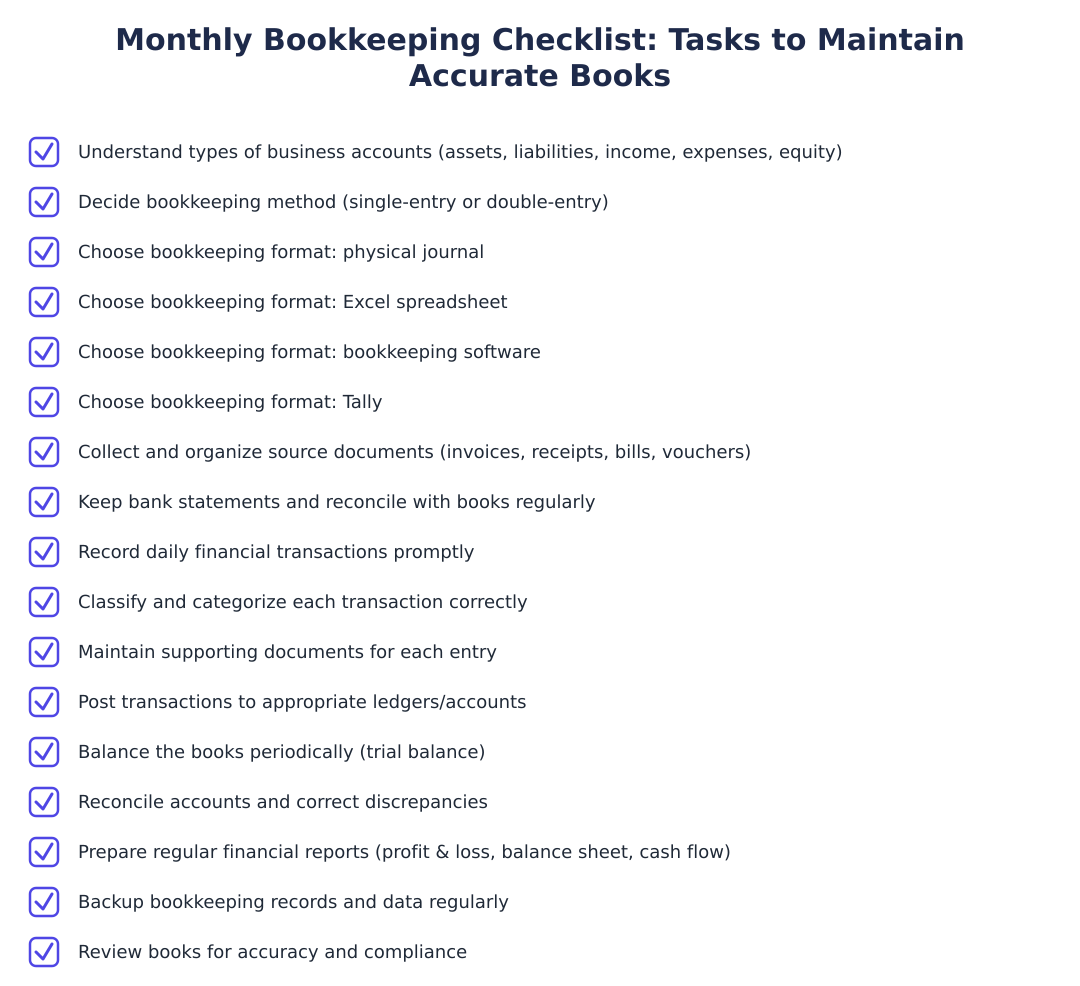
The bookkeeping process is a recurring cycle of activities that keeps financial records current and reliable. It begins with gathering source documents, invoices, receipts, bank statements and vouchers, and organising them so every transaction can be traced to supporting evidence.
Next is recording transactions in a consistent structure, using accounts or categories that reflect how money flows through the business. Consistency in naming and classification makes later aggregation and analysis much easier. Regular reconciliation, comparing recorded transactions with bank statements and other external records, helps catch errors and omissions early.
Finally, periodic closing tasks such as summarising accounts, checking balances and preparing simple reports complete the cycle. These routine activities, done reliably at set intervals, prevent backlog, reduce stress during tax time and provide timely information for management decisions.
Methods of Bookkeeping
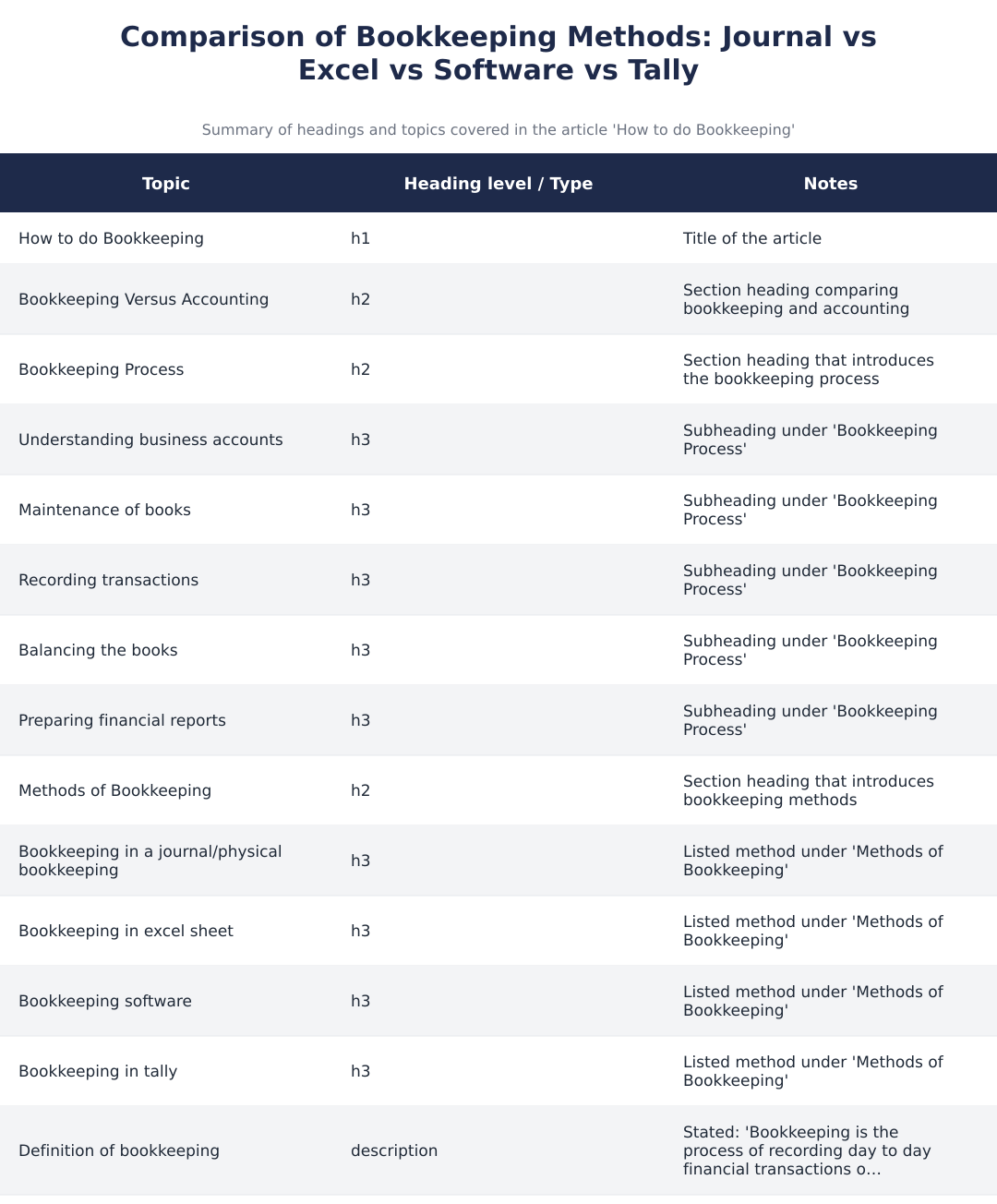
There are three common approaches to maintaining books: manual journals, spreadsheets and specialised bookkeeping software. Each has advantages and trade-offs in terms of cost, scalability, control and ease of use. Choosing a method depends on transaction volume, complexity of operations, staff skills and the need for collaboration or audit trails.
Manual methods can be suitable for very small or simple businesses that have few transactions and prefer physical records. Spreadsheets offer flexibility and are a low-cost way to structure ledgers and generate basic summaries, but they require discipline to maintain and protect against accidental changes. Software automates many routine tasks, reduces duplication, and often provides built-in reports, but it requires initial setup and ongoing maintenance.
Bookkeeping in a journal/physical bookkeeping
Physical bookkeeping uses written journals and ledgers to record transactions in chronological order. Each entry should reference a supporting document and be dated and classified to an account. A simple system typically includes a cash book for payments and receipts and a purchase and sales book to track trade-related activity.
The strengths of a physical system are transparency and low reliance on technology; it can also serve as a legal record when properly maintained. The drawbacks are that it is time-consuming, prone to human error, harder to back up, and less convenient for creating summaries or sharing records with advisers.
Bookkeeping in Excel sheet
Spreadsheets are a common digital step up from manual books. They let you design ledgers, apply simple formulas, and produce running totals or pivot summaries. With careful layout and protected cells, spreadsheets can handle regular bookkeeping tasks such as tracking sales, purchases, bank transactions and petty cash.
To use spreadsheets effectively, adopt consistent templates, date formats and account names. Implement a clear folder structure for source documents and keep versioned backups. While spreadsheets are flexible and accessible, they require internal controls to avoid accidental edits and may not scale well as transaction volume grows.
Bookkeeping software (including Tally and other packages)
Bookkeeping software automates data entry, reconciliations and report generation. Many packages offer features such as chart of accounts templates, invoicing, bank feed integration and audit logs. Using software reduces repetitive work, enforces consistent classification and makes it easier to produce financial statements on demand.
When selecting software consider ease of use, ability to export data, backup options and whether the system supports the reports you need. Software setup involves defining the chart of accounts, opening balances and user permissions. Regular maintenance, such as reconciling bank accounts and reviewing unmapped transactions, keeps the system accurate and useful for decision-making.
Consistent bookkeeping is the backbone of sound financial management. Choose a method that matches your business needs, set up simple routines for recording and reconciling transactions, and review records regularly. Whether you keep physical books, use spreadsheets or adopt software, discipline and consistency will make your financial information reliable and actionable.
Frequently asked questions
What is bookkeeping and how is it different from accounting?
Bookkeeping is the process of recording day-to-day financial transactions of a business, while accounting interprets, analyses and reports on that recorded information. Bookkeeping focuses on accurately maintaining journals, ledgers and trial balances by recording sales, purchases, receipts and payments; accounting uses those records to prepare financial statements, tax returns and perform financial analysis. Bookkeepers ensure the books are balanced and transactions classified correctly; accountants provide insights, adjust entries, apply accounting standards and advise on financial decisions. In small businesses the same person may perform both roles, but they are distinct functions with bookkeeping being the foundational recording step.
What are the main steps in the bookkeeping process?
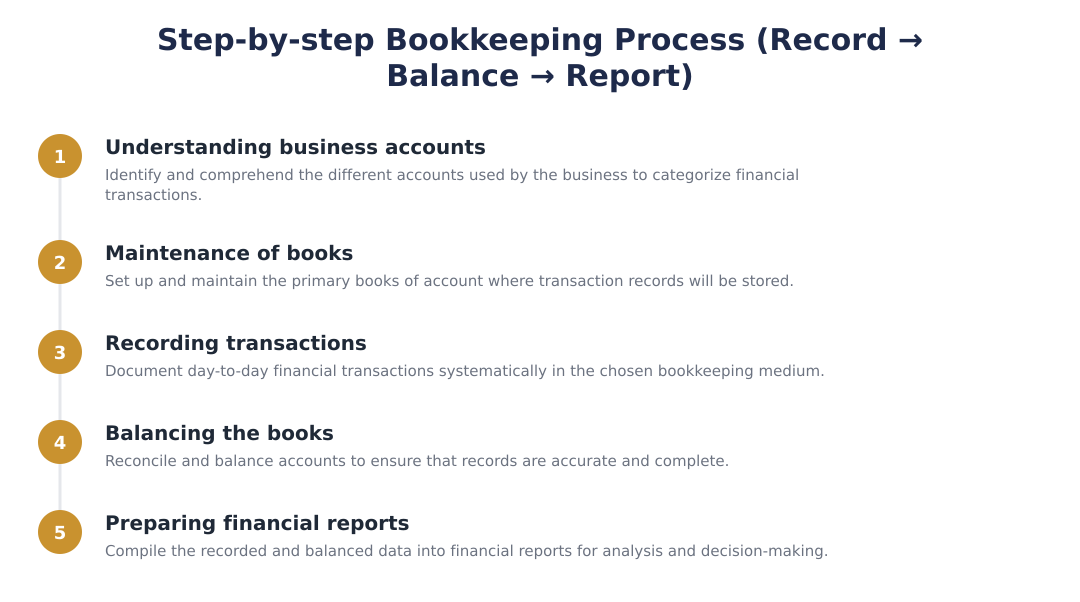
The main steps in bookkeeping are understanding business accounts, maintaining books, recording transactions, balancing the books and preparing financial reports. First, set up account categories (assets, liabilities, equity, income, expenses); then maintain journals and ledgers where each transaction is recorded chronologically and posted to the appropriate account. Regularly reconcile bank and cash balances and prepare trial balances to ensure debits equal credits, and finally compile financial reports like profit & loss and balance sheet from the posted and balanced data. Performing these steps consistently (daily/weekly/monthly as appropriate) keeps records accurate and ready for accounting and taxation.
What types of business accounts do I need to understand when bookkeeping?
You need to understand five basic account types: assets, liabilities, equity, income (revenue) and expenses. Assets are resources the business owns (cash, inventory, receivables), liabilities are obligations (loans, payables), equity is the owner’s residual interest, income records sales and other revenue, and expenses are costs incurred to earn income. Correctly classifying transactions into these categories ensures accurate financial statements, tax reporting and performance analysis; for example, a customer payment reduces receivables (asset) and increases cash (asset) without affecting income.
How should I maintain bookkeeping records and what books do I need?
Maintain bookkeeping records by keeping a chronological journal, posting to ledgers, reconciling accounts and preserving source documents (invoices, receipts, bank statements). Basic books include the journal (daybook), ledgers for each account, a cash book for receipts/payments and records for purchases and sales; digital or physical copies of source documents must be retained for verification. Organise records by date and account and establish a retention and backup process, physical files in a secure location and electronic backups for digital ledgers, to ensure compliance and ease of retrieval during audits or tax filing.
How do I record transactions correctly in bookkeeping?
Record transactions by entering them first in a journal with date, description, debit and credit entries, then post those entries to the corresponding ledger accounts. Each transaction must follow double-entry bookkeeping where total debits equal total credits; include a clear narration and reference to source documents (invoice number, receipt). For routine items use subsidiary books (sales book, purchase book, cash book) to streamline recording, and regularly verify entries against bank statements and supplier/customer statements to catch errors or omissions.
How do I balance the books and what is a trial balance?
Balancing the books means ensuring total debits equal total credits by preparing a trial balance, which lists all ledger balances to check arithmetic accuracy. A trial balance is compiled periodically (monthly or quarterly) to detect posting errors, and if totals don’t match you investigate missing or incorrectly posted entries, transposition errors, or omitted postings. After balancing, you make necessary adjusting entries (accruals, depreciation, prepayments) before finalising financial reports so the statements reflect the correct financial position.
What financial reports should I prepare from bookkeeping records?
From bookkeeping records you should prepare at least a profit & loss statement (income statement) and a balance sheet, along with cash flow summaries and trial balances. The profit & loss statement summarises revenues and expenses to show net profit or loss for a period, while the balance sheet shows assets, liabilities and equity at a point in time; cash flow summaries highlight cash movements and liquidity. Generating these reports monthly or quarterly helps monitor business performance, make tax provisions, and provide accountants with the data needed for statutory filings and audits.
What are the common methods of bookkeeping I can use for my business?
Common methods of bookkeeping include manual journal/physical bookkeeping, using Excel spreadsheets, and specialised bookkeeping software (including Tally). Manual bookkeeping involves recording transactions in physical journals and ledgers and is suitable for very small operations; Excel offers templates and automation for small-to-medium businesses; dedicated software automates entries, reconciliations and report generation and scales better with business growth. Choose based on volume of transactions, need for automation, and compliance requirements, software reduces human error and saves time but may have cost and learning considerations.
How does bookkeeping in Tally differ from Excel or manual bookkeeping?
Bookkeeping in Tally uses purpose-built accounting software that automates journal posting, ledgers, stock management and report generation, while Excel and manual methods require more manual posting and reconciliation. Tally provides features like voucher entry, automatic ledger posting, GST compliance tools and standard financial reports, making it efficient for businesses with frequent transactions and inventory; Excel can be customised but needs manual formulas and reconciliation, and manual books are the most labour-intensive. While Tally has a learning curve and licensing cost, it improves accuracy, audit trail and regulatory compliance compared with spreadsheets or physical ledgers.
Need help staying Accounting compliant?
MoneyGence's AI Finance OS tracks your compliance, wallet share, and finances in one place, built for agencies and growing businesses.
Get started with MoneyGence