How to furnish LUT in RFD-11 on GST Portal, Step-by-Step Guide
This guide explains how exporters furnish a Letter of Undertaking (LUT) on the GST portal using Form GST RFD-11, and why it matters for businesses that supply goods or services outside India or to Special Economic Zones (SEZs). You will learn what LUT is, who needs to file it, the legal context under the GST framework, and the core actions a taxpayer must take to ensure compliance. Furnishing an LUT lets eligible exporters carry out exports without payment of IGST by filing the required undertaking online before shipment, a practical relief that affects cash flow and working capital for export-oriented businesses. The guide focuses on the essential facts and practical implications exporters should know so they can plan their compliance calendar and avoid last-minute operational disruptions. Whether you are a new exporter registering for GST or an established business planning exports for the upcoming financial year, this article clarifies the scope and timing of LUT filing under the GST system and highlights the annual nature of the undertaking so you can incorporate it into year-end compliance.
What is LUT and why is it used?
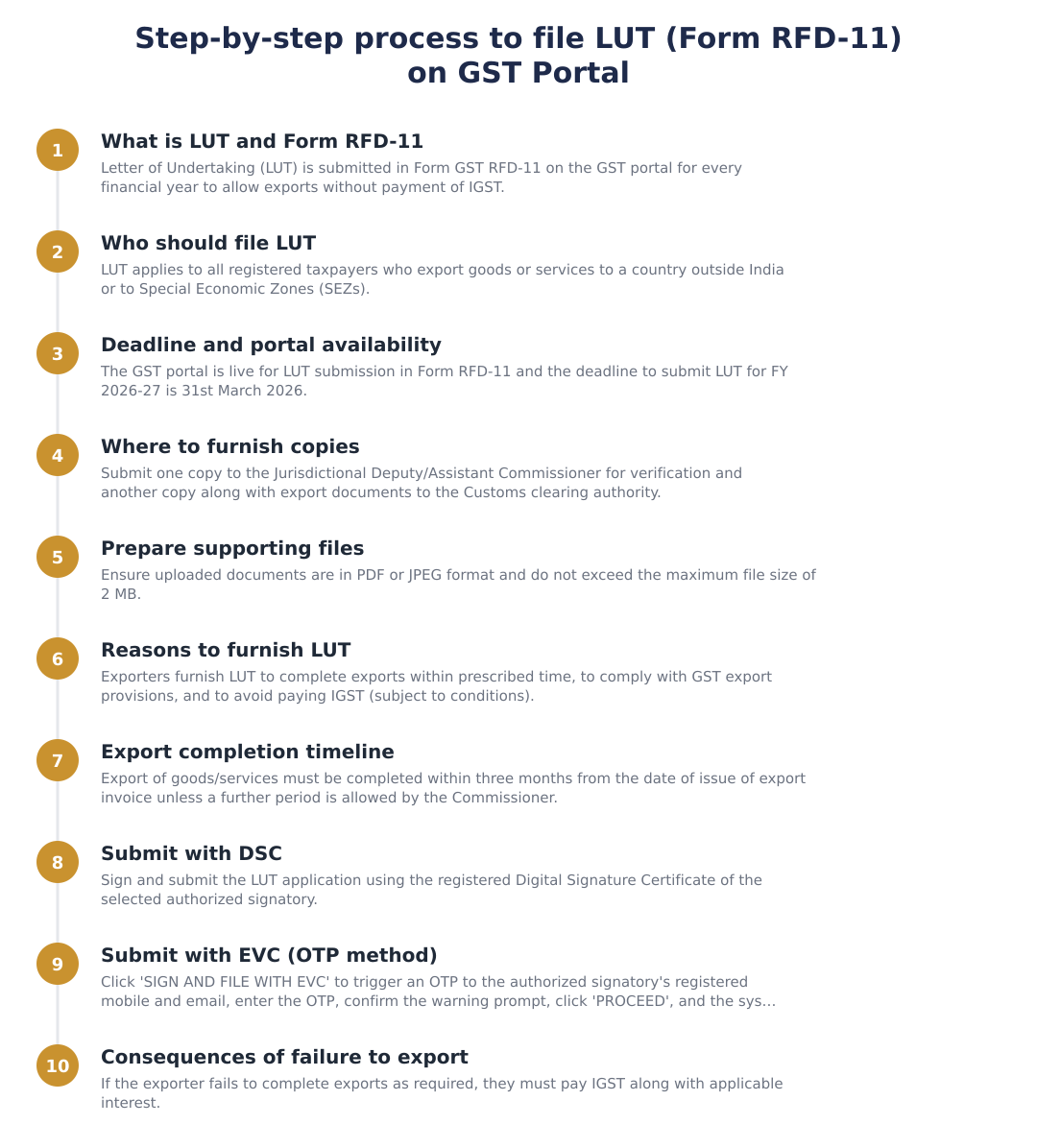
A Letter of Undertaking (LUT) is the formal undertaking that exporters submit in Form GST RFD-11 on the GST portal for every financial year. It is the prescribed instrument under the GST framework for exporters who intend to carry out exports without paying integrated goods and services tax (IGST) at the time of export.
The practical purpose of filing an LUT is to enable eligible taxpayers to export goods or services without upfront payment of IGST. For exporters, this can reduce immediate cash outflow associated with tax payment and refund procedures, thereby improving working capital management around export transactions.
Who must file LUT
LUT applies to all registered taxpayers who export goods or services to a country outside India or to Special Economic Zones (SEZs). This means any GST-registered person engaged in export supplies falls within its scope and should assess whether they need to furnish an undertaking for the financial year.
Because LUT is an annual requirement submitted in Form GST RFD-11, exporters should evaluate their export plans for the year and ensure the LUT is in place before commencing exports that they intend to do without payment of IGST.
When to file an LUT
Under the GST framework, exporters can file the Letter of Undertaking online on the GST portal before exporting goods or services without payment of IGST. Filing prior to export is essential when the exporter wishes to avoid paying IGST on outward supplies that qualify as export of goods or services.
Because LUT is submitted for every financial year, exporters need to ensure the undertaking for the relevant year is filed in advance of the export transactions intended to be covered by that LUT.
Core actions to furnish LUT on the GST portal
Submit the Letter of Undertaking in the prescribed Form GST RFD-11 on the GST portal, as this is the statutory format for LUT filing each financial year.
Ensure the LUT is filed on the GST portal before exporting goods or services when you intend to export without payment of IGST.
Remember that LUT is furnished for every financial year, so repeat the filing for each subsequent financial year in which you expect to export without paying IGST.
Practical implications for exporters
Filing an LUT removes the immediate need to pay IGST at the time of export, which can streamline export operations and reduce the administrative burden associated with claiming refunds. Exporters should plan filing timelines so that LUT is effective before shipments begin.
Since LUT is an annual compliance requirement submitted in Form GST RFD-11 on the GST portal, exporters should incorporate its renewal into their year-end compliance checklist to avoid any disruption to export transactions planned for the new financial year.
Furnishing a Letter of Undertaking in Form GST RFD-11 on the GST portal is a straightforward but essential annual step for exporters who wish to carry out exports without payment of IGST. Ensure you file the LUT before the export transactions it should cover and remember to submit a fresh undertaking each financial year to maintain uninterrupted export operations.
Frequently asked questions
Who must file LUT (Form RFD-11) on the GST portal to export without paying IGST?
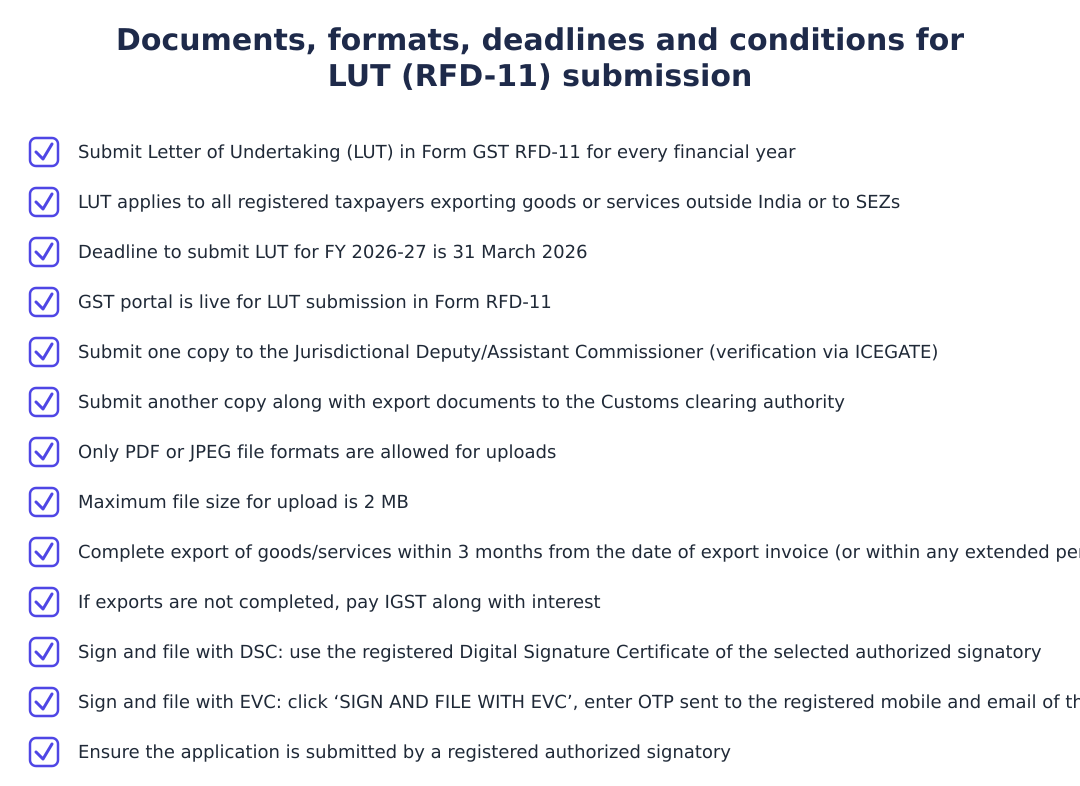
All registered taxpayers who export goods or services to a country outside India or to Special Economic Zones (SEZs) must furnish a Letter of Undertaking (LUT) in Form GST RFD-11 on the GST portal to export without payment of IGST. This requirement applies to every financial year and is mandatory before making zero-rated supplies without IGST. Exporters who prefer to furnish a bond instead of LUT must submit a physical bond on non-judicial stamp paper. Failure to furnish LUT or bond will require payment of IGST (with interest) and subsequent refund procedures may be needed.
When must I apply for LUT for a financial year and what is the deadline?
You must apply for LUT (Form RFD-11) for each financial year and the deadline to submit LUT for FY 2026-27 is 31st March 2026. The GST portal is live for online LUT submission, and LUT should ideally be filed before making the first export for that financial year to avoid paying IGST. If you miss furnishing LUT, you can still export by paying IGST and later claim a refund subject to conditions and timelines. Note that exporters who expect to use a bond instead should complete manual procedures separately on stamp paper before export.
How do I submit RFD-11 (LUT) on the GST portal, what are the key steps?
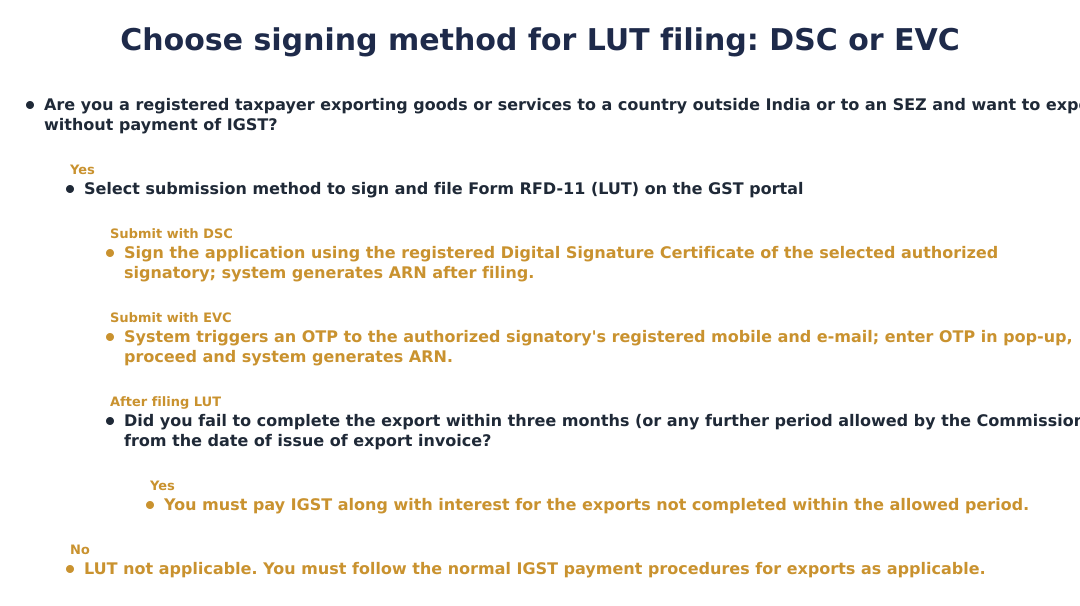
To submit RFD-11 (LUT) on the GST portal you must log in, navigate to Services > Refunds > Furnish LUT, fill the form and sign it using either the registered DSC or EVC to file it electronically. If using DSC, select the authorized signatory and sign with their registered Digital Signature Certificate; if using EVC, click 'SIGN AND FILE WITH EVC' and enter the OTP sent to the signatory's registered mobile and email, then proceed to receive an ARN. After successful submission the system generates a unique Application Reference Number (ARN) which serves as proof of filing. Keep supporting documents ready in allowed formats (PDF/JPEG, max 2 MB) in case any verification is required.
What file formats and size limits apply when uploading documents for LUT in RFD-11?
Only PDF or JPEG file formats are allowed for uploads while furnishing LUT in Form RFD-11 on the GST portal, and each file must not exceed 2 MB in size. Ensure scanned supporting documents meet legibility and size requirements to avoid upload errors or rejection. If a document exceeds 2 MB, reduce resolution or split into permitted attachments as per portal options. Keep the registered authorized signatory details handy since attachments and signatures are tied to that user.
Can I sign and file LUT using EVC instead of DSC, and how does that process work?
Yes, you can sign and file LUT using EVC instead of DSC by clicking 'SIGN AND FILE WITH EVC' and entering the OTP sent to the authorized signatory's registered mobile number and email address. After entering the OTP you will see a warning message; click 'PROCEED' to complete filing and the system will generate a unique ARN as confirmation. EVC is suitable for exporters who do not have a registered DSC; however, the OTP will be sent only to the signatory whose details are registered on the GST portal. Keep in mind some jurisdictions or specific users may still prefer DSC for additional legal security or internal compliance.
Do I need to submit LUT with the customs authority as well, and if so how?
Yes, exporters previously submitted a copy of the LUT (RFD-11) along with export documents to the customs clearing authority, but with online LUT filing the process is simplified and ICEGATE verification can be used for cross-checks. One copy used to go to the Jurisdictional Deputy/Assistant Commissioner for verification and another with the export documents to customs; now the GST portal's ARN and ICEGATE integration help customs verify LUT filing electronically. Despite online submission, keep a physical or printed copy of the ARN and filed LUT for presentation if customs or local authorities request it. If you furnished a bond manually on stamp paper, the customs authority may still require the physical bond copy during clearance.
What happens if I do not complete the export within the allowed time after issuing the export invoice?
If you fail to complete the export within the allowed period, normally within three months from the date of issue of the export invoice or any extended period allowed by the Commissioner, you may be required to pay IGST along with applicable interest. LUT is intended for genuine exports completed within the stipulated timeframe, and non-compliance can lead to tax liability and potential penalties. If export is delayed and you have to pay IGST, you can later apply for refund subject to normal refund rules and documentary proof of export. Always monitor shipment and export documentation to ensure compliance with the three-month timeline or obtain prior approval for extension from the Commissioner where permissible.
Do I need to file LUT every financial year or is one LUT valid until revoked?
You need to furnish a fresh LUT each financial year; a Letter of Undertaking in Form RFD-11 is filed for every financial year and is not automatically carried forward. The LUT must be submitted before exporting in that financial year to avail exports without payment of IGST; if not filed you must pay IGST and later claim refund subject to conditions. If circumstances change or the GST registration details/signatories change, file a new LUT reflecting the updated information. The GST portal will generate an ARN for each LUT filed, which should be retained as proof of filing for that financial year.
What should I do if the LUT filing on the GST portal fails or gets rejected?
If LUT filing on the GST portal fails or gets rejected, first check the error message and rectify issues such as incorrect signatory details, unsupported file format (only PDF/JPEG allowed) or file size exceeding 2 MB, then refile the corrected Form RFD-11. If DSC or EVC signing fails, confirm the authorized signatory's registration details and retry signing; for DSC issues ensure the certificate is valid and browser/middleware is correctly configured. If portal errors persist, contact the GST helpdesk or your jurisdictional GST officer and retain screenshots and error logs for support and follow-up. Once successfully filed the system will generate an ARN which confirms acceptance and can be used for ICEGATE/customs verification.
Need help staying GST compliant?
MoneyGence's AI Finance OS tracks your compliance, wallet share, and finances in one place, built for agencies and growing businesses.
Get started with MoneyGence