How to Prepare Cash Flow Statement - Indirect & Direct Methods
This guide explains how to prepare a cash flow statement and why getting it right matters for any business. You will learn the two accepted approaches to preparing the statement, the indirect and the direct method, and how each class of cash flow (operating, investing and financing) is identified and presented. A well-prepared cash flow statement reconciles profit with actual cash movements, highlights liquidity trends, and helps owners, managers and lenders understand whether the business generates enough cash to run operations, reinvest and meet financing obligations. This article breaks the process down step by step, clarifies common adjustments you must make when moving from accounting profit to cash flow, and shows how working capital changes affect operating cash. Whether you prepare the statement for internal management reporting or to accompany financial statements for external users, the guidance here will help you create a clear, reliable cash flow statement that supports better decision-making.
Preparation under Indirect method
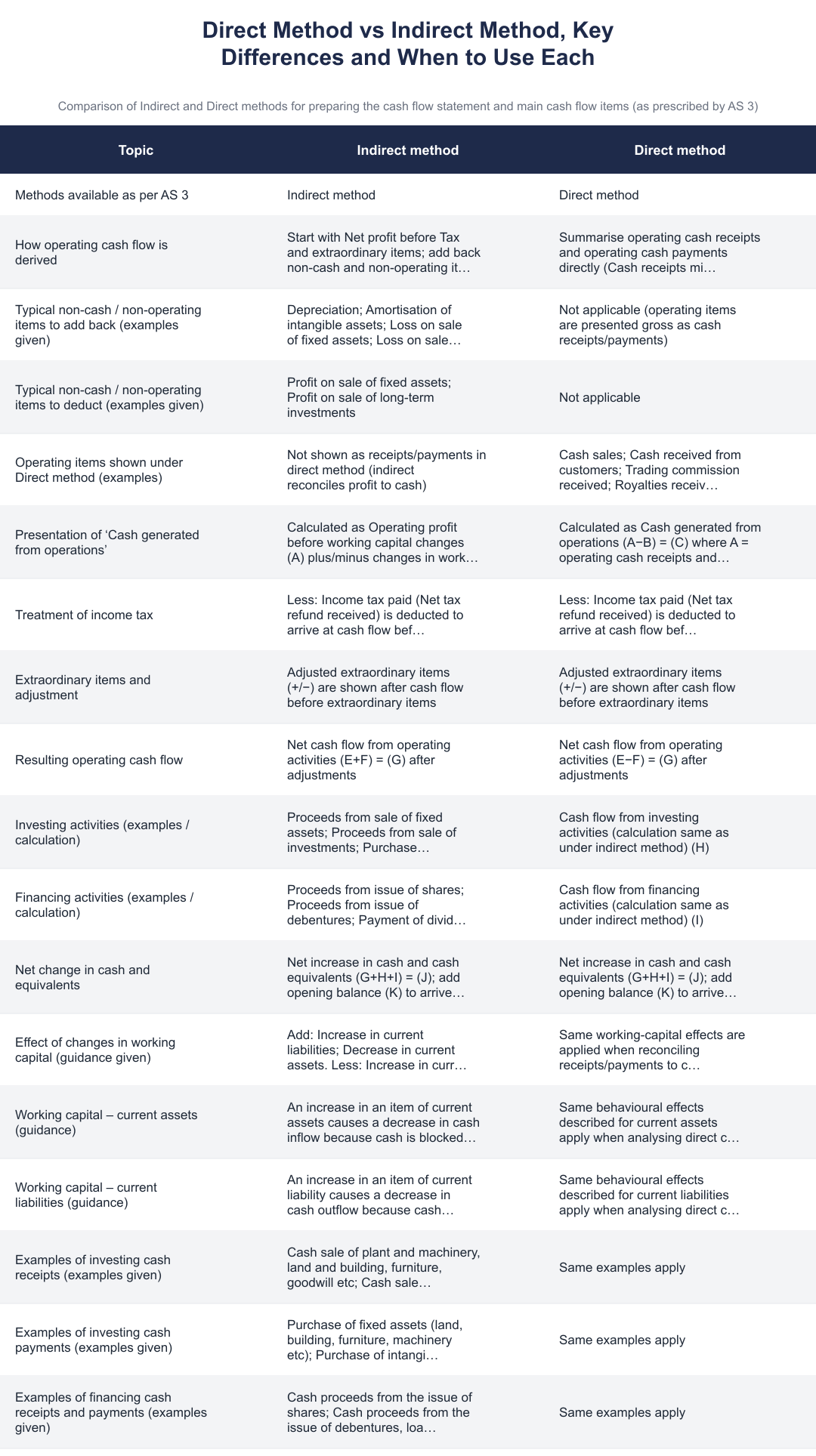
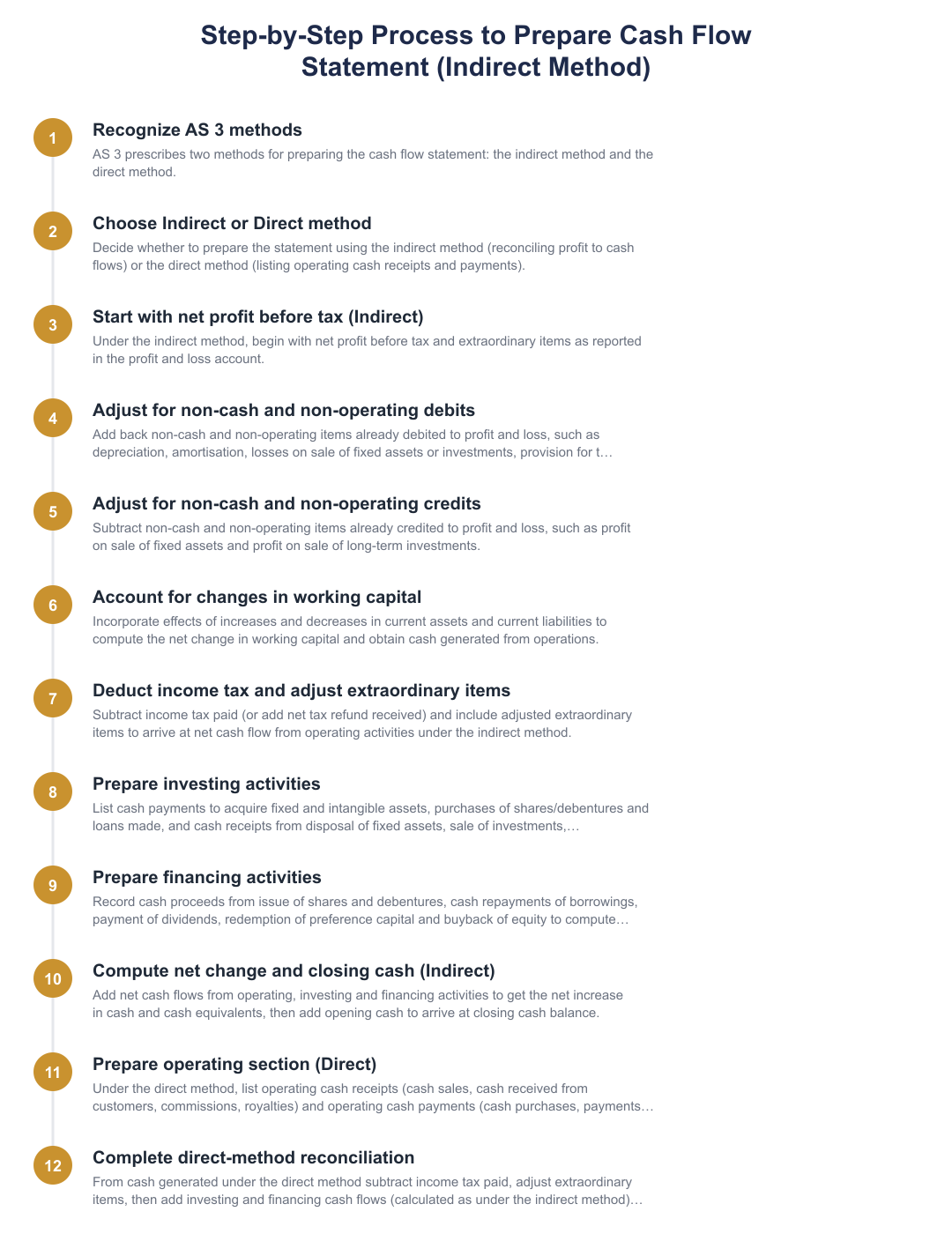
The indirect method starts with profit or loss for the period and reconciles that figure to net cash flow from operating activities. Instead of listing cash receipts and payments, you adjust accounting profit for non‑cash items and for items that are investing or financing in nature. The goal is to convert accrual‑based profit into the actual cash generated or consumed by operating activities.
Begin by taking the net profit or loss as per the profit and loss account. Then add back expenses that reduced profit but did not involve actual cash outflow (for example, depreciation and amortisation) and subtract incomes credited to profit that did not generate cash (such as unrealised gains). Next, remove items shown in profit that relate to investing or financing activities, for example, gains or losses on disposal of fixed assets, because their cash effects are reported under investing or financing sections.
After adjusting for these items, incorporate changes in working capital: movements in trade receivables, inventories, trade payables and other current assets and liabilities. These adjustments reflect the cash effects of operating cycle transactions that the profit and loss account recognises on an accrual basis. The resulting figure is cash generated from operations, which then is adjusted for items such as income taxes paid and extraordinary cash flows to arrive at net cash from operating activities.
Operating Activities
Operating activities are the principal revenue-producing activities of the entity and other activities that are not investing or financing. When preparing the cash flow statement, classify cash flows that arise from the core business here, collections from customers, cash paid to suppliers and employees, and other receipts and payments that arise from day‑to‑day trading.
Under the indirect method, operating activities are presented by starting with accounting profit and making the non‑cash and non‑operating adjustments described earlier, plus the working capital changes. Under the direct method, operating cash receipts and payments are shown explicitly (for example, cash receipts from customers and cash paid to suppliers), which gives a more intuitive view of actual cash movements during the period.
When analysing operating cash flows, pay attention to how changes in current assets and current liabilities affect cash. An increase in current assets typically ties up cash, while a decrease releases cash. Conversely, an increase in current liabilities typically preserves cash, while a decrease uses cash. Tracking these directions helps explain why the accounting profit differs from cash flows.
Investing Activities
Investing activities reflect cash flows from acquiring and disposing of long‑term assets and investments. Typical cash flows here include purchases of property, plant and equipment, purchases and sales of investments, and loans made to or recovered from third parties. The cash effect of disposals of fixed assets and sales of investments is shown as cash inflow in this section.
When preparing this section, exclude non‑cash transactions that affect the balance sheet but did not involve immediate cash movement; those are presented separately or in the notes. Present cash payments to acquire long‑term assets as outflows and receipts from the sale of such assets as inflows. The net of these inflows and outflows provides the net cash used in or provided by investing activities.
Investing cash flows are useful to readers because they reveal how much the business is reinvesting to sustain or grow operations and whether asset sales are being used to generate liquidity. Significant patterns, such as sustained capital expenditure, should be explained in accompanying notes or management commentary.
Financing activities
Financing activities show cash flows arising from changes in the size and composition of the equity and borrowings of the entity. Common items are proceeds from issuing shares or other capital instruments, proceeds from borrowings, repayments of borrowings, and payments of dividends. These flows indicate how the business funds its operations and growth, through internal generation, debt, or equity.
When compiling financing activities, present cash inflows such as proceeds from new borrowings or capital issues as positive items, and cash outflows like loan repayments, redemption of capital instruments or dividend payments as negative items. Non‑cash financing events, such as conversions of debt to equity, are disclosed elsewhere rather than in the cash flow amounts.
Analysing financing cash flows helps stakeholders assess financial strategy and solvency risk. For example, persistent reliance on borrowing to fund operating deficits or capital expenditure could signal liquidity vulnerability, while consistent positive financing inflows may reflect growth investments supported by external funding.
Preparation under the Direct method
The direct method presents major classes of gross cash receipts and payments. Instead of starting with profit, you list cash collections from customers and other operating receipts, and then list cash paid to suppliers, employees and for other operating expenses. The net of these gives cash generated from operating activities before tax and extraordinary items.
Preparing the direct method requires a detailed analysis of accounting records to separate cash and non‑cash elements and to extract actual cash receipts and payments. It often involves reconciling ledger balances, analysing bank statements, and adjusting for items such as accruals and prepayments to isolate cash transactions.
Although the direct method provides more granular visibility into cash flows from operations, many entities use the indirect method because it is simpler to prepare from accrual‑based financial statements. Regardless of the method chosen for operating activities, the investing and financing sections are prepared the same way under either method, and a reconciliation between profit and operating cash flow is typically provided when the direct method is used.
A properly prepared cash flow statement gives a clear picture of how cash moved through your business during the period. Choose the presentation method that best suits your users and the information you can reliably extract from your records, make careful adjustments between accrual profit and cash, and present clear notes on significant investing and financing transactions. Regularly reviewing cash flow statements helps management maintain liquidity, plan financing needs and communicate the company’s cash story to stakeholders.
Frequently asked questions
What are the two methods to prepare a cash flow statement?
The two methods to prepare a cash flow statement are the indirect method and the direct method. The indirect method starts with net profit before tax and extraordinary items and adjusts for non-cash and non-operating items (like depreciation, amortisation, losses or profits on sale of assets, provisions) and changes in working capital to arrive at cash flow from operating activities. The direct method lists operating cash receipts (cash sales, cash received from customers, trading commission, royalties) and operating cash payments (cash purchases, payments to suppliers, business expenses) to compute cash generated from operations; investing and financing sections are prepared similarly under both methods. Both methods then show cash flows from investing (e.g., purchase/sale of fixed assets, investments) and financing activities (e.g., proceeds/repayment of borrowings, issue of shares, dividend payments) and reconcile opening to closing cash and cash equivalents.
How do you prepare the operating activities section under the indirect method?
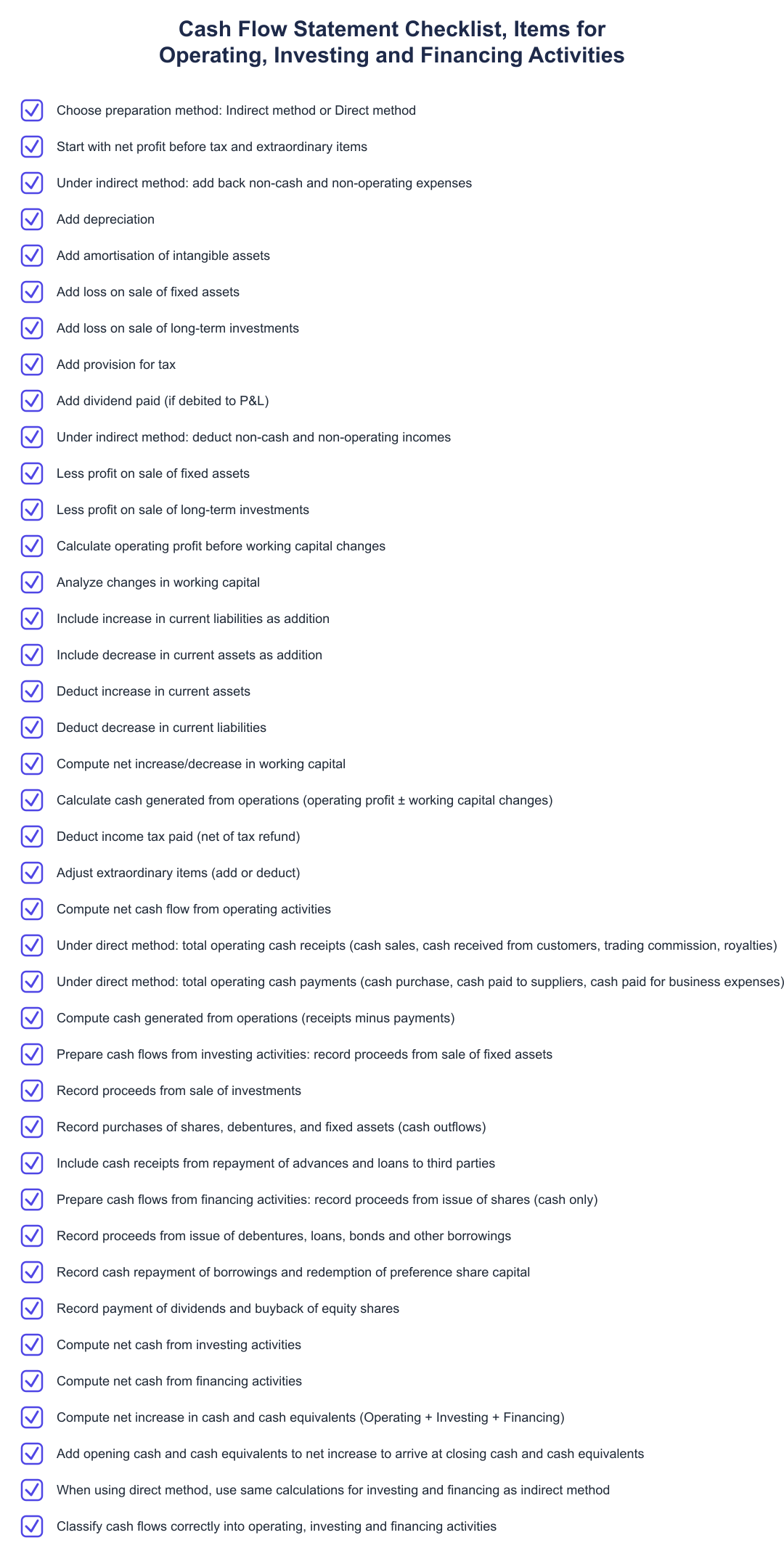
Under the indirect method, prepare operating activities by starting with net profit before tax and extraordinary items and then adjusting for non-cash and non-operating items and working capital changes. Typical additions include depreciation, amortisation, losses on sale of fixed assets or long‑term investments, provisions and dividends paid; typical deductions include profits on sale of fixed assets or investments. Next adjust for working capital: add increases in current liabilities and decreases in current assets, and subtract increases in current assets and decreases in current liabilities; then deduct income tax paid to arrive at net cash flow from operating activities. The result may be further adjusted for extraordinary items to get the final operating cash flow figure.
What non-cash and non-operating items are adjusted in the indirect method?
You adjust non-cash and non-operating items such as depreciation, amortisation of intangible assets, loss on sale of fixed assets, loss on sale of long-term investments, provisions for tax and dividend paid as additions, and profits on sale of fixed assets or long-term investments as deductions. These items are added back if they reduced accounting profit but did not use cash (e.g., depreciation) or subtracted if they increased profit without cash inflow (e.g., profit on sale). For example, depreciation shown in the profit & loss is added back to net profit before tax because it is a non-cash expense, while profit on sale of fixed asset is deducted because the cash proceeds are reflected separately under investing activities. This ensures operating profit is converted to cash generated from operations before tax and extraordinary adjustments.
How do changes in working capital affect cash flow from operations?
Changes in working capital affect cash flow from operations by reflecting cash tied up or released from current assets and liabilities. An increase in a current asset (like inventory or receivables) causes a decrease in cash inflow because cash is blocked, while a decrease in a current asset increases cash inflow because assets are converted to cash. Conversely, an increase in a current liability (like payables) reduces cash outflow because cash is conserved, and a decrease in a current liability increases cash outflow because liabilities are paid; these movements are added to or subtracted from operating profit in the indirect method to determine cash generated from operations.
What items are included in cash flows from investing activities?
Cash flows from investing activities include cash payments to acquire fixed assets, cash receipts from disposal of fixed assets, cash payments to acquire shares or debenture investments, and cash receipts from repayment of advances and loans made to third parties. Examples of investing inflows are cash sale of plant and machinery, land and buildings, goodwill, and sale of investments in other companies; examples of outflows are purchase of fixed assets, purchase of intangible assets, purchase of shares and debentures, purchase of government bonds, and loans made to third parties. The net of these receipts and payments is reported as net cash from investing activities and is prepared the same way under both indirect and direct methods.
What items are included in cash flows from financing activities?
Cash flows from financing activities include cash proceeds from the issue of shares and debentures or other long‑term borrowings, and cash repayments of amounts borrowed, dividend payments, redemption of preference share capital, and buyback of equity shares. Typical inflows are proceeds from issuing equity or debentures and borrowings; typical outflows are repayment of principal on loans, payment of dividends, redemption of bonds or preference shares, and share buybacks. These flows show how the business is financed and are presented net as the cash flow from financing activities, which together with operating and investing flows reconciles opening and closing cash and cash equivalents.
How is the direct method different when preparing the operating section?
The direct method differs by directly listing operating cash receipts and operating cash payments instead of adjusting profit for non-cash items and working capital changes. You show operating cash receipts such as cash sales, cash received from customers, trading commission and royalties as additions, and operating cash payments such as cash purchases, cash paid to suppliers and cash paid for business expenses as deductions to arrive at cash generated from operations. Then deduct income tax paid and adjust for extraordinary items to get net cash flow from operating activities; investing and financing sections are calculated the same way as under the indirect method. The direct method therefore presents a more detailed cash inflow/outflow picture but requires more granular cash collection/payment data.
How do you reconcile net increase in cash and cash equivalents?
You reconcile net increase in cash and cash equivalents by summing net cash from operating activities, investing activities and financing activities to get the net increase (or decrease) in cash and cash equivalents. Then add the cash and cash equivalents at the beginning of the period to this net increase to arrive at cash and cash equivalents at the end of the period. The statement normally displays these totals (Net increase J, Opening balance K, and Closing balance J+K) to show movement in cash during the period and provide the closing cash position.
What is an illustrative format for an indirect-method cash flow statement?
An illustrative indirect-method cash flow statement starts with net profit before tax and extraordinary items, adjusts for non-cash and non-operating items (depreciation, amortisation, losses/profits on sale of assets, provisions), computes operating profit before working capital changes, adjusts for increases/decreases in current assets and liabilities, and then shows cash generated from operations and tax paid to arrive at net cash from operating activities. It then separately lists cash flows from investing (proceeds from sale of fixed assets, sale of investments, purchase of assets/investments) and financing activities (proceeds from issue of shares/debentures, payment of dividends), and finally shows net increase in cash and cash equivalents, opening balance and closing balance. This layout, showing sections A (operating), H (investing) and I (financing) and the reconciliation (J and K), is the standard presentation used in the illustration for clarity and auditability.
Need help staying Accounting compliant?
MoneyGence's AI Finance OS tracks your compliance, wallet share, and finances in one place, built for agencies and growing businesses.
Get started with MoneyGence