HUF Meaning: What is HUF? Benefits, Tax Savings & How to Form
This guide explains what a Hindu Undivided Family (HUF) is, who can form one, who qualifies as its members, the practical steps involved around compliance such as obtaining PAN and opening an HUF bank account, how an HUF functions as a tax-planning vehicle, and the ways an HUF can be dissolved. You will learn why an HUF is treated differently under Indian tax law, which families are eligible, what rights members and coparceners hold, and the formalities commonly undertaken when an HUF conducts financial activity. This matters because an HUF is recognised as a separate person under the Income Tax Act and is a legally available strategy for joint families to organise family wealth and tax affairs. Understanding the legal nature of an HUF, who can be part of it, and the procedural touchpoints (like PAN application and banking) helps families evaluate whether forming and running an HUF suits their long-term arrangements and tax planning objectives. The guide keeps to verified legal and compliance facts so you can rely on the core points when discussing HUF formation, membership, compliance steps, and the consequences of partition or dissolution.
What is an HUF?
HUF stands for Hindu Undivided Family and is recognised under the Income Tax Act as a separate legal entity created for tax purposes. For income tax, an HUF is treated as a separate person distinct from its individual members and can be assessed to tax independently.
Because it is a separate person under the tax law, an HUF can hold assets and earn income in its own name. This legal status is central to why joint families consider an HUF when organising family property and tax affairs.
Who can Form HUF?
An HUF can be formed only by a family, it cannot be created by a single individual. A minimum of two persons is required to constitute an HUF. In practice, this means the joint-family nature (lineal ascendants and descendants) forms the basis for creating an HUF.
The ambit of HUF is not restricted to one religion: Buddhist, Sikh and Jain families are also covered under the concept of HUF. Formation as a legal entity for tax purposes is therefore available to members of these communities in addition to Hindus.
Who are the Members of HUF?
Members of an HUF include the common ancestor and all lineal descendants. This membership covers the family chain and, for tax and property purposes within an HUF, wives and unmarried daughters are recognised as part of the family structure.
Coparceners are those lineal descendants who have a birthright in HUF property. Coparceners have equal rights in HUF property and can demand partition. Notably, daughters by birth are included as coparceners under the recognised definition of coparcenary.
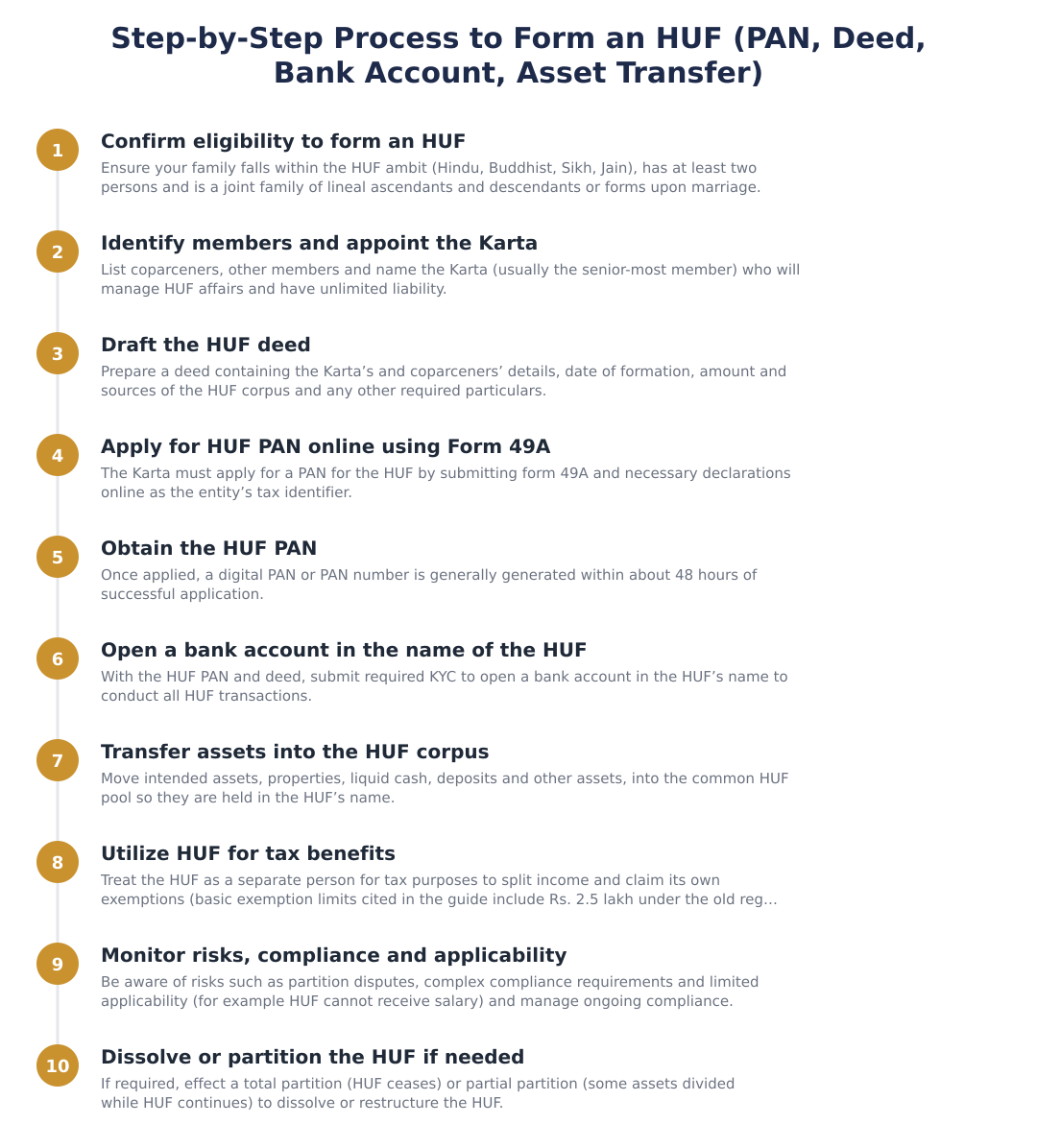
How to Form an HUF - A Step-by-Step Guide
Confirm that there are at least two persons related as lineal descendants/common ancestor so that an HUF can be formed, since a single person cannot create an HUF.
Apply for PAN online for the HUF using Form 49A to obtain the HUF's PAN for tax and compliance purposes.
Once PAN is obtained, open a bank account in the name of the HUF by submitting the HUF deed, the PAN and other KYC documents required by the bank.
Conduct financial activity in the HUF's name and maintain records under the HUF to reflect its separate legal and tax status.
How to save taxes using HUF?
Forming an HUF is a legally available tax-saving strategy for joint families because the Income Tax Act recognises HUF as a separate person. The separate tax identity allows families to allocate certain income to the HUF rather than to individual members, which can be part of broader family tax planning.
Because the HUF can be assessed to tax independently, families often consider its formation when organising family-owned assets and receipts. Whether forming an HUF produces tax benefits depends on the family’s specific income streams and the interplay between individual and HUF taxation; professional advice is recommended to map how an HUF fits into overall tax planning.
Dissolution of an HUF
An HUF can come to an end by partitioning its assets. The law recognises two types of partition: a total partition, where all assets are divided and the HUF ceases to exist, and a partial partition, where only some assets are divided and the HUF continues in respect of the remaining assets.
Coparceners, who have equal rights in HUF property and can demand partition, play a key role in dissolution. The nature of partition, total or partial, determines whether the HUF continues to exist after division of assets.
Frequently Asked Questions
Q: What does HUF stand for? A: HUF stands for Hindu Undivided Family.
Q: Can a single person form an HUF? A: No. An HUF cannot be created by one person; a minimum of two persons is required.
Q: Who is the head of an HUF? A: The head of the HUF is called the Karta.
Q: Are daughters included as coparceners? A: Yes; daughters by birth are included as coparceners and coparceners have equal rights in HUF property and can demand partition.
Q: Can Buddhists, Sikhs and Jains form an HUF? A: Yes. Buddhist, Sikh and Jain families are covered under the ambit of HUF.
Q: How do you get a PAN for an HUF? A: PAN application for an HUF can be made online using Form 49A.
Q: Can an HUF open a bank account? A: Yes. With PAN obtained, you can open a bank account in the name of the HUF by submitting the HUF deed, PAN and other KYC documents.
An HUF is a distinct legal and tax entity that joint families can use to hold assets and organise certain financial affairs. It requires a family basis of at least two persons, has defined membership and coparcenary rights (including daughters), and involves straightforward compliance steps such as obtaining a PAN using Form 49A and opening an HUF bank account with appropriate documents. Partition, total or partial, determines how and when an HUF ceases or continues. Families should consider the legal status and consult professional advisors to understand how an HUF fits into their broader estate and tax planning.

Frequently asked questions
What exactly is a Hindu Undivided Family (HUF)?
A Hindu Undivided Family (HUF) is a separate legal entity under the Income Tax Act consisting of a common ancestor and his lineal descendants, which can own property and earn income separately from individual members. An HUF can be formed by Hindus, Buddhists, Jains and Sikhs and is headed by a Karta who manages affairs; coparceners (lineal descendants, including daughters by birth) have rights in HUF property. For tax purposes the HUF gets a separate PAN, can claim its own basic exemption and deductions, and is often used to legally split family income to reduce overall tax liability. An HUF cannot be created by a single person, at least two members are required to constitute an HUF (for example, after marriage a couple plus their ancestors can form one).
Who can form an HUF and when can it be created?
An HUF can be formed by a family of Hindus, Buddhists, Jains or Sikhs with at least two members who are lineal ascendants or descendants of a common ancestor. It can be created at the time of marriage, on the birth of a child, by inheritance where ancestral property exists, or by an express declaration and creation of HUF assets (such as contributions to a common pool). Note that a single individual cannot form an HUF; there must be a family relationship, and the creation should be evidenced by an HUF deed and steps such as obtaining PAN and opening a bank account in the HUF name.
Who are the members of an HUF and what roles do they have?
Members of an HUF include the Karta (the head who manages the HUF and has wide managerial authority), coparceners (lineal descendants including daughters by birth who have a right to demand partition) and other members such as wives who are members but not coparceners. The Karta (usually the senior-most member) represents the HUF in legal and tax matters and has unlimited liability for HUF obligations; coparceners share ownership rights in HUF property and can seek partition. Wives have maintenance rights but traditionally could not demand partition; however daughters by birth now have equal coparcenary rights following recent legal developments.
How do I form an HUF step-by-step in India?
To form an HUF you should draft an HUF deed, apply for a PAN in form 49A for the HUF, and then open a bank account in the HUF’s name to route income and contributions. The HUF deed should state the name of the Karta, list of coparceners, date of formation, details of initial corpus and sources of funds; PAN application is usually digital and PAN may be issued within 48 hours. After PAN, open a bank account by submitting the HUF deed, PAN and KYC documents, and transfer intended assets (cash, deposits, property) into the HUF pool to establish the corpus for tax and legal recognition.
How does an HUF help save taxes and what limits apply?
An HUF helps save taxes by being a separate taxpayer with its own basic exemption and deduction limits, allowing families to split income legally between individual members and the HUF. Under the old tax regime HUF had a basic exemption of Rs. 2.5 lakh and under the new tax regime the guide mentions Rs. 4 lakh as a referenced exemption threshold for HUF income, and the HUF can separately claim Chapter VI-A deductions where applicable. Income like rent, dividend or capital gains attributable to HUF assets is taxed in the HUF’s hands, reducing the aggregate tax across family members, but salary income paid to an individual cannot be clubbed into HUF, and proper transfer/recording of assets to the HUF corpus is required to withstand scrutiny.
What are the main advantages of creating an HUF?
The main advantages of an HUF are separate tax identity with its own basic exemption and deductions, the ability to pool family assets and income under one entity, and potential reduction of overall family tax liability by lawful income splitting. Additionally, an HUF can hold property, earn income, claim exemptions and make investments in its own name, and the Karta can manage family finances centrally. However, the benefit depends on actual transfer of assets into the HUF corpus and compliance with PAN/bank/accounting requirements; misuse or improper documentation can invite disputes or tax challenges.
What are the risks and challenges of operating an HUF?
Key risks and challenges include partition disputes among coparceners, increased compliance (separate PAN, bank account, and tax filings), limited applicability for certain incomes (an HUF cannot receive salary as HUF income), and potential family conflicts over Karta’s decisions. Tax authorities may scrutinize transfers to HUF if not properly documented or if transfers appear artificial to avoid tax, and the Karta bears unlimited liability for HUF debts and obligations. Therefore families should maintain clear deeds, proper records of asset transfers and bank transactions, and consider legal advice before forming or funding an HUF.
How is an HUF dissolved or partitioned and what are the types of partition?
An HUF can be dissolved by total partition, where all assets are divided among coparceners and the HUF ceases to exist, or by partial partition, where only some assets are divided and the HUF continues for remaining assets. Total partition requires distribution of the entire corpus and often involves execution of partition deeds, transfer of titles and settling tax consequences such as capital gains; partial partition divides specific assets while leaving others in the HUF pool. Formal documentation of partition, revised records, and tax filings reflecting the change are essential to avoid future disputes and to correctly determine tax liabilities on distributed assets.
Do I need to file separate income tax returns for an HUF and how do I do it?
Yes, an HUF is a separate taxpayer and must file its own income tax return using its PAN whenever its total income exceeds the basic exemption limit or as required by law. The HUF return should report all income earned by the HUF (rent, interest, capital gains, etc.), claim applicable deductions under Chapter VI-A and be signed by the Karta; the HUF PAN and bank account must be used for all HUF transactions to substantiate the return. Even if income is below the exemption limit, maintaining records, PAN and bank account for an HUF is recommended to establish the corpus and avoid future tax disputes.
Need help staying Income Tax compliant?
MoneyGence's AI Finance OS tracks your compliance, wallet share, and finances in one place, built for agencies and growing businesses.
Get started with MoneyGence