Income from Salary 2026: Practical Guide (Effective 01.04.2026)
This practical note explains how income from salary is treated under the Income Tax framework and what salaried employees and payroll teams should watch for when preparing year‑end computations and returns. You will learn how salary is broadly defined, which pay components typically form part of taxable income, how common deductions and exemptions interact with gross pay, and what practical payroll and documentation practices reduce disputes and audit risk. The guidance is written for Indian employers, HR and finance teams, practitioners preparing payroll, and employees who want to understand why their CTC and take‑home pay differ, and how that difference is treated for tax purposes. The focus is practical: clarifying the nature of different salary components (basic pay, allowances, perquisites, reimbursements), explaining the distinction between exempt and taxable elements in principle, outlining employer responsibilities around payroll computation and reporting, and suggesting steps to keep records and reconcile payroll with tax filings. This note does not attempt to reproduce statutory language or cite specific statutory provisions or rates; instead it highlights the key conceptual and procedural issues that determine whether a particular element of remuneration is included in taxable salary and what employers and employees should do to ensure compliance and minimise disputes.
What constitutes "salary" in practical terms
In practice, salary is the entire consideration, monetary and non‑monetary, paid to an employee in return for services rendered. This includes periodic cash payments such as basic pay, increases, and variable pay; fixed or recurring allowances; and benefits that provide economic value to the employee.
Beyond cash, non‑cash benefits often give rise to tax consequences. Perquisites (perks) such as accommodation, employer‑provided vehicles, and concessional loans have to be evaluated on their economic value and may be treated as part of salary for tax purposes. It is important to identify whether an item is a reimbursement of an expense genuinely incurred by the employee or a benefit representing additional economic value, reimbursements supported by proper bills are typically viewed differently from benefits that directly enhance employee wealth.
Understanding what is included helps both employers and employees avoid misclassification. Employers must classify payroll items consistently and document their rationale; employees should review pay slips and benefit descriptions so they know which components could increase taxable income.
How different salary components affect taxable income
Salary packages are usually structured into components such as basic pay, allowances, reimbursements, bonuses, and perquisites. Each component can be treated differently for tax purposes depending on its nature and the conditions attached to it. For example, some allowances are intended to reimburse costs related to duties and may be non‑taxable when supported by proof; other allowances are meant to provide additional income and are taxable when paid.
Employers should maintain clear policies that describe the purpose of each allowance and the documentation required to claim any exemption or reimbursement. Where an allowance or benefit can be availed without corresponding expenditure by the employee, it is more likely to be treated as taxable income.
Variable pay and bonuses typically increase taxable income in the year of payment. Similarly, monetary or non‑monetary benefits that accrue to the employee as a result of employment should be carefully valued and recorded in payroll so that tax consequences are correctly reflected in payroll reporting and tax withholding calculations.
Common deductions and how they interact with salary
Tax systems generally provide mechanisms to reduce taxable salary by allowing certain deductions and exemptions. These can include deductions for employee contributions to specified funds, allowances exempt under specified conditions, and standard reliefs against particular heads of income. The availability of these adjustments depends on the nature of the payment and whether conditions such as proof of expenditure or prescribed limits are met.
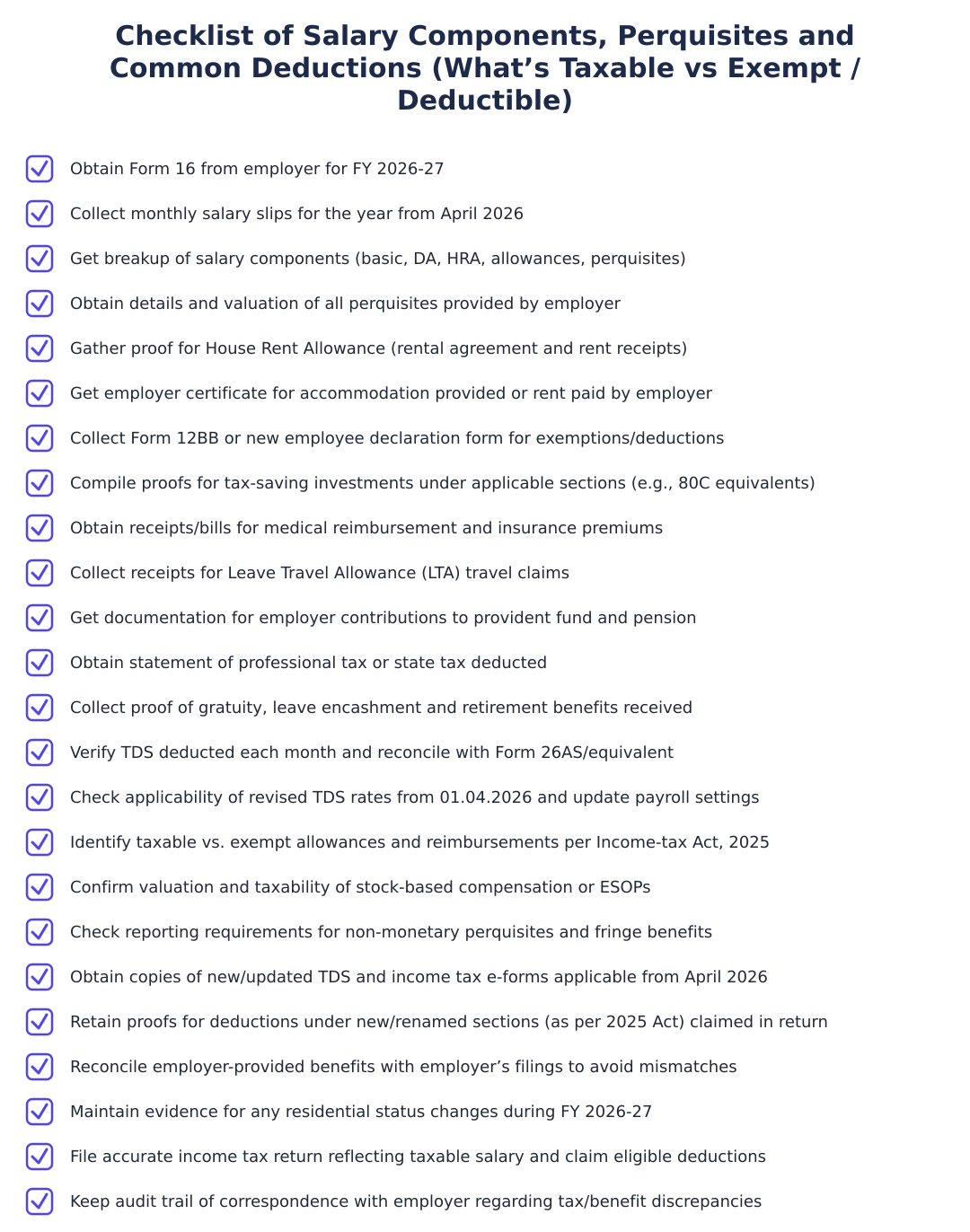
From a practical viewpoint, employees should keep documentary evidence for claimed deductions, contribution receipts, bills for reimbursed expenses, and proof of investments where applicable. Employers should verify these documents before reflecting deductions in payroll and ensure that records are retained for compliance and audit purposes.
Employers also need to ensure that payroll and reporting systems allow for these adjustments at the time of tax withholding so that employees are not over‑withheld during the year and reconciliation is simplified at year end.
Payroll responsibilities: a practical stepwise checklist
Prepare a written payroll policy that defines basic pay, allowances, reimbursements, perquisites and variable pay, and specifies the documentation required to support any non‑taxable treatment.
Ensure employees submit bills, contribution receipts, and declarations required to establish the nature of allowances and claim exemptions.
Adopt a standard methodology to value non‑cash benefits and record them in payroll so tax implications are consistently applied across the organisation.
Enter deductions and exemptions into payroll during the year to reduce over‑withholding and facilitate easier annual reconciliations.
Retain payroll ledgers, supporting documents and policy records for a reasonable period so any queries from tax authorities can be answered promptly.
Practical walkthrough: reconciling cost‑to‑company (CTC) to taxable salary
A salaried package is often described as cost‑to‑company (CTC). The CTC includes employer contributions and benefits that may or may not be taxable in the hands of the employee. To reconcile CTC to taxable salary, list all CTC components, separate cash pay from non‑cash benefits, and identify which elements are potentially taxable based on their nature and supporting documentation.
Next, apply the relevant payroll rules to value taxable benefits and gross up any benefits that are taxable on the employee. Subtract allowable deductions and exemptions that the employee is eligible for and has substantiated. The result is the taxable salary figure that should be used for payroll withholding and annual tax returns.
This reconciliation helps HR and finance teams explain differences between gross cost and employee take‑home pay, ensures accurate withholding during the year, and reduces surprises at the time of filing. Regularly revisiting these reconciliations, especially after changes in pay structure or benefits, keeps payroll compliant and employees informed.
For employers and employees alike, clarity in defining pay components, consistent valuation of benefits, timely documentation, and accurate payroll adjustments are the practical steps that reduce tax risk and minimise disputes. Maintain clear policies, good records, and routine reconciliations so salary computations and tax reporting remain transparent and defensible.
Frequently asked questions
What counts as 'salary' under the Income-tax Act, 2025 from 1 April 2026?
Salary under the Income‑tax Act, 2025 includes wages, pensions, gratuity, leave encashment and any perquisites or allowances provided by the employer. The definition covers cash salary as well as non‑cash benefits (perquisites) and contractual payments arising from employer‑employee relationship, whether paid monthly or on termination. Payments treated as salary under earlier law (for example, retrenchment compensation and certain retirement benefits) continue to be within the scope unless specifically excluded by the new Act. For practical compliance, taxpayers should review employment contracts and pay‑slips to identify all components that fall within the Act’s salary definition for the new tax year starting 01.04.2026.
Are employer‑provided perquisites taxable under the 2025 Act and how are they valued?
Yes, employer‑provided perquisites are taxable under the Income‑tax Act, 2025 unless specifically exempted. The Act requires valuation of perquisites using prescribed rules, and taxable valuation may be based on actual cost to employer, fair market value or statutory valuation methods depending on the nature of the perquisite (for example, rent‑free accommodation, motor vehicle use, or concessional loans). Certain perquisites may still be exempt up to specified limits or subject to employer reporting and proof of business connection; employees should ask employers for breakdowns showing taxable value and exemptions. Always keep documentation such as allotment letters, lease/rent details and employer statements to support valuations in case of scrutiny.
What salary deductions can an employee claim under the Income‑tax Act, 2025?
Employees can claim deductions specifically provided under the Act such as deductions for specified retirement contributions, professional tax, and other employment‑linked deductions permitted by statute or rules. The Act continues to allow certain standard employment‑related deductions (subject to amounts and conditions notified by the government), and employees should claim only those deductions for which documentary evidence or employer certification is available. Some common deductions require employee contribution proofs (for example, to recognized provident funds or pension schemes) and timely disclosures in Form ITR; absence of proof can lead to disallowance during assessment. Check the latest notifications for any revised deduction limits or new categories introduced effective 01.04.2026.
How have TDS rules on salary payments changed from 1 April 2026 under the new Act?
From 01.04.2026 the Income‑tax Act, 2025 retains employer‑deduction of TDS on salary, but introduces changes in thresholds, computation formats and reporting requirements as notified by the Central Board of Direct Taxes. Employers must compute TDS on estimated annual taxable salary after accounting for allowable deductions and exemptions and deposit tax as per the revised timelines and rates; failure to withhold attracts interest and penalty provisions under the new Act. The government has also updated TDS reporting formats and consolidated certain heads to simplify compliance; employees should review Form 16 (or its replacement) issued by their employer to confirm correct TDS and salary breakup. Employers and employees should watch for official circulars that detail new thresholds, slab changes (if any), and transitional instructions for FY 2026‑27.
Has the format or name of Form 16/other employer statements changed under the 2025 Act?
Yes, the 2025 Act and related notifications introduce updated formats for employer statements (previously Form 16 and Form 12BA) and may change names or annexures to align with new reporting requirements. Employers are required to provide the updated statement showing gross salary, break‑up of allowances and perquisites, employer contributions, exemptions claimed and TDS deducted in the prescribed new format for FY 2026‑27 onwards. Employees should obtain this revised statement from their employer to accurately file returns and substantiate claimed exemptions/deductions; retain employer certificates and annexures for future reference. Where employers delay issuing the new form, employees should request interim salary certificates or employer communications that reflect the same columnar details required by the new format.
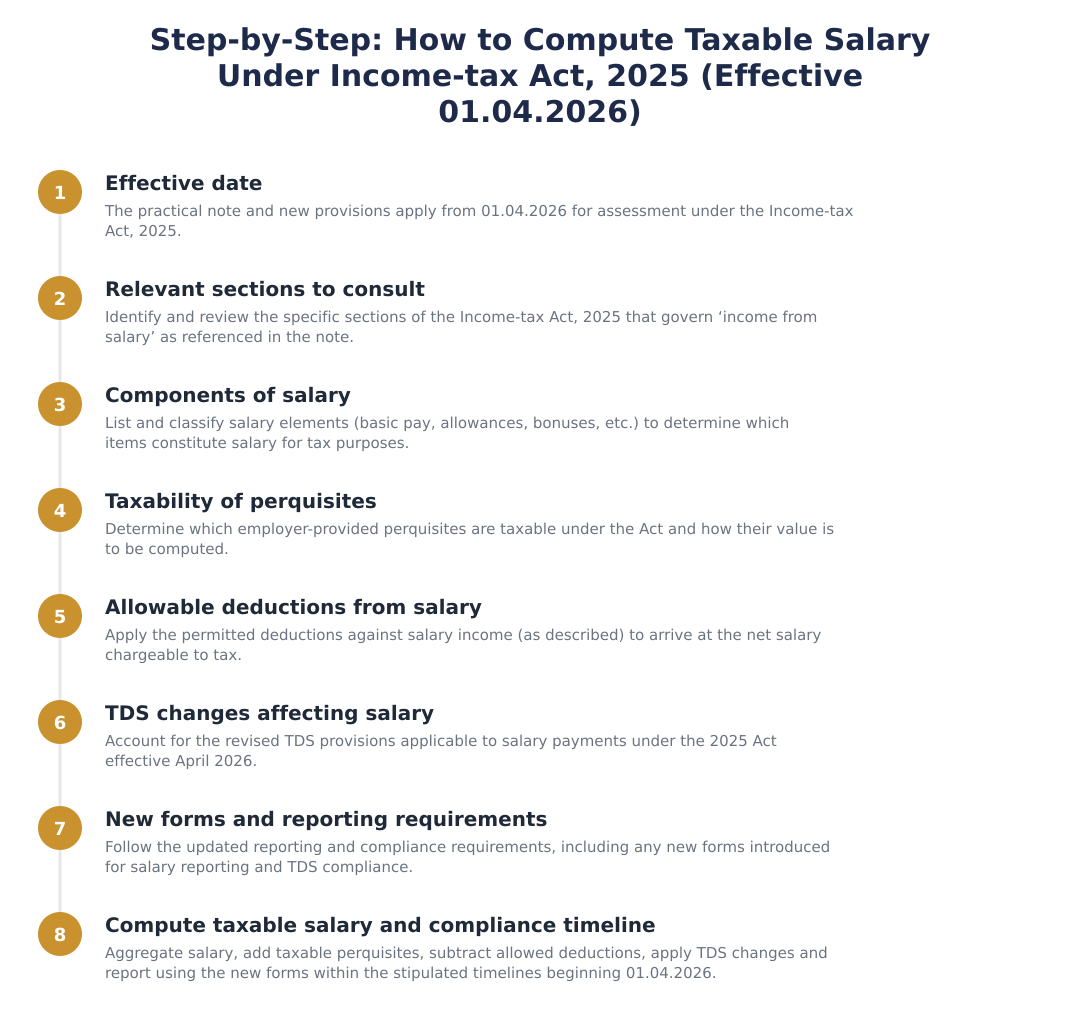
How is taxable salary computed under the new Act, what is the practical step‑by‑step?
Taxable salary under the Income‑tax Act, 2025 is computed by starting with gross salary (basic pay, allowances, bonuses, perquisites), subtracting exempt allowances/perquisites as per the Act, and then claiming allowable salary‑related deductions to arrive at net taxable salary. Practically, employees should (1) collect employer statement showing gross components and perquisite values, (2) identify and apply statutory exemptions (for example, specified house rent or travel allowances if eligible), (3) deduct employment‑linked deductions allowed under the Act, and (4) include any other income/deductions that affect total taxable income before computing tax and TDS credit. Maintain documentary evidence for exemptions and deductions; incorrect classification of components (for instance, treating taxable allowance as exempt) will lead to reassessment and interest/penalties.
What are the key compliance steps at year‑end for salaried taxpayers under the 2025 Act?
Key year‑end compliance steps include obtaining the employer’s revised salary certificate (new Form 16 or replacement), reconciling TDS and salary breakup with pay‑slips, collating proofs for deductions and exemptions, and filing the income tax return within the prescribed due date using the updated ITR form. Additionally, salaried taxpayers should verify employer contributions to retirement funds and ensure these are reflected correctly for claiming deductions or exemptions, and check that TDS deposited by the employer is available as credit in Form 26AS or the taxpayers’ consolidated tax statement. If discrepancies arise (missing TDS, incorrect perquisite valuation, or omitted income), raise them with the employer promptly and preserve correspondence and vouchers to support any rectifications or adjustments during assessment. Keep track of transitional guidance issued by tax authorities for FY 2026‑27 to apply any one‑time reporting or grandfathering provisions correctly.
Are there special rules for taxing retirement benefits (gratuity, commuted pension, leave encashment) under the Act from April 2026?
Retirement benefits such as gratuity, commuted pension and leave encashment continue to have specific tax treatments under the Income‑tax Act, 2025, with some portions taxable and some eligible for exemption subject to conditions and limits prescribed by the statute. For example, statutory gratuity and specified portions of commuted pension/leave encashment may be exempt up to limits or according to formulas specified in law, while amounts in excess are taxable as salary; the new Act preserves rule‑based treatment but may alter thresholds or computation mechanics, so taxpayers should consult the exact provisions. Employees receiving retirement payouts in FY 2026‑27 should obtain breakup certificates from employers/board of trustees and compute tax using the updated exemption formulas, keeping documentation for any claim of exemption. Any changes in exemption limits or computation methods notified for the 2025 Act will apply from 01.04.2026 and should be checked before filing returns for that year.
Need help staying Income Tax compliant?
MoneyGence's AI Finance OS tracks your compliance, wallet share, and finances in one place, built for agencies and growing businesses.
Get started with MoneyGence