Income Tax for Freelancers: Guide on Deductions, Filing & Presumptive
This guide explains how income tax rules apply to freelancers in India, focusing on how freelancing income is recognised, which expenses can reduce taxable income, how accounting method choices affect tax timing, and practical implications of depreciation and deductible expenditure. If you are an independent professional, contractor, consultant, designer, developer, or any person providing services on a freelance basis, understanding these points helps you plan cash flow, maintain compliant books, and claim legitimate reductions in taxable income. You will learn the difference between the accrual and cash bases of accounting and how each method determines when income and expenses are treated for tax purposes. The guide also clarifies the core legal test for deductions, that expenses must be wholly and exclusively for the business or profession, and explains how depreciation on capital assets works as an annual deduction. Finally, we discuss practical considerations in choosing an accounting method and how those choices affect when tax liability arises. The aim is to give freelancers a clear, principles-based understanding so you can make informed bookkeeping and tax planning decisions that align with the Income Tax Act.
Freelancing Income
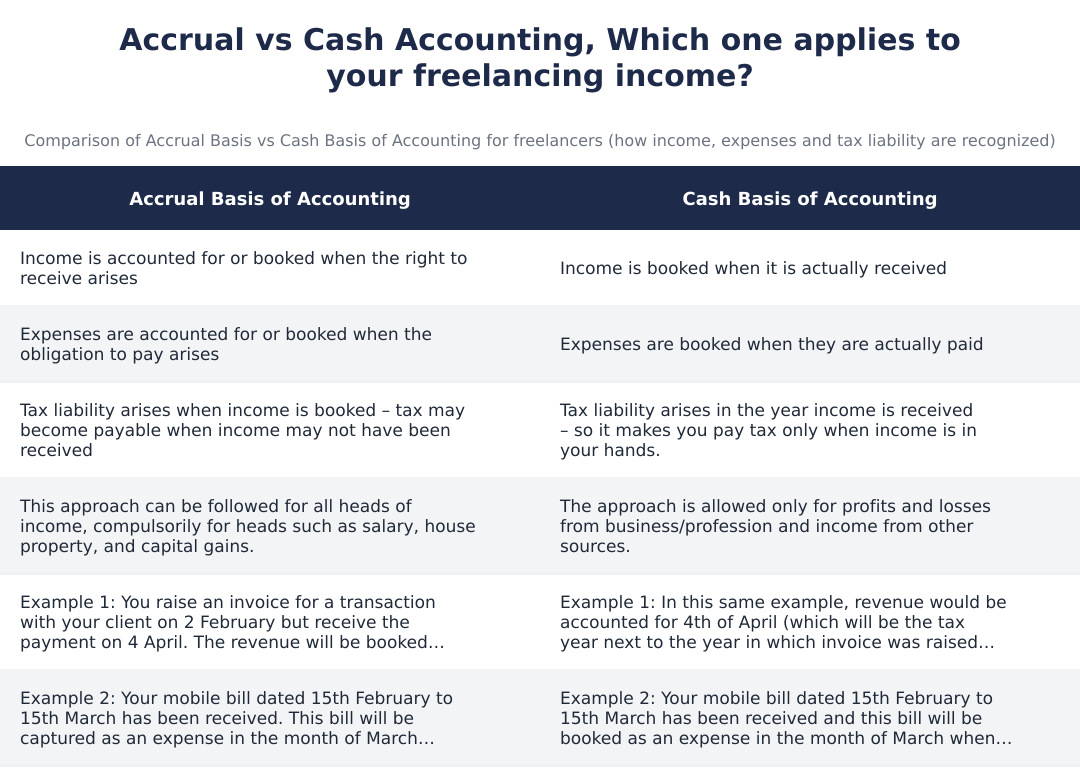
For a freelancer, the basic tax outcome depends on how and when income is recorded. Under the accrual basis of accounting, income is recognised when the right to receive it arises, for example, when you issue an invoice or have performed the service that gives you the right to be paid. Under the cash basis, income is recognised only when payment is actually received. This difference affects which financial year the income belongs to for tax purposes.
Choosing between accrual and cash basis determines the timing of tax liability. If you follow accrual accounting, tax liability can arise before the cash is in your bank because the right to receive income has already crystallised. If you follow cash accounting, tax liability arises in the year you actually receive the payment, which can help align tax outflows with cash availability.
Expenses Allowed as a Deduction
The Income Tax Act allows deductions for expenses that are incurred 'wholly and exclusively' for the purpose of carrying on the business or profession. This means routine business costs that directly support your freelance work, such as fees you pay to carry out the service, can be deducted, but personal expenses cannot. Capital expenditures (payments to acquire assets intended to provide benefit over multiple years) are treated differently and are not deducted in full in the year of purchase.
When you buy a capital asset needed for your work (for example, a laptop or specialised equipment), you do not claim the entire purchase price as an immediate expense. Instead, depreciation, a statutory mechanism to write off the cost over several years, is available as a deduction. The Income Tax Act prescribes the methods and rates to compute depreciation; you must follow those rules to claim the annual depreciation allowance.
1. Conditions To Claim Expenses As a Deduction From Freelancing Income
To claim an expense as deductible against your freelancing income, the fundamental legal requirement is that the expense must be incurred wholly and exclusively for the business or profession. Expenses that are partly personal and partly business need careful treatment: only the portion that meets the wholly-and-exclusively test is eligible for deduction.
Expenses that are capital in nature or that fund activities which are illegal or prohibited are not deductible. In practice this means routine operational costs and properly apportioned business expenses are allowed, while personal spending and capital acquisitions are not immediately deductible (though capital items may generate depreciation).
How to Choose an Accounting Method?
Selecting accrual versus cash accounting is an important decision because it governs when income and expenses are recognised for tax. The accrual basis recognises income when the right to receive arises and expenses when the obligation to pay arises, leading to tax liability that follows the booking of revenue or costs. The cash basis recognises transactions only on actual receipt or payment, which can simplify cash-flow management because tax arises when money has actually changed hands.
Practically, freelancers should consider the timing of client payments, the predictability of receipts, and how early recognition of income (under accrual) could create tax demands before funds are collected. Conversely, cash basis may better suit micro-practices where aligning tax with real cash inflows is desirable. Whatever method is chosen, maintain consistent application so that your tax computations and books remain coherent and audit-ready.
Total Taxable Income and Tax Payable
To arrive at taxable income as a freelancer you add up all receipts that constitute income for the chosen accounting method, subtract expenses that satisfy the wholly-and-exclusively test (including the allowable annual depreciation on capital assets), and include any other heads of income as relevant. The accounting method you follow directly affects which receipts and payments belong to the tax year.
Because tax liability arises according to when income is booked under accrual accounting or when received under cash accounting, timing decisions can materially affect the year in which tax is payable. Keep clear records showing the basis used and supporting documentation that demonstrates the business purpose of claimed expenses and the computation of depreciation.
Freelancers should prioritise clear bookkeeping and a deliberate choice of accounting method because these choices determine when income and expenses enter your tax computation. Claim only those expenses that meet the wholly-and-exclusively test, and use the statutory depreciation framework for capital assets rather than expensing purchases immediately. Consistent records that show why an expense is for the business and how depreciation was calculated will make filing and any future scrutiny much easier.
Frequently asked questions
Do I have to pay income tax on the money I earn as a freelancer?
Yes, freelancing income is taxable under the head 'Profits and gains of business or profession' and must be included in your total taxable income. You must add receipts from freelancing to any other income (like salary or rental) and compute tax according to your applicable slab rates; any TDS already deducted should be credited against your tax liability. If your net tax payable for the year exceeds Rs.10,000 you will also need to pay advance tax in instalments during the year. Failure to report freelancing income or underpay tax can attract interest and penalties under the Income Tax Act.
Which freelancing expenses can I deduct from my income to reduce tax?
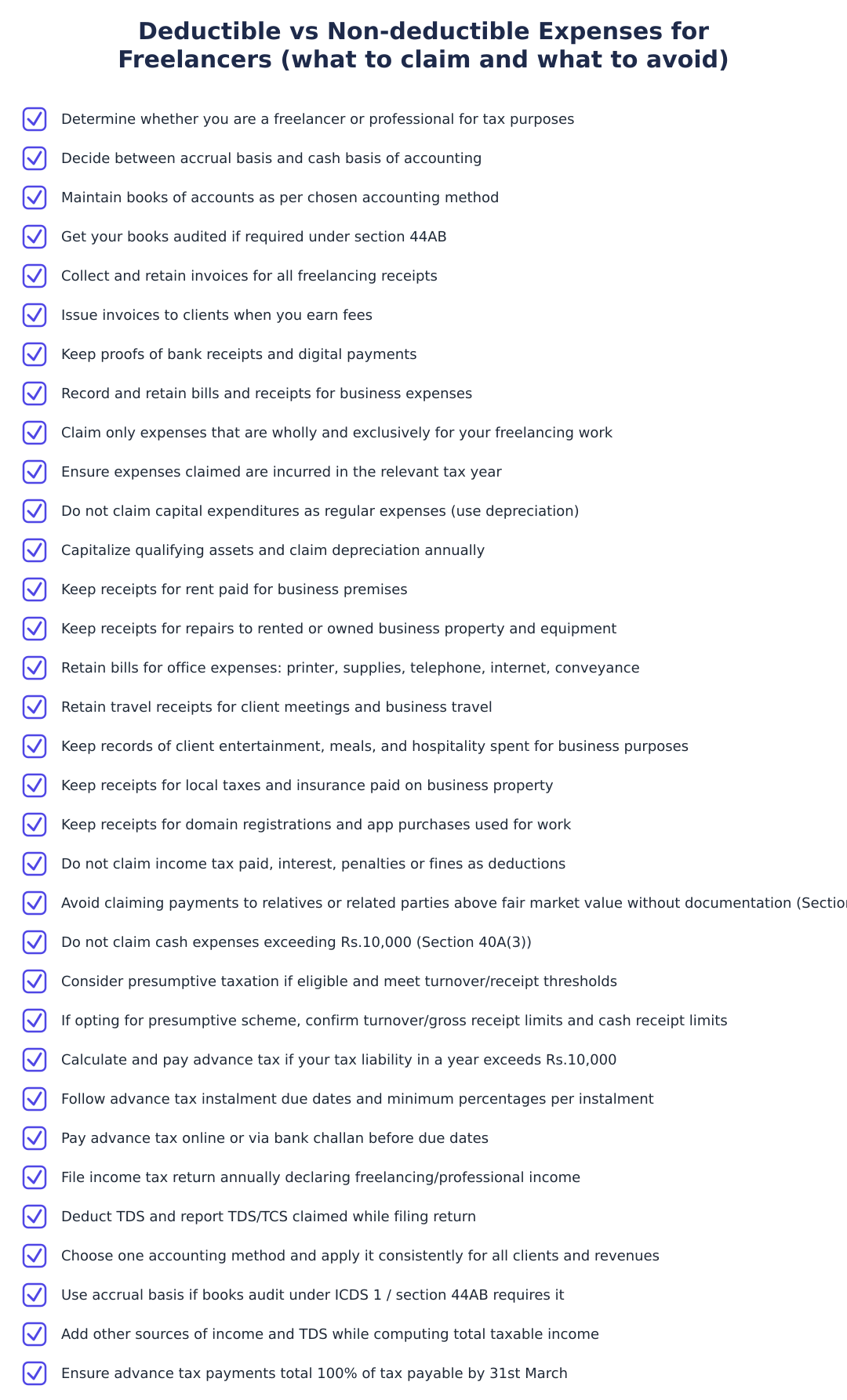
You can deduct ordinary and necessary expenses wholly and exclusively incurred for carrying on your freelance work, such as rent for an office, repairs, depreciation on capital assets, office supplies, telephone and internet bills, travel to meet clients, and domain or app costs. Depreciation on capital assets (like a laptop) is allowed as per Income Tax Act rates, for example a Rs.60,000 laptop with 33.33% rate gives Rs.20,000 depreciation a year. The expense must be incurred in the tax year, not be personal or capital (except via depreciation), and you cannot claim expenses if you opt for the presumptive taxation scheme. Keep bills and invoices to substantiate each deduction.
What expenses are explicitly disallowed as deductions for freelancers?
Expenses that are specifically disallowed include income tax paid, interest/penalty for late tax payments, payments to relatives or related parties above fair market value (Section 40A(2)), and cash payments over Rs.10,000 for a single expense (Section 40A(3)). Any payment made for an illegal or prohibited purpose is also not deductible. These disallowances can increase your taxable income if transactions fall under these categories, so use bank transfers or receipts and avoid excessive cash payments to preserve deductibility.
What conditions must be satisfied to claim an expense as a deduction for my freelance work?
To claim an expense you must show it is incurred for the freelancing business, spent wholly and exclusively for that purpose, incurred during the tax year, not be a capital or personal expenditure, not for any unlawful purpose, and you must not be opting into the presumptive taxation scheme. If any of these conditions fail, e.g., the expense is partly personal or a capital purchase, only the allowable portion (like depreciation for capital items) or none may be deducted. Maintain contemporaneous bills, invoices and allocation records to prove these conditions at assessment or audit.
What is presumptive taxation for freelancers and how does it work?
Presumptive taxation lets eligible freelancers compute income at a prescribed percentage of gross receipts instead of maintaining detailed books, professionals can declare 50% of gross receipts as income if gross receipts do not exceed Rs.50 lakh (limit is Rs.75 lakh if cash receipts are ≤5%); business-type freelancers can declare 8% of turnover (6% if digital receipts) if turnover ≤Rs.2 crore (limit increased to Rs.3 crore if cash receipts ≤5%). If you opt for presumptive taxation you cannot separately claim actual expenses, and certain conditions apply for carrying forward losses or claiming deductions. Choosing presumptive taxation simplifies compliance (no detailed profit computation) but may result in higher or lower tax depending on your real expenses.
Which accounting method should I use, cash basis or accrual, and what difference does it make?
You can use either accrual (mercantile) or cash basis for business/profession income, but accrual records income when the right to receive arises and expenses when obligation arises, while cash basis records them when actually received or paid. Accrual can create tax liability before cash is received (e.g., invoice raised in February but paid in April gets taxed in the earlier year), whereas cash basis taxes you when money hits your hands. If you must get your books audited under section 44AB (based on turnover), ICDS rules require using accrual basis for computation of income for tax purposes, so check audit thresholds before choosing.
When do I have to pay advance tax as a freelancer and what are the instalment rules?
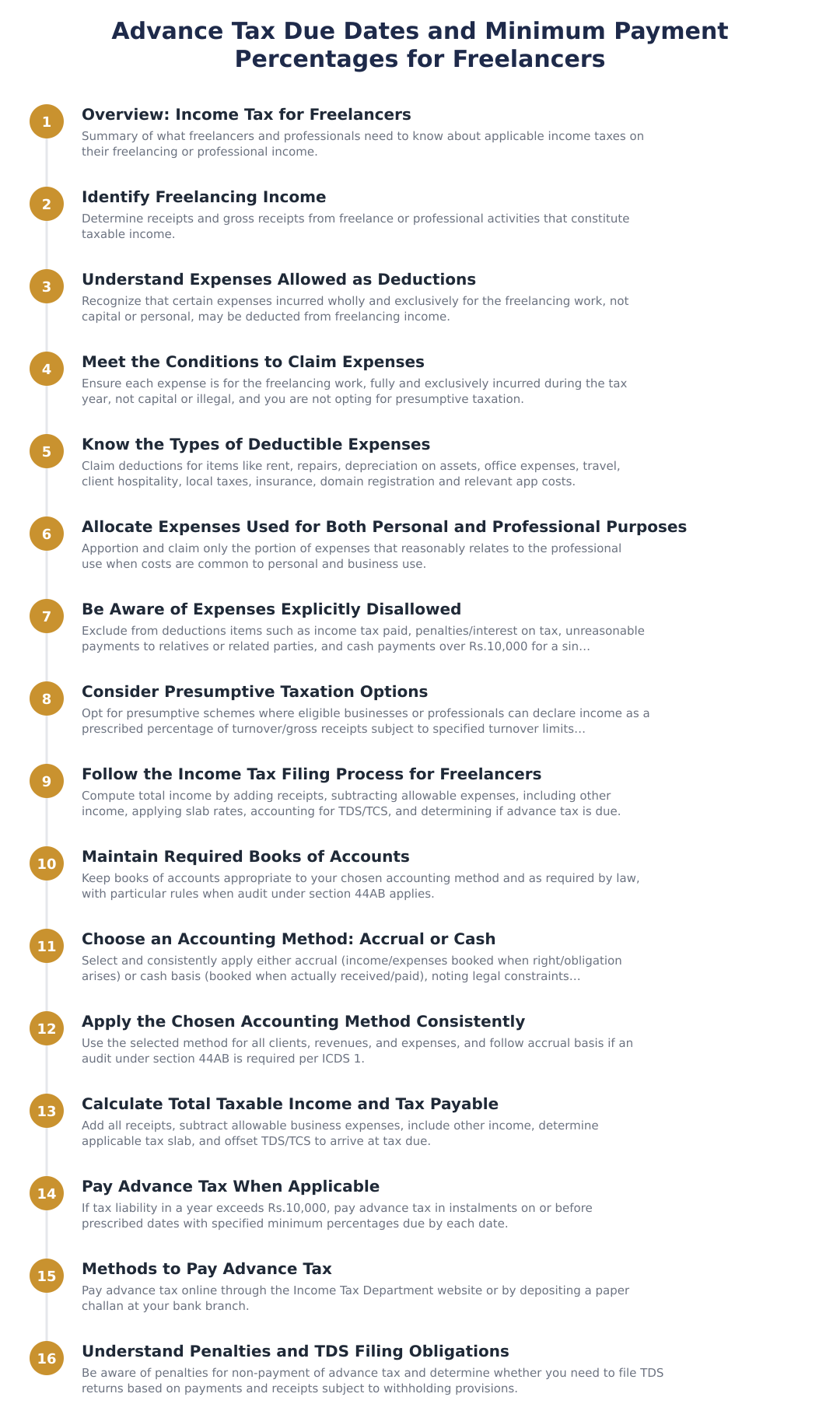
You must pay advance tax if your total tax liability for the year (after TDS/TCS) exceeds Rs.10,000; advance tax is payable in four instalments: at least 15% by 15 June, 45% (cumulative) by 15 September, 75% (cumulative) by 15 December, and 100% by 15 March. Payments can be made online on the Income Tax Department’s portal or via a paper challan at your bank. If you underpay or delay advance tax instalments you will be liable for interest (and possibly penalties), so estimate your yearly tax carefully and pay instalments on time.
Do I need to maintain books of accounts and get audited as a freelancer?
Freelancers must maintain books of accounts appropriate to their accounting method and the size/nature of their business; if turnover or gross receipts exceed specified limits (triggering section 44AB) an audit of books is required. The accounting method you choose must be followed consistently for all clients and transactions, and if audit is required ICDS rules mandate accrual basis for tax computation. Even if audit is not mandatory, keeping clear invoices, expense bills, bank statements and a proper ledger helps substantiate income and deductions and simplifies filing and any scrutiny.
Am I required to file TDS returns or deduct TDS as a freelancer?
As a freelancer you may be subject to TDS: clients making certain payments (professional fees) to you are required to deduct TDS (typically under Section 194J or 194C depending on the nature) at specified rates and deposit it with the government, and you should claim this TDS credit when filing your income tax return. If you make payments that require TDS (for example to contractors or professionals you engage), you must deduct and deposit TDS and file TDS returns, failure attracts penalties and interest. Keep Form 26AS or TRACES records to reconcile TDS credits shown against your PAN before filing your return.
Need help staying Income Tax compliant?
MoneyGence's AI Finance OS tracks your compliance, wallet share, and finances in one place, built for agencies and growing businesses.
Get started with MoneyGence