Income Tax Notice to Salaried Employees: Reasons, Types & Response
This guide explains why salaried employees receive income tax notices, the common notice types they may encounter, how to respond correctly, and practical measures to minimise the risk of receiving one. You will learn how the Income Tax Department identifies discrepancies, what documents to keep ready when a notice arrives, the statutory notice categories that typically apply to salaried taxpayers, and the stepwise actions needed to reply within the notice deadline. Understanding these points is important because a timely, well-documented response can close an enquiry quickly, prevent escalation, and reduce the chance of penalties or further scrutiny. The guidance here is focused on everyday scenarios faced by salaried individuals, such as mismatch with employer data, undeclared additional income, and improper deduction claims, and gives clear, actionable directions for assembling evidence, authenticating the notice, and sending a response that addresses the department’s concerns. Whether you have received an intimation after assessment, a request for clarification, or a notice alleging escaped income, this guide will help you recognise the type of notice, gather the correct paperwork, and take the right steps so you can resolve the matter efficiently.
What is an Income Tax Notice?
An income tax notice is a communication issued by the Income Tax Department requesting clarification, additional information, or specific action from a taxpayer where there is a perceived discrepancy in the return filed. Notices are not always punitive; many are routine requests that allow the department to reconcile data and complete its assessment process.
For salaried employees, a notice typically arises when the department’s records, such as employer declarations, information under AIS/TIS, or third‑party data, do not match what the taxpayer has declared. The notice will set out the reason for contact, specify any documents required, and give a deadline for response. It is important to treat each notice seriously, authenticate that it is genuine, and respond within the deadline to avoid escalation.
Reasons for Income Tax Notices to Salaried Employees
A common trigger for notices is claiming excess or fraudulent deductions. For example, overstating deductions such as house rent allowance (HRA) or other exemptions to obtain a larger refund or reduce tax liability can attract scrutiny from the department and lead to a notice.
Mismatch of figures between the return and third‑party sources is another frequent reason. If the income declared in your tax return differs from amounts shown in Form 26AS, AIS (Annual Information Statement), or TIS (Taxpayer Information Summary), this inconsistency can prompt the department to seek clarification.
Discrepancies between what an employer reports and what the employee declares can also cause notices. Similarly, failure to disclose other income, such as rental income, bank interest, gifts, or any other taxable receipts, may result in the department issuing a notice to reconcile the undeclared income.
Types of Income Tax Notices to Salaried Employees
| Notice Type | When it is issued / Purpose |
|---|---|
| Section 143(1), Intimation | Issued after a preliminary assessment of the filed tax return. |
| Section 142(1) | Issued when the tax officer requires clarification, documents or information even after the return has been filed (or when a reminder to file is required). |
| Section 148 | Issued when the assessing officer believes income has escaped assessment or income reported is less and tax is underpaid. |
| Section 139(9), Defective Return Notice | Issued for a return containing defects in prescribed particulars. |
How to Respond to Income Tax Notices?
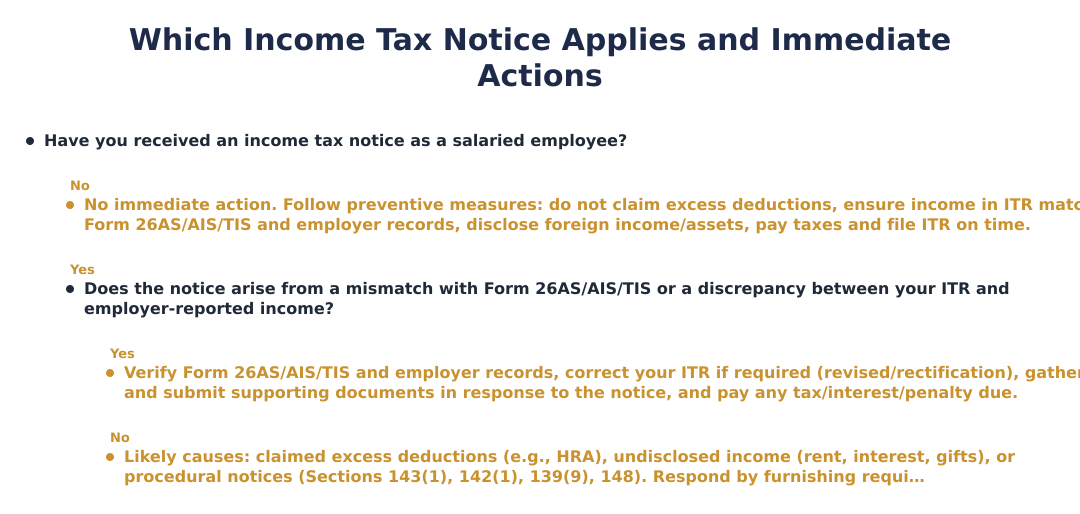
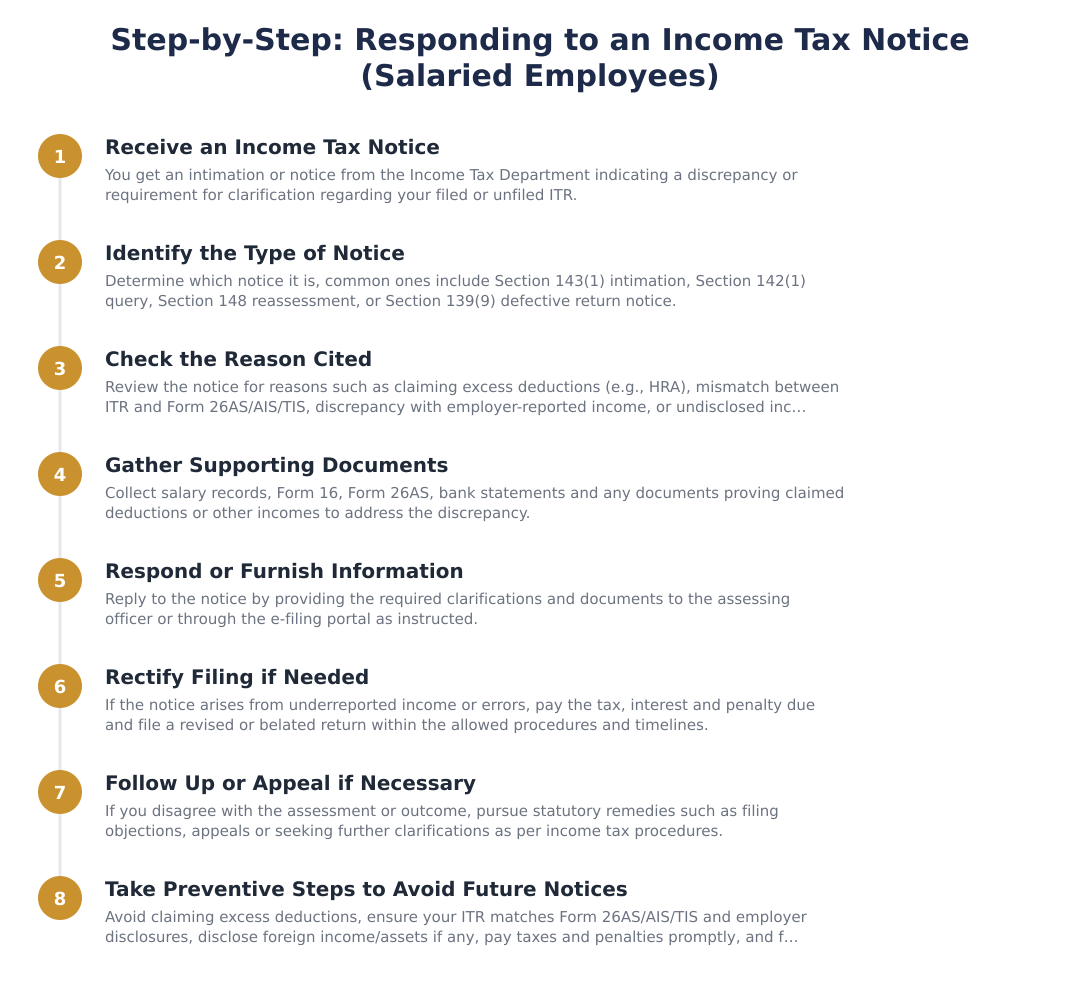
Examine the notice carefully to understand the reason cited, the sections invoked, and the deadline; verify it is issued by the tax department before taking further action.
Collect your ITR copy, Form 16, Form 26AS, proofs of investments and deductions, bank statements, and any other documents relevant to the issue raised.
Draft a concise explanation addressing each point in the notice and include the supporting documents that resolve the discrepancy or substantiate your claim.
Submit your reply and attached documents within the notice deadline and obtain an acknowledgement or response from the Income Tax Department to confirm receipt.
How to Avoid Income Tax Notices to Salaried Employees?
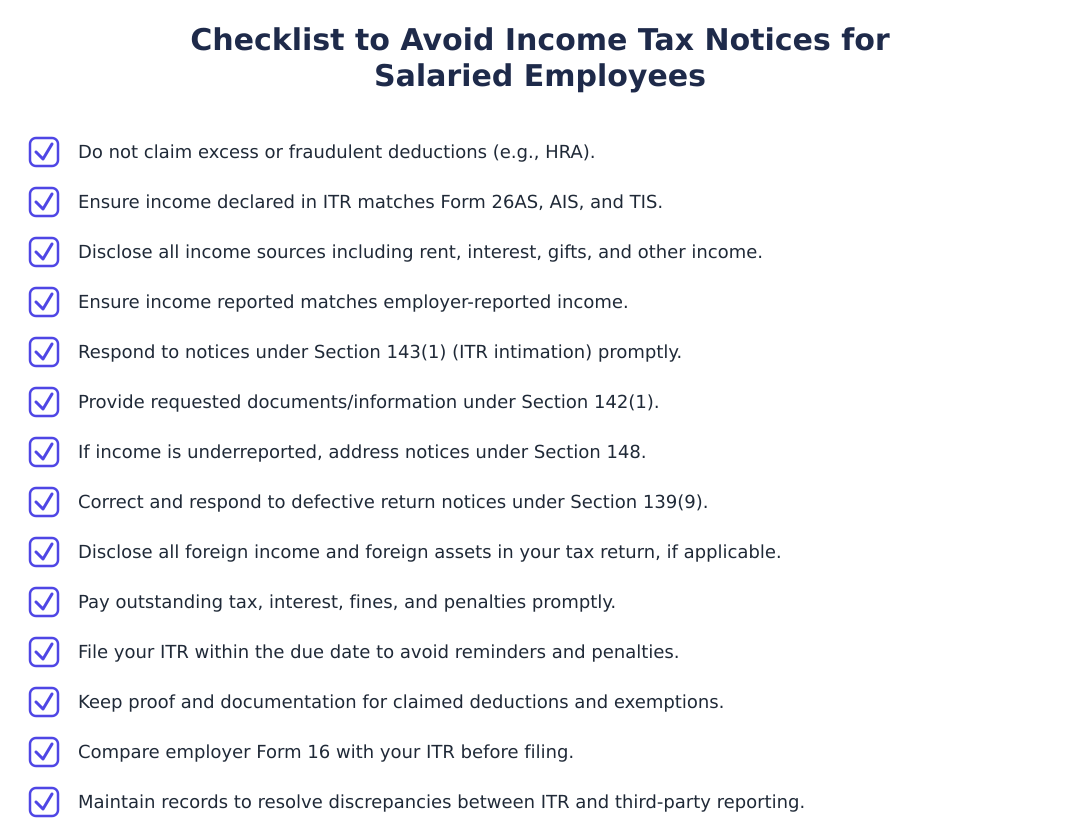
The best defence against notices is accurate and complete reporting. Do not claim excess deductions or otherwise manipulate figures simply to obtain a refund or reduce taxable income. Claims should be supported by genuine documentation and match what is reflected in third‑party information sources.
Ensure the income you report in your return is at least equal to the figures shown in Form 26AS, AIS, or TIS, and that the income declared is not less than what your employer has reported. Also disclose any other sources of income, including foreign income and foreign assets if applicable, so there is no mismatch between your return and information available to the department.
Timely compliance helps avoid reminders and penalties: file your ITR on time, pay any tax, fines or penalties promptly, and keep records organized so you can respond quickly if a clarification is sought.
Frequently Asked Questions
Q: Will every notice mean I am guilty of wrongdoing? A: Not necessarily. Notices are often sent to seek clarification or reconcile data; they do not automatically imply fraud or evasion. A correct and timely response with supporting documents can resolve many notices.
Q: What documents should I keep ready if I receive a notice? A: Keep a copy of your filed ITR, Form 16, Form 26AS, proofs of investments and deductions, bank statements, and any employer communications that support the figures declared. These documents help substantiate your entries when replying to the department.
Q: What happens if I miss the notice deadline? A: It is important to respond within the deadline specified in the notice and obtain acknowledgement. Missing the deadline may lead to further notices or administrative action; therefore, timely submission and obtaining confirmation of receipt are essential.
Income tax notices to salaried employees commonly arise from data mismatches, undeclared income, or defective returns. Responding promptly, authenticating the notice, and providing clear documentation as described above usually resolves the matter. Maintain accurate records, report all income truthfully, and adhere to filing and payment timelines to reduce the likelihood of receiving future notices.
Frequently asked questions
What is an income tax notice and why might I receive one as a salaried employee?
An income tax notice is a formal communication from the Income Tax Department asking for clarification, additional information, or corrective action regarding your tax return or tax liability. Salaried employees typically receive notices for reasons such as discrepancies between ITR and Form 26AS/AIS/TIS, claiming excess deductions (for example, incorrect HRA or Section 80C claims), mismatch between income declared by the employer and the employee, or undisclosed income like interest or rent. Notices can ask you to file a missing return, correct a defective return, or explain under-reported income and may carry deadlines to respond. Ignoring a notice can lead to further enquiries, penalties or reassessment proceedings under relevant sections of the Income Tax Act.
What are the common reasons a salaried employee gets an income tax notice?
Common reasons include claiming excess or fraudulent deductions (such as an inflated HRA claim), mismatch between income declared in the ITR and Form 26AS/AIS/TIS, discrepancies between salary reported by the employer and by the employee, and failure to disclose other income like rental income, bank interest, or gifts. The department routinely matches third-party data (Form 16, Form 26AS, employer reports) with the ITR, and any inconsistency triggers a notice. Even simple mistakes like arithmetic errors, omitted TDS credits, or late filing can prompt specific notices that require explanation or correction within the notice timeline.
What types of income tax notices can a salaried employee receive and what do they mean?
A salaried employee can receive notices such as Section 143(1) intimation (preliminary assessment after filing ITR), Section 142(1) notice (request for information or reminder to file ITR), Section 148 notice (reassessment when income appears under-reported), and Section 139(9) notice (defective return). Section 143(1) often shows tax computation differences or refunds/dues; Section 142(1) asks for documents or clarifications; Section 148 reopens assessment if the department believes income was omitted, and Section 139(9) requires you to correct or explain defects within a limited period. Each notice has specific statutory timelines and responses required, and failing to respond can lead to further action or penalties.
What should I do immediately after receiving a Section 143(1) intimation as a salaried taxpayer?
You should first read the Section 143(1) intimation carefully and compare the department’s computation with your filed ITR and Form 26AS to identify mismatches. If the intimation shows additional tax due, pay the amount or file a rectification request under Section 154 if you believe it's an error; if it shows excess tax or refund, check processing delays and claim rectification if necessary. Keep supporting documents like Form 16, payslips, investment proofs and Form 26AS handy for quick resolution and respond within the timelines stated in the intimation to avoid escalation.
How should I respond to a Section 142(1) notice asking for documents or information?
You should provide the exact documents and clear written explanations requested in the Section 142(1) notice within the specified deadline, either electronically through the e-filing portal or in the manner prescribed in the notice. Typical documents include Form 16, Form 26AS, bank statements, investment proofs, rent receipts or tenancy agreements for HRA, and explanations for any unexplained income entries; make sure to authenticate and attach translations if needed. If you need more time, you may request an extension or appear in person at the assessing officer’s office on the given date, but failure to respond can lead to proceedings under the Act and potential penalty.
What does a Section 148 notice mean and how risky is it for a salaried person?
A Section 148 notice means the assessing officer believes there is income that was omitted from your original return and seeks to reassess your tax liability for that year, which can be serious because it can lead to additional tax, interest and penalties. For salaried individuals, reassessments commonly arise from undeclared income like bank interest, rental income, or mismatches in third-party reports; the department can reopen assessments generally up to three years (and up to ten years for certain cases of income escaping assessment). On receipt, you should consult a tax professional immediately, gather supporting records for the year under review, and respond within the statutory time limits to avoid default assessments or higher penalties.
What documents should I gather to respond to any income tax notice as a salaried employee?
Gather Form 16, the filed ITR copy, Form 26AS, payslips for the relevant year, bank statements, proof of claimed investments (insurance, PPF, ELSS), rent receipts or lease agreements for HRA claims, and receipts for any other deductions or exempt income. Also keep a clear computation of taxable income and TDS credits marked against entries in Form 26AS, and any communication with your employer regarding salary components. Submitting organized, matching documents with a concise cover letter or written explanation makes it easier for the assessing officer to verify and close the matter quickly.
What are the steps to properly respond to an income tax notice to avoid penalties?
First, carefully read the notice to identify the assessed section and deadline, then verify the facts against your filed ITR, Form 26AS and supporting documents. Second, collate and submit the requested documents and a clear written response (with computations if needed) through the e-filing portal or as directed, and pay any admitted tax, interest or penalty promptly; if you disagree, file a detailed explanation or rectification petition. Finally, retain proof of submission and communication, and if the matter is complex or involves reassessment, consult a tax professional to consider legal remedies or appeals, timely, accurate responses usually prevent further escalation or heavier penalties.
How can a salaried employee reduce the chances of getting an income tax notice in the future?
You can reduce the chances by correctly reporting income equal to the amounts shown in Form 26AS/AIS/TIS, avoiding inflated or unsupported deduction claims (for example, accurate HRA and Section 80C claims), disclosing all foreign income or assets if any, and filing timely and accurate ITRs with payment of any tax, interest or penalties due. Reconcile your employer’s Form 16 and your Form 26AS before filing, maintain documentary proof for all deductions and exemptions, and promptly rectify any mismatch through the e-filing portal. Consistent record-keeping and honest reporting of all income sources make notices less likely and simplify responses if a notice is issued.
Need help staying Income Tax compliant?
MoneyGence's AI Finance OS tracks your compliance, wallet share, and finances in one place, built for agencies and growing businesses.
Get started with MoneyGence