Income Tax on Gold in India: Digital, Physical & Paper Gold Rules
This guide explains how income tax applies to different forms of gold held or traded in India, physical gold (coins, jewellery, bars), digital gold (online units backed by physical metal), paper gold (ETFs, mutual funds and other non-physical instruments), derivatives and sovereign gold bonds, and what common tax considerations investors should keep in mind. You will learn the conceptual differences between these forms, how gains from sale or transfer are typically classified for tax purposes, special considerations for gifts and inheritance, the position for non-resident investors, and general strategies commonly used to manage tax on gains. The aim is practical: to help you recognise which tax head is likely to apply, what documentation matters when you prepare returns, and how holding form, duration and purpose of your investment can affect tax treatment. This article does not provide specific statutory rates or time limits; instead it focuses on the rules’ logic and the steps you can take as an investor to remain compliant and to plan efficiently. Whether you hold a small quantity of gold as personal jewellery or manage a portfolio with paper and digital gold, understanding these principles will help you evaluate tax outcomes, gather the right records, and discuss precise numbers with a tax professional or through authoritative tax notifications when needed.
What is Digital Gold?
Digital gold refers to arrangements where an investor buys a claim to an amount of gold through an online platform, and the issuer stores equivalent physical metal in a vault on the investor’s behalf. From the investor’s perspective, ownership is represented electronically rather than by physical possession.
Practically, digital gold combines convenience of online purchase and small-ticket investing with custody services. Investors should be aware that the investment’s underlying economics track gold prices, while custody, storage and transaction terms are governed by the issuer’s product terms rather than a single uniform statutory framework.
Income Tax on Digital Gold in India
For tax purposes, gains arising from sale of digital gold are treated on the same conceptual basis as gains from sale of physical gold, namely, as capital gains or other income depending on how the investment is held and traded. The actual tax outcome depends on whether the gain is treated as short-term or long-term under the tax law, and on the investor’s broader income situation.
Because digital gold is typically backed by physical metal, the point of taxation and the type of record keeping required (purchase invoices, statements from the issuer, and sale receipts) are similar to those for physical holdings. Investors should retain transaction confirmations and holding statements from the digital-gold provider to establish cost and sale consideration when preparing returns.
Taxes on Physical Gold Purchase
Physical gold, including jewellery, coins, bars and biscuits, has long been a popular form of savings and gifting. From an income-tax perspective, sale of physical gold will generally give rise to capital gains where the seller realises proceeds exceeding their cost of acquisition, subject to the classification rules in the tax law.
When holding physical gold for personal use or for investment, documentation such as purchase bills, hallmarking certificates and valuation records for jewellery are important to support cost and any claimed basis. Because jewellery may have separate labour or making charges, separating metal cost from other components is often relevant when computing tax consequences.
Income Tax on Paper Gold in India
Paper gold covers instruments that give exposure to gold prices without physical delivery, such as ETFs, mutual funds that invest in gold and other securities whose underlying asset is gold. For investors, returns from these instruments are typically taxed as capital gains arising on unit sale or transfer.
Tax treatment depends on holding pattern and instrument type; for planning and compliance purposes keep records of purchase dates, unit allotments, NAV at purchase and sale and any folio or demat statements. If you use these instruments in a business activity, the way gains are classified for tax may differ from a simple capital asset sale.
Income Tax on Gold Derivatives
Gold derivatives, futures and options or similar contracts, are traded in commodity and derivatives markets. Profits from trading these instruments are frequently treated as business income rather than capital gains, reflecting the trading nature and frequency of transactions for many participants.
When gains are treated as business income, taxpayers often prepare profit & loss statements and can claim business expenses related to the activity. Traders should maintain detailed trading records, contract notes and broker statements to support computation of taxable income and allow for correct treatment of expenses and losses.
Income Tax on Sovereign Gold Bonds (SGBs)
Sovereign gold bonds are government-issued instruments that provide exposure to gold prices and may include features such as periodic interest and a defined maturity. The tax treatment of gains arising from SGBs can depend on whether the bonds are held till maturity and whether they were acquired in an original issue or in the secondary market.
Investors should refer to the terms of the specific bond issuance and authoritative tax notifications to understand tax outcomes on maturity proceeds, interest receipts and capital gains on earlier sale, and should keep records of allotment confirmations and redemption statements for tax filing.
Income Tax on Gift or Inheritance of Gold
Gold received as a gift or by inheritance raises two separate tax questions: whether receipt of the gold is taxable when received, and whether a subsequent sale attracts capital gains. The answers depend on the relationship between the parties and the applicable provisions in the tax law.
Even when receipt as a gift is not taxable, the person who later sells the gold will typically need to compute capital gain on the sale using an appropriate cost basis and holding period. Maintaining documentation that shows the source, date and nature of the gift or inheritance is critical for later tax computations.
Income Tax Rules on Gold for NRIs
Non-resident investors can hold and trade various forms of gold subject to the country’s foreign exchange and tax regulations. Tax on gains realised by non-residents from gold transactions is governed by the tax law applicable to non-residents and may be similar in principle to that for residents, but procedural and compliance aspects can differ.
NRIs should pay attention to withholding requirements, documentation for proof of purchase and sale, and any special reporting requirements. Consulting a tax adviser with cross-border experience helps in correctly addressing residence status, treaty implications and compliance steps.
How Can You Save Taxes on Long-Term Capital Gains from Gold Investments?
Tax-efficient planning around gains from gold typically involves choosing the appropriate holding form, understanding the applicable classification for gains (capital vs business), and using available exemptions or reliefs where permitted by law. Reinvesting proceeds into specified assets or meeting conditions for exemptions, when available, can reduce taxable amounts in some situations.
Practical steps include documenting cost and holding periods, using official valuations when needed, holding instruments in the manner required for specific exemptions, and consulting a tax professional before restructuring holdings purely for tax reasons to ensure compliance with anti-abuse provisions.
Final Word
Taxation of gold in its different forms depends on the nature of the instrument, how long you hold it, whether it’s treated as an investment or business asset, and the specific statutory provisions that apply. Keeping clear records and understanding how your holding is classified are the two most important steps to get tax reporting right.
Because specific rates, time limits and exemptions are set out in tax laws and notifications that can change, consult the latest official guidance or a qualified tax adviser for exact calculations and to apply any reliefs correctly.
Frequently Asked Questions
Q: Is the tax treatment different for physical and digital gold? A: Conceptually they are treated similarly for capital gains purposes because digital gold is backed by physical metal; however, documentation and issuer terms differ so you should keep appropriate records.
Q: Do derivatives have the same tax treatment as physical gold? A: Derivative trading is often treated as business income for frequent traders, which differs from simple capital gains on sale of physical gold. Q: What records should I keep? A: Retain purchase invoices, issuer statements, contract notes and any valuation or hallmark certificates to support cost and sale consideration when filing returns.
Gold taxation depends heavily on form, intent and documentation. Use careful record-keeping, understand how your holdings are classified under tax law, and seek up-to-date official guidance or professional advice before making tax-driven investment decisions.
Frequently asked questions
What exactly is digital gold and how is it different from physical gold?
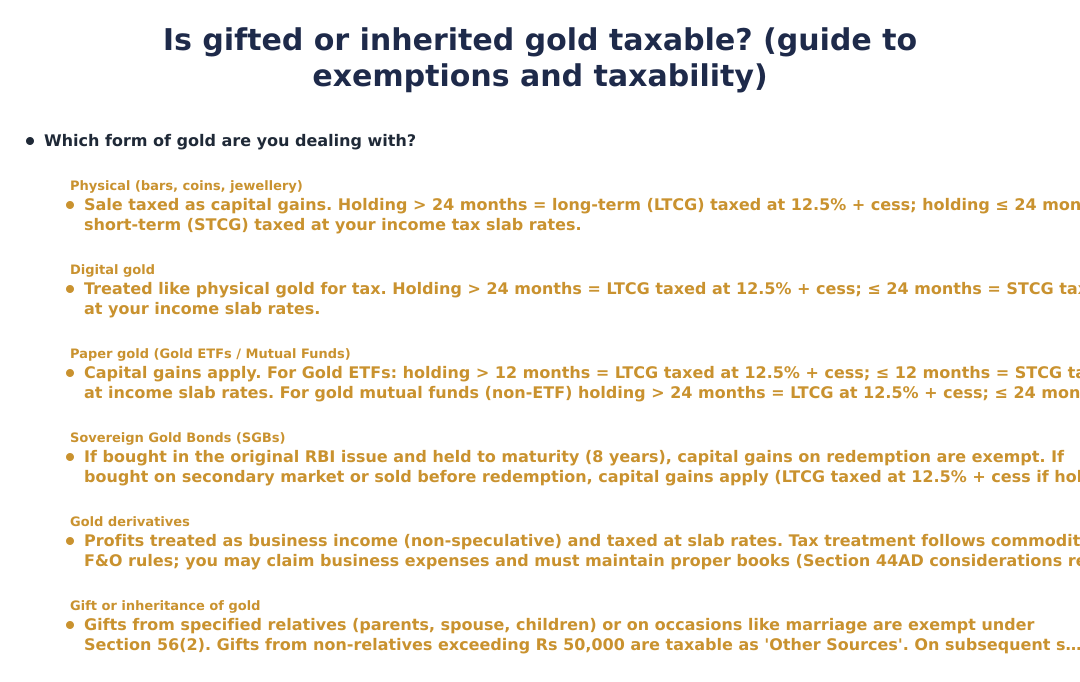
Digital gold is functionally the same as physical gold but is bought online and stored in vaults by the issuer on your behalf. It does not give you physical possession unless you ask for delivery, and government bodies like the RBI or SEBI do not regulate digital gold. Because it represents ownership of actual gold stored by the seller, tax treatment on sale follows the same capital gains rules as physical gold. You should still check the issuer’s storage, insurance and buy/sell spreads before investing.
How is income tax charged when I sell physical gold like jewellery, coins or bars?
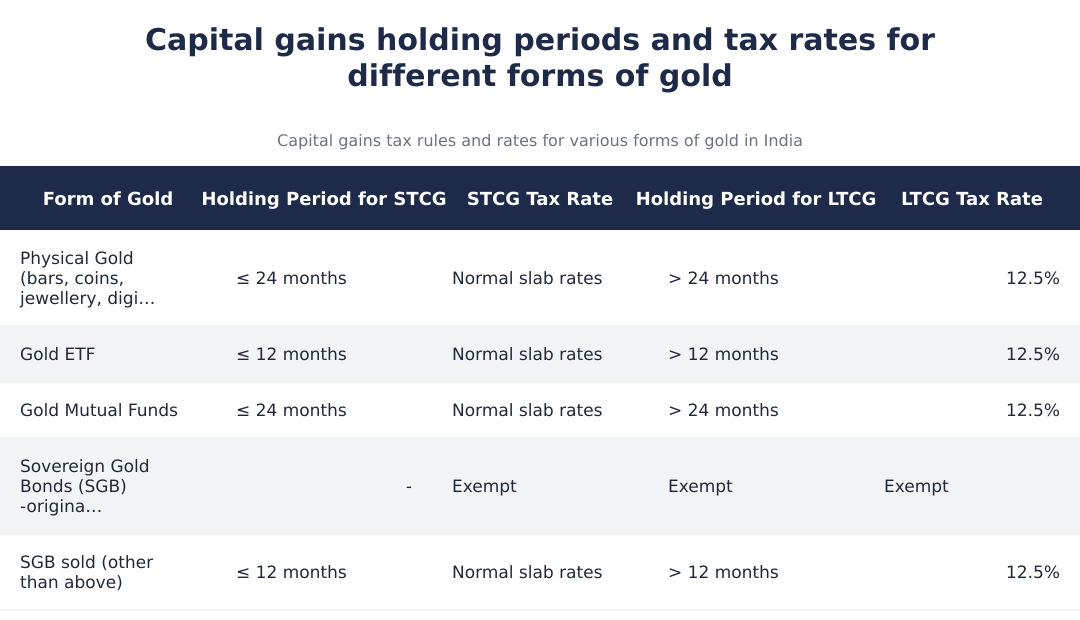
Income tax on sale of physical gold is charged as capital gains: short-term if held for 24 months or less and long-term if held for more than 24 months. Short-term capital gains (STCG) from physical gold are added to your income and taxed at your applicable slab rate, while long-term capital gains (LTCG) are taxed at 12.5% plus applicable cess. These rates apply to physical forms including jewellery, biscuits, coins and to digital gold treated like physical holdings for tax purposes.
What are the holding periods and tax rates for gold ETFs and gold mutual funds?
Gold ETFs are treated as short-term if held for 12 months or less and long-term if held for more than 12 months, whereas gold mutual funds follow a 24-month short-term threshold like physical gold. For short-term holdings you pay tax at your income-tax slab rates on gains, and for long-term holdings you pay 12.5% (LTCG) plus cess. The same distinction means a gold ETF held 13 months attracts LTCG at 12.5%, but a gold mutual fund needs 25 months to qualify for LTCG treatment.
Are capital gains on Sovereign Gold Bonds (SGBs) taxable?
Capital gains on Sovereign Gold Bonds (SGBs) are fully exempt if you subscribed in the original RBI issue and held them till maturity (8 years). If you sell SGBs on the secondary market or dispose of them before maturity, capital gains apply: STCG if held 12 months or less is taxed at slab rates, and LTCG if held over 12 months is taxed at 12.5% plus cess. Additionally, the periodic interest paid on SGBs is taxable as income under your usual tax slab.
How is income from trading gold derivatives taxed?
Income from gold derivatives (futures and options) is treated as business income and taxed at your applicable slab rates as non-speculative business income. Such trading follows commodity F&O tax norms rather than capital gains rules, so you can claim business expenses and maintain P&L accounts to determine taxable income. To claim presumptive taxation under Section 44AD you should maintain proper books; otherwise normal business taxation and compliance (audit thresholds, TDS where applicable) will apply.
If I receive gold as a gift or inheritance, do I have to pay income tax?
Gold received as a gift or inheritance from specified relatives (for example parents, spouse, children) or on certain occasions like weddings is exempt from income tax when received. If you receive gold from non-relatives and the value exceeds Rs 50,000, the surplus is taxable under the head 'Income from Other Sources' as per Section 56(2). Note that even when receipt is exempt, any capital gains arising on a later sale of that gold will attract capital gains tax based on the applicable holding-period rules.
Do NRIs face different tax rules when they sell gold in India?
NRIs are subject to the same capital gains tax rates on sale of gold as resident Indians: STCG taxed at slab rates and LTCG at 12.5% plus cess based on the holding period applicable to the form of gold. However, NRIs are not permitted to invest in Sovereign Gold Bonds under RBI/FEMA norms, though they may hold physical, digital or paper gold traded in India. NRIs should also consider TDS provisions and treaty benefits; tax deducted at source on sales may be claimable as credit against final tax liability on filing returns.
What exemptions can I use to save tax on long-term capital gains from selling gold?
You can claim exemptions under Sections 54F and 54EC to reduce long-term capital gains tax when conditions are met: Section 54F provides exemption if you invest the sale proceeds into a residential house (proportionate exemption applies), while Section 54EC allows reinvestment into specified bonds (subject to limits and timelines). These exemptions apply only to LTCG (i.e., when the asset qualifies as long-term) and you must follow the investment timelines and conditions laid down in each section to claim the benefit. Keep documentary proof of investments to support the exemption when filing your tax return.
Does buying physical gold attract any income tax at the time of purchase?
No, purchasing physical gold does not attract income tax at the time of purchase; tax is triggered only when you sell and realize capital gains. The tax treatment (STCG vs LTCG) depends on the holding period, 24 months for most physical gold, with LTCG taxed at 12.5% and STCG taxed at slab rates. However, for jewellery purchases you should retain purchase invoices and valuation proofs to establish cost and holding period for accurate capital gains computation when you sell.
Need help staying Income Tax compliant?
MoneyGence's AI Finance OS tracks your compliance, wallet share, and finances in one place, built for agencies and growing businesses.
Get started with MoneyGence