Income Tax Rate Chart AY 2026-27: Rates for All Taxpayers
This guide explains how to read and use an income-tax rate chart for a given assessment year and legislative update. You will learn what elements a rate chart normally contains, how to compare different tax regimes, and which practical checks to perform when using the chart for personal or business tax planning. The aim is to make you confident in spotting the parts of a chart that matter, slab structure, special rates, surcharges, rebates, and any optional tax regimes, and to translate those into actionable choices for filing, payroll, or advisory work. Understanding a rate chart is important because it turns legislative text into everyday decisions: whether a taxpayer benefits from an alternative regime, how marginal relief can affect high-income taxpayers, and which components of income may be taxed at special rates. This guide focuses on interpretation and application rather than repeating statutory language verbatim. You will also get practical tips on where to look for authoritative updates and how to document assumptions when advising clients or preparing individual returns. By the end, you should be able to read a typical income-tax rate chart, identify the elements that influence tax liability the most, and use that knowledge to plan withholding, estimated tax payments, and year-end tax-saving steps.
What an income-tax rate chart typically shows
A standard income-tax rate chart lays out the sequence of taxable income slabs and the corresponding rates that apply to each slab. It also flags separate provisions such as optional tax regimes, concessional slabs for senior taxpayers, and rates applicable to particular entities. When you see a chart, treat it as a map: the slabs tell you how marginal income is taxed, while special entries indicate exceptions or alternate paths.
Beyond slab rates, charts commonly include ancillary information that materially affects computation: surcharge slabs, any applicable health or education cess, and notes on special-rate incomes. A careful reader should scan the fine print for exclusions and cross-references to sections that restrict or exempt certain incomes. In practice, these annotations determine whether a taxpayer pays tax at ordinary slab rates or at a different, specified rate.
How to compare tax regimes and choose the best option
Many jurisdictions offer more than one personal-tax regime, a default regime that allows certain deductions and an alternative simplified regime with lower rates but fewer deductions. Comparing regimes requires a side-by-side calculation of taxable income under each approach, factoring in realistic estimates of deductions, exemptions and credits a taxpayer expects to claim.
When advising clients or deciding for yourself, run scenario analyses for typical income items (salary, capital gains, interest) and common deductions. Pay particular attention to the break-even point where the benefit of deductions equals the advantage of lower rates in the alternative regime. Document assumptions clearly so that the choice remains defensible if circumstances change during the year.
Special-rate incomes, surcharge and marginal relief, what to watch for
Rate charts often separate special-rate incomes, for example, certain capital gains or income from specified activities, which may not follow the ordinary slab pattern. These items can affect overall liability disproportionately because they may be taxed at a flat, higher, or concessional rate and are sometimes excluded from general rebates.
Surcharge provisions can increase tax liability at higher income levels and may introduce non-linear jumps. In some systems, a concept called marginal relief limits the effective additional burden when a small increase in income crosses a surcharge threshold. When reviewing a chart, identify surcharge trigger points and note whether any relief mechanics apply so you can estimate the real incremental tax on additional income.
Practical checklist for using a rate chart in tax planning
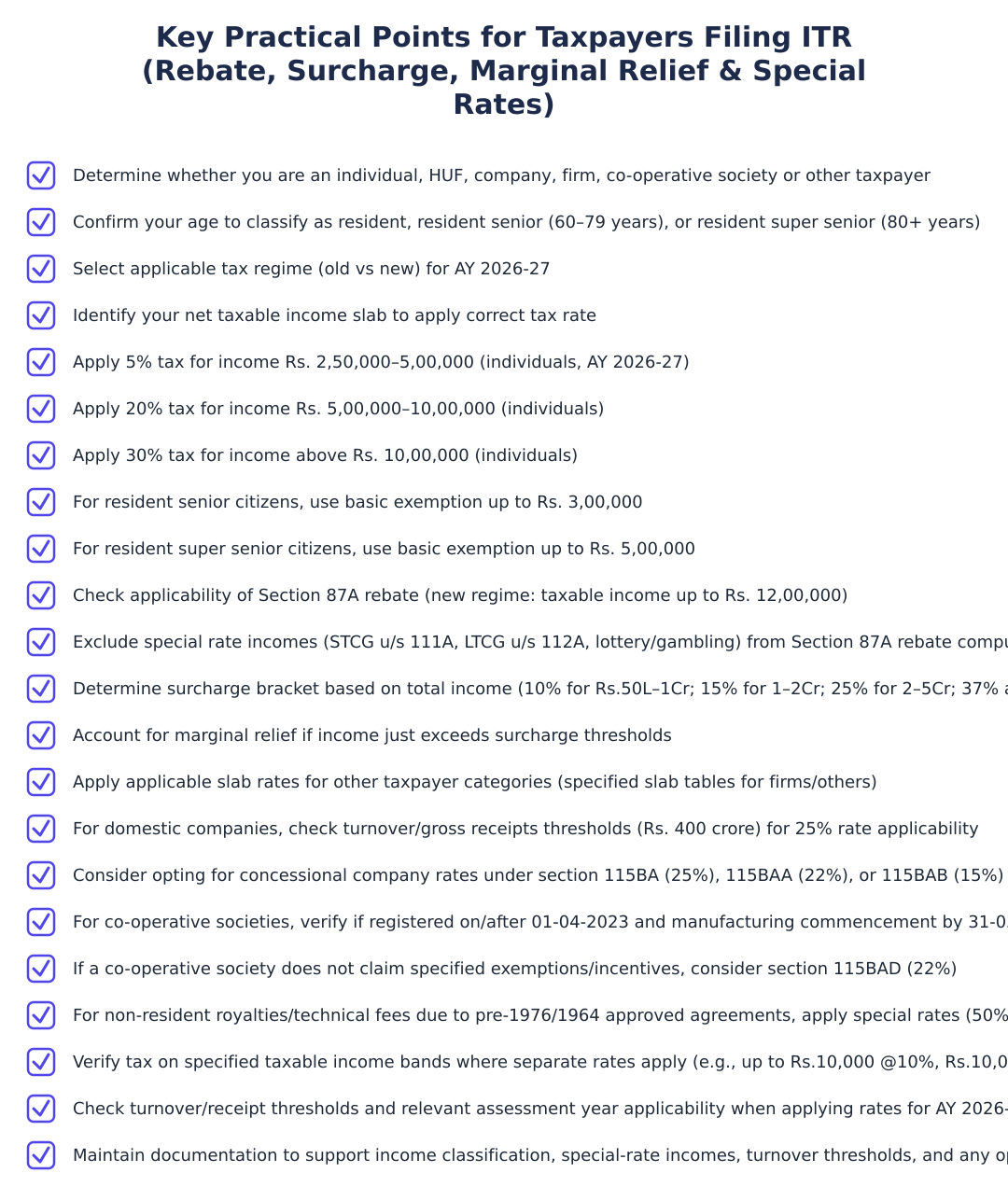
Start with correct classification of the taxpayer, individuals, senior taxpayers, firms, companies or cooperative societies, because charts often have different headings for each class. Next, segregate income types that attract special rates and compute them separately before aggregating for overall tax liability.
Also verify applicability of any rebates or threshold-based concessions and ensure you understand which incomes are excluded from such benefits. Finally, use conservative estimates for uncertain items (like fluctuating capital gains) and re-run projections periodically through the year to decide on withholding and estimated payments.
Where to find authoritative updates and how to document assumptions
Tax rates and related rules change through legislation, notifications, and official clarifications. Rely on primary sources, the finance act, official gazette notifications, and administrative guidance, for final confirmation. Secondary summaries and charts are useful for quick reference but should be cross-checked against the authoritative text before making binding decisions.
When you prepare advice, keep a one-page assumptions note that lists the versions of the law consulted, the taxpayer classification used, and the specific incomes treated as special-rate items. This makes your analysis transparent and defensible if facts or law change later.
A rate chart translates statutory provisions into a practical tool for estimating tax liability. Use it as a starting point: identify slabs and special rates, compare alternative regimes with clear assumptions, watch surcharge mechanics, and confirm figures against official sources. Periodic re-checks during the year help avoid surprises at filing time.
Frequently asked questions
What are the individual income tax slabs for AY 2026-27 under the ordinary (old) regime for a regular taxpayer under 60 years?
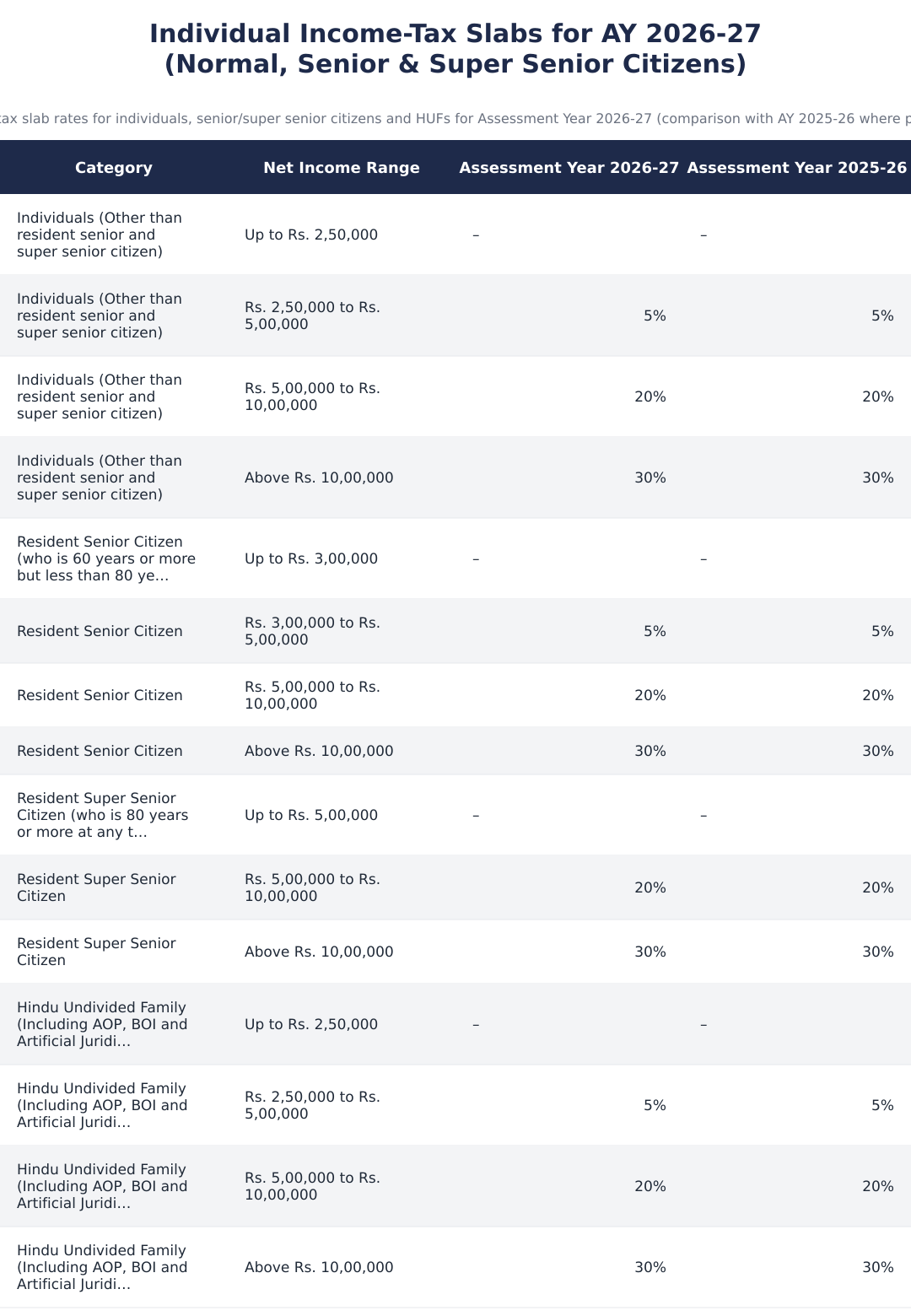
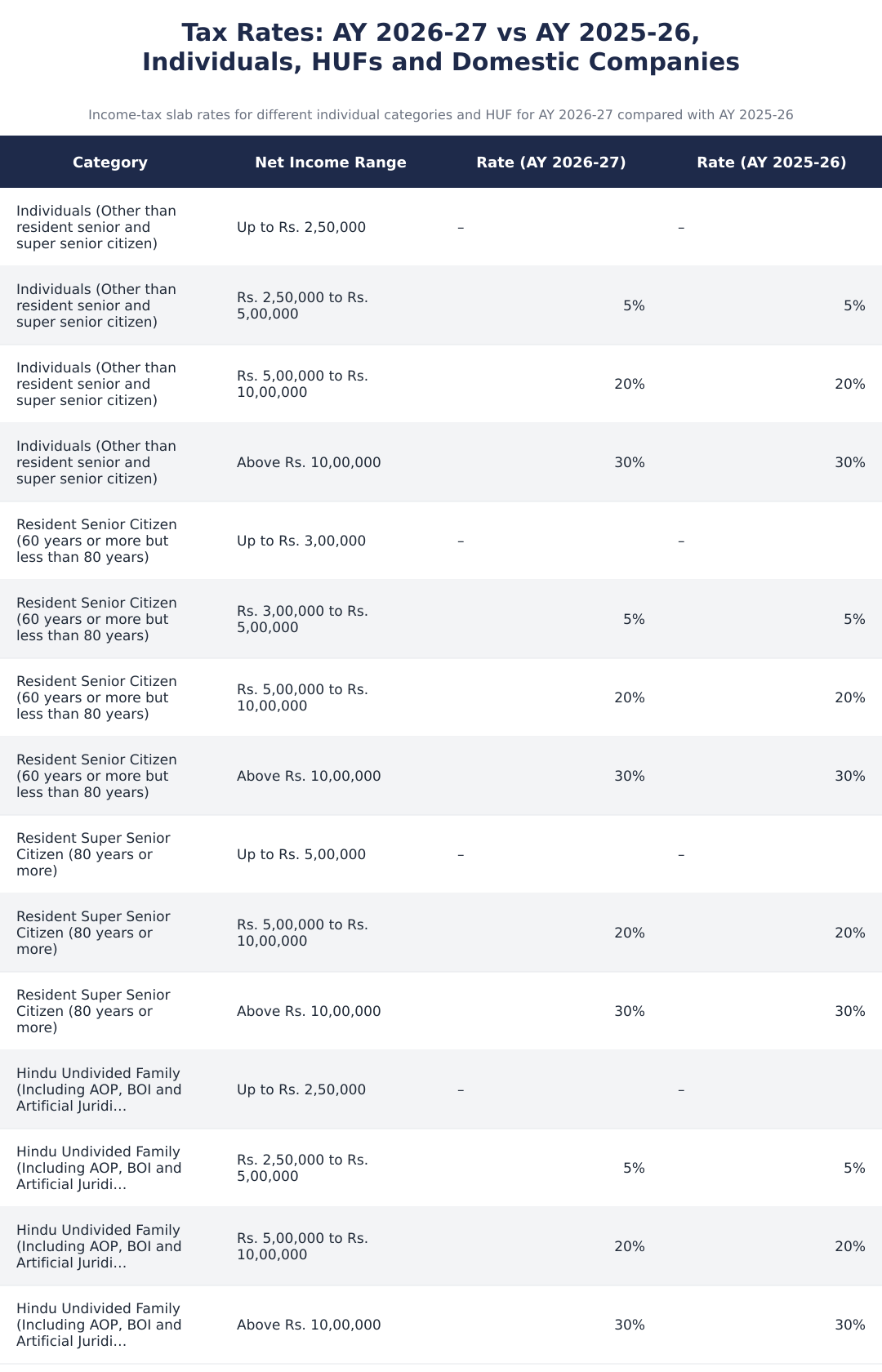
For AY 2026-27 a resident individual (other than senior or super senior) pays tax at 5% on income between Rs. 2,50,000 and Rs. 5,00,000, 20% on income between Rs. 5,00,000 and Rs. 10,00,000, and 30% on income above Rs. 10,00,000. The basic exemption limit remains Rs. 2,50,000 for taxpayers below 60; income up to that amount is tax-free. These rates are the same as AY 2025-26 for these slabs. Remember that health and education cess and applicable surcharge (if income exceeds prescribed thresholds) are charged in addition to these rates.
How do the tax slabs differ for resident senior (60–79 years) and super senior (80+ years) taxpayers in AY 2026-27?
Resident senior citizens (60–79 years) get a higher basic exemption of Rs. 3,00,000 while resident super senior citizens (80+ years) get an exemption of Rs. 5,00,000 for AY 2026-27. For seniors, income from Rs. 3,00,000 to Rs. 5,00,000 is taxed at 5%, Rs. 5,00,000 to Rs. 10,00,000 at 20% and above Rs. 10,00,000 at 30%; for super seniors the 5% slab applies from Rs. 5,00,000 to Rs. 10,00,000 and 30% above Rs. 10,00,000. These slab rates match AY 2025-26’s percentages but with the raised exemption thresholds for older age groups.
What is the surcharge structure for AY 2026-27 on income tax and when does it apply?
Surcharge for AY 2026-27 applies on the income-tax amount and is charged at 10% for income over Rs. 50 lakh up to Rs. 1 crore, 15% for income over Rs. 1 crore up to Rs. 2 crore, 25% for income over Rs. 2 crore up to Rs. 5 crore, and 37% for income exceeding Rs. 5 crore. The surcharge percentages are applied to the basic tax, increasing the effective tax burden for high-income taxpayers and are separate from the health and education cess. Marginal relief rules may limit the surcharge for incomes that just cross a threshold so that the surcharge does not create a disproportionate jump in tax liability.
What is the Section 87A rebate threshold for AY 2026-27 and how does it work with special-rate incomes?
For AY 2026-27 the Section 87A rebate applies in the new regime only if total taxable income does not exceed Rs. 12 lakh, and the rebate amount can reduce tax liability to zero on eligible income. Special-rate incomes such as short-term capital gains under Section 111A (20%), long-term capital gains under Section 112A (12.5%), and certain lottery/gambling incomes are excluded from the rebate calculation, their tax remains payable even if the rebate otherwise reduces tax on the rest of your income to zero. For example, if you have Rs. 11.5 lakh salary income (eligible for rebate) plus Rs. 2 lakh STCG taxed at 20%, the STCG tax (Rs. 40,000) is payable even though the salary portion may get rebate benefits.
What corporate tax rates apply to domestic companies for AY 2026-27 including the concessional options?
For AY 2026-27 domestic companies generally face a 25% tax rate if their turnover in FY 2023-24 did not exceed Rs. 400 crore; other domestic companies are taxed at 30%. Companies that opt for concessional regimes pay 25% under section 115BA, 22% under section 115BAA, or 15% under section 115BAB (subject to the conditions of each option). These concessional rates require the company to forgo specified exemptions, incentives or deductions and must meet the eligibility and compliance conditions specified in each section.
What tax rates apply to co-operative societies for AY 2026-27 and what are the new sections 115BAE/115BAD?
Co-operative societies that meet the special manufacturing conditions and registration dates and do not claim specified exemptions can be taxed at 15% under Section 115BAE for income from manufacturing activities; otherwise a co-operative society that does not claim specified exemptions is taxed at 22% under Section 115BAD. Section 115BAE applies only if the society is set up and registered on or after 01-04-2023, is engaged in manufacture, commences manufacturing on or before 31-03-2024, and does not claim specified exemptions/incentives. If these conditions are not satisfied but the society still foregoes specified exemptions, Section 115BAD (22%) is the applicable concessional rate.
What are the tax rates for Hindu Undivided Families (HUFs) and other AOP/BOI entities for AY 2026-27?
Hindu Undivided Families (including AOP, BOI and artificial juridical persons) for AY 2026-27 follow the same slab structure as individuals: up to Rs. 2,50,000 is tax-free, Rs. 2,50,000–5,00,000 taxed at 5%, Rs. 5,00,000–10,00,000 at 20%, and above Rs. 10,00,000 at 30%. The HUF slab rates are identical to the individual (non-senior) slabs and mirror the rates applied in the previous assessment year. Surcharge and cess are applicable additionally where thresholds are crossed.
How does marginal relief work when your income just crosses a surcharge threshold?
Marginal relief limits the surcharge payable when a taxpayer’s total income marginally exceeds a surcharge threshold so the extra tax due to surcharge does not exceed the income amount above that threshold. For example, if income is Rs. 50.5 lakh the normal surcharge (10% on base tax) could be larger than the incremental income above Rs. 50 lakh; marginal relief restricts the surcharge to an amount equal to that incremental income (here Rs. 50,000). This prevents a disproportionately large jump in tax liability for small increases in income around surcharge cut-offs.
What are the tax rates for non-resident Indians (NRI) and special incomes like royalty or technical fees?
Special incomes for non-resident taxpayers attract specific rates: royalty or fees for technical services received from the Government or an Indian concern under certain historical agreements are taxed at 50% if those agreements were executed in specified older periods and approved by the Central Government; other income of non-residents is generally taxed at 35% where specified. These special rates apply to particular types of income and historical agreements and are separate from the normal resident slab system; other non-resident income rules (like tax treaties) and withholding provisions may also apply.
Need help staying Income Tax compliant?
MoneyGence's AI Finance OS tracks your compliance, wallet share, and finances in one place, built for agencies and growing businesses.
Get started with MoneyGence