Income Tax Slab for Senior Citizens FY 2025-26, Old & New Regimes
This guide explains how income tax treatment differs for senior and super senior citizens in India and what matters to taxpayers and their advisors for FY 2025-26. You will learn which age groups the tax law recognises, how slab-based taxation is structured in broad terms, where the old and new tax regimes differ conceptually, which common deductions and income sources are most relevant to older taxpayers, and practical considerations when deciding a filing approach. Understanding these points helps retirees, family members and tax professionals plan taxable income, choose between regimes, and identify relevant deductions so that tax compliance and cash flow decisions are better informed. Because older taxpayers often have a higher proportion of income from pensions and interest, awareness of qualifying income types and eligible deductions (including widely used investment-linked deductions) is particularly important. This article focuses on clear explanations and practical context rather than detailed numeric examples, so you can apply the principles to your own situation or discuss specifics with a tax adviser.
Who is a Senior Citizen for Income Tax Purposes?
For income tax purposes Indian resident individuals are classified into three age-based categories. These are: individuals below 60 years of age, senior citizens who are aged 60 to 80 years, and super senior citizens who are aged above 80 years. The age classification determines which category of tax provisions and concessions may be available to a taxpayer.
The distinction matters because the tax code often treats these categories differently, for example, through different slab structures, eligibility for certain deductions, or administrative concessions. When planning taxes, confirm your residency status and correct age category first, because those two determinations are the starting point for applying the right rates, exemptions and benefits.
Income tax slabs and regimes: a conceptual overview
India’s personal income tax system is slab-based: income is divided into ranges and each range is taxed at a specified rate. Over recent years the tax framework has offered two broad options for individuals, a traditional (often called the old) regime and a simplified (often called the new) regime. Each regime applies slab rates to charge tax but they differ mainly in the availability of deductions and exemptions.
Conceptually, the old regime typically allows a taxpayer to claim a variety of deductions and exemptions (for investments, certain expenses, etc.) which can reduce taxable income before slab rates are applied. The new regime offers lower slab rates in many cases but removes or limits many of these deductions so the taxpayer accepts narrower deductions in exchange for simpler, generally lower nominal rates.
For senior and super senior citizens the slab structure under each regime can be different compared with younger taxpayers, reflecting policy decisions to provide relief to older taxpayers. When choosing between regimes, compare the tax after applying the deductions and exemptions you actually qualify for under the old regime versus the tax computed under the new regime without those deductions.
Rebate and standard deduction, what they mean in practice
Two general concepts that taxpayers encounter are rebate (a reduction of the tax liability) and standard deduction (a fixed deduction allowed from gross salary income). A rebate reduces the final tax payable subject to eligibility conditions, whereas a standard deduction reduces taxable income before tax is computed. Both can materially change take-home income, particularly for pensioners whose income sources are limited.
When assessing which tax regime to use and whether you should claim available reliefs, consider how a rebate or standard deduction interacts with your overall taxable income. If most of your income is pension and bank interest, smaller allowances applied against that base can have a proportionally larger impact on final tax. Always check the precise eligibility conditions and values applicable for the year in question before filing.
Key deductions and common sources of income for senior taxpayers
One frequently-used deduction available under the tax law is Section 80C, which allows a deduction for certain eligible investments and payments up to a specified monetary limit. Section 80C remains a central tax-saving route for many taxpayers and can be particularly relevant to seniors who continue to invest in prescribed instruments or make eligible payments.
Beyond Section 80C, older taxpayers often rely on a mix of income streams that determine their tax profiles. Typical sources include pension; interest from savings or fixed deposits; rental income from property; capital gains from sale of assets; and returns from senior-specific savings and post office schemes or reverse mortgage arrangements. The composition of these incomes affects whether tax is mostly collected at source (TDS), needs quarterly instalments, or is handled through end-of-year filing.
When planning taxes, match the available deductions to the nature of your income. For example, investment-linked deductions reduce taxable income, while reliefs specific to medical expenses or interest income (where applicable) can target particular income types. Because older taxpayers may have simpler income mixes, it is often easier to compare the net tax outcome under each regime and choose the most beneficial approach.
Practical considerations: filing, documentation and getting advice
Senior and super senior taxpayers should maintain clear records of their income sources, pension statements, bank interest certificates, rent agreements and proof of any investments claimed under deductions like Section 80C. Good documentation speeds up accurate computation, makes it easier to substantiate claims in case of queries, and helps determine whether the old or new regime is financially better.
Because taxation can hinge on small differences in income composition and permissible deductions, consult a tax adviser or use reliable tax preparation software when in doubt. A short review that compares tax under both regimes using your actual incomes and eligible deductions will typically identify the better route. Keep in mind that rules and thresholds change regularly; always confirm current-year specifics before finalising returns.
Senior and super senior taxpayers benefit from understanding the age categories, the conceptual difference between old and new regimes, and how deductions like Section 80C and common income sources shape their tax position. Focus on accurate documentation, compare actual outcomes under both regimes, and seek timely advice to optimise tax and cash flow during retirement.
Frequently asked questions
What are the income tax slabs for senior citizens under the old regime for FY 2025-26?
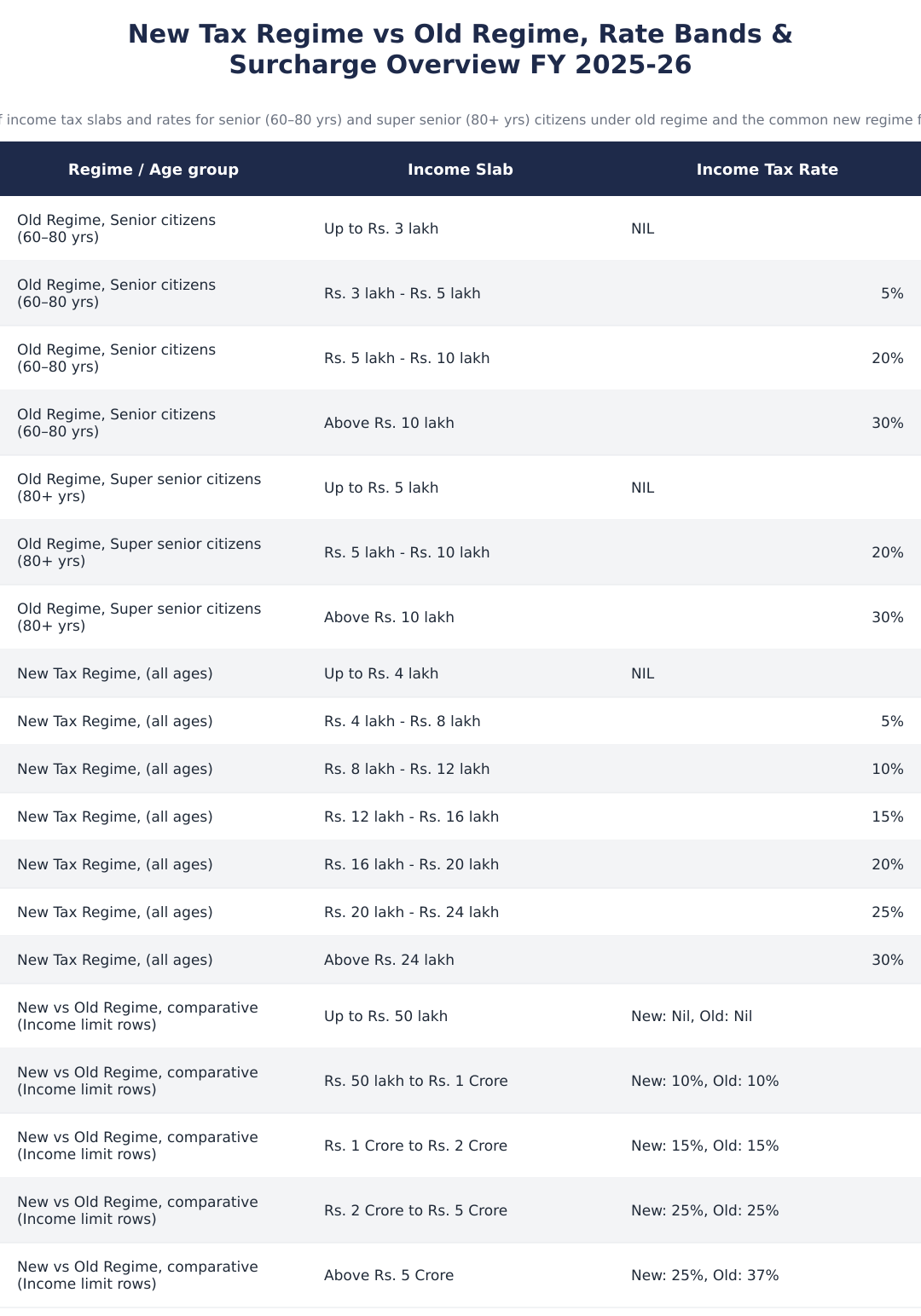
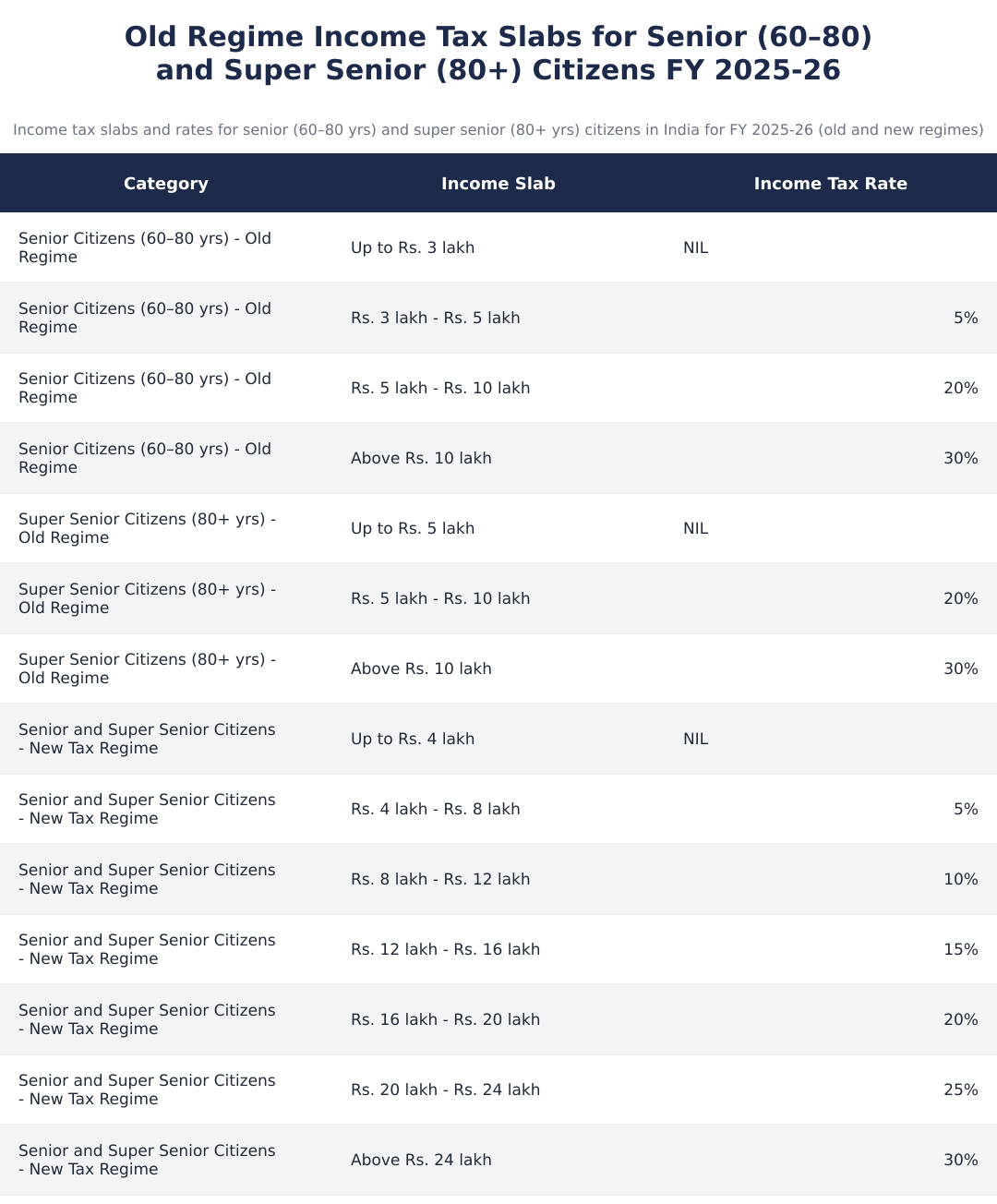
Under the old tax regime for FY 2025-26, senior citizens (aged 60 to 80 years) have a higher basic exemption limit of Rs. 3 lakh; income up to Rs. 3 lakh is tax-free, Rs. 3–5 lakh is taxed at 5%, Rs. 5–10 lakh at 20%, and income above Rs. 10 lakh at 30%. These rates apply before adding health and education cess and any applicable surcharge. Senior citizens can still claim applicable deductions (like 80C, 80D, 80TTB) under the old regime which can reduce taxable income further. If your total taxable income falls within the rebate limit under Section 87A, you may get additional relief (see rebate FAQ).
What are the income tax slabs for super senior citizens (80+) under the old regime for FY 2025-26?
For super senior citizens (aged above 80 years) under the old regime for FY 2025-26, the basic exemption limit is Rs. 5 lakh; income up to Rs. 5 lakh is tax-free, Rs. 5–10 lakh is taxed at 20%, and income above Rs. 10 lakh at 30%. These slab rates are applied before adding cess and any applicable surcharge. Super senior citizens can also claim eligible deductions such as Section 80D, 80DDB and 80TTB which can lower their taxable income further. Note that the new tax regime offers a different slab structure with no age-based exemption increases.
What are the new tax regime slabs that apply to senior and super senior citizens in FY 2025-26?
Under the new tax regime for FY 2025-26, age does not change exemption limits: income up to Rs. 4 lakh is NIL, Rs. 4–8 lakh taxed at 5%, Rs. 8–12 lakh at 10%, Rs. 12–16 lakh at 15%, Rs. 16–20 lakh at 20%, Rs. 20–24 lakh at 25%, and above Rs. 24 lakh at 30%. The new regime offers lower slab rates but disallows most exemptions and deductions that are available under the old regime. A taxpayer (including senior citizens) must compare tax outgo under both regimes to decide which is better, based on their eligible deductions and income composition.
What is the rebate under Section 87A for FY 2025-26 and who can claim it?
Section 87A rebate provides tax relief by reducing income tax liability up to the rebate limit for eligible taxpayers; for FY 2025-26, the rebate applies as per current slab rules (subject to the maximum rebate threshold applicable that year), and is available only if total taxable income is within the specified limit. The rebate reduces the tax liability but does not affect cess or surcharge, and it is available under the regime where the taxpayer's taxable income falls within the prescribed slab for the rebate. Senior citizens should check the exact rebate ceiling for FY 2025-26 when filing because the rebate amount and income threshold can change annually.
What deductions are specifically available for senior citizens to reduce taxable income?
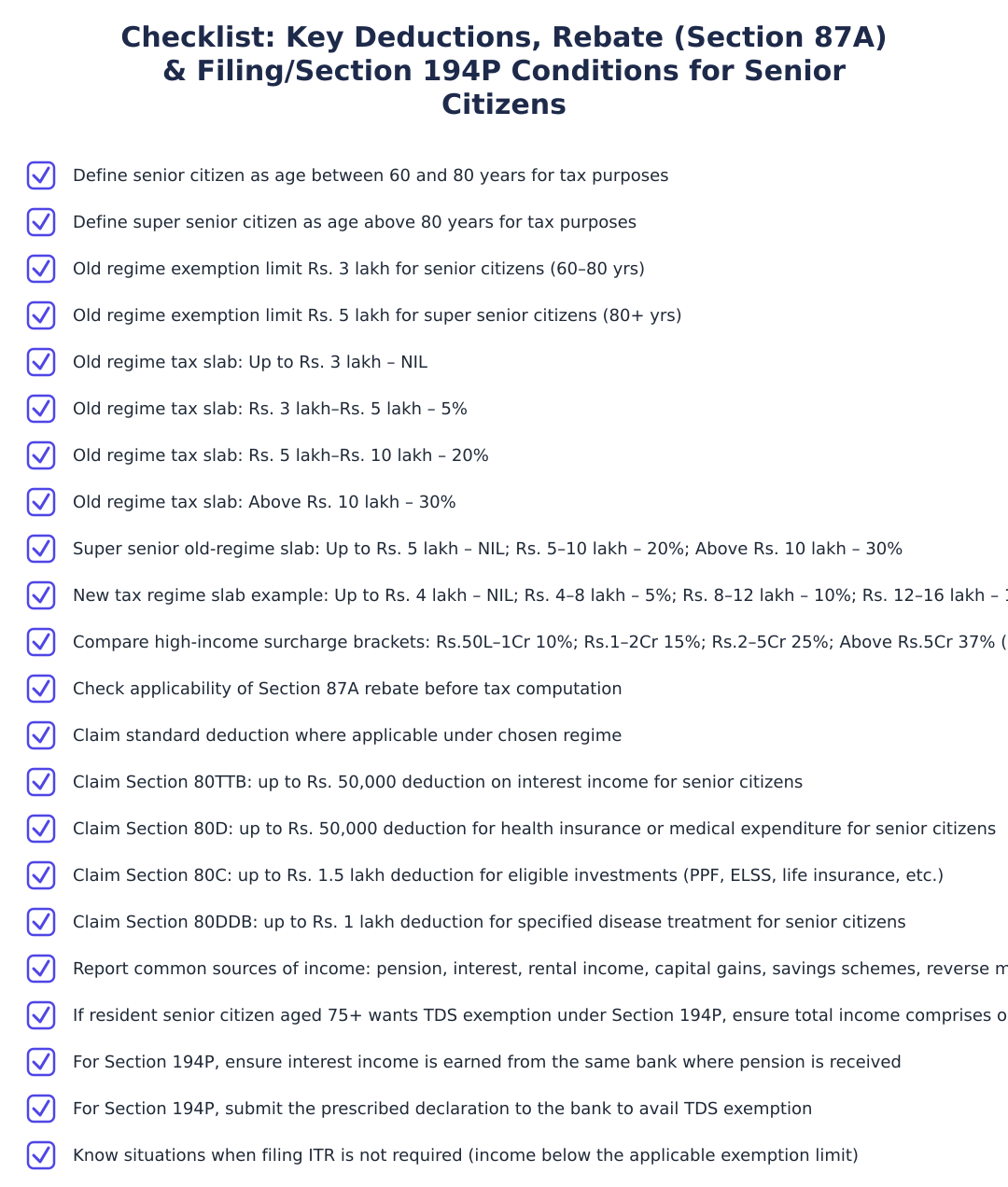
Senior citizens can claim several key deductions such as Section 80TTB (interest income deduction up to Rs. 50,000), Section 80D (health insurance premium or medical expenditure up to Rs. 50,000 for senior citizens), Section 80C (investments up to Rs. 1.5 lakh), and Section 80DDB (medical treatment of specified diseases up to Rs. 1 lakh for senior citizens). These deductions are available under the old tax regime and can substantially reduce taxable income for seniors with eligible expenses or investments. Note that many of these deductions are not available if you opt for the new tax regime, so seniors should compare tax liability under both regimes before choosing.
How are cess and surcharge applied to a senior citizen’s income tax for FY 2025-26?
Health and education cess at 4% is levied on the income tax plus surcharge for all taxpayers, including senior citizens, for FY 2025-26. Surcharge rates depend on total income: up to Rs. 50 lakh there is no surcharge, Rs. 50 lakh–1 crore attracts 10%, Rs. 1–2 crore 15%, Rs. 2–5 crore 25%; above Rs. 5 crore the surcharge is 25% under the new regime and 37% under the old regime as per the provided table. You must compute base tax from applicable slab, add any surcharge determined by income slab, and then add 4% cess on the resulting tax to arrive at total tax payable.
What incomes are commonly taxed for senior and super senior citizens?
Senior and super senior citizens are taxed on various income sources including pension, interest from savings and fixed deposits, rental income from property, capital gains, income from senior citizen saving schemes, reverse mortgage receipts where applicable, and post office deposit interest. Certain incomes like pension and interest form the bulk for many seniors and can qualify for special treatments or deductions (for example, interest deduction under 80TTB up to Rs. 50,000). Income character and sources determine applicable slab and deductions, so seniors should aggregate all taxable receipts when calculating total income for the year.
What is Section 194P and how does it help very elderly senior citizens?
Section 194P allows resident senior citizens aged 75 years or above to have tax deducted by their bank under specified conditions so they may not need to file an income tax return, provided they meet the criteria; the conditions include being resident aged 75+, having only pension and interest income (both from the same bank), submitting a prescribed declaration to the bank, and the bank deducting TDS under Section 194P. If all conditions are satisfied and the bank deducts tax correctly, these senior citizens need not file a return because the bank handles tax deduction; however, any other income sources or failure to meet conditions would require normal return filing. This provision is aimed at simplifying compliance for very elderly residents who rely only on bank pension and interest receipts.
When are senior citizens not required to file an income tax return?
Senior citizens may not be required to file an income tax return if they are aged 75 or above, their total income consists only of pension and interest from the same bank where pension is received, they submit the required declaration to the bank, and the bank deducts tax under Section 194P; under these strict conditions the bank’s deduction obviates the need to file. Outside these conditions, if you have additional income (like rent or capital gains), are under 75, or the bank does not deduct TDS under 194P, you must file the return as per normal rules. Even when not strictly required to file, some seniors may choose to file a return to claim refunds, carry forward losses, or show proof of income for loan or visa purposes.
Need help staying Income Tax compliant?
MoneyGence's AI Finance OS tracks your compliance, wallet share, and finances in one place, built for agencies and growing businesses.
Get started with MoneyGence