Ind AS 16 Property Plant and Equipment, Applicability & Key Rules
This guide explains Ind AS 16, the Indian Accounting Standard that governs Property, Plant and Equipment (PPE). You will learn what the standard requires on recognition, subsequent measurement (including the two permitted measurement bases), depreciation and its changes, capitalization of certain costs, derecognition and the key disclosure considerations companies must manage. Understanding Ind AS 16 matters because PPE are often among the largest assets on a company’s balance sheet and the accounting choices made for recognition, measurement and depreciation can materially affect reported profit, asset values and key financial ratios. The guide focuses on practical implications of core Ind AS 16 requirements: when an item should be recognised as PPE, how the carrying amount can be measured after recognition, how depreciation methods and estimates are treated, the specific requirement to capitalise costs of major inspections, and the need for regular reviews of residual values and useful lives. It also summarises the principal tasks that finance teams must perform each reporting cycle so that PPE accounting remains compliant and auditable. Throughout, the explanation links the standard’s prescriptions to everyday accounting actions, for example, how to treat a change in depreciation method, or when to revisit an asset’s residual value, so you can apply the standard consistently and explain the accounting choices to auditors, management and regulators.
Ind AS 16 Property, Plant and Equipment, scope and applicability
Ind AS 16 prescribes the accounting for Property, Plant and Equipment, covering recognition, measurement, derecognition, disclosure, the cost model and the revaluation model, and depreciation. The standard applies to items of property, plant and equipment that an entity holds for use in the production or supply of goods or services, for rental to others, or for administrative purposes.
From a practical perspective, applying Ind AS 16 means assessing whether an expenditure meets the recognition criteria for PPE, selecting an appropriate measurement basis after initial recognition (cost or revaluation) and ensuring ongoing compliance with the standard’s measurement and disclosure requirements.
Recognition
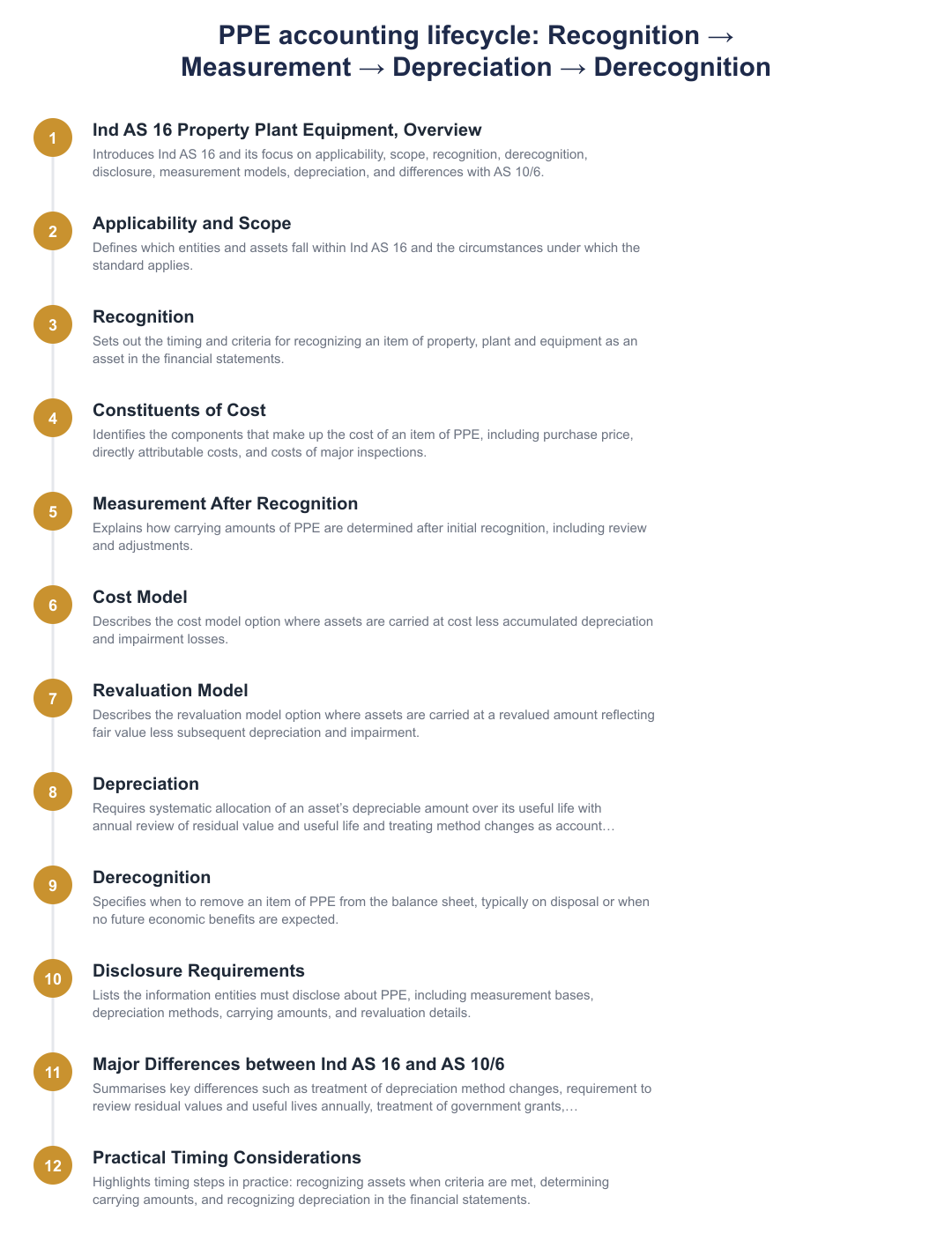
Recognition of an item as PPE requires judgement about timing, specifically, when future economic benefits associated with the item are probable and its cost can be measured reliably. The guide highlights three key tasks related to PPE accounting: timing of recognising an asset; determining the carrying amounts of assets; and recognising depreciation in the financial statements.
Practically, teams should document the assessment that supports recognition decisions, because timing affects both the carrying amount reported and the period in which depreciation begins. Clear documentation also helps where subsequent reviews of estimates lead to adjustments applied prospectively under the standard.
Constituents of cost
The components of an asset’s cost determine its initial carrying amount and form the basis for subsequent depreciation. Ind AS 16 requires capitalization of certain expenditures that relate directly to bringing the asset to the location and condition necessary for it to operate as intended.
A specific and important consequence under Ind AS 16 is that the cost of major inspections must be recognised in the carrying amount of PPE. This means that where the cost relates to a planned major inspection, it is capitalised and depreciated rather than expensed immediately, affecting both asset values and future depreciation charges.
Measurement after recognition, cost and revaluation bases
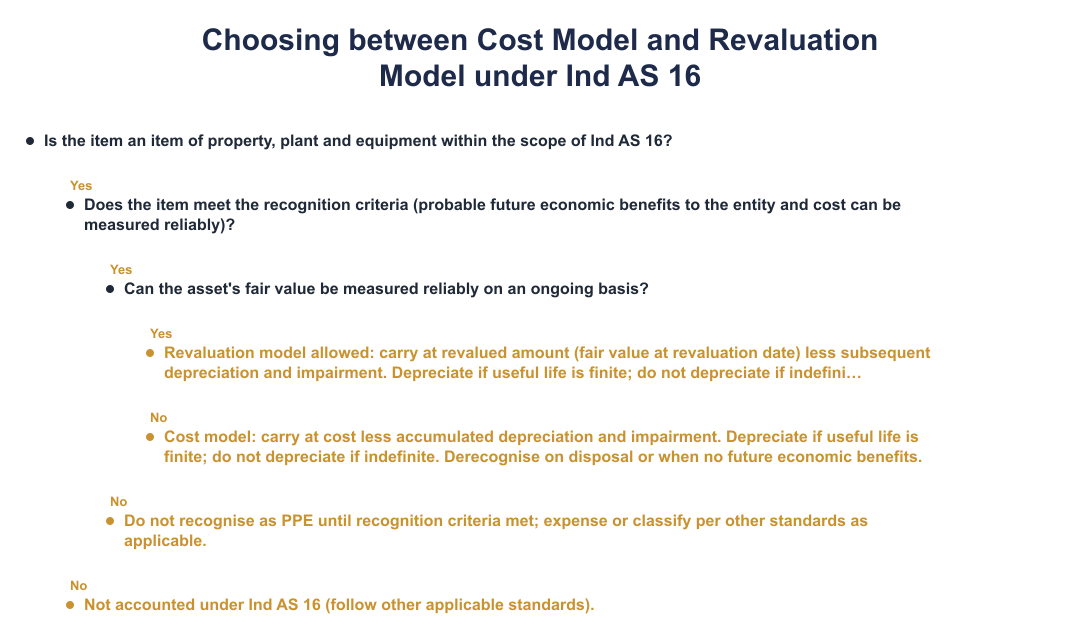
After initial recognition, Ind AS 16 permits two measurement approaches: the cost model and the revaluation model. The choice between these bases affects how carrying amounts move over time and what gets presented in the financial statements.
Whether an entity uses the cost model or the revaluation model, the standard’s wider requirements for review of estimates and capitalisation of inspection costs continue to apply. Management should ensure policies are consistently applied and disclosed so users of the financial statements understand the measurement basis and its impact.
Depreciation, method, useful life and changes
Depreciation under Ind AS 16 should reflect the pattern in which the asset’s future economic benefits are expected to be consumed. This means selecting a method that best matches consumption of benefits and reviewing that selection over time.
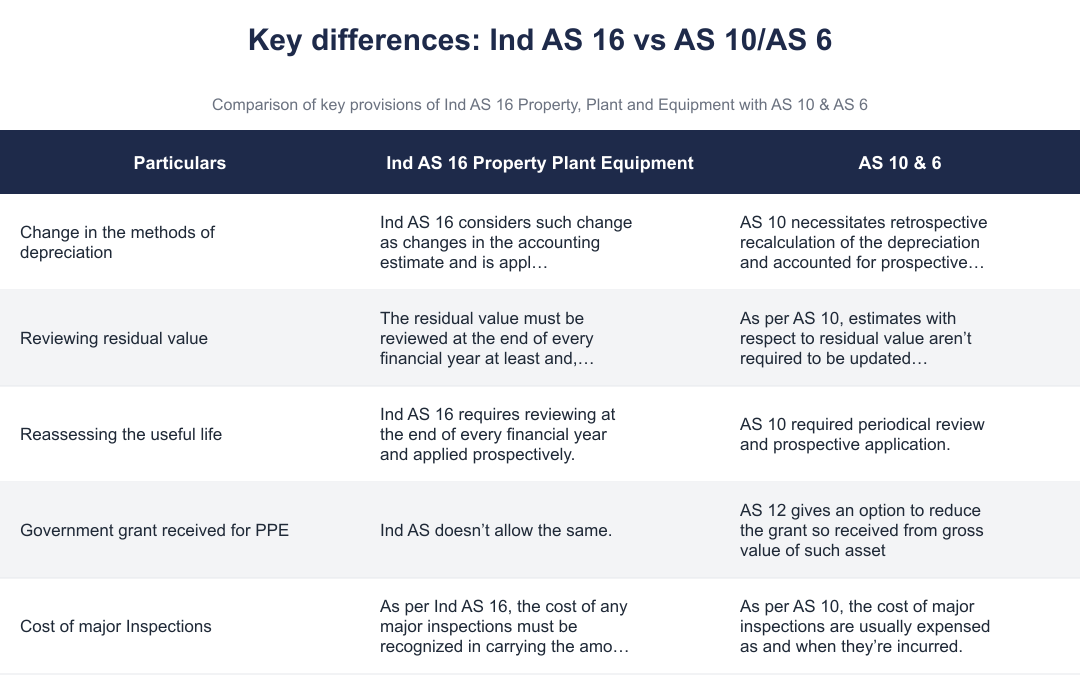
Ind AS 16 requires that the residual value and the useful life of an asset be reviewed at least at the end of each financial year, and any changes are accounted for as changes in accounting estimates with prospective application. Similarly, a change in the method of depreciation is treated as a change in accounting estimate and applied prospectively. These requirements mean that adjustments to depreciation arising from revised estimates or methods affect current and future periods only, not prior periods.
In practice, these prescriptions require a disciplined annual review process, reassessing useful lives and residual values each year and documenting the rationale for any changes so that depreciation charges are supportable and auditable.
Derecognition
Ind AS 16 covers derecognition of PPE when an asset is disposed of or when no future economic benefits are expected from its use or disposal. Derecognition removes the asset from the balance sheet and any gain or loss on disposal is recognised in profit or loss.
From an operational standpoint, companies should have controls to ensure disposals are recorded promptly and that carrying amounts are updated to the date of derecognition. Proper documentation of disposal approvals and calculation of any gain or loss helps maintain auditability.
Disclosure requirements
Ind AS 16 requires disclosures that enable users to assess the effect of PPE on the financial position, performance and cash flows of the entity. This includes disclosing the measurement basis used for classes of PPE and information about depreciation, useful lives and changes in estimates.
To meet these disclosure requirements, finance teams should maintain schedules showing carrying amounts, movements during the period (including additions, disposals and revaluations), and details of estimates or changes to estimates that materially affect depreciation or carrying amounts. These schedules support the notes to financial statements and explain the accounting choices made under the standard.
Major differences between Ind AS 16 and older AS
Ind AS 16 embodies specific prescriptions, for example, treating a change in depreciation method as a change in accounting estimate with prospective application, requiring annual review of residual values and useful lives, and capitalising the cost of major inspections. These rules affect timing and measurement of charges to profit or loss and the carrying amounts of PPE.
While older Indian standards took different approaches in several areas, the practical effect for accountants is that under Ind AS 16 certain items and changes are handled as estimates with prospective application. Entities transitioning between standards or comparing prior-period figures should therefore be attentive to these conceptual differences and ensure their accounting policies and disclosures reflect the Ind AS 16 requirements.
Ind AS 16 sets out a robust framework for recognising, measuring and disclosing Property, Plant and Equipment. Key operational actions are annual reviews of residual value and useful life, capitalisation of major inspection costs, selecting a measurement basis and treating changes in depreciation and estimates prospectively. Consistent application of these principles, supported by clear documentation and disclosure, helps ensure that PPE accounting is transparent, comparable and auditable.
Frequently asked questions
What assets fall under Ind AS 16 Property, Plant and Equipment?
Ind AS 16 applies to tangible items that are held for use in the production or supply of goods or services, for rental to others, or for administrative purposes and are expected to be used during more than one period. Examples include land, buildings, plant, machinery and equipment that an entity controls and expects to derive future economic benefits from. The Standard does not apply to biological assets related to agricultural activity, mineral rights, or exploration and evaluation assets which are covered by other standards. Leased assets are covered by Ind AS 17/Ind AS 116 (as applicable) and investment property is scoped out unless accounted for under the PPE rules by choice.
When should an item be recognised as property, plant and equipment under Ind AS 16?
An item should be recognised as PPE when it is probable that future economic benefits associated with the asset will flow to the entity and the cost of the asset can be measured reliably. Both recognition criteria must be met at the time the asset is acquired or constructed; if not, costs are expensed until recognition criteria are satisfied. Costs incurred before the asset is capable of operating as intended are capitalised only if they meet the recognition criteria (for example, directly attributable costs of construction and commissioning). Routine repairs and maintenance that do not meet the recognition criteria are expensed as incurred.
What items are included in the cost of an asset under Ind AS 16?
The cost of an asset under Ind AS 16 includes its purchase price (minus trade discounts and rebates), any costs directly attributable to bringing the asset to the location and condition necessary for it to be capable of operating, and the initial estimate of the costs of dismantling, removing the asset and restoring the site. Examples of directly attributable costs are site preparation, delivery and handling, installation, professional fees and the costs of testing whether the asset functions properly. Borrowing costs that meet the criteria in Ind AS 23 are also included when applicable; subsequent costs are capitalised only when they increase future economic benefits and can be measured reliably.
What measurement options are available after initial recognition of PPE under Ind AS 16?
After initial recognition an entity must choose either the cost model or the revaluation model for measuring PPE and apply that choice consistently to an entire class of assets. Under the cost model an asset is carried at cost less accumulated depreciation and impairment losses; under the revaluation model an asset is carried at a revalued amount (fair value at revaluation date) less subsequent depreciation and impairment. Revaluations must be made with sufficient regularity to ensure carrying amount does not differ materially from fair value, and when a class of assets is revalued, the entire class must be revalued.
How is depreciation determined under Ind AS 16 and when should it start?
Depreciation under Ind AS 16 is allocated on a systematic basis over an asset's useful life, reflecting the pattern in which the asset's future economic benefits are expected to be consumed, and it begins when the asset is available for use. The method chosen (straight-line, diminishing balance or another) should reflect the asset's consumption pattern and must be reviewed at least at each financial year end along with useful life and residual value. Changes in depreciation method, useful life or residual value are accounted for prospectively as changes in accounting estimates; they do not require retrospective restatement.
How does Ind AS 16 require treatment of major inspections and overhaul costs?
Ind AS 16 requires the cost of major inspections or overhauls to be recognised as part of the carrying amount of the PPE when those costs meet the recognition criteria, typically by replacing a significant part of the asset or by improving future economic benefits. The Standard expects entities to capitalise costs of major inspections and to account for any remaining carrying amount of the previous inspection as derecognised when replaced. This is different from older practice where such inspection costs might have been expensed as incurred; under Ind AS 16 they are added to the asset and depreciated over the interval until the next inspection.
When should an item of PPE be derecognised under Ind AS 16?
An item of PPE should be derecognised on disposal or when no future economic benefits are expected from its use or disposal. The gain or loss on derecognition is the difference between the net disposal proceeds (if any) and the carrying amount of the asset, and it is recognized in profit or loss when the asset is derecognised. If an asset is replaced by a new asset (for example major overhaul), any remaining carrying amount of the replaced part is derecognised and the cost of the new part is capitalised.
What disclosures does Ind AS 16 require in the financial statements for PPE?
Ind AS 16 requires disclosure of measurement basis (cost or revaluation), depreciation methods used, useful lives or depreciation rates, gross carrying amount and accumulated depreciation at the beginning and end of the period, and reconciliation of carrying amounts showing additions, disposals, revaluations, and impairment losses. Additional disclosures include restrictions on title, contractual commitments for acquisition, and the carrying amount of assets pledged as security; if the revaluation model is used, details of the revaluation and effects on other comprehensive income are required. These disclosures ensure users can assess the nature, carrying amounts and changes in PPE during the reporting period.
What are the main differences between Ind AS 16 and the older AS (AS 10/AS 6) on accounting for PPE?
Key differences include: Ind AS 16 treats changes in depreciation method as changes in accounting estimates applied prospectively, whereas AS 10 required retrospective recalculation; Ind AS 16 requires annual review of residual value and useful life and prospective accounting for changes, while AS 10 did not mandate updating residual value estimates; government grants related to PPE are not presented the same way under Ind AS 16 (it does not allow reducing the gross carrying amount by the grant), whereas AS 12 provided an option to reduce the asset's gross value by grant; and costs of major inspections must be capitalised under Ind AS 16 but were commonly expensed under AS 10. These differences affect measurement, presentation and timing of expense recognition.
Need help staying Accounting compliant?
MoneyGence's AI Finance OS tracks your compliance, wallet share, and finances in one place, built for agencies and growing businesses.
Get started with MoneyGence