Ind AS 2 Inventories: Guide to Measurement, Cost & Disclosure
This guide explains the core principles and practical implications of Indian Accounting Standard on inventories for finance teams, auditors and business owners. You will learn the objective behind the standard, which types of assets typically fall inside and outside its scope, how inventories are measured for financial reporting, what costs may be included when determining inventory value, common measurement techniques and cost formulas, how net realisable value is treated, when inventory costs flow through to profit or loss, and the key disclosure areas that users of financial statements should expect to see. Understanding these topics matters because inventory values directly affect reported profits, asset balances and working capital metrics, all of which influence management decisions, lending assessments and statutory reporting. The guide focuses on practical interpretation: why rules exist, how they influence day‑to‑day inventory accounting, and what managers and preparers should monitor to ensure inventories are measured consistently and presented transparently. Whether you are preparing year‑end accounts, setting internal policies, or reviewing audit queries, this guide gives a clear conceptual roadmap for applying the inventory standard in a way that supports reliable financial information and informed business decisions.
The Objective of the Standard
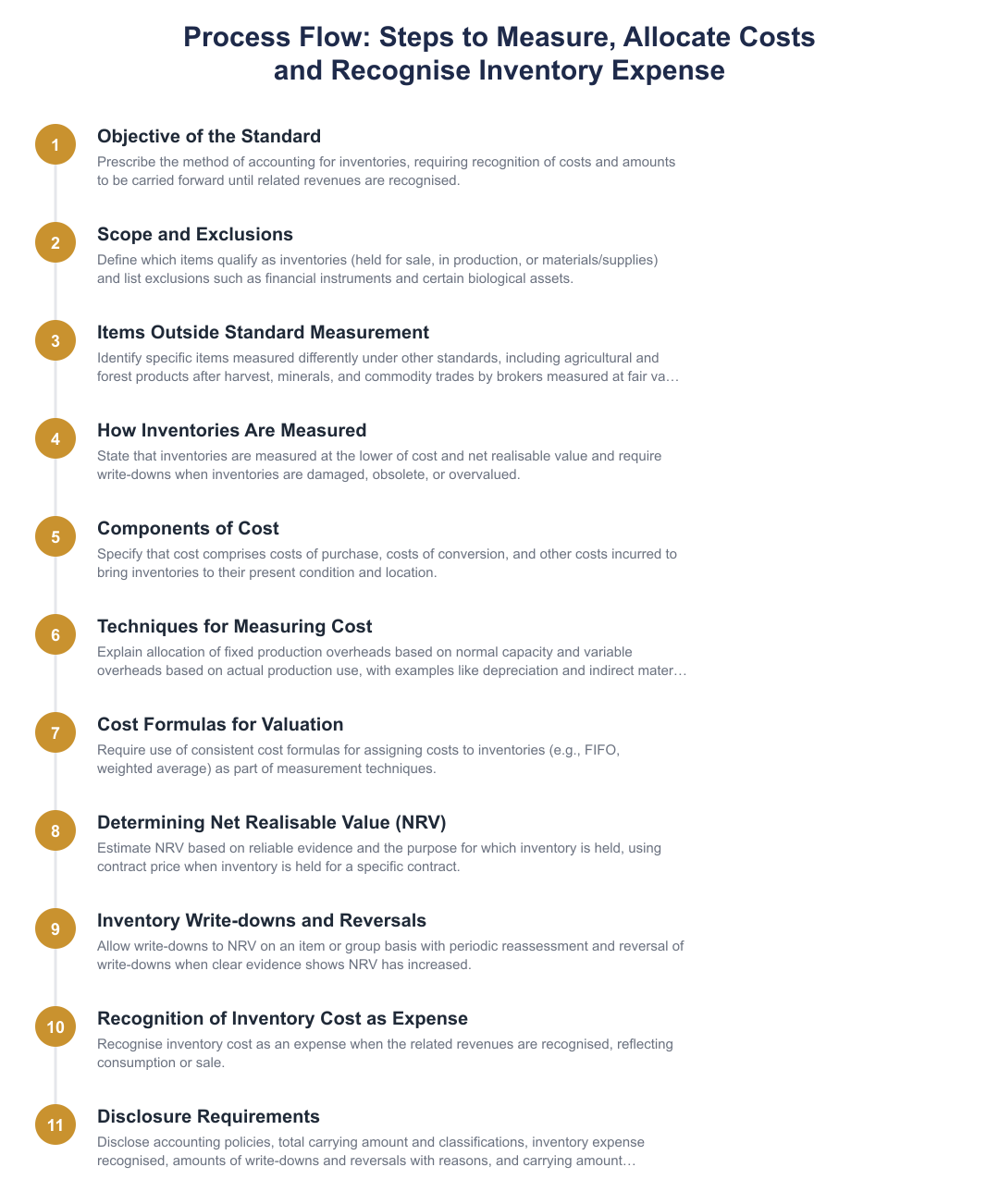
The principal objective of the inventory accounting standard is to prescribe the accounting treatment for inventories so that users of financial statements can reliably assess an entity’s performance and financial position. This involves setting out what should be recognised as inventory, how inventory should be measured, and the information to be disclosed.
By standardising the measurement and presentation of inventories, the standard reduces diversity in practice and promotes comparability across reporting entities. Clear guidance helps ensure that profit or loss is not distorted by inconsistent inventory valuation methods and that reported inventories represent amounts that are expected to be realised through sale or use in the normal course of business.
Exclusions to the Scope of this Standard
Certain categories of assets are typically excluded from the inventory standard because they are subject to different measurement bases or separate accounting standards. Examples include some financial instruments and biological assets related to agricultural activity, where alternative measurement rules better reflect economic reality.
When an item is excluded from the inventory standard, preparers must follow the alternative standard or measurement basis that applies to that class of asset. It is important for entities to identify these exclusions early so that the appropriate accounting treatment and disclosures are applied consistently.
How are Inventories Measured?
Inventories are generally measured at an amount that reflects the cost of bringing them to their present location and condition, but financial reporting also requires comparison of cost to a recoverable amount to avoid overstating assets. The measurement approach aims to ensure inventories are stated at values that are expected to be recovered through sale or use.
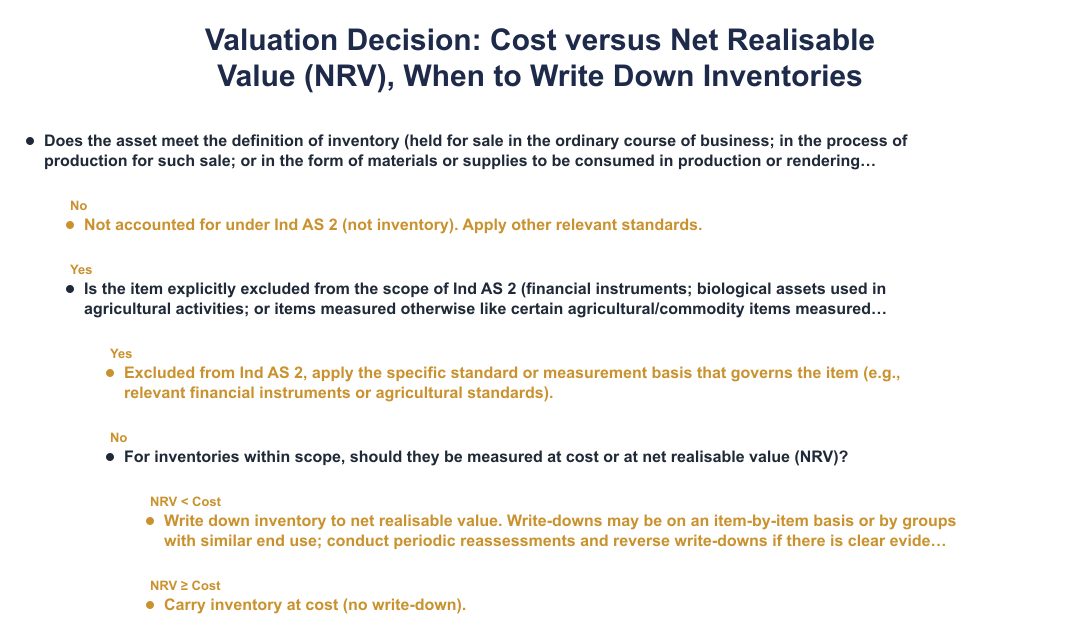
Where available evidence indicates that the recoverable amount is lower than cost, inventories are written down accordingly. This recognition of reductions in value ensures that losses are recognised in the period in which the decline in recoverable amount occurs rather than when the inventory is sold.
What Does Cost Comprise of?
The cost of inventories typically comprises direct purchase costs, direct conversion costs (such as direct labour and production overheads) and other costs incurred in bringing the inventories to their present condition and location. Determining which costs to include requires judgement: only those costs that are directly attributable to bringing inventory to its current state should be capitalised.
Entities must also consider how to allocate production overheads between normal production and abnormal amounts. Fixed production overheads are commonly allocated on a systematic basis based on normal capacity, while variable overheads are allocated based on actual production usage. Careful allocation policies help prevent distortion of unit costs when production volumes fluctuate.
Techniques for the Measurement of Cost
Common techniques used to determine the cost of inventories include identifying specific costs with particular items, applying a first-in, first-out approach or using a weighted average cost formula. The choice of technique should reflect the nature of the inventory and the pattern in which economic benefits are realised.
Whichever technique is selected, it should be applied consistently from period to period to ensure comparability. When circumstances change such that another technique better reflects the flow of costs and benefits, entities should update their policy and disclose the change along with its effects.
Cost Formulas Used for Valuation of Inventories
First‑in, first‑out (FIFO) and weighted average cost formulas are widely used to assign costs to units of inventory when physical identification is impractical. FIFO assumes that the earliest goods purchased or produced are the first ones to be sold, while the weighted average method spreads total cost evenly across units.
Where items are identifiable and distinct, specific identification assigns the actual cost of each item to inventory. Entities must select the cost formula that best reflects the flow of economic benefits in their operations and disclose this policy in the financial statements.
Net Realisable Value
Net realisable value is an estimate of the amount that an entity expects to realise from the sale of inventory in the ordinary course of business, less the estimates of costs of completion and costs necessary to make the sale. It is a forward‑looking measure that reflects current market conditions and expected costs to sell.
When inventories are damaged, obsolete or when their selling prices have declined, net realisable value can fall below cost. In such cases, inventories are written down to net realisable value. If later evidence shows that the decline in value has reversed, the write‑down may be reversed to reflect the higher recoverable amount, subject to applicable constraints.
When Should Inventory Cost be Recognised as an Expense?
Inventory costs become an expense when the related goods are sold, typically recognised as part of cost of goods sold in the period in which the associated revenue is recognised. This matching ensures that the expense is recognised in the same period as the income that the inventory helped generate.
In addition to cost of goods sold, any write‑downs to net realisable value and losses on inventory are recognised as expenses in the period in which the write‑down or loss occurs. Conversely, a reversal of a prior write‑down is recognised as a reduction of the expense, to the extent permitted by the applicable accounting framework.
Disclosure Requirements
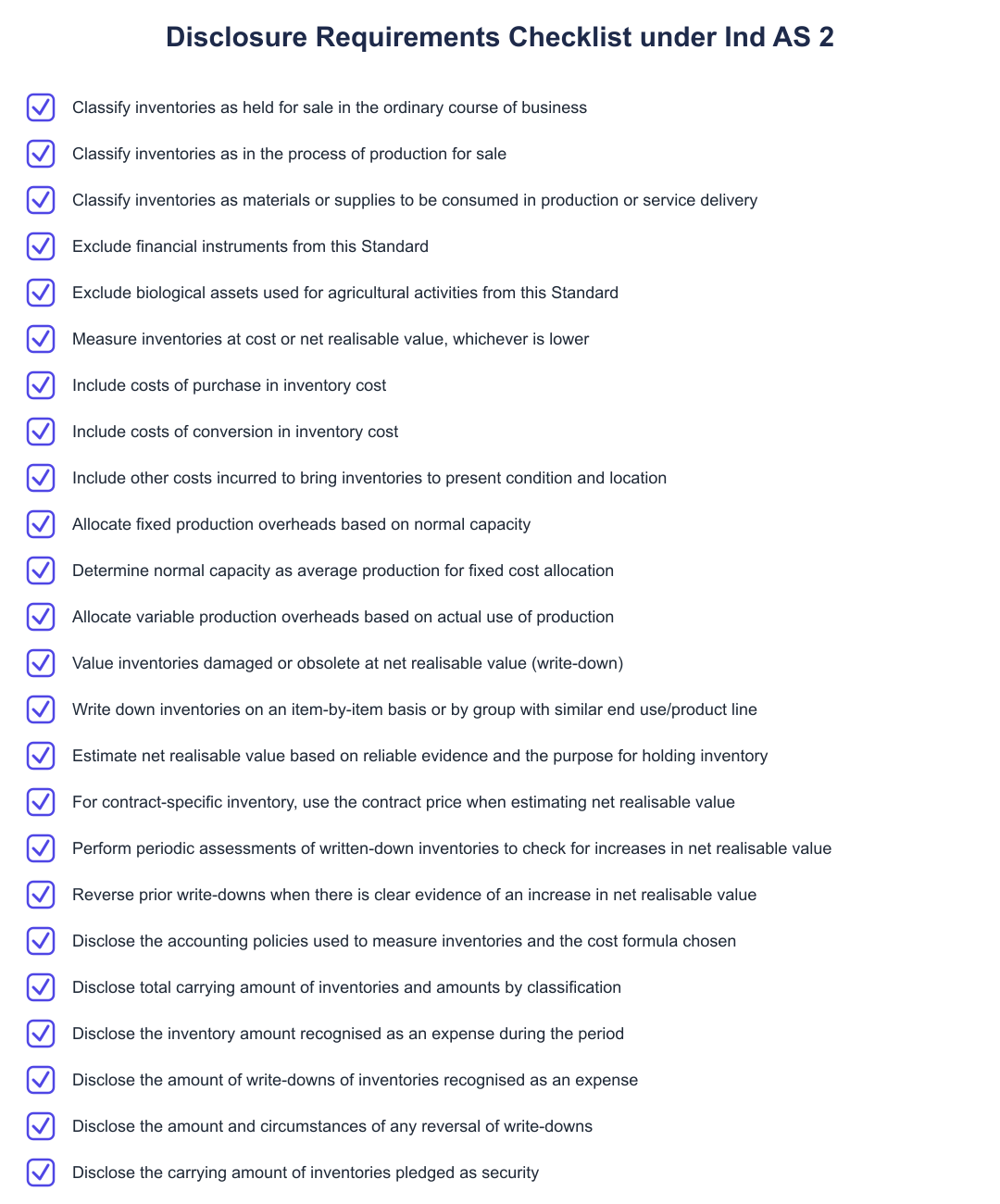
Financial statements should disclose the accounting policies adopted in measuring inventories, including the cost formula used and the basis for cost and net realisable value measurements. Clear disclosures help users understand the judgments and estimates applied in arriving at inventory balances.
Additional disclosures typically include the total carrying amount of inventories, the amount recognised as an expense during the period, the amount of any write‑downs and reversals, and information about inventories pledged as security. Transparent disclosure supports comparability and enables users to assess the impact of inventory measurements on financial results.
Accurate measurement and disclosure of inventories are essential for reliable financial reporting and sound business decision‑making. By applying consistent measurement principles, selecting appropriate cost formulas, recognising declines to net realisable value promptly, and providing transparent disclosures, entities can ensure that inventory balances faithfully represent expected economic benefits and that their financial statements remain useful to investors, lenders and other stakeholders.
Frequently asked questions
What is the main objective of Indian Accounting Standard (Ind AS) 2 on inventories?
The objective of Ind AS 2 is to prescribe how to account for inventories so that costs are recognised and carried forward until related revenues are recognised. It requires entities to measure inventories at the lower of cost and net realisable value and to include in inventory costs those amounts necessary to bring the inventories to their present condition and location. The Standard applies to inventories held for sale, in the process of production for sale, or in the form of materials and supplies to be consumed in production or rendering services. It also specifies exclusions, measurement techniques, cost formulas, treatment of write-downs and required disclosures.
Which items are excluded from the scope of Ind AS 2?
Ind AS 2 excludes certain assets such as financial instruments and biological assets related to agricultural activity from its scope. It also excludes agricultural and forest products after harvest, and minerals and mineral products measured at net realisable value, as well as commodity broker-traders whose inventories are measured at fair value less costs to sell. These exclusions are addressed by other standards that are more appropriate for those specific types of assets and measurement bases.
How should inventories be measured under Ind AS 2?
Inventories should be measured at the lower of cost and net realisable value (NRV). Cost includes costs of purchase, costs of conversion (including an allocated portion of fixed and variable production overheads), and other costs incurred to bring inventories to their present condition and location. When inventories are damaged, obsolete or their cost exceeds expected selling price less costs to complete and sell, they must be written down to NRV, and that write-down can be made item-by-item or for groups with similar end use.
What costs are included when determining the cost of inventories?
Cost of inventories comprises costs of purchase, costs of conversion and other costs incurred in bringing inventories to their present condition and location. Costs of purchase include purchase price, import duties, non-recoverable taxes, transport and handling, less trade discounts and rebates. Costs of conversion include direct labour, direct materials and a systematic allocation of fixed and variable production overheads based on normal capacity and actual usage respectively.
What techniques or cost formulas can be used to measure inventory cost?
Ind AS 2 permits the use of techniques such as specific identification where items are not ordinarily interchangeable and cost can be directly attributed, and cost formulas like FIFO and weighted average cost for interchangeable items. FIFO (first-in, first-out) assigns the cost of earlier purchases to cost of sales, while weighted average spreads costs evenly across units produced during the period. The chosen cost formula must be applied consistently and disclosed in the accounting policies.
What is net realisable value (NRV) and how is it estimated?
Net realisable value is the estimated selling price in the ordinary course of business less estimated costs of completion and estimated costs necessary to make the sale. NRV must be estimated using reliable evidence available at the time and taking into account the purpose for which the inventory is held (for example, a particular contract price for contract-specific inventory). Items that are damaged, obsolete or whose costs exceed expected recoverable amounts should be written down to NRV, and periodic reassessments must be made to reverse write-downs when evidence supports an increase in NRV.
When should inventory cost be recognised as an expense?
Inventory cost should be recognised as an expense in the period in which the related revenue is recognised, typically when the goods are sold or services are provided. If inventories are written down to net realisable value, the write-down is recognised as an expense in the period of the write-down. For inventories manufactured for specific contracts, costs are recognised in accordance with revenue recognition for that contract and NRV is assessed based on the contract price.
What are the disclosure requirements under Ind AS 2 for inventories?
Entities must disclose the accounting policies used to measure inventories and the cost formula adopted, the total carrying amount of inventories and their classification, and the amount of inventories recognised as an expense during the period. They must also disclose the amount of any write-downs to NRV recognised as an expense and the amount of any reversals of such write-downs, together with the circumstances that led to reversals, and the carrying amount of inventories pledged as security. These disclosures help users understand valuation methods, changes and risks associated with inventory.
How are production overheads allocated between fixed and variable costs for inventory valuation?
Fixed production overheads are allocated to inventory based on normal production capacity, while variable production overheads are allocated based on actual use of production. Normal capacity is the average production level expected over a period, and fixed overhead allocation should not include abnormal amounts of capacity-related costs. Variable overheads vary directly or nearly directly with production volume and are apportioned to each unit produced on actual consumption.
Need help staying Accounting compliant?
MoneyGence's AI Finance OS tracks your compliance, wallet share, and finances in one place, built for agencies and growing businesses.
Get started with MoneyGence