Input Service Distributor (ISD) under GST, Guide & Rules
This guide explains Input Service Distributor (ISD) under GST: what an ISD is, who can act as one, how input tax credit (ITC) is distributed, key invoice and documentation requirements, practical limits on distribution, and consequences of incorrect usage. You will learn the legal contours that define an ISD, the situations where ISD treatment does not apply, how credit for services received under reverse charge is handled, and the recovery and interest consequences if credits are wrongly allocated. Understanding ISD rules matters because many multi‑location businesses operate under a single PAN with different GST registrations for branches or units; correct use of ISD preserves ITC and avoids demands, interest and compliance risk. This guide also highlights the link between the earlier service tax approach and the GST regime so you can appreciate what changed in scope and documentation. Practical readers, tax managers, compliance teams and advisors, will get clarity on permitted allocations (exclusive use vs common services), the proportionality rule based on turnover for common services, the required content of an ISD invoice, and the penalties and recovery mechanics that can follow incorrect or excessive distribution. Use this guide to set up ISD processes that keep ITC available to the right units, prevent inadvertent cross‑charging, and reduce exposure to audit and demand notices under the CGST Act.
Who is an Input Service Distributor (ISD) under GST?
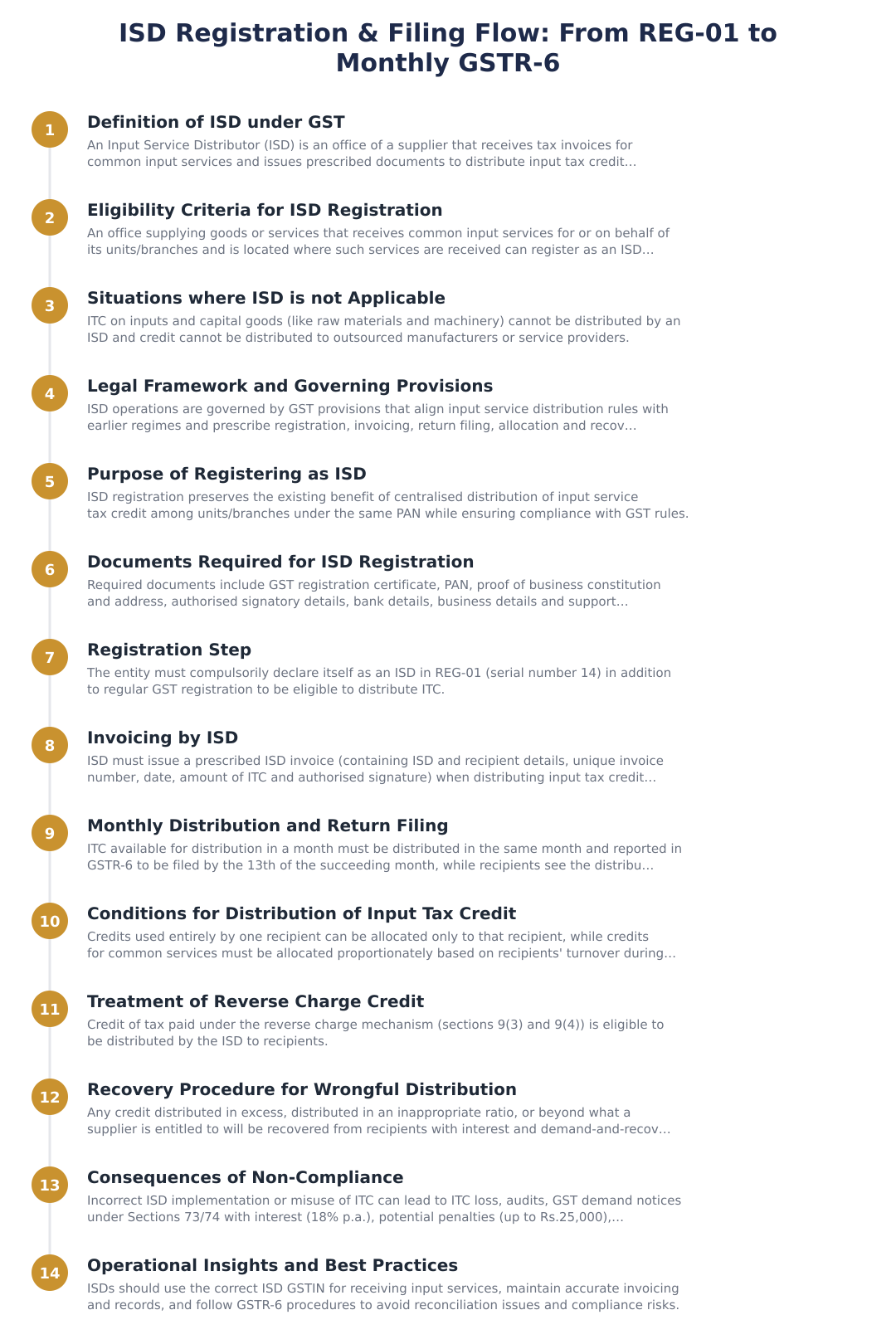
An Input Service Distributor (ISD) is defined as an office of the supplier of goods and/or services that receives tax invoices for common input services and issues a prescribed document to distribute input tax credit. The recipients of the distributed credit are units or branches that operate under the same PAN as the ISD but hold different GSTINs.
The ISD mechanism centralises the receipt and allocation of credit for input services so that centralised costs, for example, corporate overheads or shared services, can be reflected in the tax credit position of each supplying unit. This ensures that credit on services acquired for shared use is not stranded at the office that procured the service but is routed to the operational units that will utilise the credit.
Eligibility Criteria for ISD Registration under GST
To function as an ISD the office must be that of a supplier of goods and/or services which actually receives tax invoices for common input services. The ISD issues a prescribed document (commonly referred to as an ISD invoice) to distribute the input tax credit of CGST, SGST and/or IGST to its recipient units that have the same PAN but different GSTINs.
An ISD may apply for multiple ISD registrations when common services are received at different offices located in different states or districts. This flexibility recognises that common services may be procured and consumed at distinct places of business and permits separate ISD registrations to match those operational realities.
Format of the ISD invoice
| Field |
|---|
| Name and address of ISD |
| GSTIN of ISD |
| Unique invoice number |
| Date of invoice |
| Name and address of recipient unit |
| GSTIN of recipient |
| Amount of ITC distributed |
| Signature of authorised person |
Conditions for Distribution of Input Tax Credit
An ISD must respect the nature of use when allocating credit. If an input service is used entirely by a single recipient, the tax credit available against that service can be allocated only to that recipient and cannot be given to other recipients. This preserves the link between consumption and credit entitlement.
When input services are commonly used by more than one recipient, the available tax credit must be allocated proportionately. The proportion is determined by the ratio of the recipient's turnover in a State or Union territory during the relevant period to the aggregate turnover of all such recipients for that period. This proportionality rule ensures allocation aligns with economic activity across recipient units.
Credits that arise on services where GST is paid under the reverse charge mechanism (sections 9(3) and 9(4) of the GST Act) are also eligible to be distributed by an ISD. The ISD can therefore centralise and pass on reverse charge ITC to recipient units under the same PAN.
Recovery Procedure and Consequences of Wrongful Distribution
If credit is distributed in excess of what is available, or distributed in an inappropriate ratio or to ineligible recipients, the excess or wrongly allocated credit shall be recovered from the recipient(s) and the provisions of 'Demand and Recovery' will apply. Recovery can therefore target the recipient units that have utilised the incorrect credit.
Wrongful allocation or incorrect cross‑charging involving ISD treatment can trigger GST demand notices under Sections 73 and 74 of the CGST Act. Such demands attract interest at the rate of 18% per annum. Using a regular GSTIN instead of the ISD GSTIN for receipt of common services can lead to loss of ITC, and produces audit and compliance risks that may culminate in assessments and recovery.
Insight on Earlier Service Tax Regime vs GST Regime
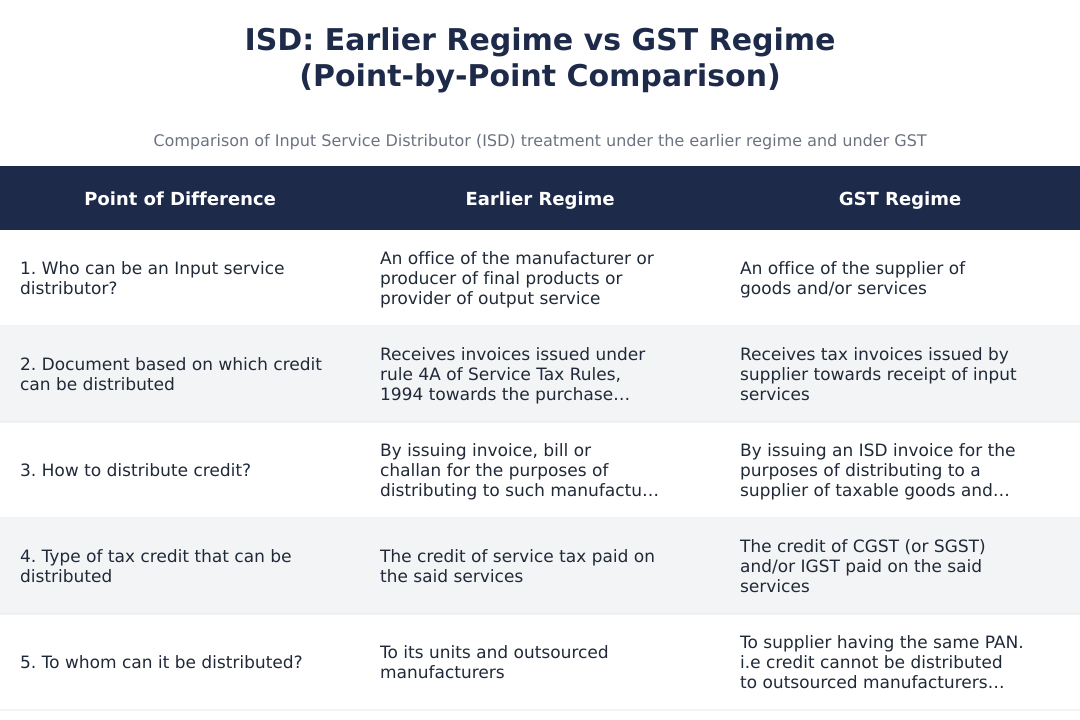
ISD rules under GST align the underlying policy intent of the earlier service tax regime (Rule 4A of the Service Tax Rules, 1994) with the GST framework, while changing scope and documentation. Under the earlier regime, certain provisions were tailored to manufacturers or producers; under GST the concept is framed around an office of the supplier of goods and/or services.
Practically, this alignment means that businesses which earlier distributed service tax credit using the old rules now follow a similar distribution concept under GST, but must pay attention to differences in documents and the scope of recipients eligible to receive distributed credit.
ISD is a compliance tool for multi‑location suppliers to centralise receipt and proportionate distribution of ITC on input services, including reverse charge supplies. Adhering to the allocation rules, using the correct ISD invoice format, and avoiding distribution to ineligible recipients are essential to preserve ITC and reduce the risk of GST demand notices under Sections 73/74 with interest. Implement robust controls so credits are allocated only to entitled units and in the prescribed proportions to avoid recovery and interest exposure.
Frequently asked questions
What is an Input Service Distributor (ISD) under GST?
An Input Service Distributor (ISD) is an office of a supplier that receives tax invoices for common input services and distributes the Input Tax Credit (ITC) of CGST/SGST or IGST to its units or branches having the same PAN but different GSTINs. The ISD issues a prescribed ISD invoice to allocate the credit to recipient units and cannot distribute credit to outsourced manufacturers or external service providers. For example, a head office receiving a software maintenance invoice for all branches will distribute ITC to each branch by issuing ISD invoices. The ISD mechanism preserves the benefit of centralised purchase of services while ensuring correct allocation of ITC across GST registrations under the same PAN.
Who is eligible to register as an ISD under GST?
An entity eligible to register as an ISD must be an office that supplies goods or services (or both), receives tax invoices for input services meant for its units/branches with different GSTINs under the same PAN, and is located where the common services are received. The ISD may distribute ITC including credit on services taxed under reverse charge (sections 9(3)/9(4)) and can obtain multiple ISD registrations if common services are received at different offices in different states or districts. The ISD must declare itself as an ISD in the REG-01 form (serial number 14) when registering, and it can distribute credit only after this declaration. Note that credit on inputs and capital goods (e.g., raw materials or machinery) cannot be distributed via ISD.
What documents do I need to register as an ISD under GST?
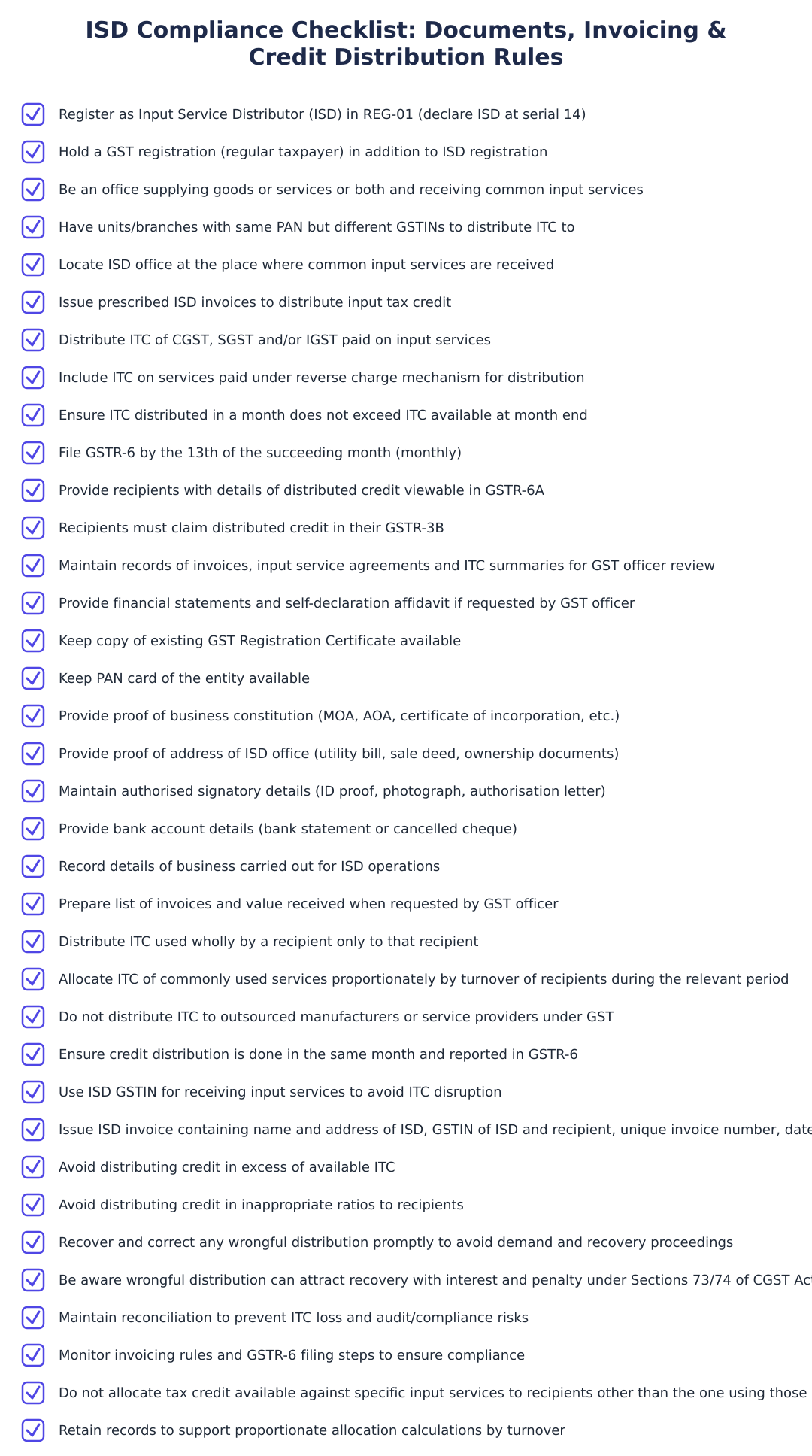
To register as an ISD you need the regular GST registration certificate (or application), PAN card, proof of business constitution (MOA/AOA and certificate of incorporation for companies or equivalent for other entities), proof of the ISD office address (rent agreement/utility or sale deed), authorised signatory details (ID, photo, authorisation letter), and bank account proof (bank statement or cancelled cheque). If called for by the GST officer, you should also provide lists of invoices, input service agreements, summaries of ITC distributed, financial statements and a self-declaration affidavit confirming GST compliance. Keeping these documents ready speeds up the REG-01 registration process and supports any subsequent scrutiny by tax authorities.
How do I register as an ISD step-by-step on the GST portal?
To register as an ISD you must apply through REG-01 on the GST portal and declare the registration type as 'ISD' under serial number 14, submitting required business, PAN and office documents; the ISD can distribute credits only after successful registration. After registration you should begin issuing the prescribed ISD invoices when distributing ITC and file periodic returns (GSTR-6) for the credits distributed. If the GST officer requests, maintain and produce invoices, input service agreements and summaries of ITC distributed to support the registration and subsequent distributions.
What is the format and essential particulars of an ISD invoice?
An ISD invoice must contain the name and address of the ISD, its GSTIN, a unique invoice number, invoice date, name and address of the recipient unit/branch, recipient GSTIN, the amount of ITC distributed and the signature of the authorised person. The ISD should issue this prescribed document whenever it distributes the input tax credit of CGST/SGST and/or IGST to its units under the same PAN. Proper sequencing and accurate details on the ISD invoice are essential because these records feed into GSTR-6 and auto-populate the recipient’s claim in GSTR-2A/6A and GSTR-3B.
How is input tax credit distributed by an ISD and what are the allocation rules?
An ISD must distribute the available ITC in the same month it is available and report details in GSTR-6; credits for services used wholly by one recipient can be allocated solely to that recipient, while credits for services used commonly must be allocated proportionately based on the turnover of each recipient in the relevant period. The ratio for common services is: (turnover of the recipient in the State/UT during the relevant period) divided by (aggregate turnover of all such recipients), and reverse charge credits (sections 9(3)/9(4)) are also distributable. The ISD cannot distribute more credit than available and must follow the same-month distribution rule to ensure accurate claims by recipient units in their GSTR-3B filings.
When and how does an ISD file returns and what are filing deadlines?
An ISD must file return GSTR-6 by the 13th day of the month succeeding the month in which ITC was distributed, reporting the details of credit distributed during the month; recipients view this distributed credit in auto-populated GSTR-6A and can claim it in GSTR-3B. The ISD need not file an annual return in GSTR-9, but it must ensure monthly reconciliation so distributed amounts do not exceed available ITC as at month-end, using GSTR-2B or internal records to verify balances. Timely filing is important because late or incorrect reporting can trigger demands, interest and penalties under GST provisions.
What happens if an ISD distributes credit wrongly or in excess?
If an ISD distributes credit in excess of the available amount or distributes to ineligible recipients or in incorrect ratios, that excess credit will be recovered from the recipient(s) along with interest and GST demand/recovery procedures under Sections 73/74 may apply. Interest on wrongly distributed credit is charged at 18% per annum and penalties on misallocation can be levied, including potential fines up to Rs.25,000 depending on the nature of non-compliance. Additionally, incorrect ISD use can trigger audits, disrupt ITC reconciliation, and lead to scrutiny from GST authorities, so maintaining accurate invoices, allocation ratios and filings is critical to avoid these consequences.
In what situations is ISD not applicable under GST?
ISD is not applicable for distribution of ITC on inputs and capital goods, for example, raw materials and machinery cannot be distributed via ISD; such credits must be claimed directly by the GST registration that received or used the goods. Also, ISD credit cannot be distributed to outsourced manufacturers or external service providers who do not share the same PAN as the ISD, because distribution is limited to units/branches with the same PAN but different GSTINs. Finally, if common services are not received at the ISD office location or units do not qualify as recipients under the same PAN requirement, the ISD mechanism does not apply.
Need help staying GST compliant?
MoneyGence's AI Finance OS tracks your compliance, wallet share, and finances in one place, built for agencies and growing businesses.
Get started with MoneyGence