Input Tax Credit under GST, Guide to Claiming ITC in India
Input Tax Credit (ITC) under GST allows businesses to reduce their tax liability on outward supplies by claiming credit for tax paid on inward supplies used in the course or furtherance of business. This guide explains what ITC is, who can claim it, what qualifies (and what does not), the documents and special cases to watch for, how ITC must be reported, and practical steps to reconcile and reverse credits when needed. Understanding ITC is essential because it affects working capital, invoice pricing, and compliance risk, incorrect claims can lead to notices and the need to reverse credits. You will also learn why using technology and automation for reconciliation and reporting reduces errors and strengthens audit trails. Throughout the guide we focus on the compliance features you must respect, for example, certain supplies are specifically excluded from ITC, ITC must be reported in the monthly GSTR-3B return (Table 4), and Input Service Distributors (ISDs) have a formal role in distributing credit. By the end of this article you will have a practical sense of the rules you must follow and the controls you should put in place to maximise legitimate credits while avoiding wrongful accumulation of ITC and potential non-compliance notices.
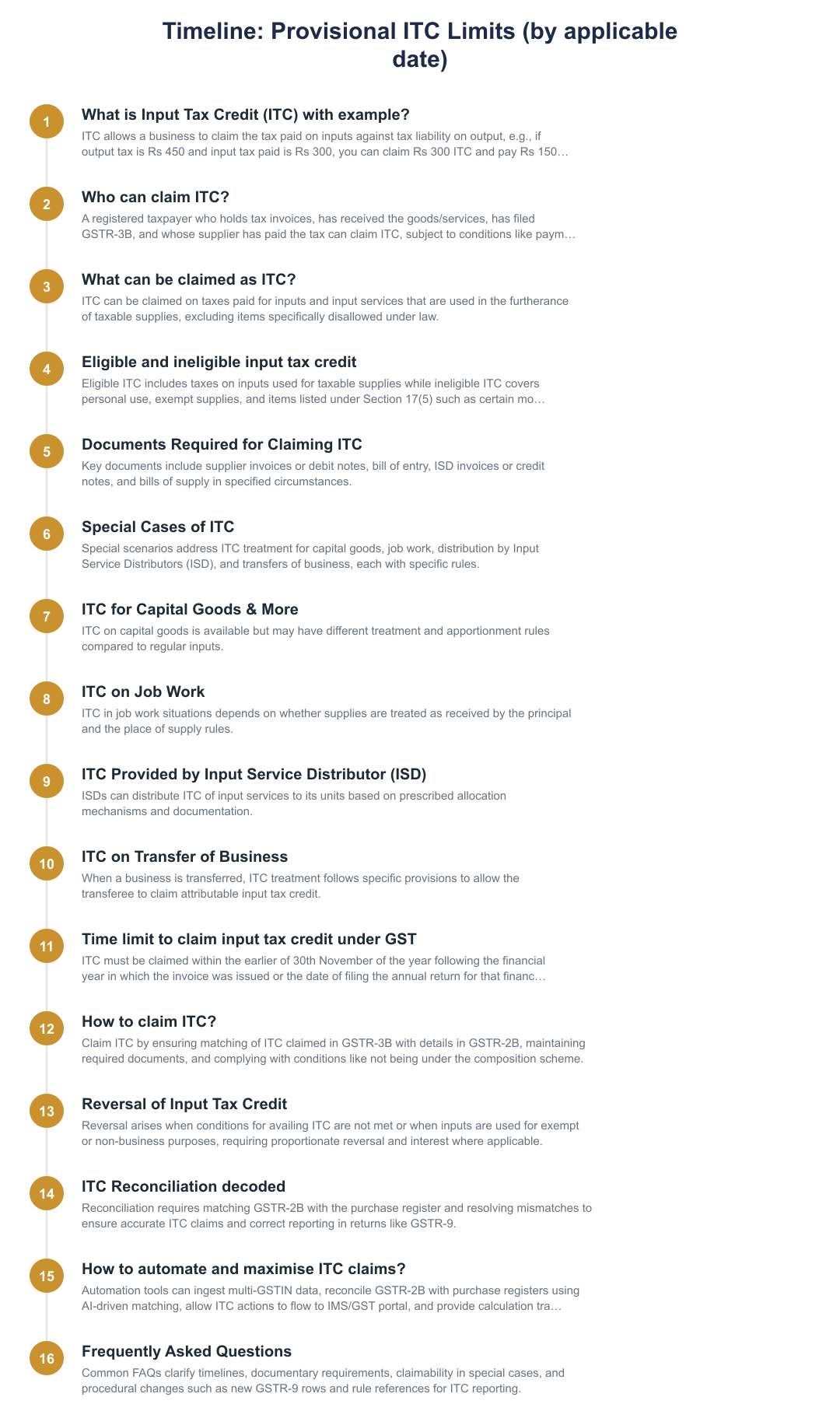
What is input tax credit with example?
Input Tax Credit (ITC) is a mechanism under GST that prevents taxation on tax itself by allowing a registered person to offset tax paid on purchases against tax payable on sales. Practically, ITC ensures that tax is levied only on the value added at each stage of the supply chain, enabling the seamless flow of credit across suppliers, recipients, and state boundaries for taxable supplies of goods or services.
An example helps illustrate the concept: when a business pays tax on purchases used in its operations, that tax can be claimed as a credit and set off against the tax it collects on its outward supplies. This reduces the cash tax outflow and avoids cascading taxes, ensuring that the final consumer bears the full tax burden while businesses are taxed only on their value addition.
Who can claim ITC?
Eligible taxpayers are those making taxable supplies and registered under GST. The seamless flow of input credit across the chain and across the country is a foundational feature of the GST system, enabling recipients in the supply chain to claim credit for taxes paid upstream, subject to eligibility rules.
However, not every registered person or every purchase qualifies. Supplies that are specifically excluded from ITC under CGST Section 17(5), and goods or services used for personal use or for exempt supplies, are examples of disallowed credits. Businesses must therefore determine eligibility before claiming ITC to avoid wrongful accumulation of credits.
What can be claimed as ITC?
Broadly speaking, ITC can be claimed on taxes paid for inputs, input services, and input tax on capital goods where those inputs are used in the course or furtherance of business for making taxable supplies. The law’s intent is to permit offset of tax on inward supplies against output tax liability, supporting neutral taxation of business transactions.
At the same time, the claim must respect exclusions in the law: ITC is not available for supplies listed under CGST Section 17(5), and it is not available for goods or services used for personal consumption or for making exempt supplies. Businesses must segregate eligible from ineligible credits and report them correctly when filing returns.
Eligible and ineligible input tax credit
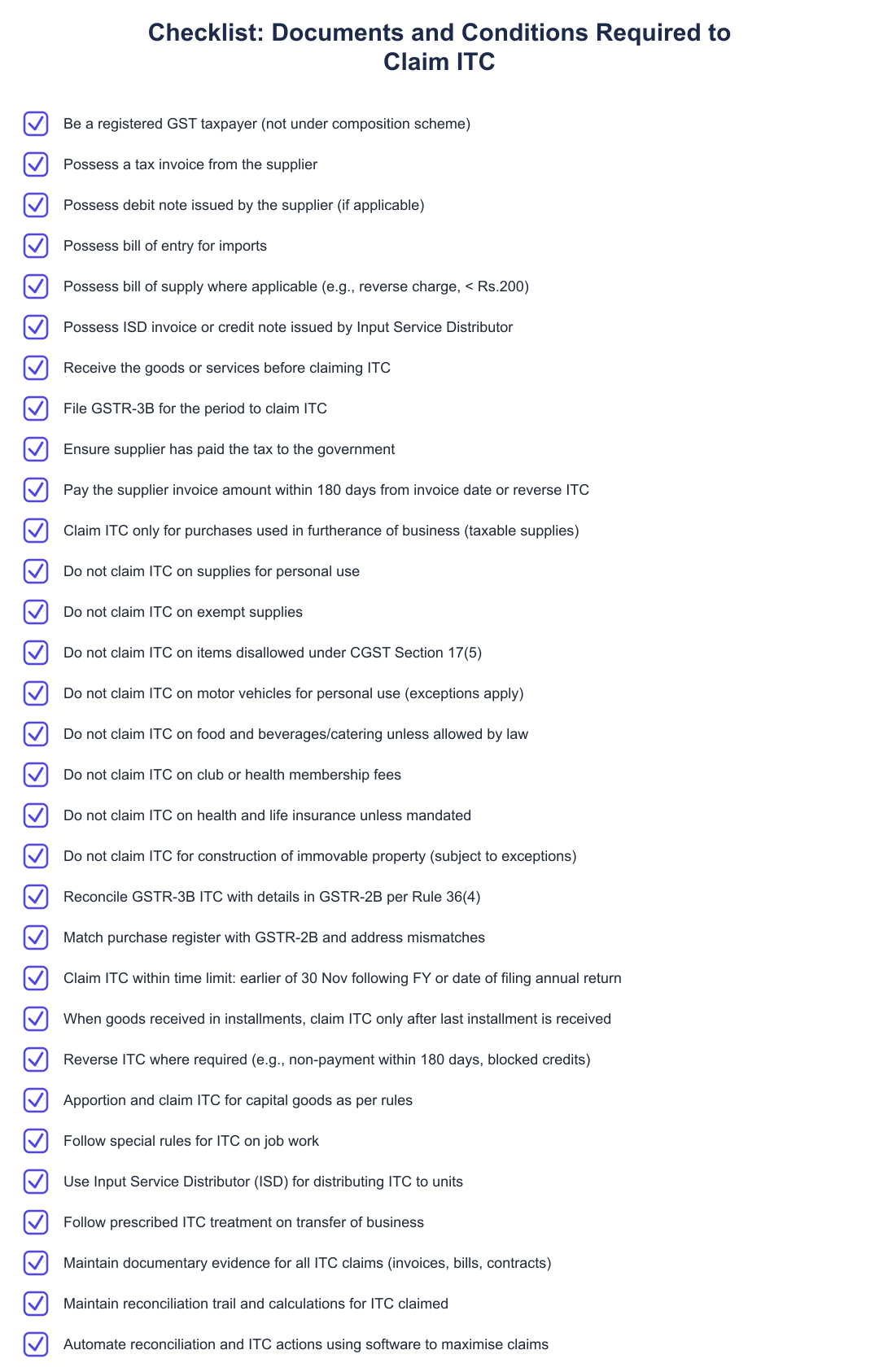
Eligible ITC consists of taxes paid on inputs and services that are used to make taxable supplies and that are not specifically excluded by statute. In practice, this requires a business to maintain supporting documents and an audit trail showing that purchases are for business use and feed into the taxable supplies of the taxpayer.
Ineligible ITC includes tax on supplies specified under CGST Section 17(5) and tax on goods or services used for personal use or for exempt supplies. Claiming ineligible ITC can lead to wrongful accumulation of credits and compliance consequences, so businesses should treat exclusions conservatively and reconcile frequently.
Documents Required for Claiming ITC
Proper documentation is essential to substantiate ITC claims. One important source of documentary evidence is invoices or credit notes issued under GST. Input Service Distributors (ISDs) are authorised to issue invoices or credit notes as per GST invoice rules and can distribute ITC to the units they serve.
Maintaining invoices, credit notes from ISDs (where relevant), and a clear reconciliation of purchases with ITC claimed in returns are fundamental controls. These records form the audit trail that supports the amounts reported in the monthly GSTR-3B (Table 4) and defend the business in case of enquiries or assessments.
Special Cases of ITC
There are several specialised contexts where ITC treatment needs careful handling, capital goods, job work, ISD distributions, and transfer of business are some common scenarios. In each case the underlying principle is the same: credit is allowed only when it is legitimately linked to taxable business activity and properly documented.
Because these special cases can create complex accounting and timing issues, many businesses use internal policies and technological controls to manage allocation, distribution, and tracking of ITC across these activities. This reduces the risk of misclaims and eases auditability.
Time limit to claim input tax credit under GST
ITC must be reported in the monthly return Form GSTR-3B, specifically in Table 4 which summarises eligible ITC, ineligible ITC, ITC reversed and ITC reclaimed. Regular monthly reporting ensures that ITC is tracked contemporaneously with output tax liabilities.
While there are statutory time limits and conditions that govern when a particular invoice’s credit can be claimed, the operational takeaway is that businesses should have processes to capture inputs and reconcile them for inclusion in the appropriate month’s GSTR-3B Table 4 to maintain compliance.
How to claim ITC?
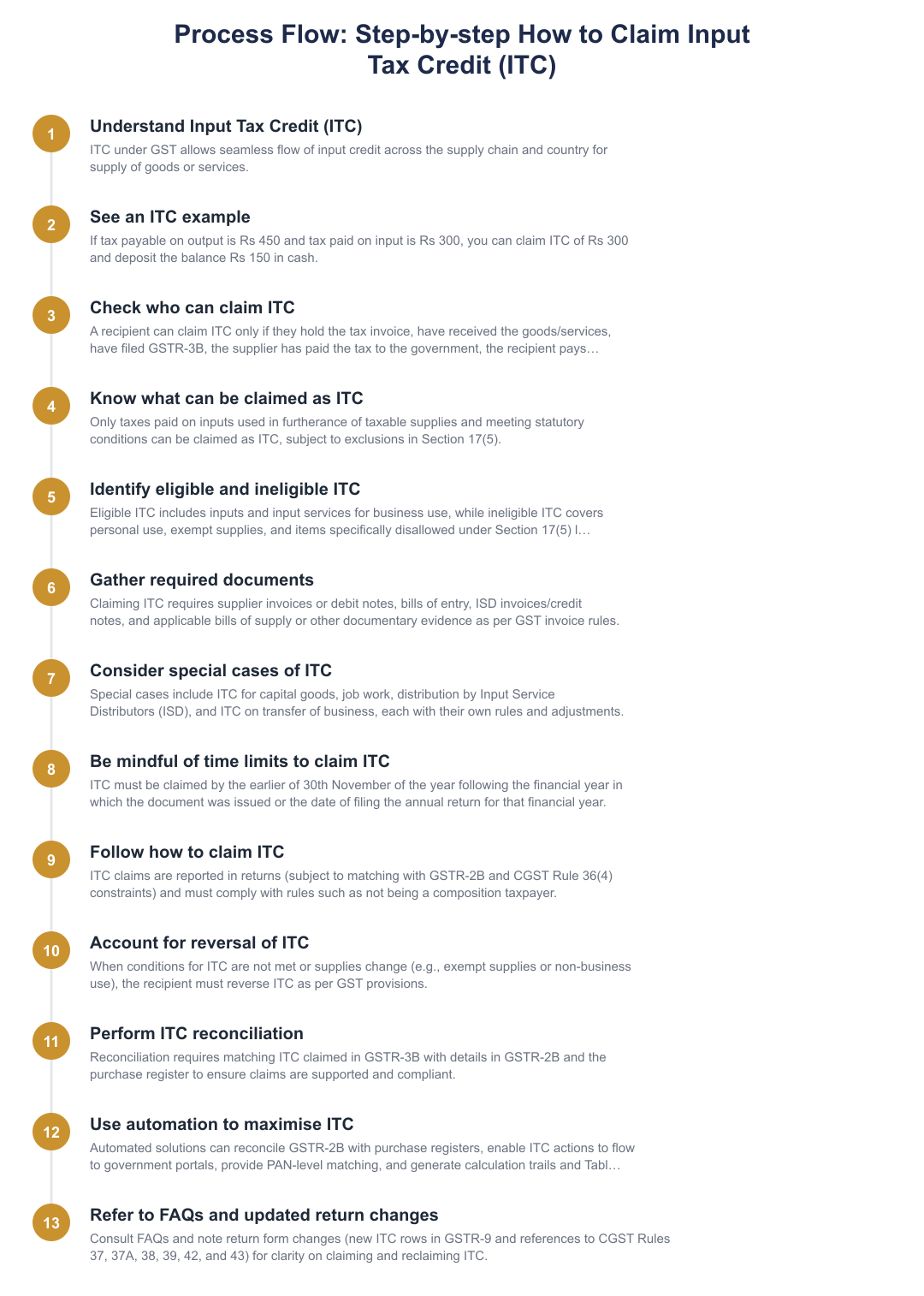
Gather supplier invoices and credit notes, including those issued by an Input Service Distributor, and verify they relate to business use and taxable supplies.
Allocate credits to the appropriate cost centres or GSTINs and maintain an audit trail showing the link between input and output supplies.
Include eligible and ineligible ITC, as well as any reversals or reclaimed credits, in the monthly Form GSTR-3B Table 4 as part of the return filing process.
Reversal of Input Tax Credit
Reversal of ITC is necessary when credits are not eligible or when conditions for claiming credit are not met. Failure to reconcile and reverse ineligible ITC may lead to wrongful accumulation in net ITC claims and potential notices due to non-compliance.
To avoid reversals becoming a surprise liability, businesses should implement periodic reconciliations between purchase records, supplier disclosures, and the ITC claimed in returns. Timely reversal where required preserves compliance and reduces downstream interest or penalty exposure.
ITC Reconciliation decoded
Reconciliation is the process of matching internal purchase records and ledgers with supplier-reported data and the credit claimed on returns. The government framework and practice encourage businesses to reconcile to ensure that the ITC claimed in GSTR-3B Table 4 is accurate and supported by supplier filings.
Use of technology and automation, for example, reconciling IMS+2B, auto-population into Table 4, multi-GSTIN ingestion and maintaining a robust audit trail, helps mitigate compliance risk, streamlines the matching process, and makes it easier to document corrective actions like reversals or reclamations.
How to automate and maximise ITC claims?
Automation reduces manual errors, speeds up reconciliation, and provides an auditable trail for ITC claims. Systems that ingest multi-GSTIN data, match supplier disclosures against the purchase register, and help auto-populate return tables can materially reduce the compliance burden while improving accuracy.
Beyond convenience, technology-enabled reconciliation helps identify missed credits, highlights discrepancies for follow-up with suppliers, and creates a defensible calculation trail. These benefits together help businesses maximise legitimately available ITC while minimising the risk of notices and reversals.
ITC is a central feature of GST that prevents tax cascading and preserves tax neutrality across the supply chain. To claim ITC correctly, businesses must distinguish eligible from ineligible credits (including those excluded under CGST Section 17(5)), substantiate claims with proper invoices or ISD credit notes, report accurately in GSTR-3B Table 4 every month, and reconcile regularly. Implementing technology and strong internal controls reduces the risk of wrongful accumulation of ITC and the attendant compliance notices, while helping firms maximise legitimately available credits.
Frequently asked questions
What is input tax credit (ITC) and can you give a simple example?
Input Tax Credit (ITC) allows a GST-registered taxpayer to reduce the tax paid on purchases from the tax payable on sales, effectively claiming the tax already paid on inputs. For example, if tax on your output sale is Rs 450 and you paid Rs 300 as tax on inputs, you can claim ITC of Rs 300 and pay the balance Rs 150 in cash; this nets your tax liability to the government. ITC flows across the supply chain and across India for taxable supplies, enabling seamless tax credit utilization so long as statutory conditions are met. The mechanism requires proper tax invoices, receipt of goods/services, and compliance with return filing and payment rules to be validly claimed.
Who is eligible to claim ITC under GST?
Only a person registered under GST can claim ITC, provided they satisfy specified conditions. These conditions include possession of a tax invoice or debit note, receipt of goods or services, filing required returns (like GSTR-3B), supplier having paid tax to the government, and payment to the supplier within 180 days of the invoice otherwise ITC must be reversed. If goods are received in installments, ITC can be claimed only after the last lot is received, and ITC is not allowed if depreciation has been claimed on the tax component of capital goods. Also, taxpayers making supplies under the composition scheme are not eligible to claim ITC.
What documents do I need to claim ITC?
You need the supplier's tax invoice (or debit note), bill of entry for imports, or an ISD invoice/credit note as applicable to claim ITC. In specific situations invoices like bill of supply (when amount under Rs.200 or for reverse charge scenarios) and certain alternative invoices are accepted, but the claimant must also have filed returns and have the supplies reflected in GSTR-2B/GSTR-3B where required. For imports, bill of entry and proof of payment of integrated tax are necessary, and Input Service Distributor (ISD) credits require the ISD invoice rules to be satisfied. Maintaining these documents and reconciling them with GSTR-2B and your purchase register helps substantiate ITC claims during assessment or audit.
Which purchases or inputs are ineligible for ITC under GST?
ITC is not available for inputs used for personal consumption, supplies that are exempt, and items specifically restricted under Section 17(5) of the CGST Act. Common ineligible items include motor vehicles for personal use (with narrow exceptions for resale, transport of passengers, or mandated services), food and beverages (for catering except where allowed), club or gym membership fees, certain insurance (like health/life unless legally required), construction of immovable property, and goods lost or destroyed or given as gifts. There are specific carve-outs where ITC on motor vehicles or services may be allowed, for example when used for taxable hiring/transport or where the vehicle is meant for resale, so assess eligibility under the exceptions. Always segregate and reverse ineligible ITC amounts in your returns to avoid wrongful claim accumulation.
What is the time limit to claim ITC under GST?
You must claim ITC within the earlier of two dates: 30th November of the year following the financial year in which the invoice/debit note was issued, or the date of filing the annual return for that financial year. For example, for a document issued anytime in FY 2024–25, the last date to claim that ITC would be either 30th November 2025 or the date you file the annual return for FY 2024–25, whichever comes earlier. This time limit applies to regular invoices and debit notes and taxpayers must ensure ITC is reported in GSTR-3B and supported by GSTR-2B entries where relevant. Special transitional provisions and rules (like provisional ITC percentages for blocked credits earlier) may affect timing historically, but current claims must follow these two prescribed deadlines.
How is ITC claimed for capital goods and are there special rules?
ITC on capital goods can be claimed but is subject to the same documentary and time-limit conditions and may require proportionate reversal if used partly for exempt or non-business purposes. If depreciation has been claimed on the tax component of a capital good under Income Tax laws, ITC on that tax component is not allowed, and adjustments must be made accordingly. For machinery and plant used in taxable supplies, full ITC can generally be taken, while assets used partly for exempt supplies require apportionment and reversal under Section 17. Specific capitalization and depreciation interactions should be checked to avoid double benefits.
How does ITC on job work and Input Service Distributor (ISD) credits work?
ITC on job work is available to the principal if the goods are sent for job work and the principal satisfies documentary and receipt conditions, and he can claim ITC when goods return or upon completion as per rules; inputs supplied to a job worker can be accounted for by the principal without reversal if goods return within prescribed time. Input Service Distributor (ISD) can distribute ITC of centralized input services to its units on the basis of an ISD invoice and applicable allocation logic, provided the ISD follows invoice rules and allocation ratios under GST. Both job work and ISD credits require proper invoices, records, and reconciliation with GSTR-2B/GSTR-3B to substantiate distributed or claimed credits.
When do I have to reverse ITC and how is reversal calculated?
You must reverse ITC when inputs or services are used for exempt supplies, non-business purposes, or if payment to the supplier is not made within 180 days of the invoice date, among other specified situations. Reversal is calculated by adding the ineligible ITC back to the output tax liability along with interest from the date of claim, and if the supplier later pays the tax, the recipient may reclaim the reversed ITC following prescribed procedures. Specific rules (like Rule 37/37A/39/42/43 references) govern reversal and reclaim mechanics, and partial reversal applies where inputs are partly for taxable and partly for exempt supplies. Maintaining accurate segregation and timely reconciliation prevents unnecessary reversals and interest liabilities.
How do I reconcile ITC between my purchase register, GSTR-2B and GSTR-3B to avoid mismatches?
Reconcile ITC by matching invoices in your purchase register with entries in GSTR-2B and the ITC claimed in GSTR-3B, ensuring amounts claimed in Table 4 of GSTR-3B reflect eligible ITC only and reversing ineligible amounts in Table 4(B). Use a three-way check, purchase register, GSTR-2B (auto-drafted), and IMS/GSTR-2A where relevant, to identify missing supplier invoices, mismatched GST amounts, or timing differences and take corrective actions such as communicating with suppliers or adjusting claims. Tech-enabled solutions that ingest multi-GSTIN and PAN-level data, regenerate GSTR-2B after IMS actions, provide AI-powered matching and produce audit trails (including Table 4 sub-breakups) significantly simplify reconciliation and help claim maximum compliant ITC. Regular monthly reconciliation and prompt action on discrepancies reduce risk of notices and downstream reversals during annual return reconciliation.
Need help staying GST compliant?
MoneyGence's AI Finance OS tracks your compliance, wallet share, and finances in one place, built for agencies and growing businesses.
Get started with MoneyGence