Intimation u/s 143(1): Reasons & How to Respond to Notice
This guide explains what an intimation under section 143(1) of the Income Tax Act, 1961 is, why you might receive one, and practical steps to respond. You will learn what information the intimation contains, common reasons why the Income Tax Department’s processed computation may differ from the figures you filed, and the immediate actions taxpayers should take on receiving an intimation. The guide also summarises the corrective options available when you disagree with the Department’s processing, including filing a rectification application under section 154(1) and using the e-filing portal or CPC channels for follow-up. Understanding these points matters because an intimation can show either a refund or a tax demand; responding correctly ensures you protect your tax position, obtain refunds due, or contest incorrect demands efficiently. The guidance below focuses on verifiable procedures and recommended checks so you can act promptly and use the Income Tax Department’s online mechanisms for resolution.
What Is Intimation under Section 143(1)?
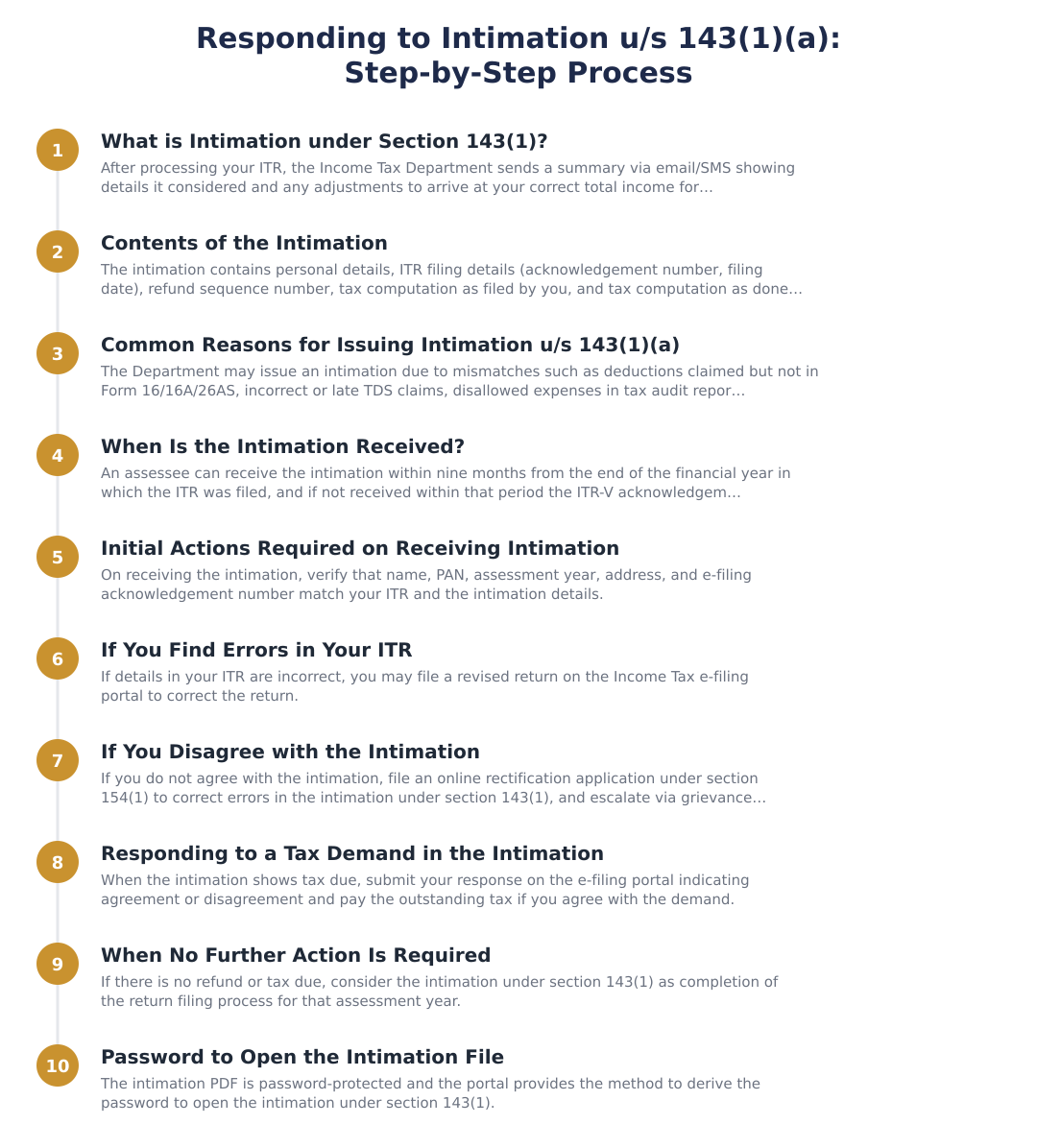
An intimation under section 143(1) is a summary communication issued by the Income Tax Department after it processes an Income Tax Return (ITR). The document sets out the details the taxpayer provided in the return alongside the details the Department has considered in accordance with the Income Tax Act, 1961. It is effectively the Department’s record of how it has computed the taxpayer’s total income after automated or standard processing.
The intimation serves to inform the taxpayer of any differences between the tax computation shown in the filed ITR and the computation arrived at by the Department. This helps taxpayers verify whether tax has been accepted as filed, whether a refund has been determined, or whether the Department’s processing has resulted in a different tax outcome.
What the Intimation Contains
The intimation is sent to the taxpayer’s registered contact (via e-mail or SMS alert) and includes key identification and filing information. Specifically, it contains personal details such as name and address, ITR filing details including the acknowledgement number and filing date, and a refund sequence number when applicable.
Critically, the intimation contrasts the tax computation as reported by the taxpayer in the ITR with the computation as carried out by the Income Tax Department. This comparative summary allows the taxpayer to see where figures match or differ and indicates whether any refund or tax due has been recorded by the Department.
Actions Required for Intimation under Section 143(1)
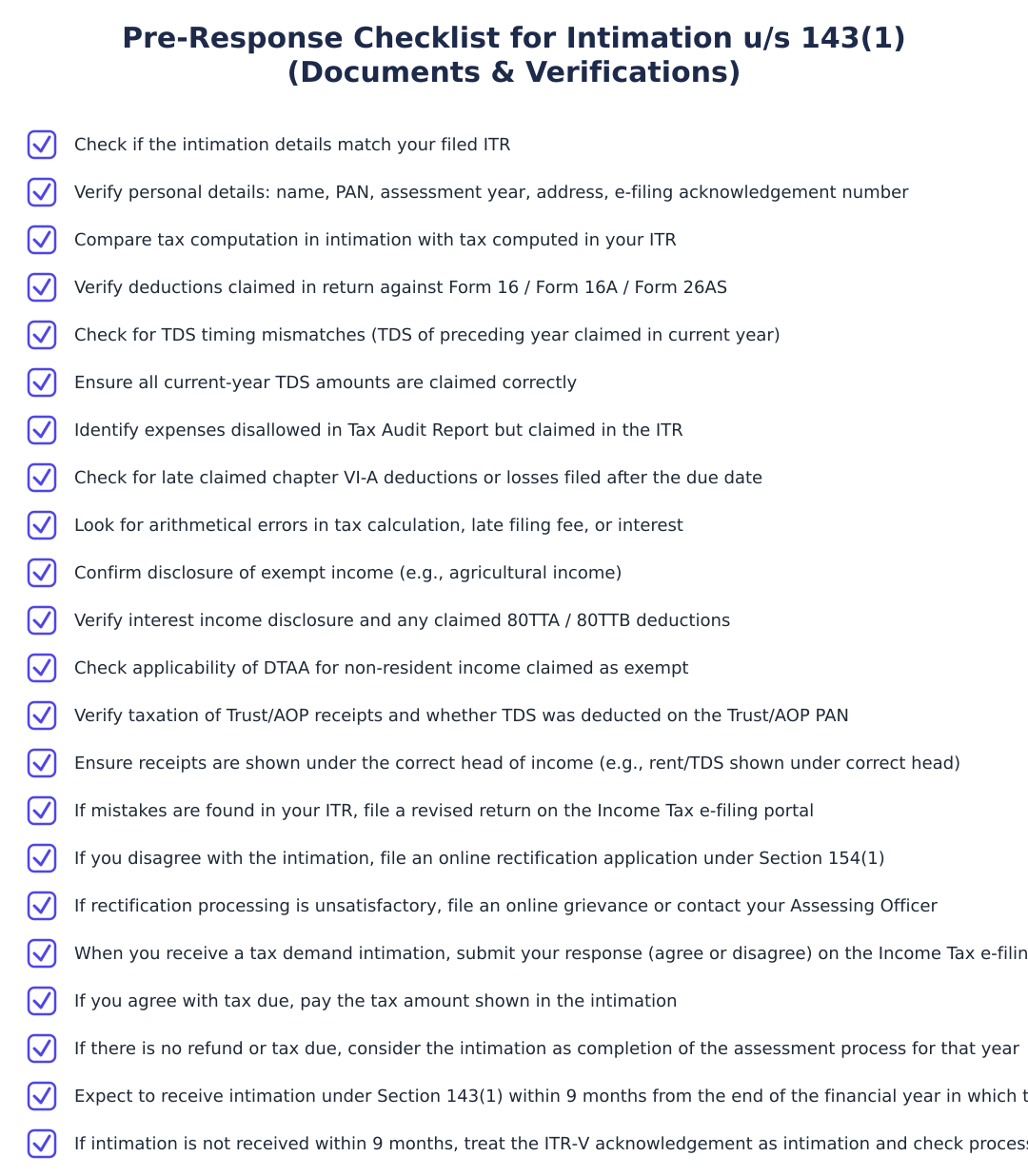
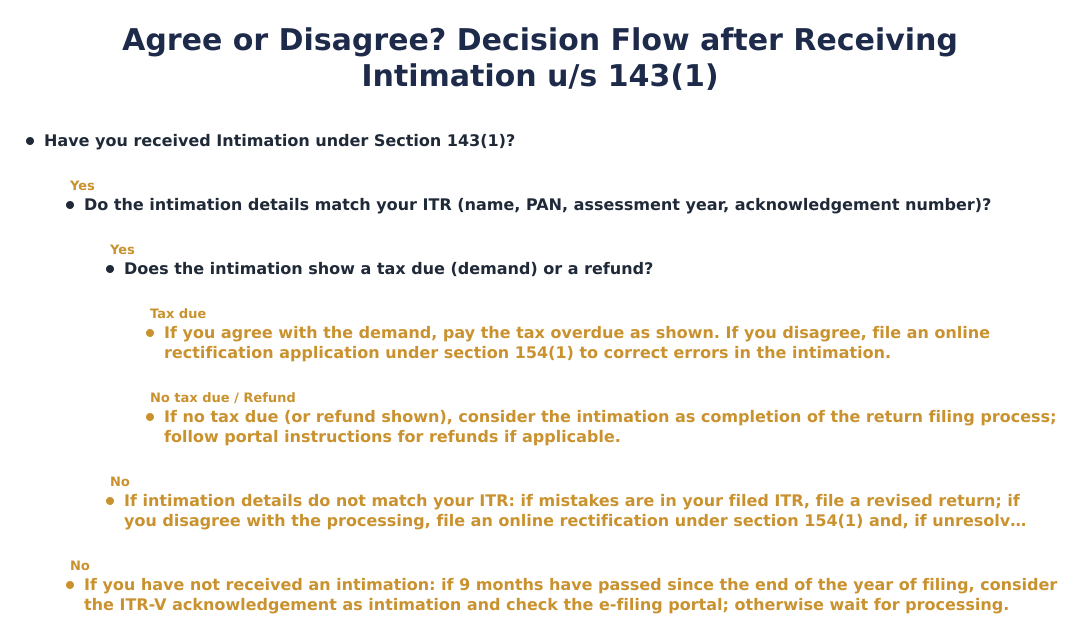
Check that the personal details (name, address), PAN, assessment year and the e-filing acknowledgement number in the intimation match your records.
Review the tax computation shown by the Department against what you filed to identify any differences in income, deductions, TDS or tax liability.
Where the mismatch arises from an error in your original ITR, you can file a revised return on the Income Tax e-filing portal to correct those mistakes.
When the intimation contains mistakes attributable to the Department’s processing or you disagree with adjustments, file an online rectification application under section 154(1) to seek correction of the intimation.
If processing or rectification via the Centralised Processing Centre (CPC) is unsatisfactory, pursue grievance or redressal options provided on the Income Tax e-filing portal and related CPC channels.
When You Receive an Intimation and What to Do About Demands
When the intimation shows a tax demand, the Income Tax Department expects a response to be furnished via its e-filing portal indicating whether you agree or disagree with the demand. If you agree, the verified facts require that you pay the tax shown as overdue in the intimation.
If you disagree with the demand, follow the rectification process under section 154(1) and use the e-filing and CPC channels for follow-up. Throughout, maintain records of communications and any payments or rectification requests submitted so you can evidence timely compliance or contestation.
Responding and Using the E-filing/CPC Channels
The Income Tax Department communicates intimations and related processing outcomes through the e-filing portal and the Centralised Processing Centre (CPC). Use these online facilities both to view the intimation in detail and to carry out any of the corrective actions (revised return, rectification application) described above.
If a rectification under section 154(1) is required, submit it online through the e-filing portal. If CPC processing of your rectification or other requests does not resolve the matter, use the portal’s grievance or contact mechanisms to seek further redressal.
What This Means Practically for Taxpayers
An intimation is not a final assessment order but a processed summary that can either confirm your return or indicate adjustments. Prompt review and response protect you from interest, penalties, or missed refunds arising from mismatches.
Use the documented channels, the e-filing portal and CPC, both for submitting corrections and for escalating matters that remain unresolved. Filing a revised return or a rectification application under section 154(1) are the structured ways to correct returns or contest the Department’s processing.
An intimation under section 143(1) is a routine, but important, communication that summarises how the Income Tax Department has processed your ITR. Review it carefully, compare computations, and take prompt action, either by filing a revised return for your own errors or an online rectification under section 154(1) if you disagree with the Department’s processing. Use the e-filing portal and CPC channels for viewing, responding and escalating so your tax position is settled correctly and efficiently.
Frequently asked questions
What is an intimation under section 143(1) of the Income Tax Act?
An intimation under section 143(1) is a communication from the Income Tax Department summarising how your filed ITR was processed and showing any adjustments made to compute your correct total income. It contains personal details (name, PAN, address), ITR filing details (acknowledgement number, filing date), refund sequence number (if any), the tax computation as declared by you and as computed by the Department, and is sent by e-mail or SMS to the registered contact. The intimation reflects only arithmetical errors, missed TDS credits, and other automated adjustments and does not initiate a detailed scrutiny assessment. You should treat it as the completion of processing for that assessment year unless you need to file a rectification or revised return due to errors.
Why did I get a notice under section 143(1)(a) that my income doesn’t match Form 16/Form 16A?
You got a notice under section 143(1)(a) because the Income Tax Department’s processed figures (from Form 26AS, TDS statements, and other data) don’t match the income or deductions shown in your ITR or Form 16/Form 16A. Common causes include claiming deductions not reflected in Form 16/16A (like late TDS credits), reporting TDS for the wrong assessment year, claiming chapter VI-A deductions after the due date, arithmetical errors, or incorrectly classified incomes (for example treating TDS on rent as business income). The intimation lists the specific mismatches and the amount of tax/refund difference; you should verify Form 26AS, your Form 16/16A, bank interest statements and auditor reports to identify the source. If the mismatch is genuine, you can file a revised return (if within time) or an online rectification under section 154(1) to correct the intimation.
What steps should I take immediately after receiving an intimation under section 143(1)?
Immediately check that the intimation’s details (name, PAN, assessment year, acknowledgement number) match your ITR and then reconcile the Department’s tax computation with your Form 16/16A, Form 26AS and bank statements to spot discrepancies. If you find an error in your ITR, file a revised return on the e-filing portal (within time limits) or submit an online rectification under section 154(1) to correct mistakes in the intimation. If you agree with the tax demand shown, pay the outstanding tax, interest and any fees as mentioned; if you agree with a refund, verify bank details for the refund credit. If unsatisfied with rectification processing, raise an online grievance or approach the Assessing Officer.
How do I respond step-by-step to a notice about TDS or income mismatch?
To respond, first download and open the intimation (password is PAN + DOB in lower case), reconcile the differences with Form 16/16A and Form 26AS, and gather supporting documents (TDS certificates, bank statements, audit reports). If the taxpayer’s figures were correct, file an online rectification under section 154(1) explaining the discrepancy and upload proofs; if your filed ITR was incorrect and still within the statutory period, file a revised ITR with correct figures. If the intimation shows tax due and you accept it, pay the tax and interest via the e-filing portal; if you disagree after rectification, you may contact the Assessing Officer or file a grievance with CPC. Keep acknowledgement receipts of rectification/revision and payments as evidence until the matter is closed.
What is the password to open the intimation PDF issued under section 143(1)?
The password to open the intimation PDF issued under section 143(1) is your PAN followed by your date of birth in lower case. For example, if PAN is ABCDE1234F and DOB is 01-04-1990, the password would be abcde1234f01-04-1990 in lower case. Use this password exactly (no spaces) to view the detailed intimation and verify the computations and noted mismatches. If you cannot open the PDF with the correct password, ensure you are using the registered PAN and the correct DOB format shown in the intimation instructions.
When should I file a revised return and when should I file a rectification for a 143(1) intimation?
File a revised return when you discover omissions or mistakes in your original ITR that can be corrected within the statutory period for revision (usually before the end of the relevant assessment year or within the time allowed under the Income Tax Act). File an online rectification under section 154(1) when the intimation under section 143(1) contains arithmetic errors, incorrect TDS credits, or other processing mistakes by the Centralised Processing Centre, rectification corrects the intimation without replacing the original ITR. Use revision to change income, deductions or claims that were genuinely omitted; use rectification to ask the Department to correct processing or clerical errors and to credit missing TDS after submitting proof. If in doubt, reconcile figures and choose revision for return-level corrections and rectification for CPC processing adjustments.
What are the common reasons CPC makes adjustments and issues an intimation under section 143(1)?
Common reasons for CPC adjustments include deductions claimed in the return but not supported by Form 16/Form 16A/Form 26AS, TDS claimed in wrong assessment year, unclaimed or missing TDS for the current year, expenses disallowed in a tax audit report but claimed in the return, and late claims for chapter VI-A deductions or losses. Other frequent causes are arithmetical errors, nondisclosure of exempt income (for example agricultural income), mismatch in interest income with reported deductions under sections 80TTA/80TTB, and DTAA-related exemptions for non-residents. CPC also flags receipts shown under a different head of income than the head under which TDS was deducted (e.g., TDS on rent shown as business income), leading to mismatch notices. Each of these reasons will be mentioned in the intimation and you should reconcile with supporting documents to decide on revision or rectification.
What happens if I agree or disagree with the tax demand shown in the intimation under section 143(1)?
If you agree with the tax demand shown in the intimation, you must pay the outstanding tax, interest and any fees indicated via the Income Tax e-filing portal to regularise your assessment. If you disagree, you should first file an online rectification under section 154(1) with documentary evidence explaining why the Department’s computation is incorrect; if the rectification is unsatisfactory, you can file a grievance or contact the Assessing Officer for further redress. Failure to respond or pay an accepted demand can lead to notices for recovery and interest; conversely, a successful rectification may result in cancellation of the demand or issuance of a refund. Always keep proof of payment and rectification/revision acknowledgements until the matter is fully resolved.
How long should I wait for the intimation and what if I don’t receive it?
You should normally receive the intimation under section 143(1) within nine months from the end of the financial year in which the ITR was filed; if not received within this period, the acknowledgement (ITR-V) may be treated as the intimation for practical purposes. If the intimation is not received after nine months, check the Income Tax e-filing portal to confirm whether your ITR has been processed and ensure your contact details (email and mobile) are correct; you may also download the intimation from the portal. If processing shows discrepancies or the ITR is unprocessed, consider contacting CPC or the Assessing Officer and keep copies of ITR-V/acknowledgements as evidence.
Need help staying Income Tax compliant?
MoneyGence's AI Finance OS tracks your compliance, wallet share, and finances in one place, built for agencies and growing businesses.
Get started with MoneyGence