ITR-1 (Sahaj) AY 2026-27, Eligibility, Changes, Due Date & Filing
This guide explains the essentials of filing ITR-1 (Sahaj) for individuals for Assessment Year 2026-27, focusing on practical steps, common deductions and how tax payments affect refunds. You will learn who cannot use ITR-1, which common deductions are typically claimed while filing, how tax paid components are treated during return computation and the exact e-filing portal flow to file and e-verify your return. Understanding these points helps ensure accurate filing, reduces the chance of needing to revise a return, and speeds up any legitimate refund. The guide is aimed at salaried taxpayers and other simple-profile assessees who want a clear, no-nonsense walkthrough of the filing process and how to check that tax credits and payments have been appropriately accounted for. It also clarifies the role of common deductions when calculating taxable income and the final tax liability. Finally, you will get step-by-step instructions for using the Income Tax e-Filing portal so you can complete the filing and e-verification process confidently. This is intended as a practical resource to reduce errors and improve compliance during the filing season.
What is ITR-1?
ITR-1 (Sahaj) is a simplified income tax return form intended for individuals with relatively straightforward income profiles. It is designed to capture common income heads and deductions without the complexity of forms intended for business owners, investors with complex capital gains, or taxpayers with foreign assets.
Because it is streamlined, many routine taxpayers find ITR-1 faster to complete. The form emphasizes basic personal information, typical income heads, routine deductions, computation of tax payable, details of tax already paid, and verification. Its simplicity helps reduce data-entry errors and makes e-filing more accessible for first-time filers.
Who Cannot File ITR-1?
Not all assessee types are eligible to use ITR-1. Specifically, ITR-1 cannot be filed by Hindu Undivided Families (HUFs). This is a statutory restriction and means HUFs must use a different return form appropriate to their status.
Beyond HUFs, taxpayers with more complex tax situations, such as those requiring detailed reporting of foreign assets, extensive capital gains, business or professional income, or other specialized disclosures, should choose the form that best matches their profile. Using the wrong form can lead to processing delays and may require filing a revised return later.
Deductions Commonly Claimed in ITR-1
While preparing your ITR-1, there are several standard deductions taxpayers commonly claim to reduce taxable income. Among the deductions referenced frequently are those under Sections 80C, 80D, 80TTA and 80TTB. These cover long-standing reliefs such as certain investments and insurance premiums, as well as interest-based exemptions for savings and senior citizens, depending on eligibility.
When claiming deductions, ensure you correctly identify the section under which each deduction is claimed. The e-filing system requires selection of the specific clause/sub-section for many deductions, improving accuracy and reducing processing queries from the tax department.
How Tax Paid Components Affect Refunds
Tax paid before or during filing is aggregated from various components and set against the computed tax liability to determine whether you owe tax or are entitled to a refund. Key tax-paid components that are treated as credit include Tax Deducted at Source (TDS), Tax Collected at Source (TCS), Advance Tax, and Self-Assessment Tax.
If the total of these tax-paid components exceeds your computed tax liability for the year, the excess amount becomes refundable. Therefore, reconciling your Form 26AS, AIS/TIS or other tax credit statements with the figures entered in the return is important to ensure you claim the correct refund amount and avoid delays.
Steps to File ITR-1 Online on the Income Tax Portal
On the e-Filing portal go to e-File > Income Tax Returns > File Income Tax Return and select the relevant assessment year and preferred filing mode.
Choose 'Start New Filing' to begin a fresh return; the portal will guide you to fill personal and income details.
Enter or verify personal information and input income items as applicable; some fields may be pre-filled from existing records.
Select and claim deductions such as those under Sections 80C, 80D, 80TTA or 80TTB, ensuring you choose the correct sub-section or clause where required.
Submit the completed return and complete the e-verification process to validate the filing; the portal will provide available e-verify options.
ITR-1 (Sahaj) remains the appropriate return form for many individuals with straightforward income and common deductions. Keep your records handy, reconcile tax-paid credits like TDS/TCS/Advance and Self-Assessment Tax with your filing, and follow the portal flow to submit and e-verify your return. If your situation is more complex than typical individual income and standard deductions, consider using a different ITR form suited to your circumstances or consult a tax professional.
Frequently asked questions
What is ITR-1 (Sahaj) for AY 2026-27?
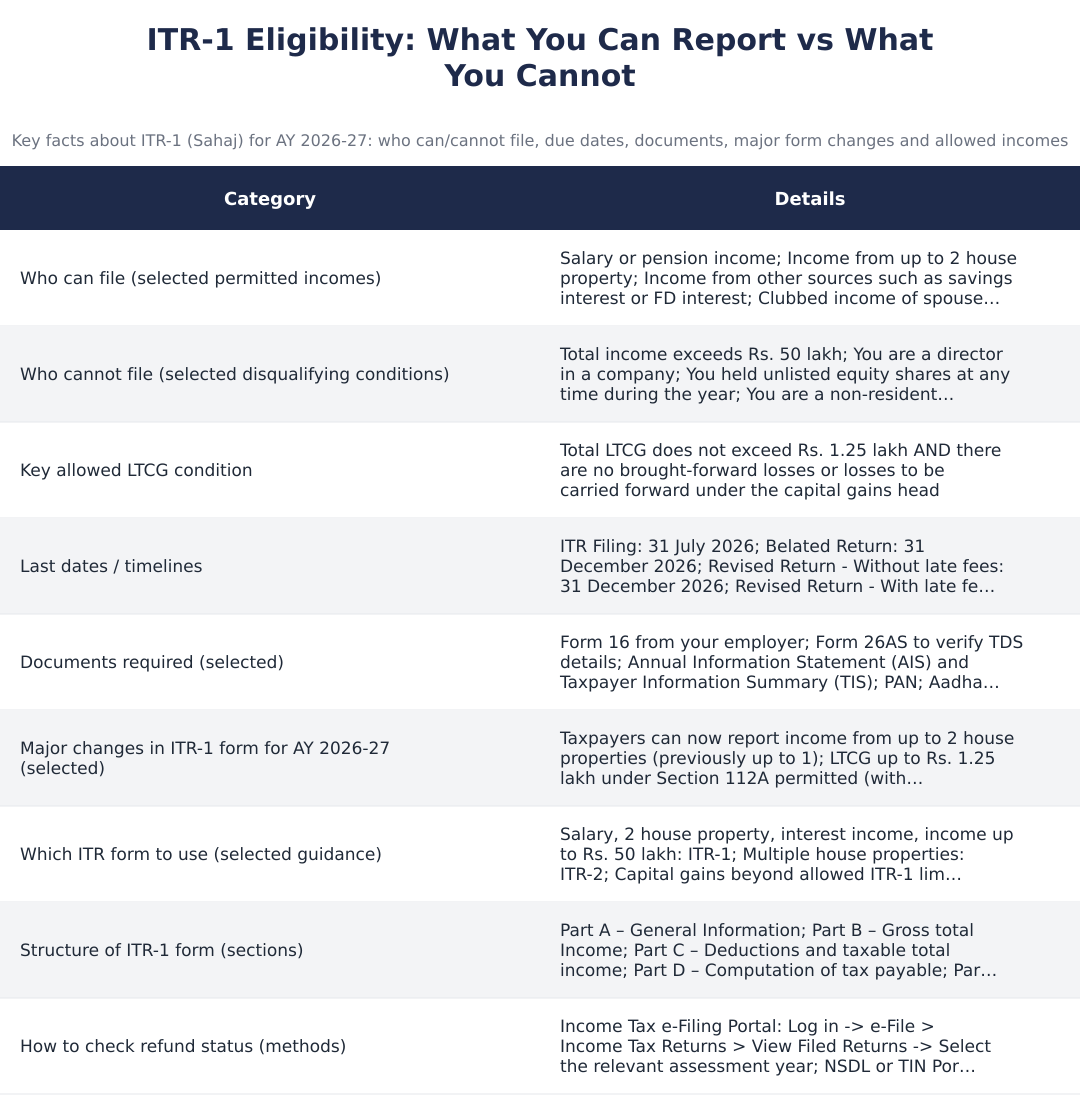
ITR-1 (Sahaj) is the simplest income tax return form for resident individuals and Hindu Undivided Families (HUFs) with straightforward incomes up to Rs. 50 lakh. It is meant for taxpayers with salary or pension, income from up to two house properties, income from other sources (like savings or FD interest), agricultural income up to Rs. 5,000, and long-term capital gains under Section 112A up to Rs. 1.25 lakh provided there are no carried-forward capital losses. The form is structured into parts for personal information, gross total income, deductions, tax computation and verification, and includes schedules for TDS and advance tax. New AY 2026-27 updates also add fields such as selection of exact deduction sub-sections and stricter Aadhaar input rules.
Who can file ITR-1 for FY 2025-26 (AY 2026-27)?
You can file ITR-1 if you are a resident individual with total income not exceeding Rs. 50 lakh and your income consists of salary or pension, income from up to two house properties, other sources like interest, clubbed income (if within permitted heads), agricultural income up to Rs. 5,000, or LTCG under Section 112A up to Rs. 1.25 lakh with no carried-forward capital losses. The form also covers taxpayers who need to report TDS/TCS, advance tax, and claim common deductions such as under Sections 80C and 80D. Ensure you are a resident (not NRI or RNOR) and do not hold disallowed items like unlisted equity shares or foreign assets to remain eligible.
Who cannot file ITR-1 for AY 2026-27?
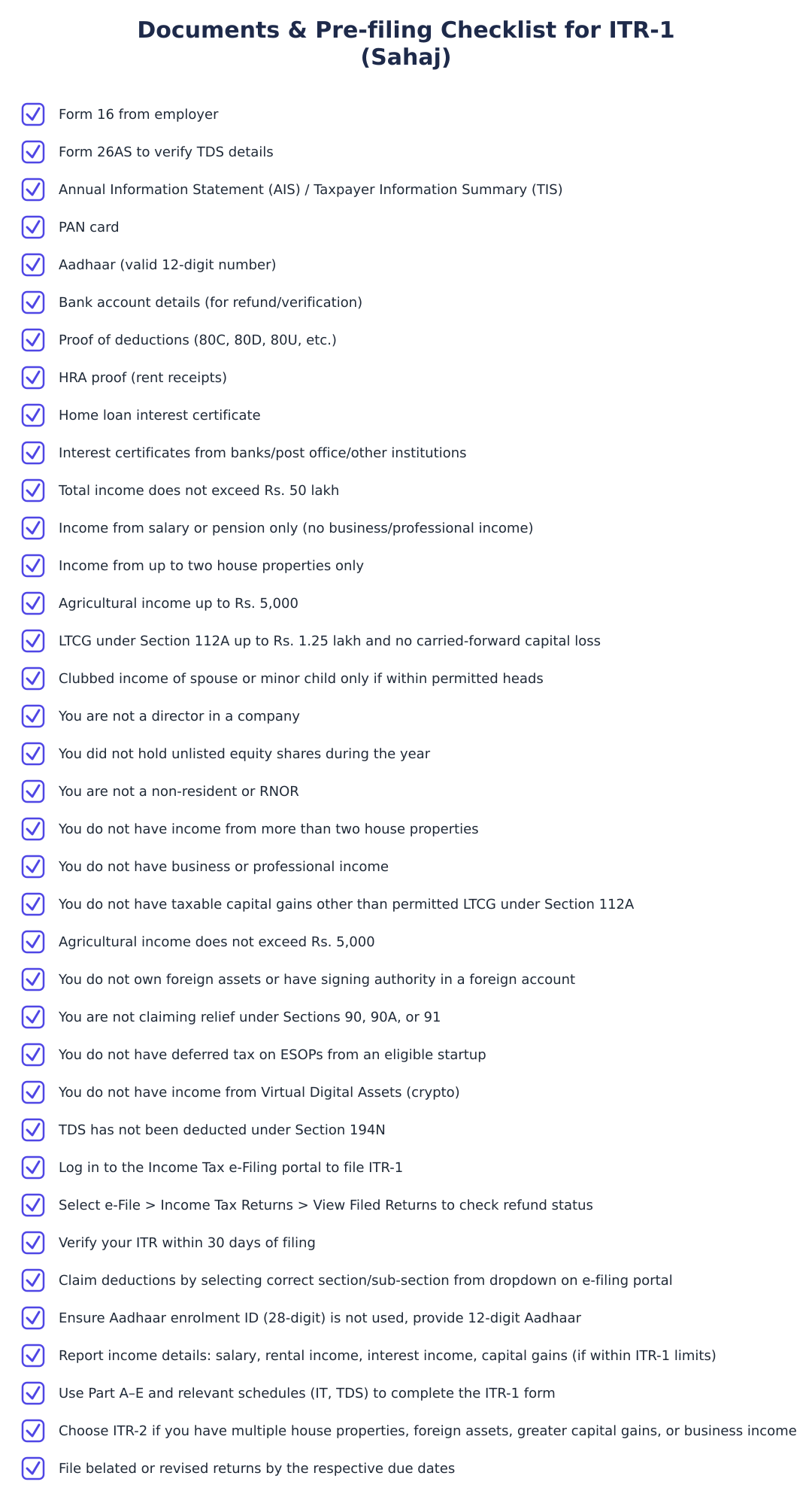
You cannot file ITR-1 if your total income exceeds Rs. 50 lakh, you are a director in a company, you held unlisted equity shares, you are a non-resident or RNOR, you have income from more than two house properties, business or professional income, taxable capital gains beyond permitted LTCG, agricultural income over Rs. 5,000, foreign assets or signing authority in foreign accounts, relief claims under Sections 90/90A/91, deferred ESOP tax from eligible startups, income from virtual digital assets, or TDS deducted under Section 194N. Any one of these conditions makes ITR-1 inapplicable and you should choose a different ITR form such as ITR-2 or ITR-3 as appropriate. HUFs and cases requiring special relief or disclosures are also outside ITR-1 scope.
What is the last date to file ITR-1 for FY 2025-26 and key cut-offs?
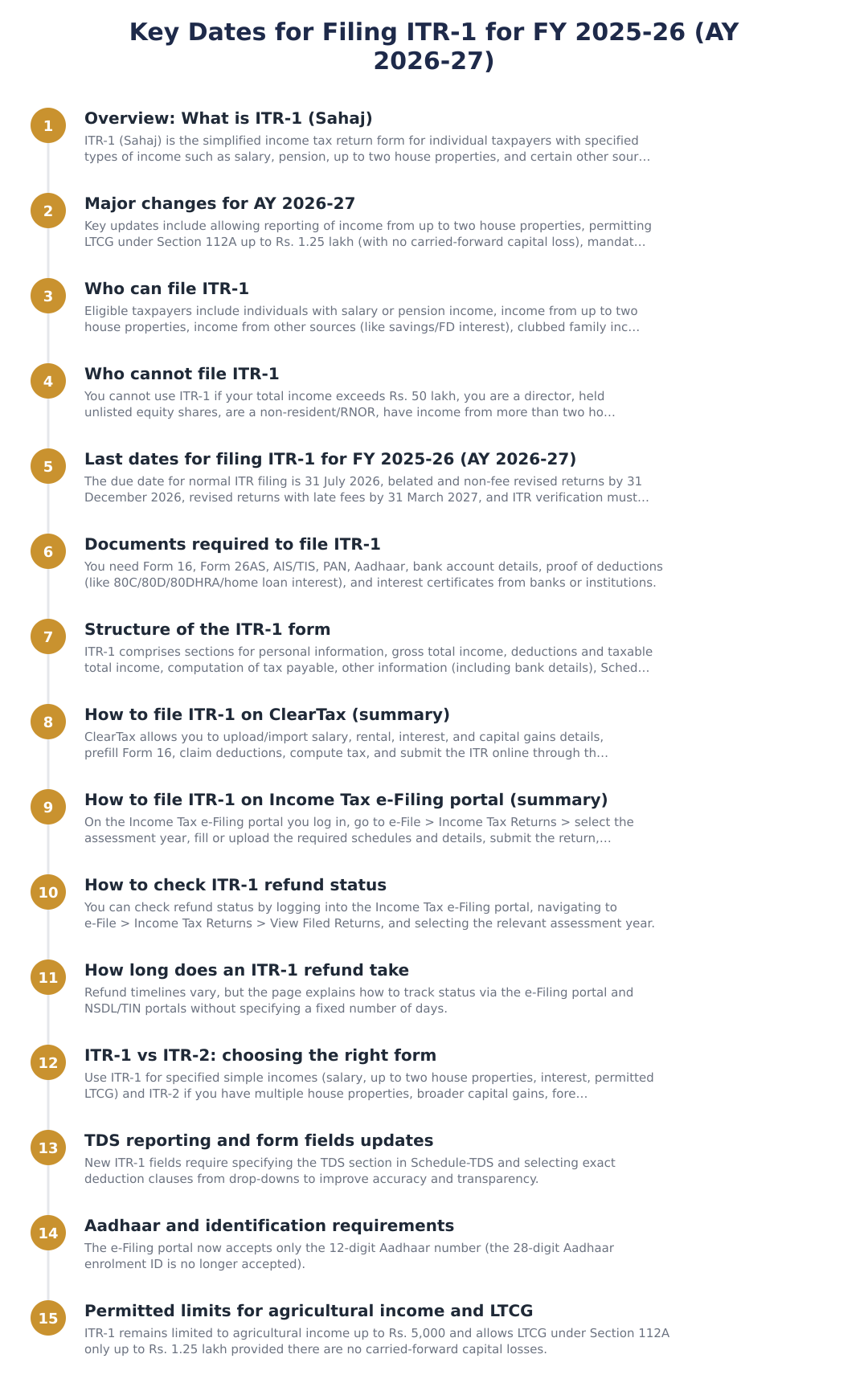
The due date to file ITR-1 for FY 2025-26 (AY 2026-27) is 31 July 2026, with belated returns allowed until 31 December 2026. Revised returns without late fees can be filed until 31 December 2026, and with late fees until 31 March 2027; ITR verification must be completed within 30 days of filing. These timelines are important for claiming refunds, carrying forward losses, and avoiding late fees or interest. Missing the original deadline also affects the ability to carry forward certain losses, so timely filing is advisable.
What documents do I need to file ITR-1 online?
To file ITR-1 you typically need Form 16 from your employer, Form 26AS to verify TDS, AIS/TIS summaries, PAN, Aadhaar, bank account details, proof of deductions (like 80C, 80D, HRA, home loan interest) and interest certificates from banks or post offices. These documents help auto-fill income details and support claimed deductions and tax payments such as advance tax or self-assessment tax. Keep digital copies (PDF/JPEG) handy for upload when using e-filing portals or tax-filing services.
How do I file ITR-1 online on the Income Tax e-Filing portal?
To file ITR-1 on the Income Tax e-Filing portal, log in, go to e-File > Income Tax Returns > File Income Tax Return, select the assessment year and 'Online' mode, then start new filing, choose your status and ITR-1 form and complete the five sections: personal information, gross total income, deductions, tax computation and verification. The portal now requires selection of specific deduction sub-sections from drop-downs and accepts only valid 12-digit Aadhaar numbers; ensure your details match PAN/Aadhaar to avoid validation errors. After submission, e-verify within 30 days using methods like Aadhaar OTP, net banking, or EVC to complete filing.
How do I file ITR-1 using ClearTax or a tax-filing service?
On ClearTax, sign in with PAN and OTP to link your PAN, upload Form 16 if available, review auto-filled details, add income (salary, rent, interest, capital gains), claim deductions and tax payments, then submit and e-verify your return. The platform auto-fills many fields from Form 16 and Form 26AS and compares tax liability under the old and new tax regimes to suggest the better option; complete the self-declaration and OTP e-verification to finish filing. ClearTax and similar services streamline uploads and validations but you must ensure all details and supporting documents are accurate before submission.
How can I check the status of my ITR-1 refund and how long does it take?
You can check your ITR-1 refund status by logging into the Income Tax e-Filing portal and viewing Filed Returns for the relevant assessment year, or by checking the NSDL/TIN portal; the e-filing portal shows processing status and any communicated adjustments. If your return is correctly filed and e-verified, refunds are generally processed within 4 to 8 weeks, though more complex cases or departmental verifications can take longer. Keep your bank account details updated in the return to avoid delays and monitor communication from the tax department for any queries.
What are the major changes in ITR-1 for AY 2026-27 that I should know?
Major changes for AY 2026-27 include allowing reporting of income from up to two house properties, permitting LTCG under Section 112A up to Rs. 1.25 lakh (with no carried-forward capital loss), mandatory selection of exact deduction sub-sections from a drop-down on the e-filing portal, and the portal now accepting only 12-digit Aadhaar numbers (28-digit enrolment ID is not accepted). Additional fields were added for foreign retirement account relief (Section 89A) and a TDS schedule now requires the specific section under which TDS was deducted to be mentioned. These updates are intended to improve accuracy and cover slightly more complex but common cases while keeping ITR-1 simple.
Need help staying Income Tax compliant?
MoneyGence's AI Finance OS tracks your compliance, wallet share, and finances in one place, built for agencies and growing businesses.
Get started with MoneyGence