ITR-2 Filing AY 2026-27: Due Date, Eligibility & How to File
This guide explains who should use ITR-2 for Assessment Year (AY) 2026-27 and clarifies key eligibility boundaries so you can pick the correct income‑tax return form. You will learn which categories of individual and HUF taxpayers must file ITR-2, which common incomes disqualify you from using this form, and practical scenarios, such as high salary, capital gains, foreign income, ESOP/RSU events, and directorship, that point to ITR-2. Understanding the right form matters because using an incorrect ITR can lead to processing delays and unnecessary follow-ups from the tax department. The guide also compares ITR-2 with the simpler ITR-1 to help you decide when it is acceptable (or advisable) to use the simpler form versus ITR-2. Throughout, the emphasis is on accurate classification of income types, particularly the distinction between passive incomes (salary, capital gains, house property, foreign income) that fit ITR-2 and business or professional incomes that require a business return, so you can file confidently and avoid common mistakes.
Who Can File ITR-2?
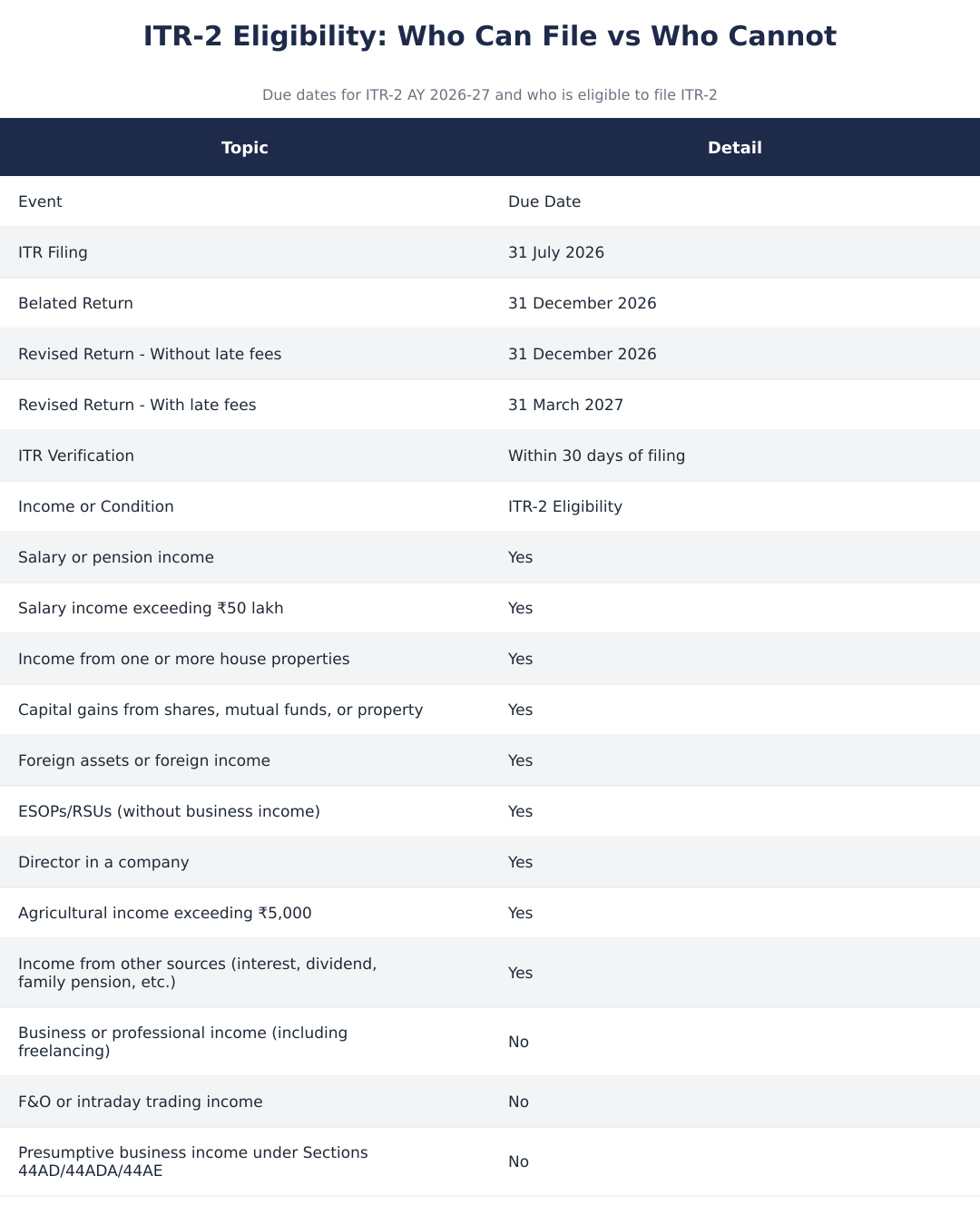
ITR-2 is intended for individuals and Hindu Undivided Families (HUFs) who have income types other than "Profits and Gains from Business or Profession." This means taxpayers with income sources such as salary or pension, capital gains from sale of shares, mutual funds, or property, income from one or more house properties, and certain other non-business incomes should use ITR-2.
Specific situations that point to ITR-2 include salary income above higher thresholds where the simpler forms are not appropriate, agricultural income exceeding statutory limits, holding foreign assets or receiving foreign income, and transactions involving ESOPs or RSUs where there is no accompanying business or professional income. Additionally, individuals who have served as a director in a company are within the scope of ITR-2.
Who Cannot File ITR-2?
ITR-2 is not for taxpayers who have income from business or profession. If you earn profits and gains from a business or from a profession, including freelancing where income is assessable under business/professional head, you should use the appropriate business-return form rather than ITR-2.
Similarly, incomes arising from trading in derivatives (F&O) or intraday trading are treated as business income and therefore make a taxpayer ineligible to use ITR-2. Taxpayers under presumptive taxation schemes or those with partnership income taxable as business are also outside the scope of ITR-2 and must file the relevant business forms.
Special situations commonly reported in ITR-2
Capital gains: If you have capital gains from sale of shares, mutual funds or immovable property, these gains are reported in ITR-2. This covers both short‑term and long‑term capital gains when there is no business/professional income to report.
Foreign assets and foreign income: Individuals with overseas bank accounts, investments or other foreign-source income should use ITR-2 so that relevant disclosures can be made in the return. Likewise, employees who have received ESOPs or RSUs but do not have business income should file ITR-2 to report those events.
Agricultural income and directorship: Agricultural income above the statutory small threshold requires ITR-2 rather than the simpler forms. Also, persons who were directors in a company during the year fall within the population that should use ITR-2.
ITR-1 vs ITR-2: When to prefer the simpler form
Taxpayers who clearly meet the eligibility conditions for ITR-1 may still have the option to file ITR-2, but filing ITR-1 is generally advisable when you qualify. The simpler form reduces complexity and is tailored for straightforward salary/pension income and few other limited income types.
However, once you have capital gains, foreign income/assets, agricultural income beyond the small threshold, ESOP/RSU events without business income, or are a company director, ITR-2 becomes the appropriate form. Choosing the correct form up front helps avoid return processing issues and the need for amendments later.
Frequently Asked Questions
Q: Can a taxpayer with salary above a high threshold use ITR-1? A: Verified guidance indicates that taxpayers with salary income above the simpler-form thresholds should use ITR-2 rather than ITR-1, so if your salary exceeds the stated limit for ITR-1 you should opt for ITR-2.
Q: I did ESOPs but also freelance occasionally, which form? A: If you have freelancing income that is taxable as business or profession, you are not eligible to use ITR-2; business/professional income requires a business-return form. If there is no business/professional income, ESOP/RSU events can be reported in ITR-2.
Q: I trade F&O and have capital gains from long‑term investments, which form applies? A: Trading in F&O is treated as business income, therefore ITR-2 is not appropriate when F&O or intraday trading income exists. Business-return forms should be used in such cases.
Selecting the correct ITR form is a crucial step in tax filing. Use ITR-2 if you are an individual or HUF with capital gains, foreign income or assets, high salary, agricultural income above the small threshold, ESOP/RSU events without business income, or if you served as a director. Do not use ITR-2 if you have business or professional income or trading treated as business, in those cases file the appropriate business return. When in doubt, compare your income heads with the descriptions above or consult a tax professional to ensure accurate filing.
Frequently asked questions
What is the last date to file ITR‑2 for FY 2025‑26 (Assessment Year 2026‑27)?
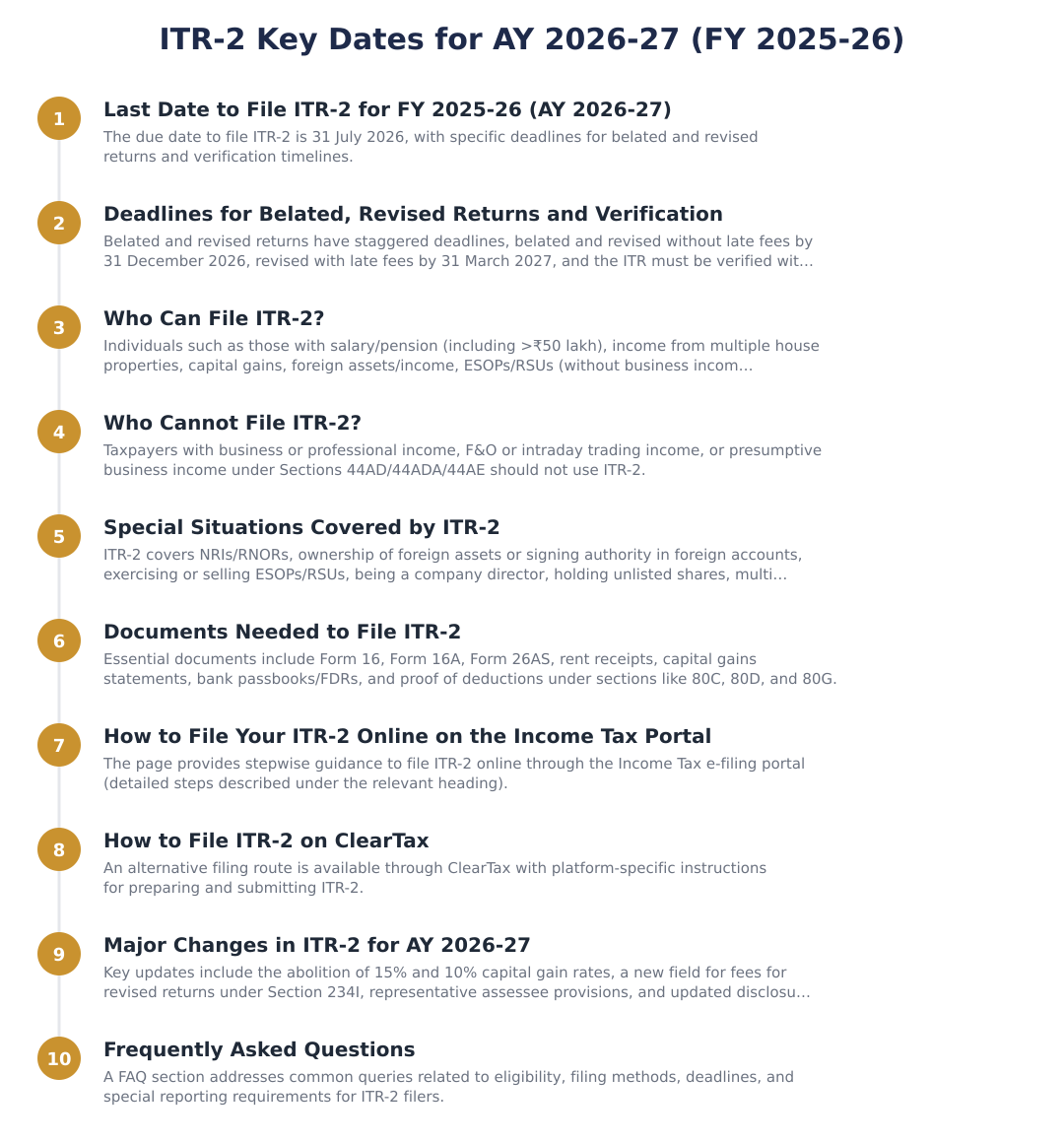
The last date to file ITR‑2 for FY 2025‑26 (AY 2026‑27) is 31 July 2026. If you miss this deadline you can file a belated return up to 31 December 2026, and revised returns without late fees are also allowed until 31 December 2026; revised returns with late fees can be filed up to 31 March 2027. Remember you must verify the ITR within 30 days of filing for it to be considered valid, and late filing may attract interest and penalties under applicable provisions. Plan to file early if you have tax payments due to avoid additional charges and to claim refunds sooner.
Who should file ITR‑2 for AY 2026‑27?
You should file ITR‑2 if you are an individual or HUF with income other than profits and gains from business or profession. This includes salary or pension (including salary above ₹50 lakh), income from one or more house properties, capital gains (shares, mutual funds, property), foreign assets or foreign income, ESOPs/RSUs (if no business income), director in a company, agricultural income over ₹5,000, or income from other sources such as interest and dividends. NRIs and Residents but Not Ordinarily Resident (RNOR) with the above incomes should also use ITR‑2; however those with business/professional income, F&O or intraday trading, or presumptive business income must not use ITR‑2. If you are eligible to file ITR‑1 you can still choose ITR‑2 but filing on ITR‑1 is usually simpler when criteria are met.
Who cannot file ITR‑2 and which form should they use instead?
You cannot file ITR‑2 if you have income from business or profession, including freelancing, F&O or intraday trading, or presumptive income under Sections 44AD/44ADA/44AE. Taxpayers with business income should instead file ITR‑3 (for income from proprietorship business or profession) or ITR‑4 (for presumptive taxpayers), depending on their exact circumstances. If you have both salary and business income, ITR‑2 is not appropriate even if business income is small; choose the correct business-return form to avoid return rejections and incorrect tax computation. Note that partnership firm income and income taxable under PGBP must also be reported on business-specific ITR forms.
How do I file ITR‑2 online on the Income Tax e‑filing portal?
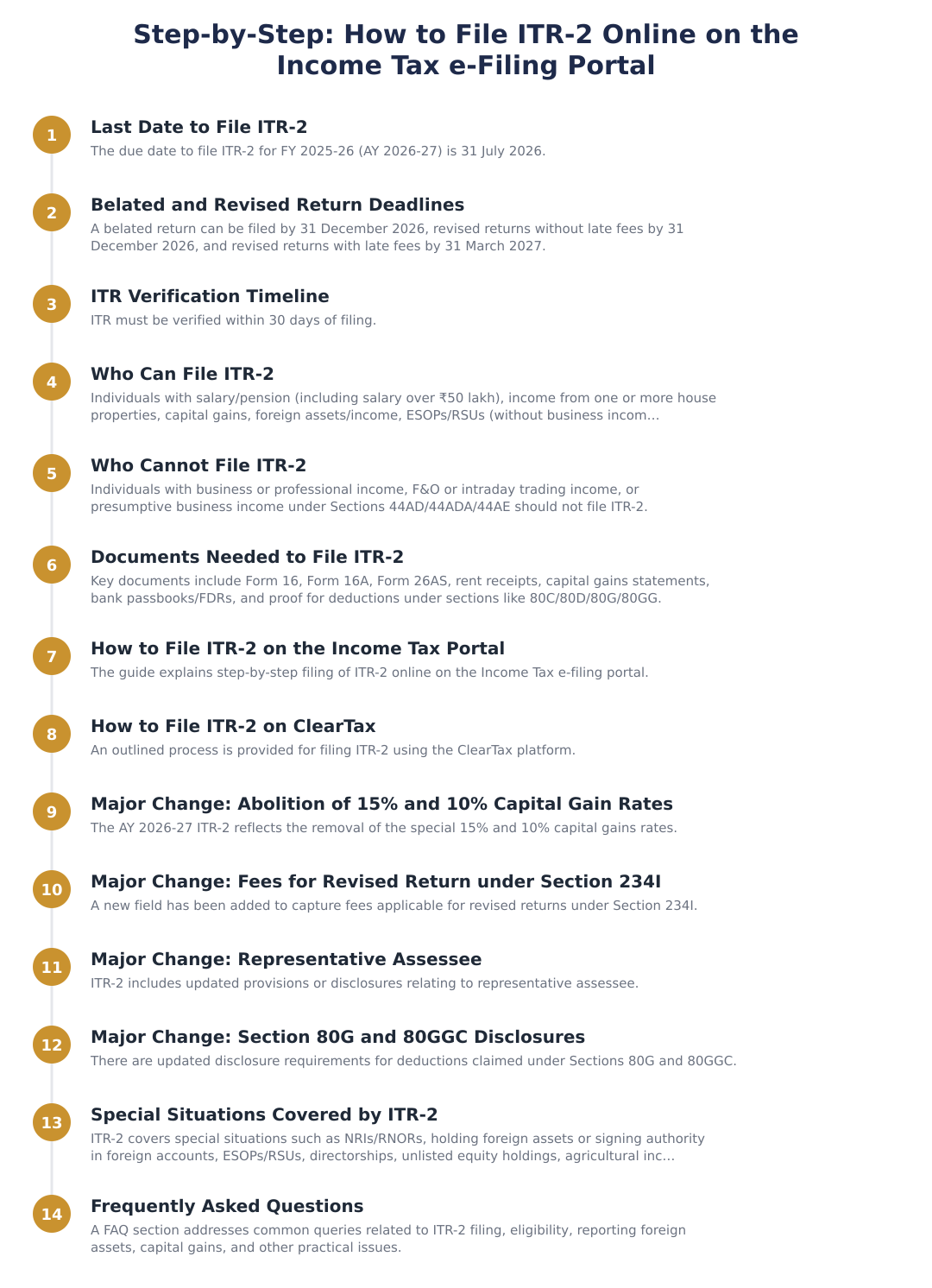
You can file ITR‑2 online by logging into the Income Tax e‑filing portal with your PAN, selecting e‑File > Income Tax Return, choosing Assessment Year 2026‑27 and the Online filing mode, then starting a new filing for the Individual taxpayer status and selecting ITR‑2. After choosing applicable schedules and filling General Information, select the tax regime (old or new), enter income details, pay any self‑assessment tax if due, and proceed to verification and submission. Keep Form 16, Form 26AS, bank and capital gains statements ready to prefill or cross‑verify entries, and verify the return within 30 days to complete the process. If you prefer assisted filing, platforms like ClearTax can import Form 16 and capital gains data to simplify the steps.
What documents do I need to file ITR‑2?
You need Form 16 from your employer, Form 16A if TDS was deducted on non‑salary income, and Form 26AS to verify TDS and advance tax entries. Additionally keep rent receipts for HRA, capital gains statements for share/mutual fund/property transactions, bank passbooks or FDRs for interest income, and proof for deductions claimed under Sections 80C, 80D, 80G, and 80GG such as insurance receipts, donation receipts and tuition fee receipts. If you have foreign assets or income, keep relevant overseas bank statements and documentation ready, and NRIs should have their residential status details and foreign tax credit documents if applicable. Accurate records of ESOP/RSU transactions and unlisted equity holdings are also important when reporting capital gains or perquisites.
Do NRIs and taxpayers with foreign assets file ITR‑2 and what foreign disclosures are required?
Yes, NRIs and resident individuals holding foreign assets or earning foreign income should file ITR‑2 and must disclose foreign assets and signing authority in foreign accounts. The return requires details of foreign bank accounts, financial assets, and income from abroad, and you may also need to report foreign tax paid to claim foreign tax credit where allowed. Resident but Not Ordinarily Resident (RNOR) and non‑resident taxpayers follow the same disclosure norms applicable to their residential status, and failure to disclose foreign assets can result in penalties and scrutiny. Keep overseas bank statements, Form 67 (if claiming relief), and documentation of foreign taxes paid to substantiate entries.
What are the major changes in ITR‑2 for AY 2026‑27 I should be aware of?
Major changes for AY 2026‑27 include the abolition of the special 15% and 10% capital gain tax rates, a new field to report fees for revised returns under Section 234I, updates to the Representative Assessee section, and additional disclosures for Sections 80G and 80GGC. Abolition of those preferential capital gain rates means capital gains will now be taxed under the regular slab or other applicable rates as per the Finance Act, affecting tax on transfers of specified assets. The new fields and disclosure changes require careful entry when filing revised returns or claiming charitable deduction benefits, and directors/representative assesses need to check the updated declaration requirements. Review these changes before filing to ensure correct computation and to avoid amendment notices.
What are the deadlines and fees for belated and revised ITR‑2 returns for AY 2026‑27?
Belated returns for AY 2026‑27 can be filed up to 31 December 2026, while revised returns without late fees are also allowed until 31 December 2026 and with late fees until 31 March 2027. If you file a revised return after 31 December 2026 but before 31 March 2027 you may have to pay late fees and interest under relevant sections; the portal now includes a field to report fees under Section 234I for revised filings. Verification must still be completed within 30 days of filing for either belated or revised returns, and late filing could affect carry‑forward of certain losses and delay refunds. Always calculate any interest under Sections 234A/234B/234C where applicable before submitting a belated or revised return.
When should someone with ESOPs or RSUs file ITR‑2 and how are these reported?
If you exercised or sold ESOPs/RSUs during the financial year and do not have business or professional income, you should file ITR‑2 and report them as perquisite income and/or capital gains as applicable. The exercise of ESOPs is taxable as salary/perquisite at exercise (reported under salary income) and any subsequent sale attracts capital gains (short‑term or long‑term depending on holding period) which you must report in the capital gains schedule. Keep employer certificates, transaction statements showing exercise price and sale proceeds, and cost basis documents for accurate computation; ESOP income combined with business income would require a different ITR form. Proper disclosure avoids double taxation and ensures TDS and tax liabilities are reconciled with Form 26AS.
Need help staying Income Tax compliant?
MoneyGence's AI Finance OS tracks your compliance, wallet share, and finances in one place, built for agencies and growing businesses.
Get started with MoneyGence