ITR Mistakes FY 2025-26: 15 Common Errors to Avoid
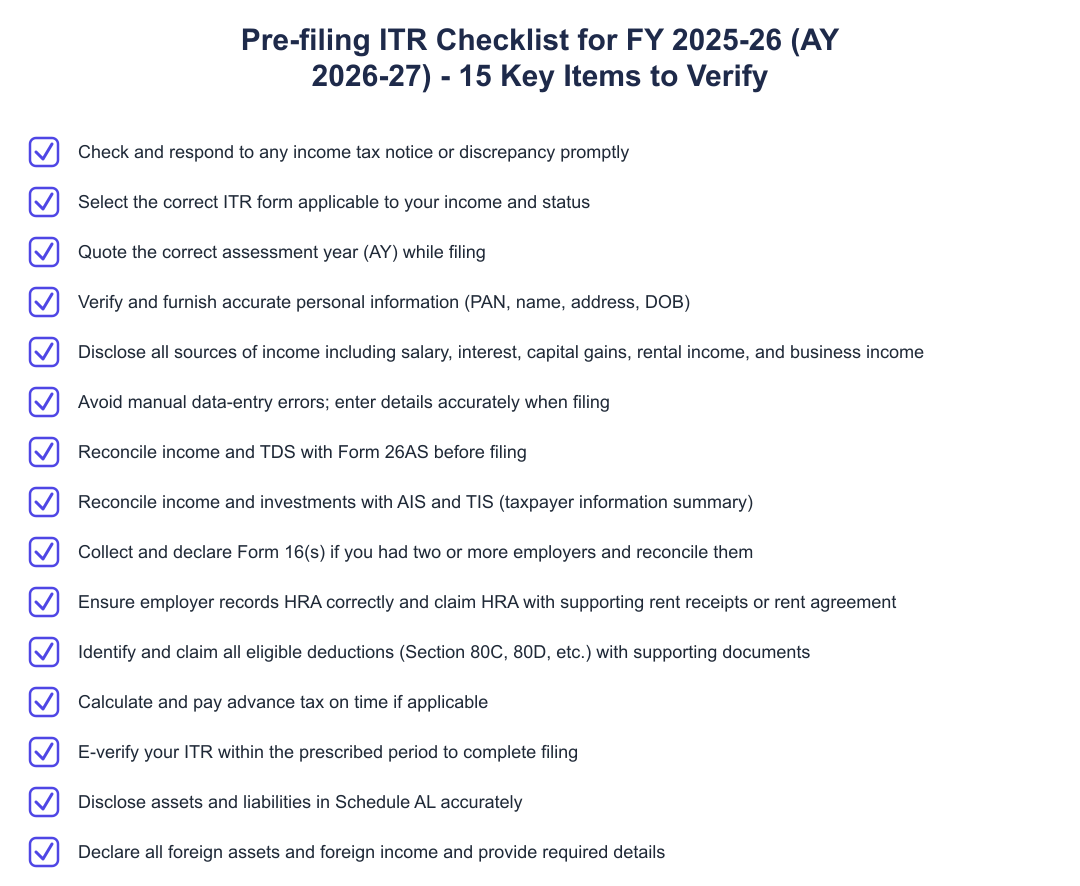
This guide explains 15 common mistakes taxpayers make while filing their Income Tax Return (ITR) for Financial Year 2025-26 (Assessment Year 2026-27) and shows how to avoid them. Good ITR practice reduces the risk of notices, prevents unnecessary reassessments, speeds up refunds and helps maintain clean tax records. You will learn what errors frequently occur, from selecting the incorrect form to failing to reconcile tax deducted with your records, and practical ways to prevent them. The title and guidance in this article specifically refer to filing ITR for FY 2025-26 (AY 2026-27), so ensure you use the correct assessment year when preparing and submitting returns. Throughout the guide, each mistake is explained in plain language with actionable steps you can take to avoid it. Whether you are an employee, a business owner, a freelancer, or an investor, this checklist-style approach helps you perform focused checks before filing. Use it as a pre-filing review to catch common slip-ups that create complications later. The aim is to help you file accurately, confidently, and in alignment with the relevant assessment year for FY 2025-26.
Selecting the Incorrect Form
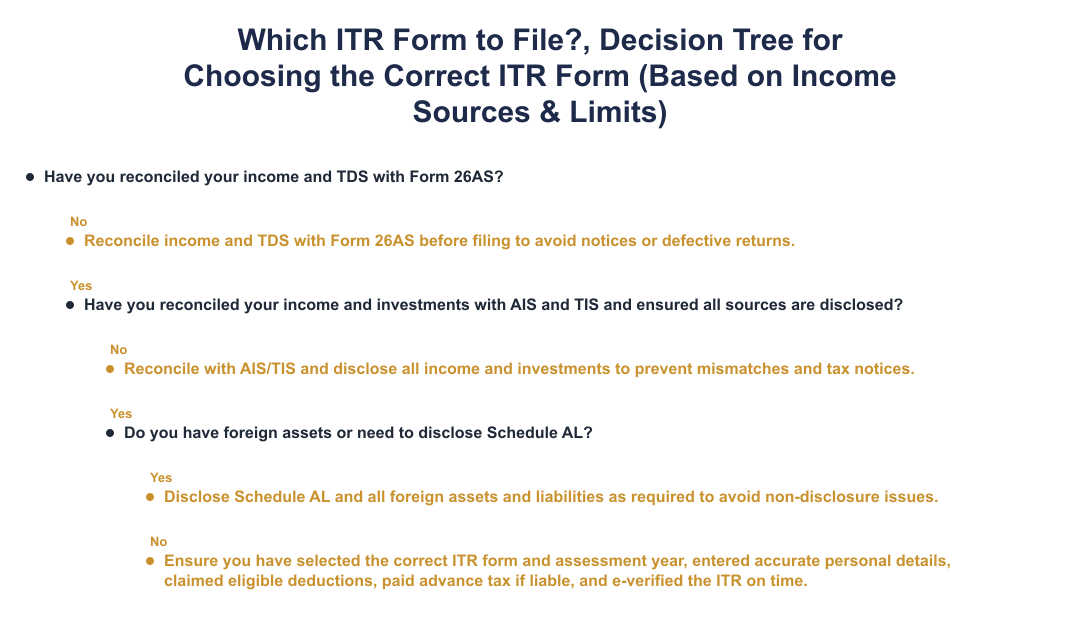
Many taxpayers pick an ITR form that doesn’t match their income profile or status. Using the wrong form can lead to the tax department asking for corrections or filing an amended return, both of which are avoidable if you match your income sources, residential status and other particulars to the appropriate form before you start.
To prevent this mistake, review the nature of your income, such as salary, business or professional income, capital gains or income from other sources, and ensure the selected form is designed to capture those incomes. If you are unsure, consult guidance from a trusted adviser or the official instructions for the assessment year you are filing for.
A quick verification step before submission, confirming that the form fields cover all your income types and deductions, can save time and reduce the likelihood of receiving a query from the tax authority.
Quoting the Wrong Assessment Year
One explicit rule when filing is to quote the correct assessment year on your ITR. For returns relating to Financial Year 2025-26, the correct assessment year to quote is AY 2026-27. Using the wrong assessment year can create administrative confusion and may lead to processing delays or requests for clarification.
Always check the assessment year field on the form before submission. The assessment year ties your filed return to the right financial period in the tax department’s records, so accuracy here is essential for correct crediting of tax payments and tracking of refunds or communications.
Furnishing Incorrect Personal Information
Errors in basic personal information such as name spelling, PAN details, contact information or bank account numbers cause avoidable delays in processing. Incorrect PAN or bank details, in particular, may lead to mismatches with official records and hinder refund transfers.
Before submitting, cross-check all personal fields against your official documents. Use consistent name formats and ensure PAN entries exactly match the PAN card. Small verification steps reduce correspondence and help finalise your return smoothly.
Not Disclosing All Sources of Income
A common mistake is omitting one or more income sources, such as freelance earnings, rental income, interest income, or capital gains. Underreporting income, even unintentionally, can result in notices and the need to file revisions later.
Compile a comprehensive income checklist before you file. Gather salary slips, bank interest statements, investment sale records, rent receipts and any invoices for independent work. Being thorough at the outset prevents omissions and reduces follow-up queries from the tax department.
Failure to Reconcile TDS, AIS/TIS and Form 26AS
Mismatch between records and the tax department’s data is a frequent trigger for notices. Reconciliation means comparing TDS credits shown in your Form 26AS and the department’s information statements against the TDS/TCS details you or your employers provide, and against income and investment entries in your return.
Perform a line-by-line check: ensure TDS entries credited to your PAN match the amounts in your pay slips or Form 16/16A, and verify any third-party reporting in the department’s statements. Resolving discrepancies before filing reduces the chance of objections and speeds up processing.
Failure to E-Verify and Disclose Required Schedules
Completing your ITR is not the final step until it’s verified in the prescribed manner. Failure to complete the verification process means the return may be treated as invalid, necessitating additional filings and follow-up work.
Also be mindful of schedules and annexures that the form asks for, such as asset and liability disclosures or foreign asset details where applicable. Leaving mandatory schedule fields blank or failing to provide required annexures can result in further questions from the tax authority.
Before submission, confirm that you have completed the verification procedure and filled all schedules applicable to your situation. This reduces the probability of the return being treated as defective and keeps your compliance record intact.
Avoiding these common mistakes when filing your ITR for FY 2025-26 (AY 2026-27) makes the process smoother and reduces the likelihood of receiving follow-up notices. Do a final checklist: confirm the assessment year, choose the correct form, reconcile reported tax credits, disclose all income and complete verification and any required schedules. Small pre-filing checks save time and reduce compliance risk.
Frequently asked questions
What happens if I choose the wrong ITR form for FY 2025-26 (AY 2026-27)?
Filing with the wrong ITR form can make your return defective and trigger tax notices or assessment adjustments. Each ITR form is designed for specific types of taxpayers (e.g., salary income, business/professional income, capital gains); using an incorrect form may lead the Income Tax Department to reject the return or ask for rectification, delaying refunds and causing additional scrutiny. If you realise the mistake, you should rectify by filing a revised return within the prescribed time or respond to the notice with correct information; persistent errors can also attract penalties. Always check eligibility criteria for ITR-1, ITR-2, ITR-3, ITR-4 etc., before submitting your return for AY 2026-27.
Can filing the wrong assessment year cause problems for my ITR?
Yes, quoting the wrong assessment year (AY) when filing your ITR for FY 2025-26 will lead to processing errors and potential notice from the tax department. The AY must be 2026-27 for income earned in FY 2025-26; a mismatch can result in the return being considered invalid, delayed refunds, or mismatches in tax credits. If discovered, you should file the correct return for AY 2026-27 or respond to the department’s notice promptly to avoid penalties or interest on unpaid tax. Always verify the AY before submission to ensure proper credit of TDS and refunds.
How serious is it to provide incorrect personal details in my ITR?
Providing incorrect personal information (name, PAN, Aadhaar, address, or bank account) can lead to rejection of the return, tax notices, or failure to receive refunds for AY 2026-27. PAN and Aadhaar mismatches can prevent e-verification and processing; incorrect bank details will delay or prevent direct credit of refunds. Minor errors should be corrected immediately by filing a revised return or following the rectification process after receiving a notice; consistent inaccuracies may attract scrutiny and administrative hassles. Always cross-check PAN, Aadhaar, bank IFSC/account numbers and contact details before filing.
Do I need to report all sources of income while filing ITR for FY 2025-26?
Yes, you must disclose all income sources (salary, interest, rent, capital gains, business income, foreign income) in your ITR for FY 2025-26, otherwise you risk notices, penalties, or reassessment. Undisclosed income uncovered later can lead to tax demand plus interest and possible penalties; even small incomes like bank interest and freelancing should be reported. Use Form 26AS, AIS and TIS to reconcile TDS and third-party reporting and ensure nothing is omitted; if you missed an income earlier, file a revised return as needed to correct the record. Accurate disclosure also speeds up refund processing and reduces chances of tax scrutiny.
How important is reconciling my income and TDS with Form 26AS before filing ITR?
Reconciling your income and TDS with Form 26AS is critical because mismatches between your ITR and 26AS often trigger tax notices and delayed refunds. Form 26AS shows TDS/TCS, advance tax and self-assessment tax credits reported against your PAN; failing to include these amounts in the return or ignoring differences can lead to demand notices or incorrect tax calculations. Review and correct discrepancies by contacting deductors for corrections, include missing TDS in your ITR, or file a revised return if necessary; do this before e-verifying to avoid post-filing complications. Regularly check 26AS while preparing your AY 2026-27 return to ensure all tax credits are claimed.
What are AIS and TIS and why should I reconcile them with my ITR?
AIS (Annual Information Statement) and TIS (Taxpayer Information Summary) are consolidated information reports from the tax department that contain third-party data like high-value transactions and TDS, and reconciling them with your ITR prevents mismatches and notices. These reports may include income, investments, property transactions or bank transaction summaries that the department expects you to declare; failing to reconcile can lead to queries or reassessment. Compare AIS/TIS entries with your books and ITR, and explain or correct differences by filing a revised return or submitting clarifications when required. Regular reconciliation helps detect omitted incomes (e.g., capital gains from mutual funds or sale of property) before the department raises objections.
How should I handle multiple Form 16s from two different employers?
If you have Form 16 from two or more employers in FY 2025-26, you must combine salary details and TDS from all employers in a single ITR for AY 2026-27 to avoid underreporting or refund issues. Summarise gross salary, exemptions (like HRA), and tax deducted from each Form 16, and ensure total TDS matches Form 26AS; failing to consolidate can create perceived shortfall and notices. If both employers issued Form 16 for overlapping periods, reconcile the employment dates and earned amounts before filing; keep supporting documents like relieving letters and pay slips in case of queries. Correct aggregation prevents defective returns and speeds up processing of any refunds.
What should I do if my employer didn't provide HRA even though I paid rent?
If your employer didn't give HRA but you paid rent, you can still claim House Rent Allowance exemption in your ITR by declaring rent paid and providing supporting documents, but you cannot claim HRA deduction if it was not part of your salary structure; instead you may claim deduction under Section 80GG if eligible. For AY 2026-27, maintain rent receipts, lease agreement and PAN of landlord (if required) and accurately compute exemption using salary components, city of residence and actual rent paid. If HRA was paid but not reflected in Form 16, get the employer to correct Form 16 or declare the amount correctly in your ITR; incorrect HRA reporting can trigger notices or disallowance.
What are the consequences of not paying advance tax for FY 2025-26?
Not paying advance tax when applicable can result in interest under Sections 234B and 234C and a higher tax liability at the time of filing your ITR for AY 2026-27. Taxpayers with tax liability after TDS exceeding Rs 10,000 in a year must pay advance tax in instalments; missing installments attracts interest for deferred payment. To avoid interest, estimate your tax liability accurately during the year, pay advance tax by due dates, and keep challans/receipts; you can still pay remaining tax before filing but will be liable for interest on delayed instalments. Self-employed taxpayers and those with significant non-salary income should be especially vigilant about advance tax compliance.
Why is e-verifying my ITR on time important for AY 2026-27?
E-verifying your ITR within 30 days of filing is essential because an unverified return is treated as not filed and may be processed as a defective return, leading to notices or loss of refund for AY 2026-27. E-verification methods include Aadhaar OTP, net banking, EVC via bank account or demat, or sending a signed physical ITR-V to CPC within the timeline; failure to complete e-verification will result in the return being invalid after the allowed window. If you miss e-verification, you can file a fresh return before the due date or respond to notices as applicable, but timely e-verification ensures quicker processing and avoids legal complications.
Do I need to disclose foreign assets and Schedule AL while filing ITR for FY 2025-26?
Yes, taxpayers holding foreign assets or financial interests must disclose them and complete Schedule AL (Assets and Liabilities) in their ITR for AY 2026-27, otherwise they risk penalties, notices and possible prosecution under the Income Tax Act. Schedule AL requires reporting of foreign bank accounts, financial interests, immovable property abroad and other overseas assets along with corresponding liabilities if the total value exceeds specified thresholds; non-disclosure can lead to severe consequences including search and seizure or penal provisions. Even if tax is not due on those assets in India, full disclosure provides transparency and prevents future disputes; consult a tax advisor for valuation and reporting rules if you hold significant foreign holdings.
Need help staying Income Tax compliant?
MoneyGence's AI Finance OS tracks your compliance, wallet share, and finances in one place, built for agencies and growing businesses.
Get started with MoneyGence