ITR-U Section 139(8A) Guide: Eligibility, Benefits & How to File
This guide explains practical aspects of filing and updating income-tax returns in India, with a focus on how return types, portal access and verification work together for compliant filing. You will learn which return forms are available, how to access the official Income Tax Portal, the primary verification methods accepted when submitting returns, and how certain investigative provisions of the Income-tax Act can intersect with return filing. This discussion draws only on verifiable official points so you get clear, reliable steps you can act on immediately. Why this matters: taxpayers and tax professionals routinely need to choose the correct return form, access the portal securely, and complete the required verification to make a filing effective. Knowing which statutory return categories exist and what technical tools the portal accepts reduces rework, helps avoid rejected filings, and supports faster compliance. The sections below distil the verified, practical facts you must know when preparing any return.
Overview: Main statutory return types
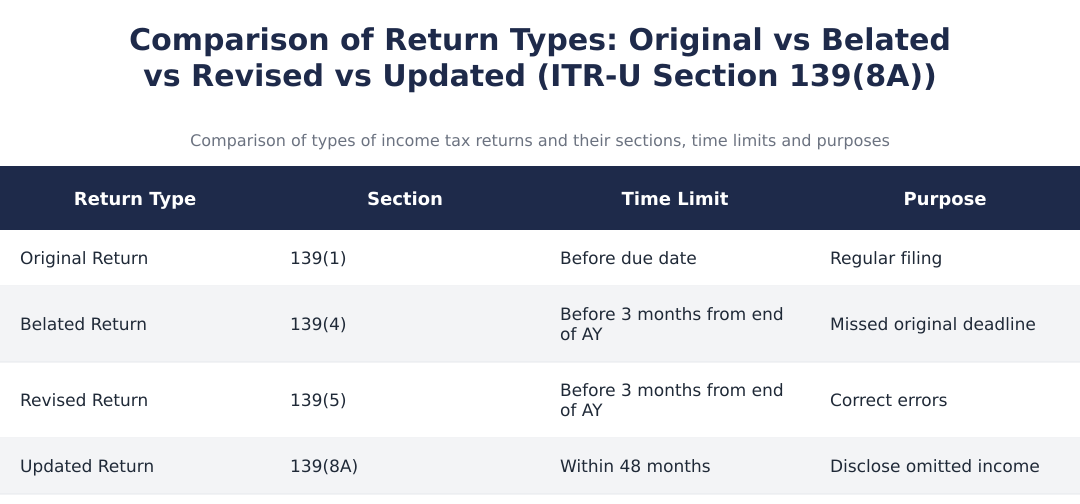
The Income-tax Act provides for multiple statutory return types that taxpayers use depending on circumstances. The principal categories that are statutorily referenced include the Original Return filed under Section 139(1), the Belated Return under Section 139(4), and the Revised Return under Section 139(5). Understanding these categories helps taxpayers identify which route applies when they are making a first filing, correcting an omission, or catching up after a missed deadline.
Each category has different legal implications and procedural consequences. Practically, taxpayers and their advisors should decide at the outset which category the filing belongs to because that choice affects downstream matters such as the timing of submission, reconciliation with previously filed data, and interaction with assessment procedures.
At-a-glance: statutory return types
| Return Type | Section |
|---|---|
| Original Return | 139(1) |
| Belated Return | 139(4) |
| Revised Return | 139(5) |
Accessing the official Income Tax Portal
All electronic filings and many taxpayer services are routed through the government’s Income Tax Portal. To begin any online return activity, taxpayers should visit https://www.incometax.gov.in and log in using their PAN or Aadhaar credentials. Using the portal ensures filings are recorded through the authorised channel and allows taxpayers to use the digital interfaces provided for uploading return data and supporting schedules.
From a practical perspective, ensure your PAN/Aadhaar linkage and login credentials are current before initiating a filing session. Accessing the portal early gives time to resolve login or authentication issues and avoids last‑minute rushes close to filing dates.
Choosing the correct ITR form
The Income-tax Department provides multiple ITR forms so taxpayers can pick the form that matches their mix of income sources. ITR forms ITR-1 to ITR-7 are available and are intended to be used based on taxpayers’ respective income sources. Selecting the appropriate form at the outset reduces the need for later corrections or revisions.
Before preparing a return, verify which form corresponds to the taxpayer’s income profile. Using an incorrect form may require filing a revised return in the correct form later, which adds administrative steps and increases compliance work.
Verification and submission methods
The portal accepts multiple electronic verification methods to complete and validate a filed return. Among the verification options are Aadhaar OTP and Digital Signature Certificate (DSC). Using an accepted verification method is necessary to make an e‑filed return valid under the electronic filing rules.
Choose the verification option that aligns with the taxpayer’s capabilities and security preferences. For example, DSC is commonly used by companies and authorised representatives, while Aadhaar OTP may be an option for individual taxpayers who have an Aadhaar linked and available for OTP verification.
Interaction with search, seizure and survey provisions
Certain provisions of the Income-tax Act relate to investigatory activity and can interact with return filings. Statutory references that govern such actions include Section 132, Section 132A and Section 133A. Taxpayers should be aware that filings and any subsequent disclosures are considered in the broader compliance landscape where these provisions operate.
In practice, if a filing is being prepared in proximity to any official action under these sections, professional advice may help align filing choices with the taxpayer’s broader compliance position. The portal and verification steps remain the procedural foundation for any electronic submission regardless of parallel proceedings.
Practical filing checklist (verified steps)
Visit https://www.incometax.gov.in and log in using PAN or Aadhaar credentials to begin the filing process.
Choose the appropriate form from ITR-1 to ITR-7 based on the taxpayer’s income sources.
Complete submission using an accepted verification method such as Aadhaar OTP or Digital Signature Certificate (DSC).
This guide summarises the verified, actionable points taxpayers need for reliable electronic filing: the principal statutory return categories, where to log in, the available ITR forms, and accepted verification methods, plus the investigatory sections that can be relevant. Use the official portal and the correct form and verification method to ensure your filing is recorded properly. For any complex factual or legal questions about specific updated‑return provisions or interactions with assessments, consult a tax professional who can apply the full statute and recent notifications.
Frequently asked questions
What is an Updated Income Tax Return (ITR-U) under Section 139(8A)?
An Updated Income Tax Return (ITR-U) under Section 139(8A) is a return that allows taxpayers to voluntarily disclose omitted income or correct errors up to 48 months from the end of the relevant assessment year. It lets taxpayers who either did not file an original return or who filed one with omissions or wrong classifications to make a fresh disclosure and compute additional tax under Section 140B. The updated return cannot be used to reduce tax liability, claim or enhance refunds, or if a search/seizure or prosecution is pending; several other exceptions also apply. Filing ITR-U triggers payment of a portion of the additional tax (sliding scale depending on delay) and requires submission and verification on the Income Tax Portal. This mechanism is designed to encourage voluntary compliance and avoid harsher consequences later if the omission is detected by authorities.
Who is eligible to file an ITR-U?
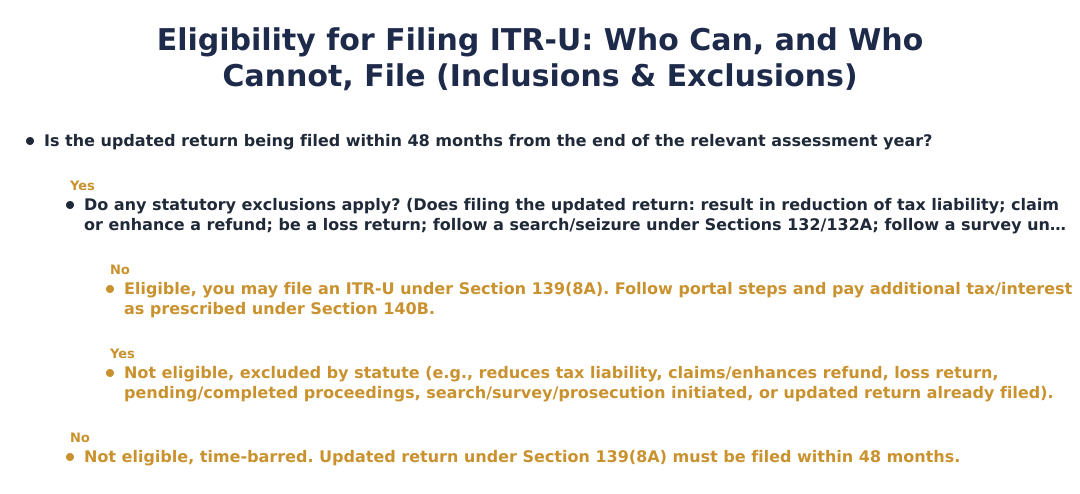
Anyone who omitted income or made errors in their original return, or who did not file a return, is eligible to file an ITR-U within the prescribed 48-month window, subject to certain restrictions. Eligible taxpayers include individuals, HUFs, firms, companies and others who need to correct classification of income, apply the wrong tax rate, or reduce carried forward losses or unabsorbed depreciation. However, eligibility excludes cases where the filing would reduce tax liability, claim or increase a refund, relates to loss returns, or where search/seizure under Sections 132/132A or survey under Section 133A has been conducted, or when assessment/reassessment/prosecution proceedings are pending or completed. Also, an updated return cannot be filed if an updated return has already been filed for the same assessment year.
What is the last date to file an Updated Return under Section 139(8A)?
You can file an Updated Return under Section 139(8A) up to 48 months from the end of the relevant assessment year. For example, for income of FY 2021-22 (AY 2022-23), the window to file ITR-U would close 48 months after 31 March 2023, i.e., 31 March 2027. The law provides a longer window than belated/revised returns (which are allowed only up to three months before the end of the assessment year) to encourage voluntary disclosure. Keep in mind that the amount of additional tax payable increases the longer you delay filing within this 48-month period.
How do I compute and pay additional tax when filing an ITR-U?
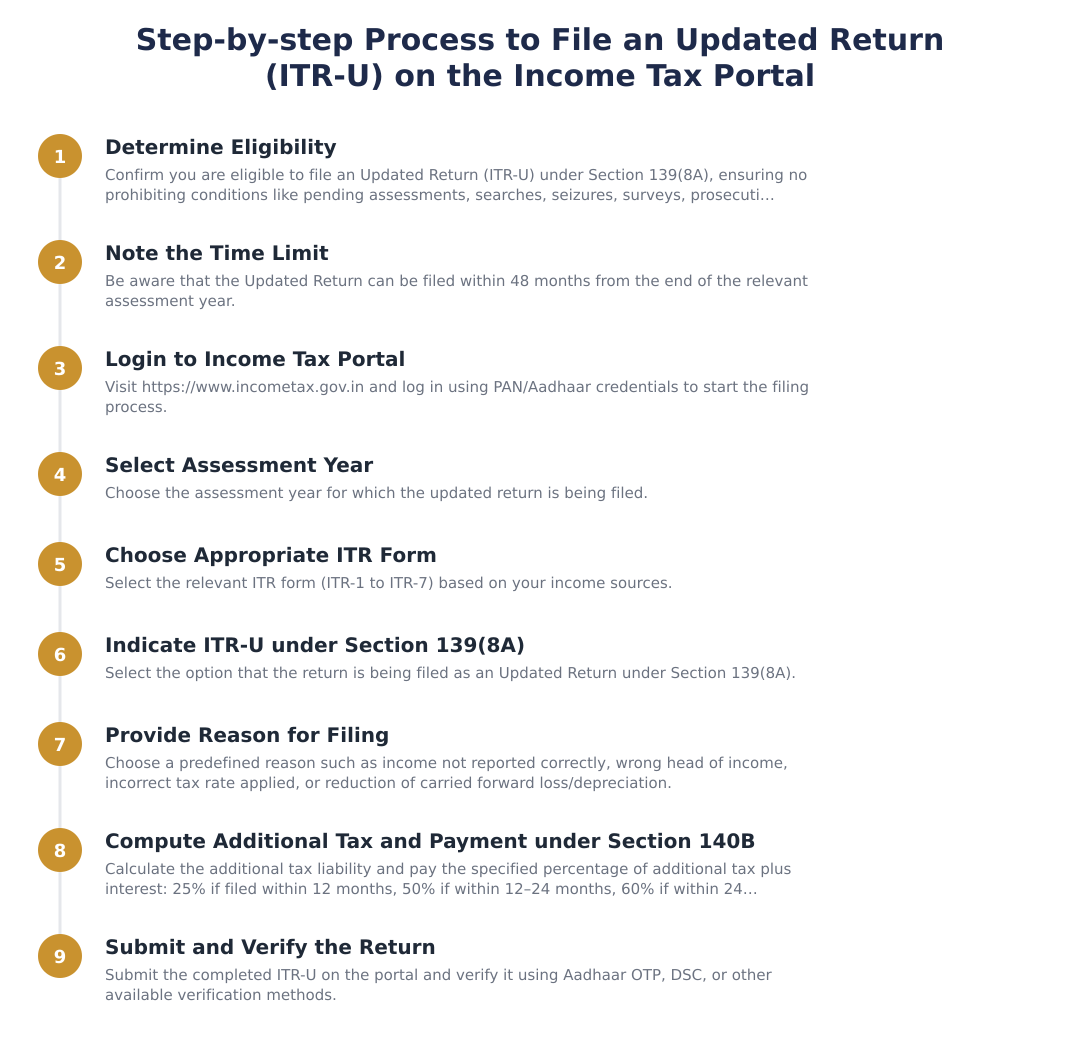
When filing ITR-U you must compute additional tax and pay a specified portion of it under Section 140B according to how late you file: 25% if within 12 months, 50% if between 12–24 months, 60% if between 24–36 months, and 70% if between 36–48 months, plus interest. The updated return requires calculation of the additional taxable income and resultant tax, then payment of the applicable percentage of that additional tax and interest before submission. These slab rates (25/50/60/70%) reflect changes introduced by the Finance Act 2025 and apply progressively with delay; full tax and interest may remain payable subsequently upon assessment. Payment is made through the Income Tax Portal when submitting the ITR-U and must be verified by Aadhaar OTP, DSC or other available methods to complete the filing.
What are the main steps to file ITR-U on the Income Tax Portal?
To file ITR-U you must log into the Income Tax Portal, select the relevant assessment year and appropriate ITR form, choose the ITR-U option, provide the reason for filing, compute and pay additional tax under Section 140B, then submit and verify the return. Accepted reasons include income not reported correctly, wrong head of income, incorrect tax rate applied, or reduction of carried forward losses/depreciation, and you must choose one while filing. Verification can be done by Aadhaar OTP, DSC or other methods available on the portal; payment of the portion of additional tax (25–70% depending on delay) is required before submission. Ensure you select the correct ITR form (ITR-1 to ITR-7) based on your income sources and follow portal prompts to complete the process.
Can I use ITR-U to reduce carried forward losses or unabsorbed depreciation?
Yes, ITR-U can be used to reduce carried forward losses or unabsorbed depreciation by correcting earlier returns, provided doing so does not result in reducing tax liability or claiming a refund and the filing meets other eligibility conditions. Taxpayers often use ITR-U to amend classification that affects set-off or carry forward of losses and unabsorbed depreciation so that future taxable income is computed correctly. Even when permitted, the taxpayer must compute additional tax under Section 140B and pay the prescribed portion (25–70% depending on delay) along with interest before filing. The update cannot be used if it would directly reduce tax payable or if any barred proceedings (search/survey/prosecution) are in place.
What situations are specifically excluded from filing an Updated Return?
Updated Returns under Section 139(8A) are excluded if filing would reduce tax liability, claim or enhance a refund, relate to loss returns, follow a search/seizure under Sections 132/132A or survey under Section 133A, or if assessment/reassessment/revision/prosecution proceedings are pending or completed for the year. Additionally, you cannot file an ITR-U if an updated return has already been filed for the same assessment year. These exclusions are intended to prevent misuse of the mechanism and to preserve the integrity of ongoing or completed enforcement actions. If any of these exclusions apply, you must address issues through regular assessment channels or legal remedies rather than ITR-U.
What are the benefits of filing an ITR-U voluntarily?
Filing an ITR-U voluntarily offers benefits like encouraging voluntary compliance, avoiding heavier penalties or prosecution later, providing a legal safeguard by disclosing omitted income before detection, and giving an extended four-year window to correct errors. It reduces litigation risk and compliance costs by allowing taxpayers to regularize past omissions by paying a portion of the additional tax and interest under Section 140B. However, it does not guarantee immunity from assessment of the remaining tax or from all penalties if misrepresentation is found, and certain exclusions apply (for example, when proceedings are pending or after a search). Overall, ITR-U is intended to promote transparency and reduce future enforcement action if used appropriately.
How is verification of an ITR-U return completed on the portal?
Verification of an ITR-U on the Income Tax Portal is completed using Aadhaar OTP, Digital Signature Certificate (DSC), or other portal-supported methods after submission and payment of the required portion of additional tax. The taxpayer must ensure the return is verified within the timeframe allowed by the portal; otherwise the return will be considered invalid and may not protect against future proceedings. If using Aadhaar OTP, the Aadhaar must be linked as per portal requirements and OTP received on the Aadhaar-registered mobile number; DSC requires a registered digital signature device. Successful verification finalizes the updated return filing and records the disclosure with the tax department.
Need help staying Income Tax compliant?
MoneyGence's AI Finance OS tracks your compliance, wallet share, and finances in one place, built for agencies and growing businesses.
Get started with MoneyGence