Job Work Under GST: Rules, Benefits & Compliance in India
This guide explains the concept of job work under GST in practical terms and why understanding it matters to manufacturers, principals and job-workers. You will learn what job work means in the context of indirect taxation, how the relationship between a principal and a job-worker typically operates, what commercial and compliance issues commonly arise, and what good practices can reduce disputes and tax risk. The focus is on conceptual clarity, distinguishing supply of goods versus processing services, how inputs and outputs are treated in the hands of the principal and the job-worker, and the typical documentary and operational controls businesses use to keep records straight. Whether you run a manufacturing unit that outsources part of production, operate a job-work service, or advise businesses on GST compliance, this guide helps you identify the points that matter: contractual allocation of responsibilities, movement and custody of goods, invoicing and value determination, and the practical steps that reduce compliance burdens. The explanation is neutral and practical rather than legalistic, it aims to give managers and compliance teams the context they need to ask the right questions of their tax advisors and implement processes that align commercial operations with indirect tax expectations.
What is job work, the commercial picture
Job work is a business arrangement where one party (commonly called the principal) sends materials or semi-finished goods to another party (the job-worker) for processing, transformation, repair or other specified operations. Commercially, the principal retains ownership of the goods while the job-worker performs agreed operations for a fee or other consideration. The relationship is often used to leverage specialized capacity, save capital investment, or manage capacity fluctuations.
From an operational perspective, job work requires clear allocation of responsibilities: who supplies the inputs, who is responsible for transportation and insurance, who bears loss or damage in transit, and who is responsible for finishing and returning the goods. Well-drafted contracts or work orders that capture these points reduce disputes and make it easier to align accounting and tax treatment with the underlying commercial reality.
How job work is treated in taxation, key concepts
Tax treatment of job work focuses on the nature of the activity (is it a service, supply of goods, or both?), the ownership of the goods during processing, and the point at which value is created or realised. These concepts determine whether consideration is taxable, who is the taxable person, and what supporting records are needed to justify the tax position taken.
Practically, businesses need to map their internal flows to these legal concepts. For example, a principal that retains ownership of inputs must ensure its accounting reflects that continued ownership, while the job-worker must record the provision of processing services. Clear documentation of when materials were sent and returned, and of the work performed, helps substantiate the tax treatment in case of queries.
Operational controls and documentation to manage risk
Good operational controls reduce dispute and audit risk. Typical controls include detailed work orders, signed receipts at dispatch and return, reconciliation of quantities and quality on receipt, and retention of job completion certificates. These records create an audit trail that explains why goods moved, what was done to them, and who is responsible at each stage.
Equally important is internal coordination between purchasing, production, warehousing and finance teams. Timely communication about goods sent for job work, expected return timelines and any by-products or wastage ensures inventory and accounting records remain accurate. Where goods are processed by multiple job-workers, chain-of-custody documentation is particularly valuable.
Contractual and pricing considerations
Contracts should define the scope of work, pricing and payment terms, quality parameters, timelines and liability for loss, damage and delays. For pricing, parties must be clear whether the job charge is for services only, whether it includes value of any inputs supplied by the job-worker, and how any additional costs (transport, packing) are handled. Clarity prevents disagreements and helps tax compliance because the nature of the charge, service fee versus supply of goods, has different consequences.
Dispute resolution and inspection clauses help manage post-job disagreements over quality or quantity. Including routine checkpoints, acceptance tests and a formal handover process can reduce escalations and provide contemporaneous evidence should authorities seek details of the arrangement.
Practical checklist for principals and job-workers
Both principals and job-workers benefit from a practical checklist that organises responsibilities: maintain clear contracts, document dispatch and receipt of goods, reconcile quantities and quality, keep records of job charges and payments, and coordinate accounting treatment between finance and operations. Regular internal audits of job work transactions highlight weak points early and keep records ready for review.
When in doubt about tax implications or documentation sufficiency, seek professional advice. Tax authorities focus on substance over form, so demonstrating the commercial reality with consistent record-keeping and transparent processes is often the best protection against disputes.
Job work arrangements are common in manufacturing and processing chains. Clear contracts, robust operational controls and disciplined record-keeping align business practice with tax expectations and reduce the risk of disputes. Use this guide to frame the right questions for advisors and to build internal processes that show the true commercial substance of job work transactions.
Frequently asked questions
What is job work under GST in simple terms?
Job work under GST is processing or working on goods by a job-worker on behalf of the principal where the goods are returned to the principal after the process. It is treated as a supply under GST law and the principal remains the owner of the goods while the job-worker performs operations such as machining, cleaning, testing, packing, or other specified processes. Both the principal and the job-worker must follow GST compliance: the principal may need to intimate the tax authorities before sending inputs out for job work, and the job-worker may need to charge GST on job-work services if registered. Examples include dyeing of fabric, machining of components, or packaging performed by another unit on contract basis.
Do I need to pay GST when I send goods to a job-worker?
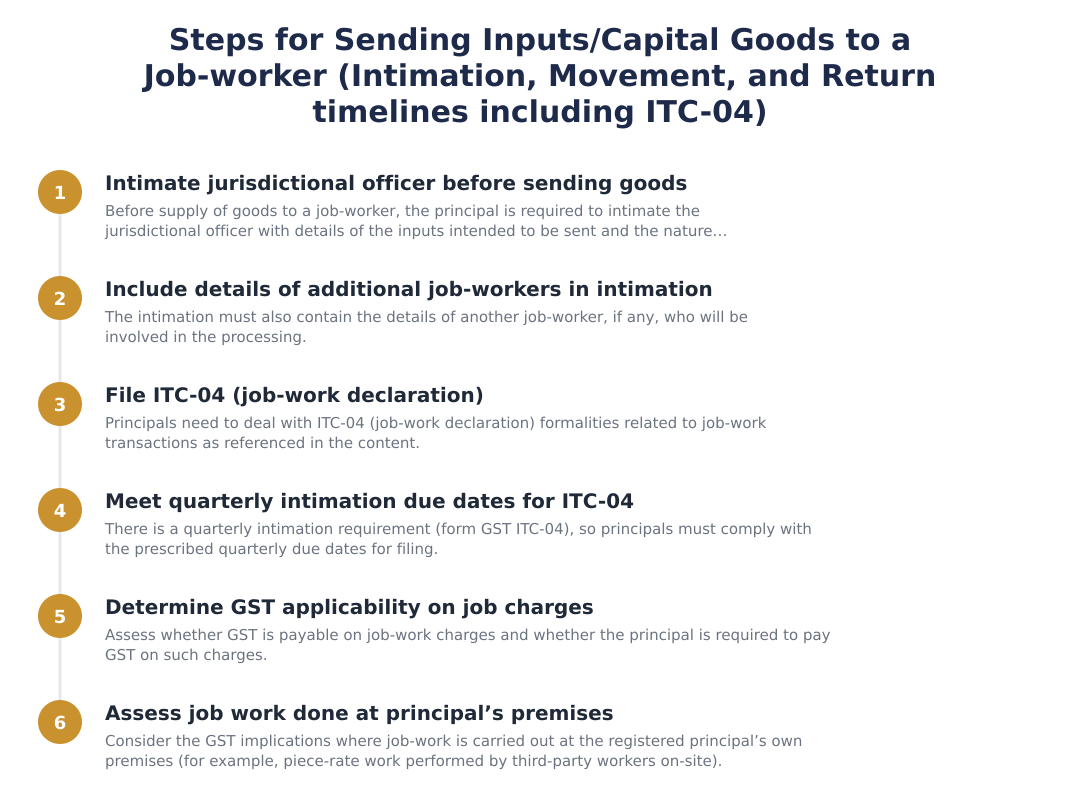
You do not have to pay GST at the time of sending goods to a job-worker if you follow prescribed GST conditions and intimations; otherwise normal supply rules apply. The principal should comply with the statutory intimation (Form GST ITC-04) and timelines so that the movement is treated as job work and not a taxable outward supply; if conditions are not met or the goods are not returned within the prescribed period, tax may become payable. If the job-worker supplies services (the job work) separately, the job-worker will charge GST on the job-work service provided to the principal, subject to registration and applicable rate. Note that specific timelines and documentary requirements determine when exemption from tax during movement applies.
What is Form GST ITC-04 and when do I need to file it?
Form GST ITC-04 is the statutory intimation a principal must file to notify the jurisdictional officer about inputs or capital goods sent to a job-worker and the nature of processing. The form records details of inputs sent out, received back, or sent to another job-worker and must be filed as per the timelines prescribed under GST rules to maintain the tax status of those movements as job work. ITC-04 helps track goods sent for job work and is also required when goods are sent to job-workers located in other states; late or non-filing can lead to compliance issues and possible tax liability. Many taxpayers ask about due dates and quarterly filing frequency for ITC-04, so check the current GST portal instructions and government circulars for exact filing periodicity and cut-offs.
Who is liable to pay GST on job-work services, the principal or the job-worker?
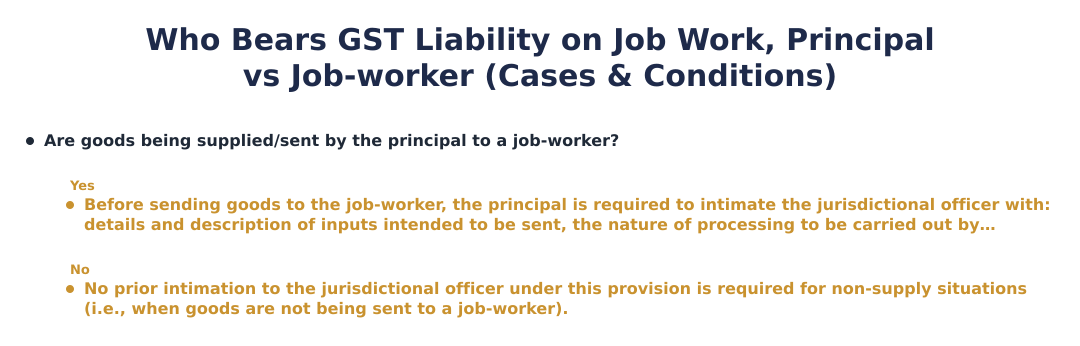
The job-worker is generally liable to charge and pay GST on the job-work service he provides, as that activity is a supply of service by the job-worker to the principal. However, when the movement of goods to and from the job-worker is treated as job work under GST rules and the principal complies with intimation and return conditions, the principal need not pay GST on the goods’ movement itself. If the job-worker supplies the processed goods to any party other than the principal, that supply is taxable in the hands of the job-worker (unless specifically exempt) and the job-worker must account for GST. There are exceptions and record-keeping conditions that determine who ultimately bears GST and how input tax credit is claimed.
What documents should I maintain when sending goods for job work?
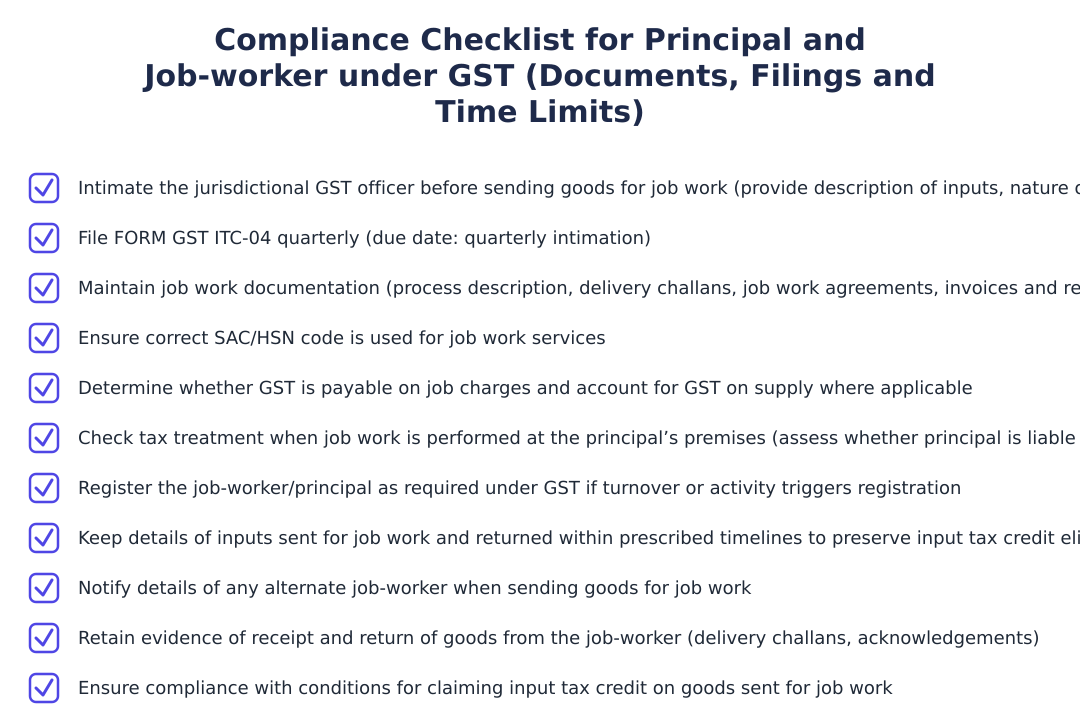
You should maintain a copy of the intimation (Form GST ITC-04), tax invoices or challans evidencing movement of goods, job-work agreements, and records of goods returned to the principal to substantiate job-work transactions. The job-worker should also maintain inward and outward records, delivery challans, and any invoices for job-work services rendered, since these documents are required for compliance, claiming input tax credit, and to defend against scrutiny. Proper documentation helps demonstrate that inputs remained with the principal for GST purposes and that timelines for return or further transfer were respected. Retain these records for the statutory retention period under GST so you can respond to notices or audits.
Can inputs sent to a job-worker be used to claim input tax credit (ITC)?
Yes, the principal can claim input tax credit on inputs used in job work provided the principal has complied with GST conditions (including filing required intimations) and the inputs are returned or accounted for within prescribed limits. The principal must possess proper invoices and records proving that the inputs remained with the principal while being processed by the job-worker, and the ITC can be claimed in accordance with regular GST input tax credit rules. If the job-worker supplies the processed goods to another person without authorization, the principal may lose ITC unless corrective steps are taken and taxes paid. Always reconcile ITC claims with the records of goods sent for job work and receipts from the job-worker.
Is GST charged on the job-work fees or on the value of goods processed?
GST is charged on the job-work fees as a supply of service performed by the job-worker, not on the value of the goods owned by the principal, provided the conditions for job work are met. The job-worker should issue a tax invoice charging GST on the service component (the consideration for processing), and the rate depends on the classification of the job-work service under GST schedules. If the arrangement amounts to a supply of goods by the principal (for example, if ownership transfers), then GST implications on the goods’ value may arise instead. Clear documentation and correct invoicing distinguish the service component (taxable to job-worker) from ownership of goods (remains with principal).
What happens if the job-worker is located in another state, do I need to pay IGST?
If the job-worker is located in another state, the movement of goods is treated as an inter-state transaction and IGST implications, reporting, and interstate GST compliances apply, unless covered by specific job-work provisions and intimations. The principal must follow the inter-state supply and movement rules, file the required intimations (ITC-04) and ensure correct GST treatment on any services invoiced by the job-worker, who may need to charge IGST on job-work services if taxable and registered. Failure to follow prescribed cross-border procedures or time limits for return of goods can result in tax liability and possible penalties. Always declare the place of supply and maintain cross-border documentation to support any exemption or deferral claim.
If job work changes the nature of goods (like paddy to rice), is GST applicable on the job work?
If the processing performed by the job-worker changes the nature or essential character of the goods (for example, paddy processed into rice), GST implications depend on whether the activity is treated as job work or as a supply of goods that results in a new product; GST may become applicable on the resulting supply. When the principal retains ownership and complies with job-work intimations, movement to the job-worker may still be treated as job work, but the subsequent supply of the finished good (if sold) will attract GST at the rate applicable to that finished product. If the processing effectively creates a new taxable supply by the job-worker to any third party, the job-worker or principal must account for GST accordingly. The classification, tax rate, and point of taxation should be determined based on the actual nature of the operation and applicable GST rules.
Need help staying GST compliant?
MoneyGence's AI Finance OS tracks your compliance, wallet share, and finances in one place, built for agencies and growing businesses.
Get started with MoneyGence