Late Fees and Interest on GST Returns: Rules, Calculation & Due Dates
This guide explains the principles behind late fees and interest under the Goods and Services Tax (GST) regime, what triggers these charges, how they are calculated in general terms, and practical steps taxpayers can take to comply and minimise costs. You will learn how due dates for different GST returns create timelines for tax payment and filing, why interest and late fees exist, how authorities typically treat nil versus non-nil returns differently, and where to make payments on the GST portal. This article is useful for regular GST filers, occasional filers, bookkeepers and tax managers who want a clear conceptual understanding of liabilities that arise from delayed filing or payment. Rather than focusing on specific numeric rates or deadlines, this guide emphasises the processes, the logic of computation, the interaction between interest and late fees, and practical compliance tips. That helps you recognise problem areas in your filing calendar, understand the likely consequences of delay, and prepare pragmatic steps to manage or avoid those consequences. If you’re responsible for GST compliance in your business, the sections below will help you map responsibilities, set internal controls, and use the portal correctly for deposition of fees and interest.
Taxpayer Due Dates Under GST
Under GST, different returns and statements have distinct due dates depending on their type and filing frequency. Monthly, quarterly and annual returns each follow their own timelines which create recurring compliance obligations for registered persons. Understanding which return applies to your business and its filing frequency is the first step to avoid late fees and interest.
Because due dates vary by return, businesses should maintain a filing calendar that maps each return type to its cut-off date. This calendar should include time for internal review, reconciliation against books, and approvals so that returns are filed on time. Automating reminders and assigning clear responsibility reduces the risk of missed deadlines.
Interest on Late Payment of GST
Interest under GST is levied to compensate the government for delayed payment of tax. It applies to outstanding tax liabilities that remain unpaid after the due date and is typically calculated from the due date until the date of actual payment.
Practically, interest is computed on the net tax liability after adjusting allowable credits and other prescribed deductions. Because interest accrues daily, even short delays increase the total amount payable, which is why timely payment is a critical element of compliance management. Interest is distinct from penal late fees: interest compensates for time-value of money, while late fees are punitive or administrative charges for delay.
What are Late Fees Under GST?
Late fees are fixed or formulaic charges imposed when a taxpayer files a return after its due date. They are intended to incentivise timely compliance and to cover administrative costs of processing delayed filings. Depending on the return and circumstances, the fee may differ between nil returns and returns reporting tax liability.
In practice, late fees may be structured as a per-day charge subject to a maximum cap, or they may be fixed amounts for certain types of returns. Authorities sometimes provide relief measures (such as waivers or caps) for specific periods or categories of taxpayers, often in response to extraordinary events, so it is important to monitor official notifications for changes.
Late Fees and Penalties Under GST
Late fees are administrative and arise from delay in filing returns. Penalties, by contrast, are usually imposed for violations beyond mere delay, such as deliberate non-compliance or fraud. The consequences for late filing can include both a late fee and interest on the unpaid tax; serious or repeated non-compliance can attract additional penalties or prosecution under the law.
Taxpayers should treat late fees and penalties as separate risks: operational weaknesses (missed filings) typically create exposure to late fees and interest, while compliance failures in recordkeeping, incorrect reporting or misuse of credits can trigger heavier penalties. A robust internal control environment, timely reconciliation, segregation of duties, and periodic compliance reviews, helps mitigate both categories of exposure.
Late Fee Computation for GSTR-3B and GSTR-1
Computation of late fee for periodic returns generally follows two elements: a daily rate (or fixed amount) for each day of delay and a statutory or notified maximum limit. Return-specific rules determine whether the fee differs for nil returns and for returns that report tax liability.
When calculating the amount payable, taxpayers must consider that late fee components for central and state/union territory acts may be applied separately and deposited into separate ledgers on the portal. Therefore, the total payable could include parallel entries even though they arise from the same delayed filing event. Always ensure each head is paid into the correct ledger to avoid technical mismatches.
Late Fees for GST annual return (GSTR-9)
Annual returns typically carry their own late fee regime, which can be different from monthly or quarterly returns. Authorities sometimes stratify annual late fees by turnover slabs or set different caps for nil versus non-nil filings to account for administrative fairness.
If you miss filing the annual return, the late fee may be computed on the basis of days of delay up to a prescribed maximum or via slab-based caps tied to aggregate turnover. Businesses with multiple registrations should check implications for each registration separately, since the fee may apply per registration and per act.
Maximum Amount of Late Fees Under GST
| Basis for cap | Common approaches |
|---|---|
| Per-return cap | A fixed maximum amount that limits daily accruals for long delays |
| Turnover-linked cap | A percentage of turnover for the financial year or a cap linked to turnover slabs |
| Nil return special cap | Lower fixed cap for nil returns to reduce burden on inactive filers |
List of Late Fee Notifications up to 2021
| Nature of notification | Typical relief provided |
|---|---|
| Waiver notifications | Complete waiver for affected return periods if filed within specified dates |
| Reduction/capping notifications | Reduction of daily fees or fixing a low maximum cap for certain return periods |
| Conditional relief | Staggered filing windows where relief applies if certain conditions are met |
How to Pay Late Fees on the GST portal?
Late fees and interest must be paid through the GST portal using the e-cash ledger; they cannot be paid using input tax credit balances unless specifically allowed. Payment screens on the portal let you select the relevant heads (tax, interest, late fee) and allocate amounts to central and state/UT components as required.
After making the payment, retain the payment reference and the portal-generated receipt. Verify that the payment entries appear under the appropriate ledger heads. If there is any mismatch or if the portal does not reflect the payment, raise a grievance through the portal helpdesk and keep records of the communication until the issue is resolved.
Rules Applicable for GST Payment for Taxpayers
Payments for tax liability, interest, and late fees must follow prescribed order of utilisation of credits and cash when both are available. Typically, payments are applied first to tax, then to interest, and finally to penalties and late fees, but the portal interface allows taxpayers to choose and allocate payments to different heads as permitted.
Because rules and notifications change periodically, taxpayers should consult official circulars or a tax professional before relying on historical practice. Keeping comprehensive records of filings, payments and acknowledgements helps defend against disputes and supports requests for relief when administrative errors occur.
Frequently Asked Questions
What triggers interest under GST? Interest is triggered when the tax liability is not paid by the due date; it accrues until actual payment. How are late fees different from interest? Late fees are punitive or administrative levies for delay in filing returns, whereas interest compensates for delayed payment of tax. Can late fees be paid using ITC? Generally, late fees and certain penalty heads need to be paid from the cash ledger; ITC is not available for such payments unless a notification permits otherwise. How can businesses limit exposure to late fees and interest? Maintain a filing calendar, reconcile monthly, automate reminders, and ensure approvals are timely; consider early payments when cash flow permits to avoid daily interest accrual.
Late fees and interest under GST are costly and avoidable with disciplined compliance. Regular reconciliations, a clear filing calendar, and correct portal payments reduce exposure. Monitor official notifications for temporary relief measures and follow prescribed payment procedures to ensure amounts are reflected correctly in the ledgers. When in doubt, consult a GST practitioner or official guidance to confirm applicability and payment procedure.
Frequently asked questions
What is the interest rate for paying GST after the due date?
You must pay interest at 18% per annum on tax paid after the due date. This interest is calculated on the net tax liability from the day after the due date until the date of actual payment. If the issue is claiming excess input tax credit or excess reduction of output tax liability, a higher interest rate of 24% per annum applies on the excess amount. Interest is separate from late fees and is payable even if returns are filed late but tax is paid on time (where excess claims exist).
How much is the late fee for delayed filing of GSTR-3B and GSTR-1?
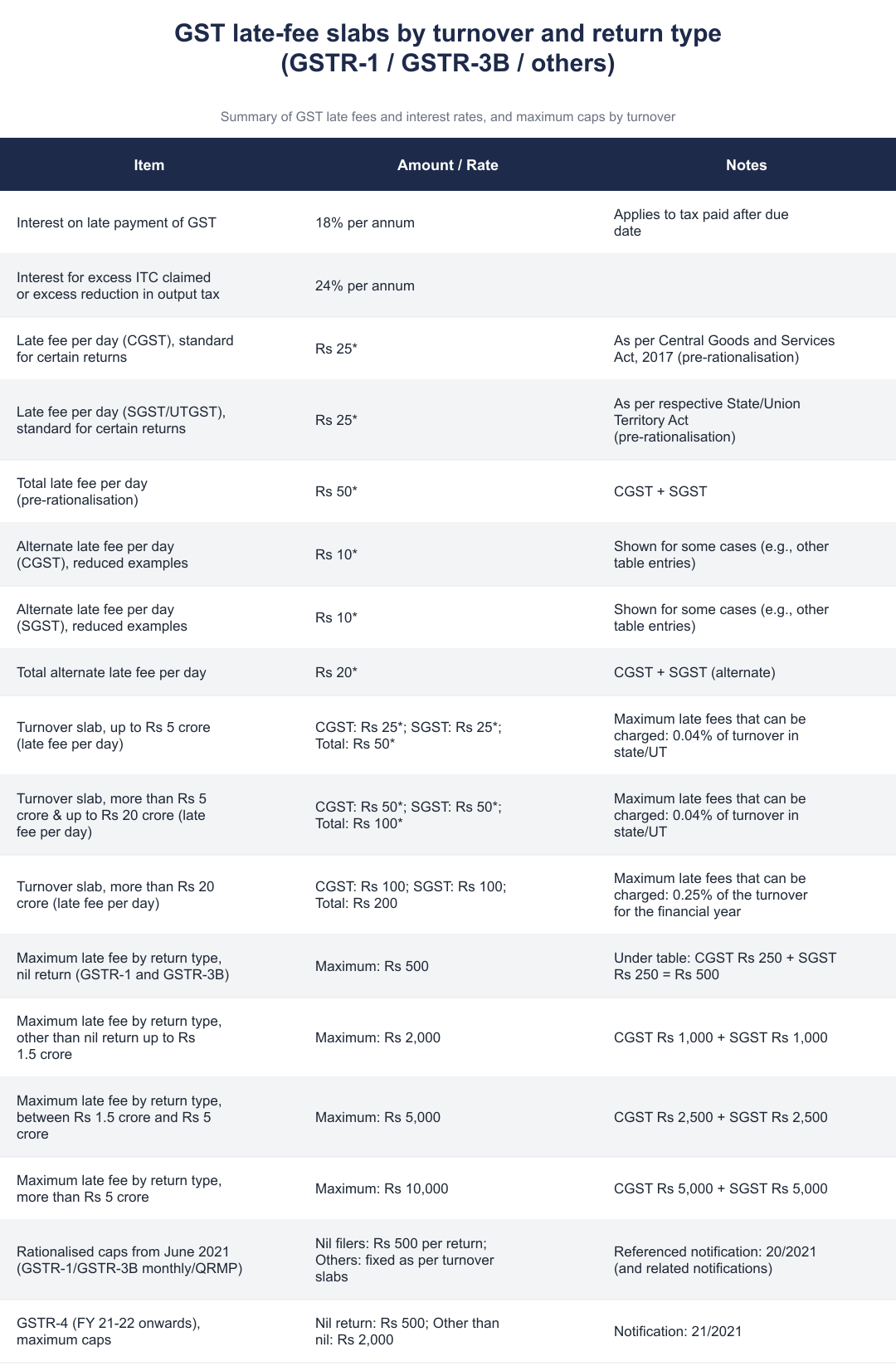
Late fees for delayed GSTR-1 and GSTR-3B filing are charged per day and depend on type of return and turnover; the standard (pre-June 2021) norm was Rs 25 under CGST and Rs 25 under SGST (Rs 50 per day). From June 2021 onwards the maximum late fee has been rationalised: nil filers have a fixed cap (for example Rs 500 per return) and non-nil filers fall into turnover slabs with specified daily caps (e.g., up to Rs 5 crore attracts lower caps). Additionally, for GSTR-1/GSTR-3B the statutory maximum per return differs by annual turnover slab (examples: up to Rs 1.5 crore, max Rs 2,000; more than Rs 5 crore, max Rs 10,000 across CGST+SGST).
Is there a maximum limit on GST late fees I can be charged?
Yes, the law caps maximum late fees and these caps have been rationalised over time and by return type and turnover. For example, for GSTR-1/GSTR-3B the cap varies by annual turnover (examples: nil return cap Rs 500 per return; up to Rs 1.5 crore, Rs 2,000; more than Rs 5 crore, Rs 10,000 total), while other returns have their own caps (GSTR-4 from FY 2021-22: nil filing Rs 500, non-nil Rs 2,000). The caps and reliefs are specified through notifications (e.g., 20/2021, 19/2021, 21/2021) and some past periods were fully waived or capped by earlier notifications.
What late fee applies to nil GST returns?
Nil returns attract a lower fixed late fee cap: typically Rs 10 under CGST and Rs 10 under SGST (Rs 20 per day) historically, and after rationalisation many returns have a nil-filer maximum cap such as Rs 500 per return. Many notifications specifically provide relief or set a small fixed cap for nil filers (for example the June 2021 rationalisation fixed Rs 500 per return in several cases). Also, earlier reliefs and waivers applied to specific historic periods, so the applicable cap depends on the return period and the relevant notification.
How do I pay late fees for GST on the GST portal?
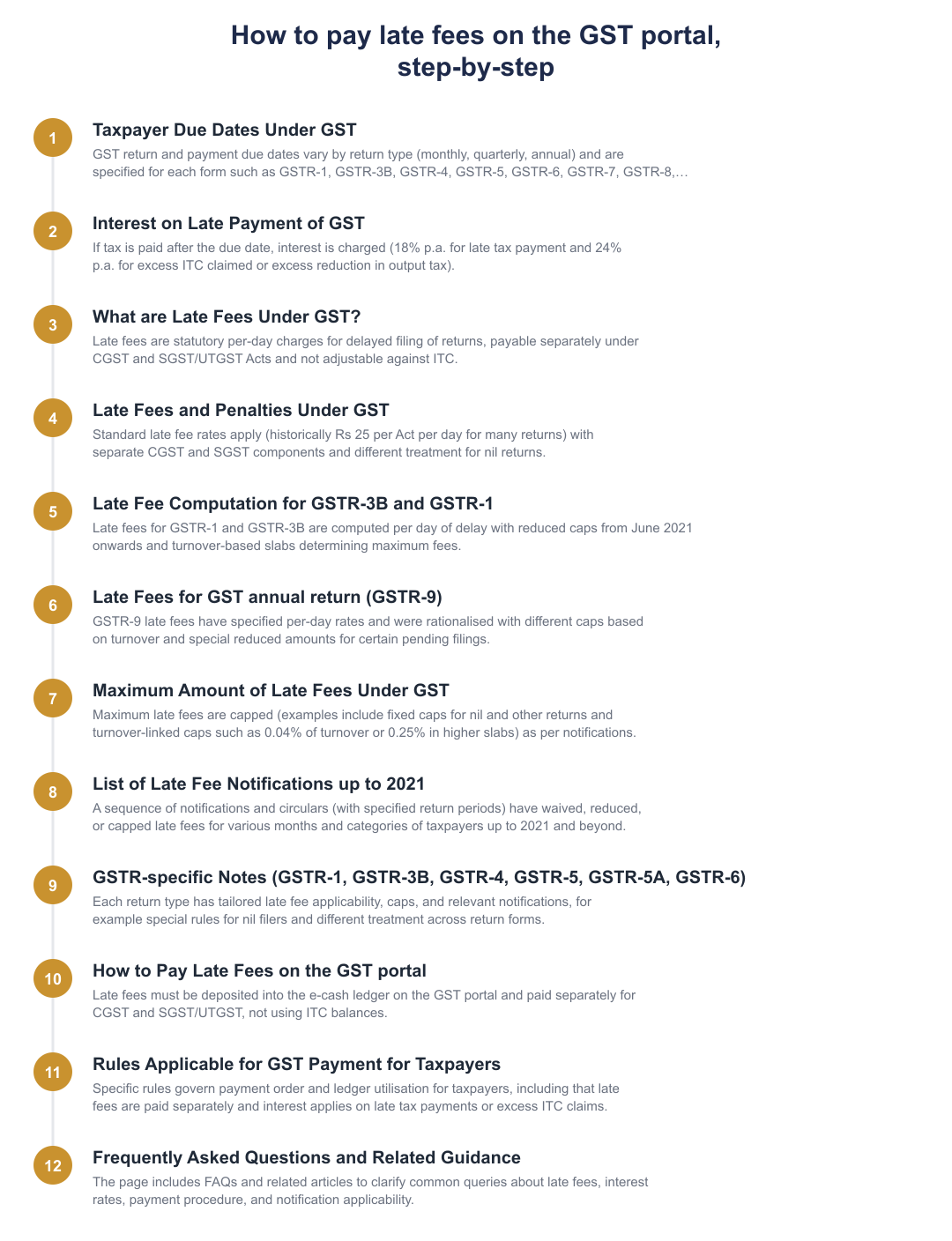
Late fees must be paid through the GST portal by making a payment into the electronic cash ledger and cannot be paid using Input Tax Credit (ITC). When paying, late fees for CGST and SGST/UTGST must be paid separately under the respective heads in the cash ledger. The portal allows selecting the appropriate tax head and depositing the amount; interest and tax payments are separate entries and must be made as required. Make sure to compute and deposit the full late fee and interest before filing or when completing the return to avoid further liabilities.
What causes GST interest at 24% per annum to be charged instead of 18%?
Interest at 24% per annum is charged when a taxpayer has claimed excess input tax credit or has made an excess reduction in output tax liability. This higher rate penalises incorrect claims or reductions of tax as opposed to merely late payment of tax, for which the standard rate is 18% per annum. The 24% rate applies on the excess amount from the date of claiming the excess ITC or excess reduction until it is reversed or paid. Therefore, ensure accurate ITC claims and timely corrections to avoid the higher interest rate.
Which GST returns attract late fees and which are covered by recent rationalisation?
Most regular returns attract late fees if filed late, common ones include GSTR-1, GSTR-3B, GSTR-4 (annual), GSTR-5, GSTR-5A, GSTR-6, GSTR-7, GSTR-8 and GSTR-9. Recent rationalisations (from June 2021 and FY 2021-22 onwards) reduced maximum late fees for many returns, fixed low caps for nil filers (for example Rs 500), and introduced turnover-based caps for non-nil filers; GSTR-9 late fees were also lowered with turnover-linked limits. Specific notifications list applicability, waivers, and capped amounts period-by-period, so relief may apply depending on the return period and whether you are a nil filer or have pending returns from earlier years.
What are the due dates for common GST returns like GSTR-1 and GSTR-3B?
Due dates vary by return: GSTR-1 (monthly) is due on the 11th of the next month, GSTR-1 (quarterly) on the 13th of the month succeeding the quarter, GSTR-3B (monthly) on the 20th of the next month, and GSTR-3B (quarterly) generally on the 22nd or 24th of the month succeeding the quarter depending on the taxpayer. Annual returns such as GSTR-9 are due by 31st December of the next financial year (subject to periodic changes), and GSTR-4 (annual) for FY 2024-25 is due by 30th June succeeding the financial year (previously 30th April). Other returns like GSTR-7, GSTR-8, GSTR-5 have their own monthly due dates (usually 10th–13th of next month) as specified in the official due date table.
Were any late fees waived or reduced for specific past periods under GST?
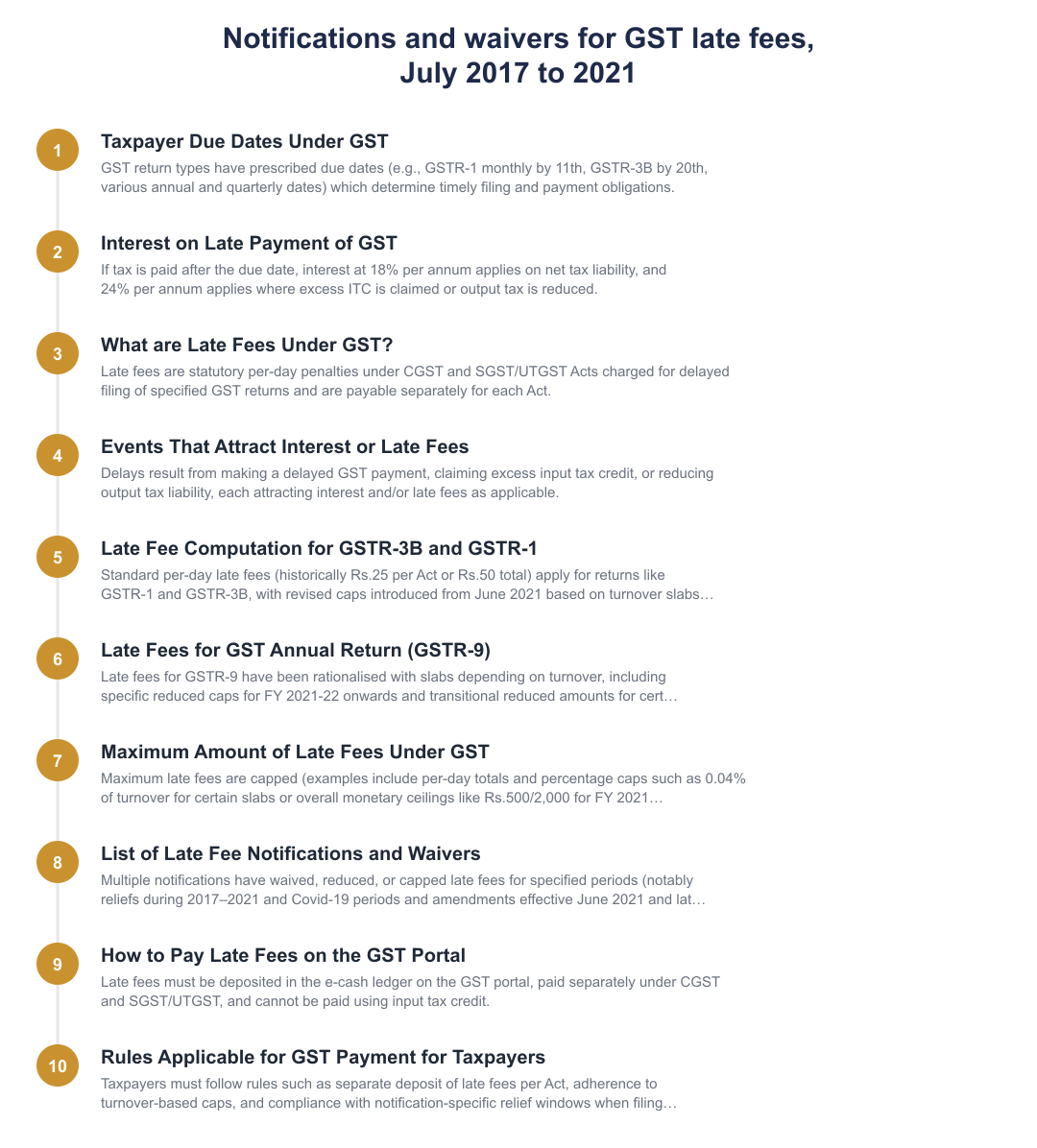
Yes, multiple notifications granted waivers or reductions for specific historic periods, such as full waiver for certain months in 2020 and conditional waivers for pandemic-related delays, and staggered reliefs for returns filed within specified periods. Examples include waivers for March–June 2020 if filed before certain July–August 2020 dates (notification 53/2020), capped late fees for returns filed by 30th September 2020 (notification 52/2020), and reduced late fees introduced via notifications 19/2021 and 20/2021 from June 2021 onwards. The applicability of waiver or reduced fee depends on the return period, turnover slab, and the specific notification, so check the notification relevant to your return period to confirm relief.
Need help staying GST compliant?
MoneyGence's AI Finance OS tracks your compliance, wallet share, and finances in one place, built for agencies and growing businesses.
Get started with MoneyGence