Leave Encashment Tax Exemption: Calculation, Formula & Rules
Leave encashment, payment an employee receives for accumulated but unused leave, is a common component of salary settlements on retirement, resignation or sometimes during employment. Its tax treatment in India depends on who receives it (government vs non-government employees) and when it is received. This guide explains the legal basis for exemption, the difference between encashment during service and at termination, the precise elements used in the exemption formula under the Income Tax Act, and how to apply the formula in practice. You will learn which portions of leave encashment can be tax-free, why the law uses a “least of” approach, and how the cap on days of leave affects the exempt amount. This is essential reading for payroll managers, HR professionals, tax practitioners and employees planning retirement or evaluating exit payouts, understanding the rules helps reduce surprise tax liabilities and ensures correct reporting on Form 16 and tax returns.
What is Leave Encashment?
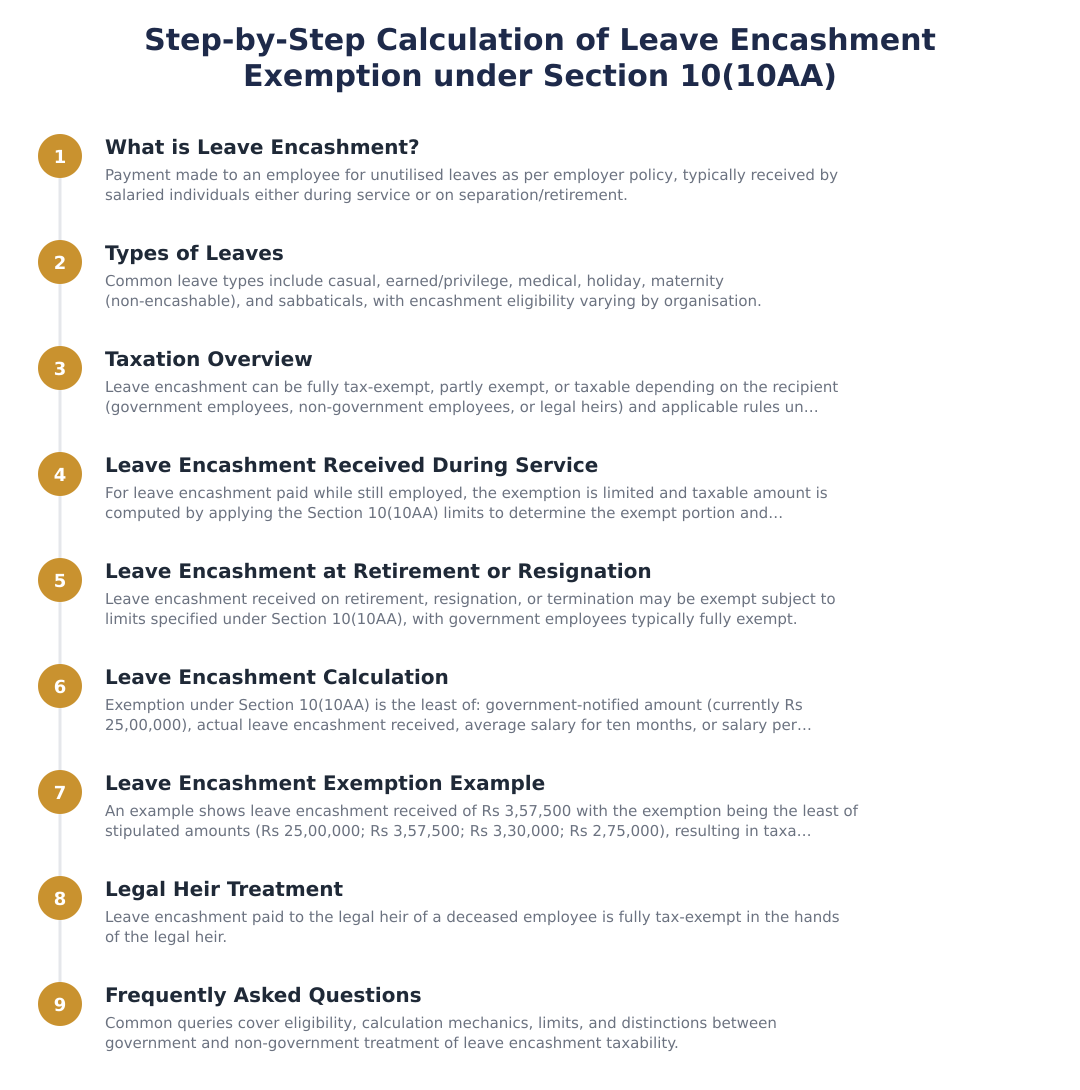
Leave encashment is the monetary compensation an employee receives in lieu of unutilised leave days. Employers may pay encashment when an employee retires, resigns, or, depending on company policy, at other times during active service. The amount represents a conversion of accumulated leave balance into cash rather than carrying the leave forward or taking time off.
From a tax perspective, leave encashment is treated as part of an employee’s income but specific exemptions under the Income Tax Act reduce the taxable portion in many cases. Because the exemption rules differ for government and non-government recipients, it is important to identify the category of recipient before applying any exemption computation.
What are the Types of Leaves?
Organisations maintain different categories of leave, earned/privilege leave, casual leave and medical leave are common examples. Only certain kinds of leave typically attract encashment provisions under company policy; for example, earned or privilege leave is commonly encashable while some other leaves may not be. Whether a leave type is encashable depends on the employer’s leave policy and applicable labour rules.
For tax treatment, the important point is the amount of unutilised leave that is eligible for encashment, because the income tax exemption formula uses the count of unutilised leave days (subject to statutory caps) when computing the exempt portion for non-government employees.
Taxation of Leave Encashment
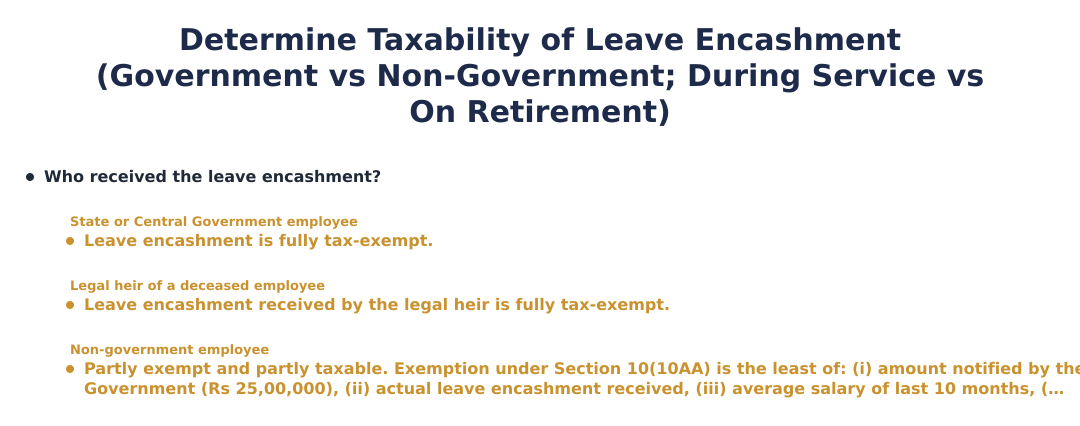
The Income Tax Act provides distinct treatments depending on the recipient. Leave encashment paid to State and Central Government employees is fully tax-exempt. In contrast, encashment received by non-government employees is only partly exempt; the exempt portion is computed as per Section 10(10AA) of the Income Tax Act and in particular the computation under Section 10(10AA)(ii).
If an employee dies, the leave encashment amount received by the legal heir is fully tax-exempt. These clear distinctions mean payroll staff must classify recipients correctly, government employee receipts and legal-heir receipts are treated differently from private-sector employee receipts when determining taxable salary.
Who gets what tax treatment?
| Leave encashment received by | Taxability |
|---|---|
| State and Central Government employees | Fully tax-exempt |
| Non-government employees | Partly exempt and partly taxable. The exemption is based on the calculation specified in Section 10(10AA)(ii). |
| Legal heir of a deceased employee | Fully tax-exempt Leave encashment amount received by the Legal heir of a deceased employee is fully tax-exempt in the hands of the legal heirs. |
Leave Encashment Calculation, Step-by-step
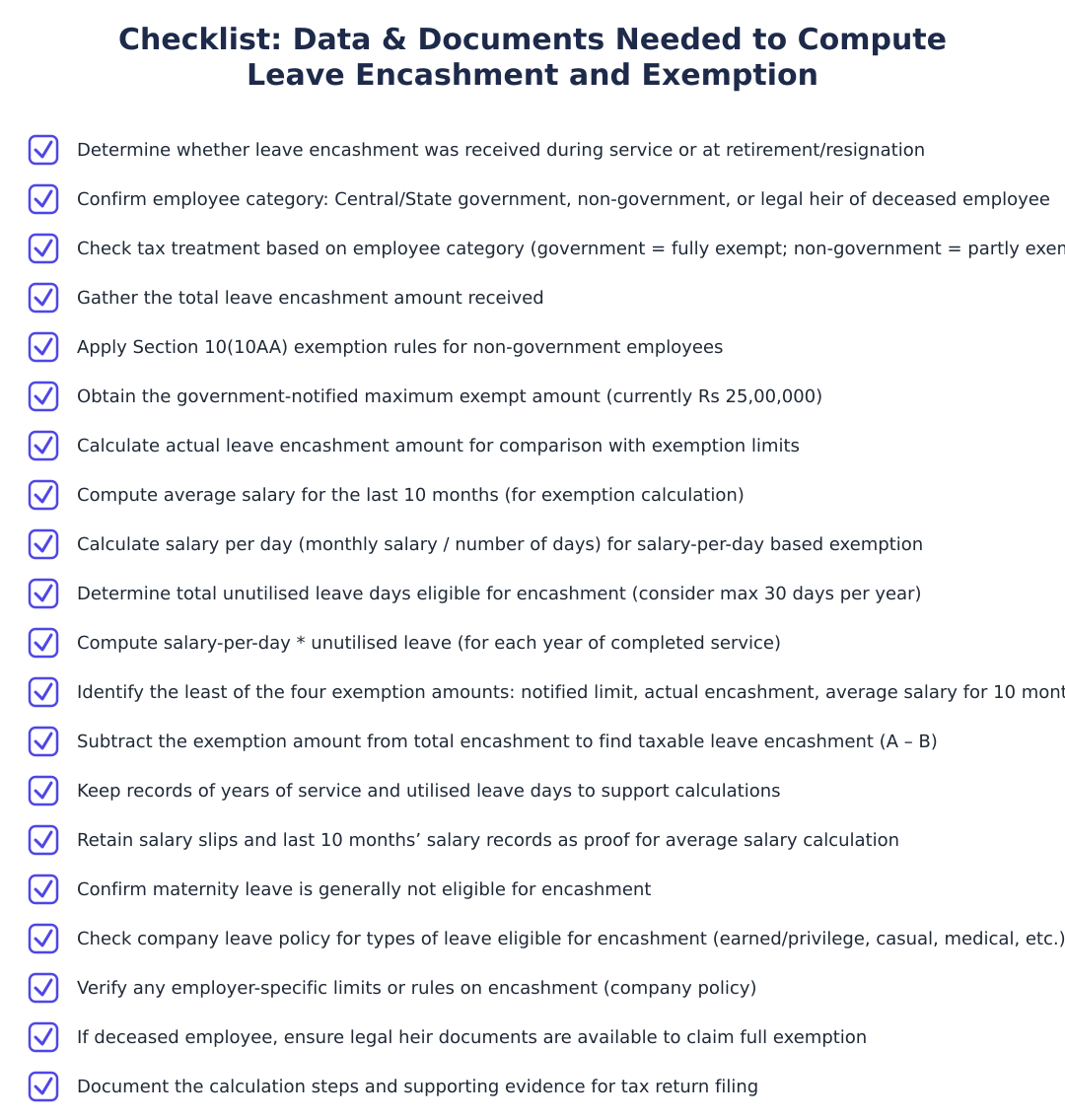
Determine whether the recipient is a State/Central Government employee, a non-government employee, or a legal heir of a deceased employee; this decides whether any exemption applies.
For non-government employees, collect the actual leave encashment amount, the average salary for the last ten months, the per-day salary and the number of unutilised leave days (subject to the per-year cap).
Compute four measures: (i) the amount notified by the Government, (ii) actual leave encashment received, (iii) average salary of the last ten months, and (iv) salary per day × unutilised leave (using a maximum of 30 days per year). The exempt portion is the least of these four.
Subtract the exempt amount (the least of the four) from the total encashment received to arrive at the taxable component, which is treated under salary income.
Leave Encashment, Key points about the formula
Section 10(10AA)(ii) prescribes a comparative approach: the exemption equals the lowest of four distinct measures. This conservative method prevents excessive exemption by capping the tax-free amount through multiple reference points, government-notified limits, actual payout, recent average salary and an accrual-based measure tied to days of service.
A specific operational detail in the rule is the cap on days: while calculating the salary-per-day times unutilised leave measure, the formula uses a maximum of 30 days of leave per year. That cap affects long-serving employees with higher accumulated leaves because only up to 30 days per year is taken into account for the accrual-based measure of exemption.
Frequently Asked Questions
Q: Which section of the Income Tax Act covers leave encashment exemption? A: Exemption for non-government employees is specified under Section 10(10AA), with the exemption computation referenced in Section 10(10AA)(ii).
Q: Are government employees' leave encashments taxable? A: No, leave encashment received by State and Central Government employees is fully tax-exempt.
Q: Is encashment received by a legal heir taxable? A: Leave encashment paid to the legal heir of a deceased employee is fully tax-exempt in the hands of the legal heirs.
Q: How is the exempt portion computed for private-sector employees? A: For non-government employees the exempt portion is the least of four measures: the government-notified amount, actual encashment, average salary of the last ten months, and salary-per-day multiplied by unutilised leave (with a cap of 30 days per year).
Accurately treating leave encashment for tax purposes reduces compliance risk and ensures employees pay tax only on the correct portion of their payout. For government employees and legal heirs the position is straightforward, full exemption applies, whereas for non-government employees the exemption requires applying the Section 10(10AA)(ii) ‘least of’ computation and observing the 30-days-per-year cap. Use the stepwise approach above when preparing payroll or exiting an employee to determine the exempt and taxable components.
Frequently asked questions
What exactly is leave encashment?
Leave encashment is the monetary payment an employer gives an employee for unutilised paid leave accumulated during employment. It compensates earned/privilege or other paid leaves that the employee did not take and which the employer allows to be converted into cash; companies may have different rules on which types of leave are encashable and any caps on carry-forward. Leave encashment is commonly paid on resignation, retirement, death (to legal heirs) or sometimes during service if the employer’s policy permits; the tax treatment depends on whether the employer is a government body or a private employer and on limits under Section 10(10AA).
How is leave encashment taxed for government employees?
Leave encashment received by State and Central government employees is fully tax-exempt. There is no limit or partial taxation for government employees, the entire amount received on encashment, whether during service, at retirement, or paid to legal heirs after death, is exempt from income tax. This full exemption applies irrespective of the amount and overrides the Section 10(10AA) limits that apply to non-government employees.
Is leave encashment taxable for private-sector employees?
Leave encashment for non-government employees is partly exempt and partly taxable, the exempt portion is the least of specified amounts under Section 10(10AA). For private employees the exemption is the minimum of: (a) the government-notified amount (currently Rs 25,00,000), (b) actual leave encashment received, (c) average salary for the last 10 months, and (d) salary per day multiplied by unutilised leave (with a maximum of 30 days leave per year for each completed year of service). Any amount received in excess of that least amount is taxable as salary income.
What is the formula to compute the exempt portion of leave encashment?
The exempt portion under Section 10(10AA) is the least of four values: (1) the government-notified ceiling (currently Rs 25,00,000), (2) the actual leave encashment amount received, (3) average salary for the last 10 months (basic + dearness allowance, etc.) multiplied by 10, and (4) salary per day multiplied by the number of unutilised leave days (with a maximum of 30 days per year of completed service). Use these four values to pick the smallest, that amount is tax-exempt and any remainder is taxable as income from salary.
Can you give a simple example showing how taxable leave encashment is calculated?
Yes, for example, if an employee receives Rs 3,57,500 as leave encashment, compute the four values and take the least as exempt: government limit Rs 25,00,000; actual encashment Rs 3,57,500; average salary for 10 months say Rs 33,000 × 10 = Rs 3,30,000; and salary-per-day × unutilised leave = Rs 1,100 × (30 days × 15 years − 200 utilised days) = Rs 2,75,000. The least of these is Rs 2,75,000, so exempt = Rs 2,75,000 and taxable portion = Rs 3,57,500 − Rs 2,75,000 = Rs 82,500, which is taxed as salary income.
What is the difference between leave encashment received during service and at retirement/resignation?
Leave encashment received during service is still eligible for exemption under Section 10(10AA but is subject to the same ‘least of’ test for private employees; there is no special higher exemption just because it was paid during service. At retirement, resignation, or on death (paid to legal heirs), government employees get full exemption while non-government employees follow the same Section 10(10AA) limits; the main practical difference is that legal heirs of a deceased employee also receive full exemption if the employee was a government servant, and for non-government cases the statutory limits still apply. Some employers also have internal policies that allow encashment during service only up to certain limits, those policy limits affect payment but not the statutory tax test.
What counts as ‘average salary of last 10 months’ for the exemption calculation?
Average salary for the last 10 months means the arithmetic mean of the employee’s salary components (usually basic pay plus dearness allowance where applicable) for the 10 months preceding the month of encashment or cessation of employment. Multiply that average monthly salary by 10 to get the third value used in the ‘least of’ test under Section 10(10AA). Components such as bonuses, commissions or other irregular payments are generally excluded unless they form part of regular salary as per employer records or specific rules.
How do I calculate the ‘salary per day × unutilised leave’ part of the exemption?
You calculate salary per day by dividing the relevant monthly salary component (usually basic + dearness allowance) by the number of days in the month or as per employer practice, and then multiply that per-day rate by the number of unutilised leave days eligible for encashment. The formula caps eligible leave at 30 days for each completed year of service, so total unutilised leave counted cannot exceed 30 days per year of service; use completed years to determine the maximum. This product gives the fourth value in the Section 10(10AA) “least of” test; any excess encashment over the least value is taxable.
Are there any special rules for leave encashment paid to legal heirs when an employee dies?
Yes, the leave encashment amount paid to the legal heirs of a deceased employee is fully tax-exempt in the hands of the heirs. This full exemption applies irrespective of whether the employee was a government or non-government employee, so the heirs do not include the amount in taxable income. Employers or heirs should ensure proper documentation of the employee’s death and the identity of legal heirs when claiming exemption.
Need help staying Income Tax compliant?
MoneyGence's AI Finance OS tracks your compliance, wallet share, and finances in one place, built for agencies and growing businesses.
Get started with MoneyGence