Legal Compliances for Startups in India: Essential Guide
This guide outlines the principal legal compliances early-stage businesses and start-ups in India should consider, with a clear focus on labour and employment-related statutes. For founders, understanding statutory obligations helps reduce litigation risk, protect employees, and build a scalable organisation that is compliant from day one. You will learn which central labour laws commonly apply to employers, why they matter in practical terms, and sensible next steps a start-up can take to organise its human-resources, payroll and contractor relationships. The guide does not replace legal advice but highlights the statutes frequently encountered by growing ventures and suggests practical actions to stay on the right side of the law. Whether you are hiring your first team, engaging contract workers for a project, or handling employee benefits, the information here will help you prioritise compliance tasks and know when to consult external counsel or payroll specialists. The emphasis in the guide is on clarity and applicability: it describes the statutory landscape, gives a compact reference of the central labour enactments start-ups should be aware of, and sets out an actionable checklist and escalation points to help founders convert legal obligations into manageable processes.
Why legal compliance should be an early priority for start-ups
Legal compliance is not just an administrative obligation; it underpins trust with employees, investors and partners. Early attention to statutory requirements reduces the likelihood of disputes that can drain management time and capital. A structured approach to compliance also supports better people management and helps when the company pursues fundraising or formalising commercial relationships.
For founders, knowing which laws commonly affect employment and workplace practices enables better design of contracts, policies and payroll processes. Preparing for compliance – by maintaining records, defining roles and documenting agreements – translates legal obligations into routine business operations rather than ad hoc firefighting.
Key labour and employment laws start-ups should know
| Act |
|---|
| The Industrial Disputes Act, 1947 |
| The Trade Union Act, 1926 |
| Building and Other Construction Workers’ (Regulation of Employment and Conditions of Service) Act, 1996 |
| The Industrial Employment (Standing Orders) Act, 1946 |
| The Inter-State Migrant Workmen (Regulation of Employment and Conditions of Service) Act, 1979 |
| The Payment of Gratuity Act, 1972 |
| The Contract Labour (Regulation and Abolition) Act, 1970 |
| The Employees’ Provident Funds and Miscellaneous Provisions Act, 1952 |
| The Employees’ State Insurance Act, 1948 |
Practical compliance checklist for early-stage companies
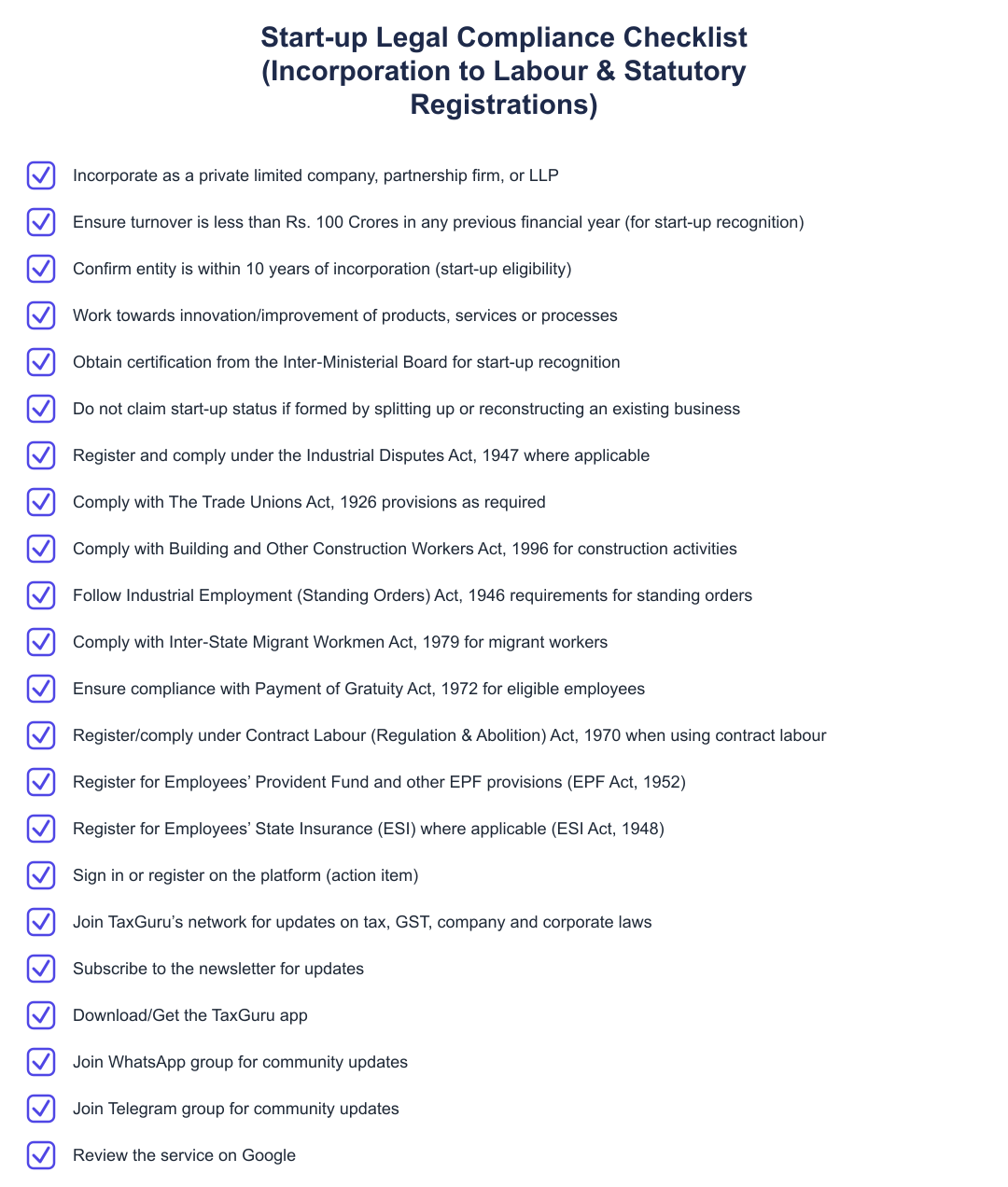
Identify which of the listed labour statutes are relevant based on the nature of work, workforce composition and whether you engage contract or migrant workers.
Use clear written contracts and offer letters to set out employment terms, roles and responsibilities, and any policies that affect workplace conduct and benefits.
Establish simple record keeping for attendance, wages, statutory contributions and employee communications so you can meet statutory obligations and produce evidence if required.
Adopt core workplace policies covering leave, disciplinary procedure and workplace safety to provide a consistent framework for managing employees and contractors.
Ensure systems are in place to handle statutory benefit schemes that may apply so contributions and entitlements can be administered correctly.
Revisit compliance steps whenever the business expands operations, changes workforce composition or enters new states to ensure ongoing alignment with statutory requirements.
When to engage external specialists
Start-ups should consider professional support when obligations become complex or when a gap in internal expertise could lead to non-compliance. Specialists such as labour law advisers, chartered accountants or payroll providers can help interpret statutes, manage statutory filings and set up compliant payroll and record-keeping systems.
Legal counsel is particularly valuable for drafting or reviewing employment agreements, handling industrial relations issues, or responding to notices and disputes under the labour laws listed earlier. Early engagement with advisers often proves cost-effective compared with the time and disruption caused by remedial action later on.
Practical next steps for founders
Begin by reviewing your current workforce arrangements against the labour statutes listed in this guide. Implementing basic HR processes and reliable payroll practices will make statutory compliance manageable as you grow.
Keep communication channels open with employees and maintain transparent documentation of policies and agreements. When in doubt about the application of a specific statute to your business model, seek specialist advice to ensure your start-up remains compliant and focused on growth.
Compliance need not be a barrier to innovation. By recognising the central labour laws relevant to employers, implementing basic HR and payroll processes, and engaging experts when needed, start-ups can build resilient teams and reduce legal risk while they scale.
Frequently asked questions
What makes an Indian company eligible to be recognised as a Start-up?
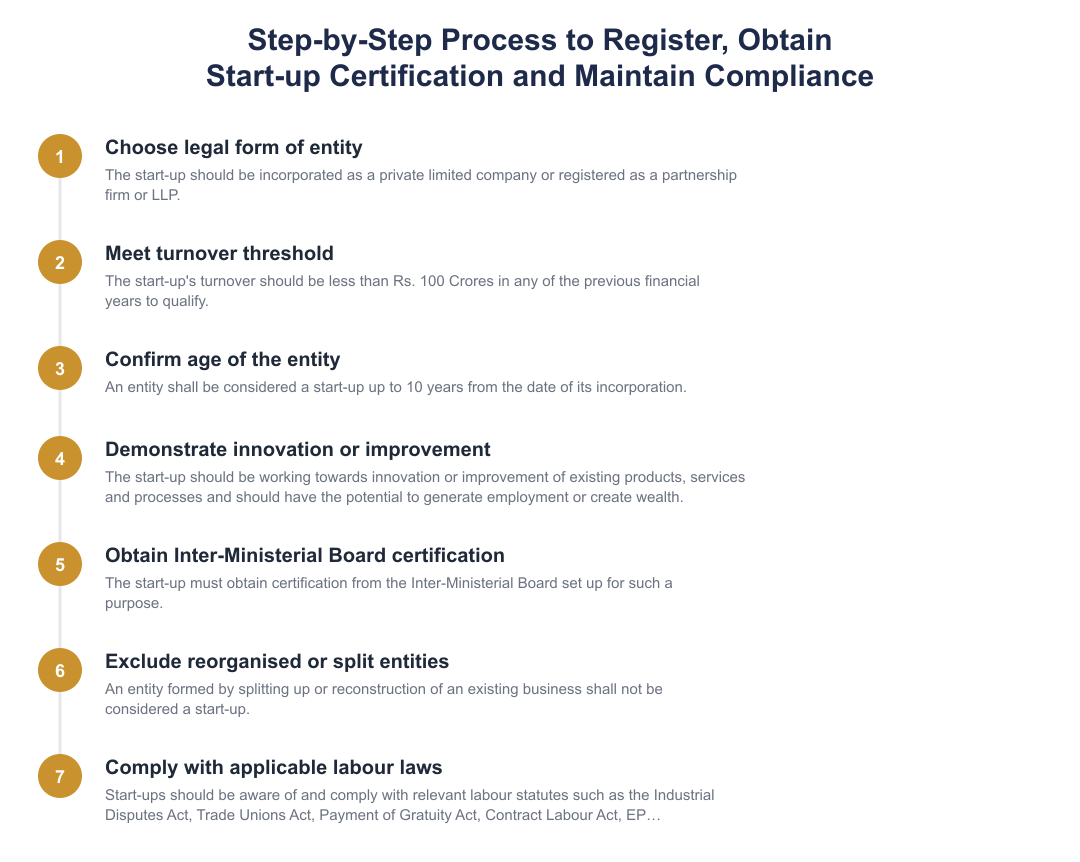
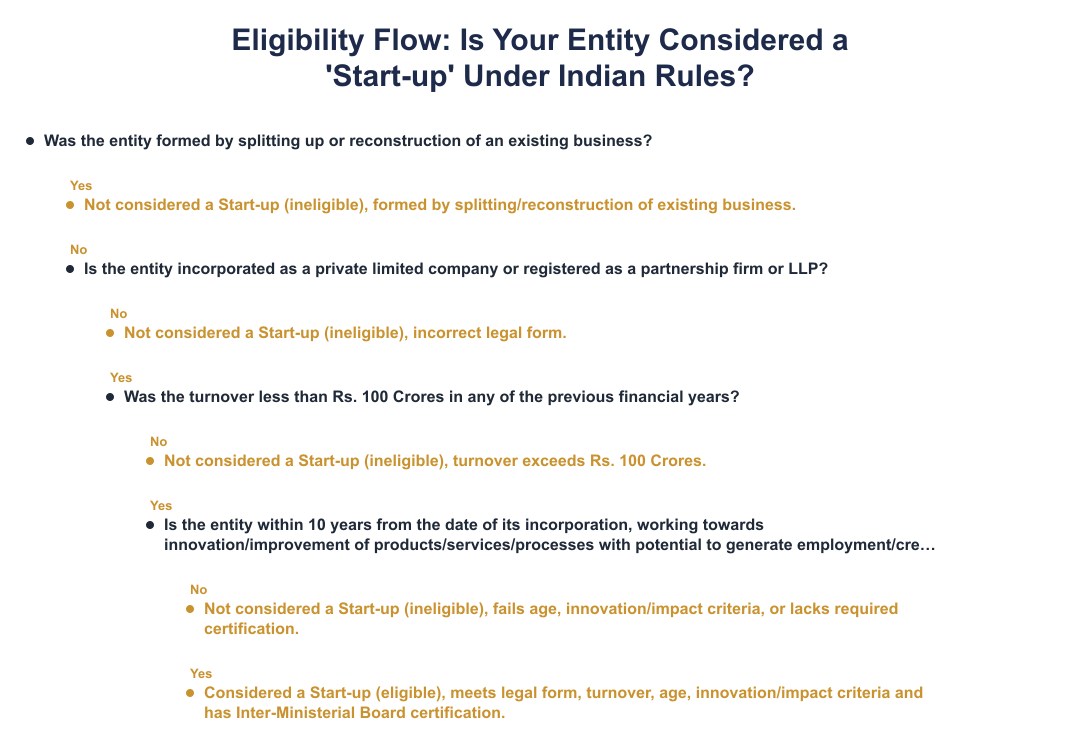
A company is eligible to be recognised as a Start-up in India if it is incorporated as a private limited company, partnership firm or LLP, has turnover less than Rs. 100 crore in any previous financial year, and is within 10 years from the date of incorporation. Additionally, the entity must be working towards innovation or improvement of products, services or processes with potential to generate employment or create wealth, and must obtain certification from the Inter‑Ministerial Board set up for this purpose. An entity formed by splitting up or reconstructing an existing business is not eligible for Start‑up recognition. For example, a 3‑year old private limited company with turnover of Rs. 5 crore and an IMB certification for its innovative tech product would qualify.
How long is a company treated as a Start-up under Indian rules?
An entity shall be considered a Start‑up for up to 10 years from the date of its incorporation. This 10‑year period is counted from the incorporation date of the private limited company, LLP or partnership firm and is a strict eligibility limit for Start‑up benefits and recognition. Note that turnover and innovation criteria still apply within this 10‑year window and IMB certification must be obtained during this period. For instance, a company incorporated on 1 April 2018 would be eligible as a Start‑up until 31 March 2028, subject to other conditions.
Can a business created by splitting or reconstructing an existing firm be called a Start‑up?
No, an entity formed by splitting up or reconstruction of an existing business shall not be considered a Start‑up. The Start‑up recognition requires a fresh entrepreneurial venture with original innovation or improvement, not a restructured part of an ongoing or previous business. This exclusion prevents established businesses from claiming Start‑up incentives by simple reorganisation. For example, carving out a division of a 20‑year old company into a new entity will not qualify that new entity as a Start‑up under these rules.
What turnover limit applies for an entity to be treated as a Start‑up in India?
The turnover limit for Start‑up recognition in India is that the entity’s turnover must be less than Rs. 100 crore in any of the previous financial years. This ceiling is assessed on past financial years and disqualifies entities whose turnover has exceeded Rs. 100 crore at any time during the eligibility period. The turnover test is applied alongside the 10‑year incorporation limit and innovation criteria. For instance, a company with Rs. 120 crore turnover in FY 2022‑23 would not meet the Start‑up turnover condition even if other criteria are satisfied.
What kinds of legal structures can register as a Start‑up in India?
A Start‑up in India can be incorporated as a private limited company, registered as a partnership firm, or set up as a limited liability partnership (LLP). These three legal forms are explicitly recognised for Start‑up status and are eligible to apply for IMB certification and related benefits, provided they meet turnover, age and innovation criteria. Sole proprietorships and unregistered entities are not listed in the recognised forms for Start‑up recognition under these rules. For example, most technology Start‑ups commonly incorporate as private limited companies to access funding and benefits tied to Start‑up status.
What labour and employment laws should a Start‑up in India be aware of?
Start‑ups in India should be aware of several central labour laws such as the Industrial Disputes Act, 1947; The Trade Unions Act, 1926; Building and Other Construction Workers’ Act, 1996; Industrial Employment (Standing Orders) Act, 1946; Inter‑State Migrant Workmen Act, 1979; Payment of Gratuity Act, 1972; Contract Labour (Regulation & Abolition) Act, 1970; Employees’ Provident Funds and Miscellaneous Provisions Act, 1952; and Employees’ State Insurance Act, 1948. These statutes cover dispute resolution, trade union registration, conditions for construction workers, standing orders for employment terms, interstate migrant labour conditions, gratuity, contract labour regulation, provident fund contributions and employee state insurance contributions. Compliance depends on workforce size, nature of work, and state‑level rules; for instance, PF and ESI applicability is often linked to employee count and wages. Start‑ups should determine which of these apply based on their industry, headcount and whether they engage contract or interstate migrant workers.
Do Start‑ups need certification from an Inter‑Ministerial Board (IMB) and why?
Yes, a Start‑up must obtain certification from the Inter‑Ministerial Board (IMB) to be officially recognised as a Start‑up and access certain benefits. The IMB certification verifies that the entity is working towards innovation/improvement of products, services or processes and has potential to generate employment or create wealth, which are core criteria for Start‑up status. Without IMB certification, even entities meeting turnover and age limits may not be eligible for government Start‑up incentives or schemes tied to formal recognition. Entrepreneurs should apply to the designated IMB portal with requisite documents demonstrating their innovative activity and incorporation details.
If my business is improving an existing product, can it still be called a Start‑up?
Yes, a business that is working towards improvement of existing products, services or processes can be recognised as a Start‑up if it demonstrates innovation and the potential to generate employment or create wealth, and meets the turnover and age limits. The IMB assesses whether the improvement is sufficiently innovative or provides meaningful enhancement beyond routine business activities before granting certification. The entity must still be incorporated as a private limited company, partnership or LLP and be within 10 years of incorporation with turnover below Rs. 100 crore. Minor or cosmetic changes that do not demonstrate genuine innovation may not satisfy the IMB’s requirements.
Are there any exclusions to Start‑up recognition I should know about?
Yes, an important exclusion is that entities formed by splitting up or reconstructing an existing business are explicitly not considered Start‑ups, and failure to meet turnover, age (10 years) and IMB certification requirements also excludes entities. This means established businesses cannot simply reorganise or rebrand to obtain Start‑up benefits; the venture must be a new, original entrepreneurial undertaking focused on innovation or improvement. Additionally, the legal form must be a private limited company, partnership firm or LLP to qualify under the stated rules. Start‑up applicants should ensure they meet all conditions before seeking government recognition to avoid rejection.
Need help staying Compliance compliant?
MoneyGence's AI Finance OS tracks your compliance, wallet share, and finances in one place, built for agencies and growing businesses.
Get started with MoneyGence