LIFO Method: Example, Formula, Advantages & Disadvantages
This guide explains the Last-In-First-Out (LIFO) inventory valuation method: what it is, how it works, when it is appropriate to use, and the main advantages and disadvantages to consider. You will learn the core principle behind LIFO, see a simple worked example to make the concept concrete, and get a concise formulaic view of how Cost of Goods Sold (COGS) and ending inventory are computed under LIFO. The guide also clarifies practical implications for businesses, particularly how LIFO behaves in periods of rising costs, and highlights compatibility issues with international accounting standards. Understanding LIFO matters because inventory valuation affects reported profit, taxable income, and balance-sheet presentation; choosing the right method helps align accounting with commercial reality and tax objectives. This article is focused on the conceptual and practical aspects of LIFO so you can decide whether it fits your reporting goals and operational flows.
What is the LIFO Method?
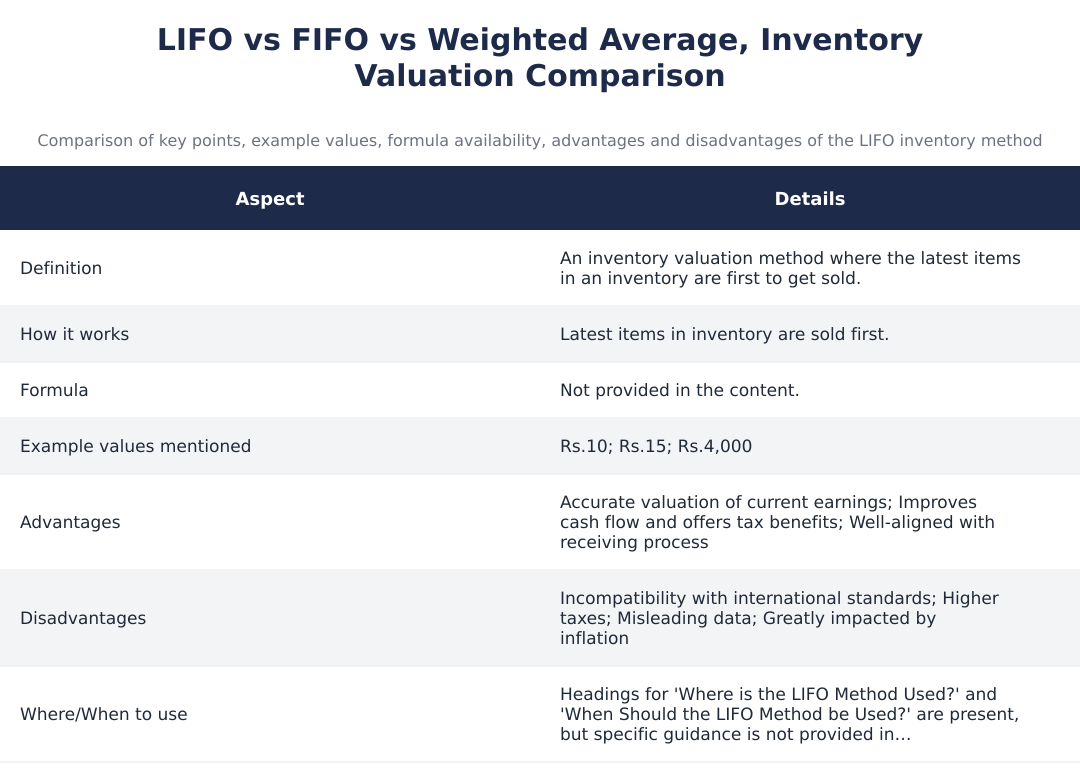
The Last-In-First-Out (LIFO) method is an inventory valuation approach in which the most recently acquired items are considered to be sold first. When preparing the income statement and balance sheet, entities applying LIFO assign the cost of the latest purchases to Cost of Goods Sold (COGS).
Under LIFO, the costs remaining in ending inventory tend to reflect older purchase prices. Because LIFO treats the newest costs as the ones consumed to generate current revenue, it changes both reported profit and the carrying amount of inventory compared with other inventory methods.
How Does the LIFO Method Work?
Practically, when a sale occurs, LIFO assumes the units sold are those most recently added to inventory. The accounting entry for COGS uses the purchase cost of those recent units rather than the cost of older stock, even if the actual physical flow differs.
This approach means COGS will reflect recent purchase prices. In a rising-cost environment, that typically increases COGS and lowers reported taxable income for that period. Conversely, the ending inventory balance will often be valued at earlier, lower costs, which affects the balance sheet's representation of assets.
LIFO Method Formula
The conceptual formula under LIFO focuses on which purchase layers are consumed when computing COGS. COGS (LIFO) = sum of costs of the most recent purchase layers assigned to the quantity sold. Ending inventory = cost of remaining, older purchase layers.
Because LIFO assigns the newest costs to COGS, you calculate COGS by taking quantities sold and allocating them against recent purchase prices in reverse chronological order, leaving earlier costs to comprise the ending inventory value.
LIFO Method Examples
A straightforward example illustrates the rule: a business bought 100 units at Rs.10 each, then later bought additional units at Rs.15 each. Under LIFO the units priced at Rs.15 are treated as sold first, so the COGS for sales will use the Rs.15 layer before using the older Rs.10 layer.
This example shows how a business’s reported COGS rises when recent purchase prices are higher. The remaining inventory after those sales will be valued using the older Rs.10 costs under LIFO, which may reduce taxable income in periods when prices are increasing.
Where and When is the LIFO Method Used?
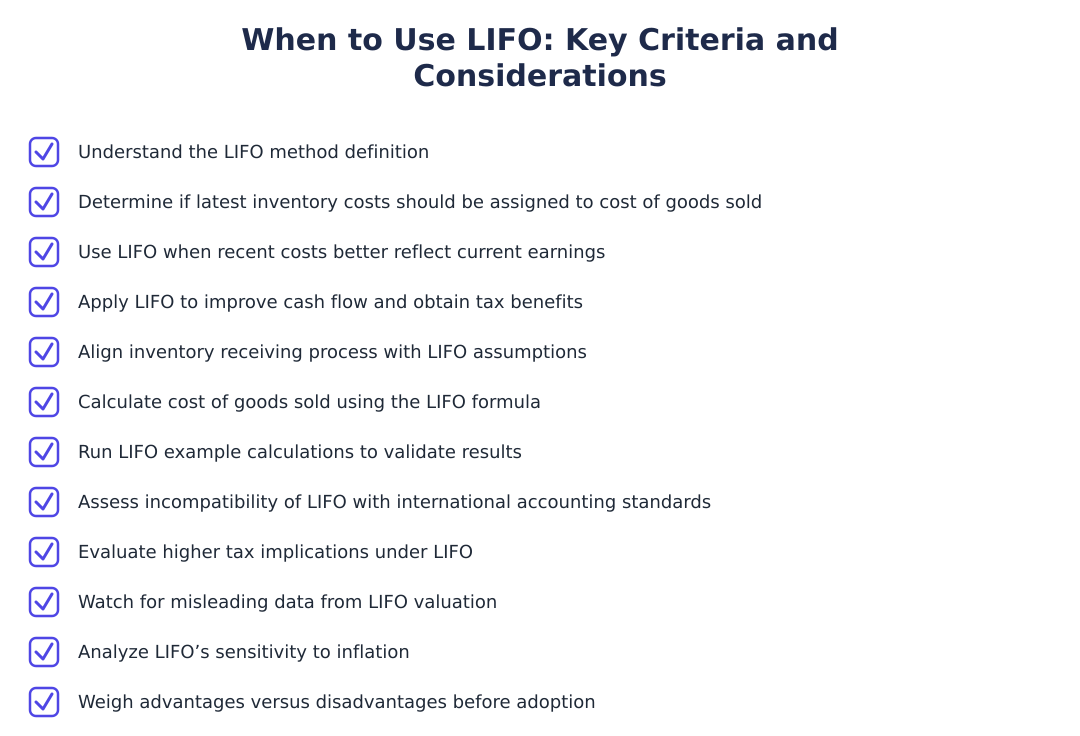
LIFO is suitable where inventory costs are expected to increase, because it matches recent, higher costs against current revenues. This matching can provide a clearer picture of current-period profitability when input prices are rising.
Operationally, businesses whose purchasing and revenue patterns align with consuming recent stock may prefer LIFO for its tax and cash-flow implications. However, the method’s suitability depends on accounting policy, regulatory environment, and the need for international comparability.
Advantages and Disadvantages of LIFO Method
Advantages include more accurate matching of current costs to current revenues, which can improve the relevance of earnings measures. In periods of rising prices, LIFO often increases COGS and therefore can reduce reported taxable income, producing cash flow benefits.
Disadvantages stem from how older costs remain on the balance sheet: ending inventory may reflect outdated, often lower costs, which can be misleading to users of financial statements. LIFO is also greatly impacted by inflation, and it has a compatibility issue with international accounting frameworks because it is not permitted under IFRS.
LIFO is a pragmatic inventory valuation method when recent costs need to be matched with current revenues and when prices are trending upward. It can lower taxable income in inflationary periods and improve cash flow, but it also leaves older costs on the balance sheet and is not compatible with IFRS. Use LIFO only after weighing its reporting and comparability implications for your business and stakeholders.

Frequently asked questions
What is the LIFO method in inventory accounting?
The LIFO (Last-In-First-Out) method values inventory by assuming the most recently purchased or produced items are sold first. Under LIFO, Cost of Goods Sold (COGS) is calculated using the cost of the latest purchases and the ending inventory is made up of the oldest costs, which can lower reported profits when prices are rising. LIFO is primarily a cost flow assumption for accounting and does not necessarily reflect actual physical flow of goods. Note that LIFO is permitted in the United States under US GAAP but is not allowed under IFRS (International Financial Reporting Standards).
How do you calculate COGS and ending inventory using the LIFO method?
To calculate COGS under LIFO, allocate the units sold to the most recent purchase batches and sum their costs; ending inventory is the cost of the remaining oldest batches. For example, if you bought 100 units @ Rs.10 and later 100 units @ Rs.15 and sold 150 units, LIFO COGS = (100×15) + (50×10) = Rs.2,000 and ending inventory = 50×10 = Rs.500. The general formula is: COGS (LIFO) = sum of costs of the latest units sold; Ending Inventory = total cost of the oldest units left. This approach changes reported profit and tax compared with other methods when purchase prices vary over time.
Why would a company choose LIFO instead of FIFO or weighted average?
A company might choose LIFO to better match current replacement costs with current revenues and potentially reduce taxable income when purchase costs are rising. Because LIFO charges the most recent (often higher) costs to COGS, reported taxable profit can be lower during inflationary periods, improving cash flow. LIFO can also align with businesses that physically use newer stock first in some operational settings, though physical flow isn’t required. However, the benefit depends on rising prices and LIFO is not permitted under IFRS, so it’s more common where allowed (e.g., the U.S.).
Where and when is LIFO allowed and commonly used?
LIFO is allowed under US GAAP and commonly used by companies in the United States, particularly in industries like oil, gas, automotive and some retailers where inventory costs fluctuate. LIFO is not permitted under IFRS, so most companies outside the U.S. cannot use it for financial reporting. Companies typically adopt LIFO when purchase costs are expected to rise and they want to reduce reported taxable income or match current costs against current revenues. Adoption also requires consistent application and, for tax purposes in the U.S., specific IRS rules must be followed.
What are the main advantages of using the LIFO method?
The main advantages of LIFO are more accurate matching of current costs with current revenues and potential tax and cash-flow benefits when inventory costs are rising. By charging recent (often higher) costs to COGS, LIFO can lower taxable income and improve short-term cash flows during inflationary periods. LIFO may also reflect the physical practice of selling newer stock first in some businesses, and it can simplify cost allocation when recent purchases dominate sales. These benefits are conditioned on rising prices and regulatory allowance (e.g., permitted in the U.S.).
What are the disadvantages and risks of using LIFO?
Disadvantages of LIFO include incompatibility with IFRS, potentially misleading financial ratios, and heavy sensitivity to inflation which can distort inventory valuation. Because ending inventory under LIFO is made up of older costs, the balance sheet can understate replacement cost and present outdated inventory values; this reduces comparability with peers using FIFO. LIFO can also require detailed record-keeping (layer tracking), may trigger LIFO liquidation problems if sales exceed recent purchases, and in some situations create tax timing complications when prices fall. Overall, LIFO’s usefulness depends on regulatory environment and the company’s price trends and reporting priorities.
Can LIFO reduce a company’s tax liability?
Yes, LIFO can reduce taxable income and thus taxes when inventory purchase costs are rising, because higher recent costs flow to COGS and lower reported profit. For example, if replacement costs have increased, charging those higher costs to COGS reduces taxable profit compared with FIFO, producing immediate tax deferral and improved cash flow. However, tax benefits depend on continuous price increases and applicable tax rules; some jurisdictions (including those following IFRS) do not allow LIFO, so the tax effect is jurisdiction-specific. Also, long-term use can create lower reported earnings and older-cost inventories on the balance sheet.
How does inflation affect LIFO inventory valuation and financial statements?
Inflation typically increases the COGS under LIFO because the most recent, higher-cost purchases are recorded as sold first, which lowers reported gross profit and taxable income. At the same time, ending inventory on the balance sheet reflects older, lower costs and therefore understates the current replacement value of stock, potentially misleading users about asset values. This distortion can worsen over prolonged inflation and complicate ratio analysis, and companies must disclose LIFO effects in financial statement notes if material. In deflationary periods the opposite may occur, COGS can be lower and taxes higher, so the effect depends on price trends.
What is a simple LIFO example showing its impact on profit and inventory?
A simple LIFO example: buy 100 units at Rs.10 and later 100 units at Rs.15, then sell 150 units; LIFO COGS = (100×15) + (50×10) = Rs.2,000 and ending inventory = 50×10 = Rs.500, whereas FIFO would give COGS = (100×10) + (50×15) = Rs.1,750 and ending inventory = Rs.750. This shows LIFO reports higher COGS and lower ending inventory when prices rise, reducing reported profit by Rs.250 in the example and lowering taxable income accordingly. The example highlights how LIFO shifts profit and balance-sheet values compared with other methods and why choice of method matters for tax and financial presentation.
Need help staying Accounting compliant?
MoneyGence's AI Finance OS tracks your compliance, wallet share, and finances in one place, built for agencies and growing businesses.
Get started with MoneyGence