LLP Registration in India: Complete Guide to Register an LLP
This guide explains Limited Liability Partnership (LLP) registration in India, what an LLP is, which documents and forms are required, who can be a designated partner, and the standard steps to incorporate and regularise an LLP on the MCA portal. If you are planning a small professional firm, a partnership that needs a formal structure, or a business where partners want an organised framework for decision-making, understanding LLP registration is essential. The process sits between a traditional partnership and a company: it uses online filings on the MCA portal, requires specific identity and office proofs, and creates a separate legal entity with perpetual succession under the LLP Act, 2008. This guide lays out the practical steps you will follow (from obtaining digital signatures to filing the LLP agreement), the mandatory documents for Indian and foreign partners, and the key statutory forms you will use. It also highlights important legal features you must keep in mind, for example, who can be a designated partner, and the filing timing for the LLP agreement. Use this guide as a checklist while preparing your incorporation package so you avoid common omissions and ensure that statutory timelines and document formats are respected.
What is Limited Liability Partnership?
An LLP in India is a business vehicle governed by the Limited Liability Partnership Act, 2008. Under that law an LLP is treated as a separate legal entity, which means the LLP itself continues regardless of changes in partners; this concept is expressed in the principle of perpetual succession.
Because an LLP is a separate legal entity, it must be incorporated and maintained through filings on the Ministry of Corporate Affairs (MCA) portal. The statutory frame and online filing requirements make the LLP a regulated form of business distinct from informal partnerships.
Key features of an LLP
Formation requires a minimum of two partners, and there is no upper limit on the number of partners who may be admitted. This flexibility allows an LLP to scale its membership without statutory caps on partner count.
Among the partners, at least two designated partners must be natural persons (i.e., real individuals). Additionally, at least one of the designated partners must be an Indian resident. Only natural persons can obtain a Designated Partner Identification Number (DPIN); legal entities cannot be designated partners.
Designated partners carry an important statutory role: they are directly responsible for ensuring compliance with the provisions of the LLP Act, 2008 and the LLP agreement. Because filings and authenticated submissions are done online on the MCA portal, Digital Signature Certificates (DSC) are required for signing and submitting documents.
LLP registration process (overview)
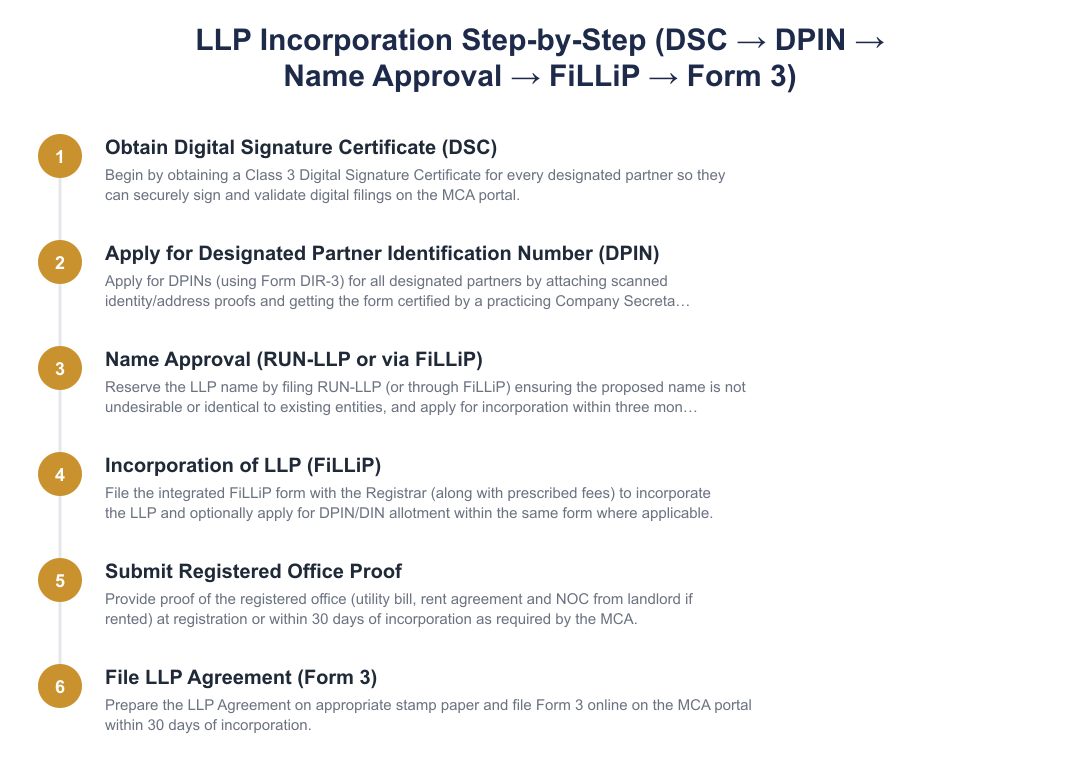
All LLP filings on the MCA portal require documents to be digitally signed. One of the designated partners must opt for a DSC and the checklist indicates DSCs are needed for all designated partners.
Designated partners must have a DPIN. Only natural persons can obtain a DPIN; legal entities are ineligible to be designated partners.
Reserve the proposed LLP name through RUN-LLP. The MCA provides a free name-search facility; the registrar will approve the name only if it is not undesirable or resembling existing entities or trademarks.
File the integrated FiLLiP form for incorporation of the LLP. FiLLiP can also be used to apply for DPIN/DIN and to seek name reservation as part of the incorporation flow.
The LLP agreement must be filed in Form 3 on the MCA portal and this form has to be filed within 30 days of incorporation. The agreement must be printed on stamp paper, the value of which differs by state.
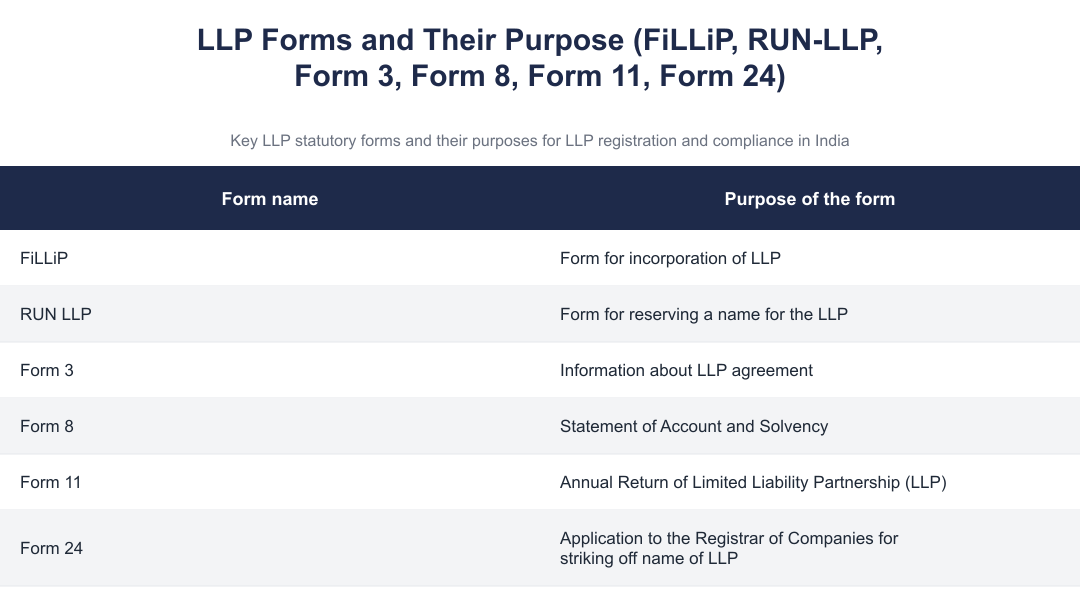
Common LLP forms
| Form name | Purpose of the form |
|---|---|
| FiLLiP | Form for incorporation of LLP; integrated form that can also be used to apply for DPIN/DIN and name reservation |
| RUN-LLP | Form for reserving a name for the LLP |
| Form 3 | Information about LLP agreement; must be filed within 30 days of incorporation |
| Form 8 | Statement of Account and Solvency |
| Form 11 | Annual Return of Limited Liability Partnership (LLP) |
| Form 24 | Application to the Registrar for striking off name of LLP |
Documents required for LLP registration
Identity and address proofs are core to the incorporation package. Common incorporation/identity documents required include PAN (as primary ID), a residence proof such as voter ID, passport, driver’s license, recent utility bills (not older than two months) or Aadhaar, and a passport-size photograph for each partner.
For foreign nationals and NRIs there are additional documentary requirements: a notarised or apostilled passport copy is required; proof of address such as a driving license, bank statement or residence card may be required; and any documents not in English must be accompanied by notarised or apostilled translations.
Proof of the LLP’s registered office must also be submitted. If the office is rented, a rent agreement and a no-objection certificate from the landlord are required, together with a utility bill showing the complete address and owner name that is not older than two months.
LLP registration checklist (practical items)
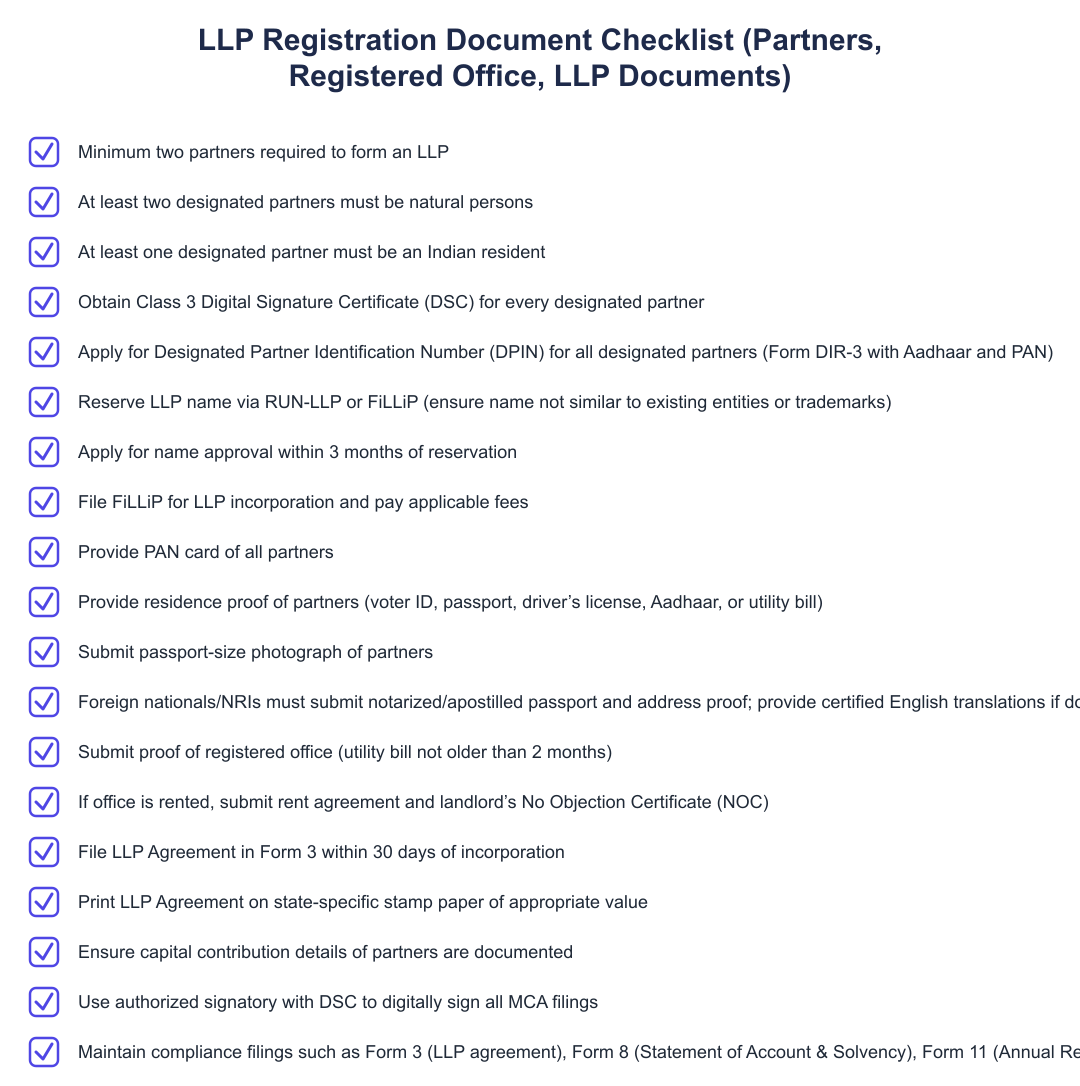
Before filing, ensure you have at least two partners and that the designated partners are natural persons with DPINs; at least one designated partner must be an Indian resident. DSCs will be needed for signing submissions on the MCA portal.
Decide and reserve a unique LLP name that does not resemble existing firm names or trademarks, prepare the capital contribution details and the LLP agreement, and assemble registered office proof (rent agreement and landlord NOC if applicable, plus a recent utility bill). Finally, plan to file Form 3 for the LLP agreement within 30 days of incorporation and use stamp paper as per the state requirement for printing the agreement.
An LLP offers a regulated structure that requires careful compliance with the LLP Act, 2008 and timely online filings on the MCA portal. Prepare identity and office documents, obtain DSCs and DPINs for designated partners, reserve a compliant name, incorporate via FiLLiP, and file the LLP agreement (Form 3) within 30 days on appropriate stamp paper. Using the checklist and form list above will help you complete incorporation without missing statutory requirements.
Frequently asked questions
What is a Limited Liability Partnership (LLP) in India?
A Limited Liability Partnership (LLP) in India is a separate legal entity that combines features of a partnership and a company, where partners have limited liability up to their agreed contribution. The LLP is governed by the LLP Act, 2008 and requires at least two partners, with no upper limit on number of partners, and at least two designated partners who are natural persons (one of whom must be an Indian resident). LLPs have perpetual succession and flexible internal management, and partners are protected from personal liability for the LLP’s debts beyond their contribution. Unlike companies, LLPs have lower compliance and no minimum capital requirement but must follow specified registration and filing procedures with the MCA.
What are the main advantages of registering an LLP in India?
The main advantages of registering an LLP in India are limited liability for partners, separate legal entity status, lower compliance compared to companies, and no minimum capital requirement. Partners’ personal assets are protected because their liability is limited to their agreed contribution, and the LLP continues to exist through perpetual succession. Compliance and incorporation costs are generally lower than for a company, making LLPs suitable for small and medium-sized professional and family businesses. However, LLPs may face challenges raising external capital compared to companies.
What are the disadvantages and risks of forming an LLP?
Disadvantages of forming an LLP include penalties for non-compliance, potentially complex winding up and dissolution procedures, and difficulty raising external capital compared to companies. LLP partners are directly responsible for complying with the LLP Act, 2008 and failure to file statutory forms (like Form 8 or Form 11) can attract penalties and late fees. Winding up an LLP follows legal processes that may be time-consuming, and investors often prefer company structures for equity funding, limiting capital-raising options. For professional practices or closely-held businesses where fundraising is not a priority, LLPs remain a practical choice despite these limitations.
What are the step-by-step stages to register an LLP in India?
To register an LLP in India you must obtain DSCs for designated partners, apply for DPINs (if needed), reserve the LLP name, file the incorporation form (FiLLiP), and then submit the LLP agreement in Form 3 within 30 days of incorporation. Begin by getting Class 3 Digital Signature Certificates because all MCA filings are digital; apply for DPINs using Form DIR-3 with ID proofs; reserve a unique name using RUN-LLP or through FiLLiP and incorporate by filing FiLLiP with requisite fees. After incorporation, the LLP agreement must be printed on state-specific stamp paper and filed online in Form 3 within 30 days to complete the registration formalities. You must also submit proof of registered office and partner documents as part of the process.
What documents do partners need to provide for LLP registration?
Partners need to submit identity proof (PAN card), residential proof (Aadhaar, voter ID, passport, driver’s license or utility bill not older than 2 months), passport-size photograph, and passport for foreign nationals or NRIs (notarized or apostilled). Name and details on PAN and residence proof must match exactly; foreign nationals must also provide notarized/apostilled translations if documents are not in English and additional address proofs like bank statements or residence cards. Designated partners must also obtain Digital Signature Certificates and DPINs, and any application signed by a professional (CS/CA/CMA) must attach their certificate as required. The LLP will also need proof of registered office (utility bill, rent agreement and landlord NOC if rented) and the LLP agreement on stamp paper.
What forms are used during LLP registration and annual compliance?
Key forms for LLP registration and compliance include FiLLiP for incorporation, RUN-LLP for name reservation, Form 3 for filing the LLP agreement, Form 8 for Statement of Account and Solvency, Form 11 for the Annual Return, and Form 24 for striking off the LLP’s name. FiLLiP is the integrated incorporation form that can also request DPINs and name reservation; Form 3 must be filed within 30 days of incorporation to submit the LLP agreement on stamp paper. Annual compliance requires Form 11 (annual return) and Form 8 (statement of accounts and solvency), failure to file which leads to penalties under the LLP Act. Use the MCA portal to submit all these digital forms and pay fees as per the prescribed schedule.
How long is a reserved LLP name valid and how soon must I incorporate after name approval?
A reserved LLP name is valid for 3 months from the date of approval and you must apply for LLP incorporation within that 3-month period. RUN-LLP or FiLLiP can be used to reserve the name, and the registrar will approve the name only if it is not undesirable and does not resemble existing entities or trademarks. The system allows two proposed names, and you can resubmit the form within 15 days to rectify defects if the initial submission has issues. If you fail to incorporate within 3 months, you will need to reapply for name reservation.
What are the timelines and stamp requirements for the LLP agreement?
The LLP agreement must be printed on stamp paper (value varies by state) and filed in Form 3 within 30 days of the date of incorporation of the LLP. Stamp duty on the LLP agreement is governed by the state-specific stamp laws, so the required value of stamp paper differs across states and must be checked before printing. Form 3 must be submitted online on the MCA portal within the 30-day window; failing to file Form 3 timely can attract penalties and may affect the enforceability of internal rights among partners. Keep a duly executed signed copy of the agreement and ensure it reflects capital contributions and rights of designated partners for compliance and opening bank accounts.
What is the checklist of essentials I must have before filing for LLP registration?
Before filing for LLP registration you must have at least two partners, DSCs for all designated partners, DPINs (or DINs if applying), a unique approved LLP name, details of capital contribution, an LLP agreement, and proof of the registered office. Also ensure partner identity and address proofs (PAN, Aadhaar or other acceptable documents), passport and legalized documents for foreign partners, and landlord NOC plus utility bill if the registered office is rented. Make sure to obtain Class 3 DSCs, reserve the name on MCA or via FiLLiP, and prepare the LLP agreement on state-specific stamp paper so Form 3 can be filed within 30 days of incorporation. Finally, be ready to pay the prescribed fees and maintain timelines to avoid penalties for delayed compliance.
Need help staying Company Registration compliant?
MoneyGence's AI Finance OS tracks your compliance, wallet share, and finances in one place, built for agencies and growing businesses.
Get started with MoneyGence