Margin Scheme under GST: Second-hand Goods Valuation Guide
This guide explains the margin scheme under GST in clear, practical terms, helping traders and tax professionals understand when and how the scheme can apply to transactions in second‑hand goods or goods that have undergone only minor processing. You will learn a conceptual definition of the margin scheme, how supply and valuation are treated under it, the kinds of conditions that typically need to be satisfied to opt for the scheme, and how to construct a simple illustrative example to see the mechanics in action. The margin scheme often changes the way taxable value is determined by focusing on the difference between purchase and sale, the margin, rather than the full selling price. That difference can have practical implications for pricing, recordkeeping and entitlement to input tax credit. Understanding these implications helps businesses decide whether electing the margin treatment is appropriate for particular transactions and prepares them to maintain the documentation and accounting entries that support the chosen valuation approach.
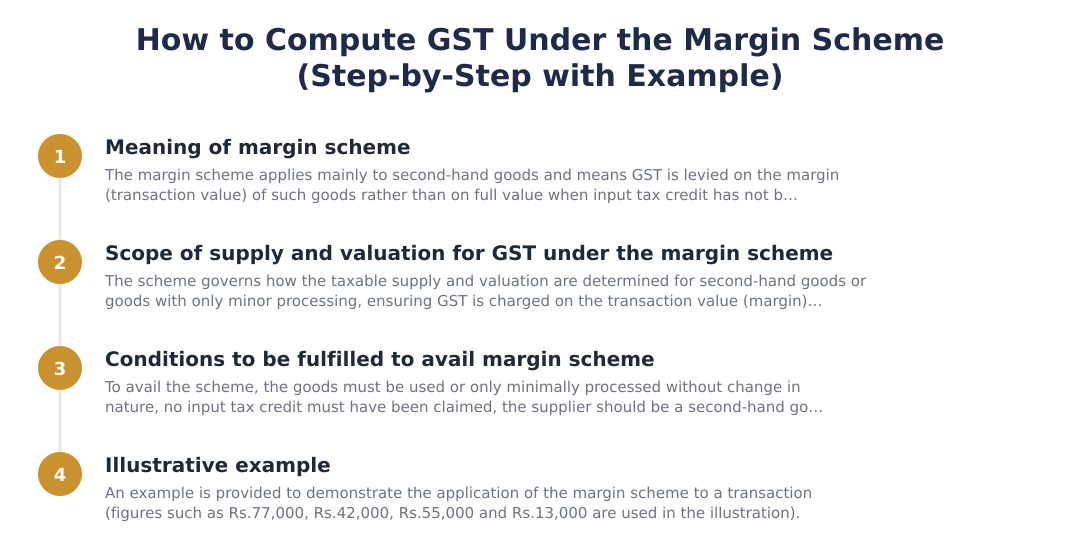
Meaning of margin scheme
Conceptually, a margin scheme is an alternative method of valuing a supply where tax is computed on the seller’s margin (the excess of the selling consideration over the acquisition cost) instead of on the full selling price. The scheme is commonly discussed in relation to second‑hand goods and goods that have undergone only limited processing, because these transactions often involve suppliers who have not claimed input tax credit on the goods they sell.
Adopting a margin‑based valuation changes the emphasis from the entire sale value to the profit component that has arisen in the hands of the seller. From a practical perspective, this can simplify tax calculation in cases where the underlying purchases did not attract or claim input tax benefits, and it can affect competitive pricing, margins and compliance obligations.
Scope of supply and valuation for GST under the margin scheme
When considering whether a particular transaction falls within the scope of a margin scheme, the essential question is whether the law or scheme permits valuation based on margin for that category of goods. This involves assessing both the type of goods being sold and the nature of any processing they have undergone. Transactions that are eligible for margin valuation typically require that the value be arrived at using a comparison between acquisition cost and sale consideration rather than applying tax to the gross selling price.
Practically, businesses should evaluate how adopting margin valuation affects their invoicing, accounting and tax filings. The chosen valuation method must be consistently applied and adequately documented so that, if queried by tax authorities, the taxpayer can demonstrate how the margin was computed and why it was the appropriate basis for determining the taxable value.
Conditions to be fulfilled to avail margin scheme
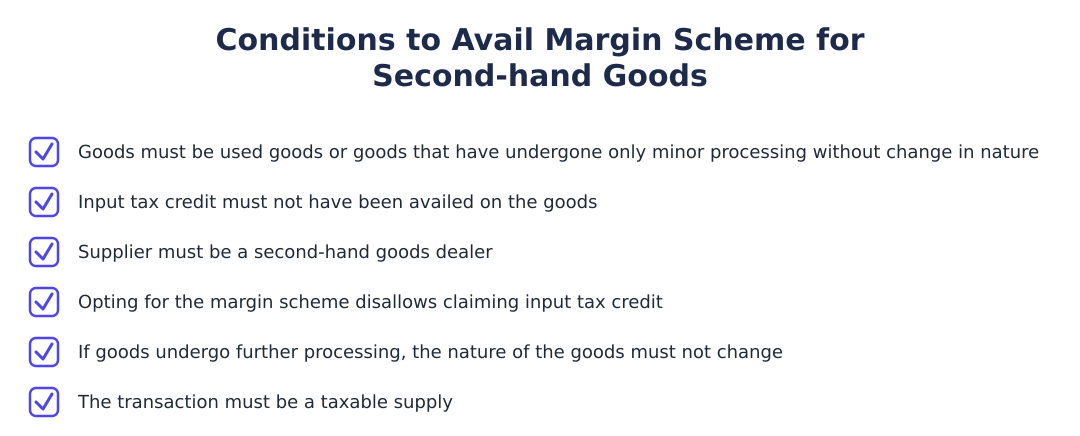
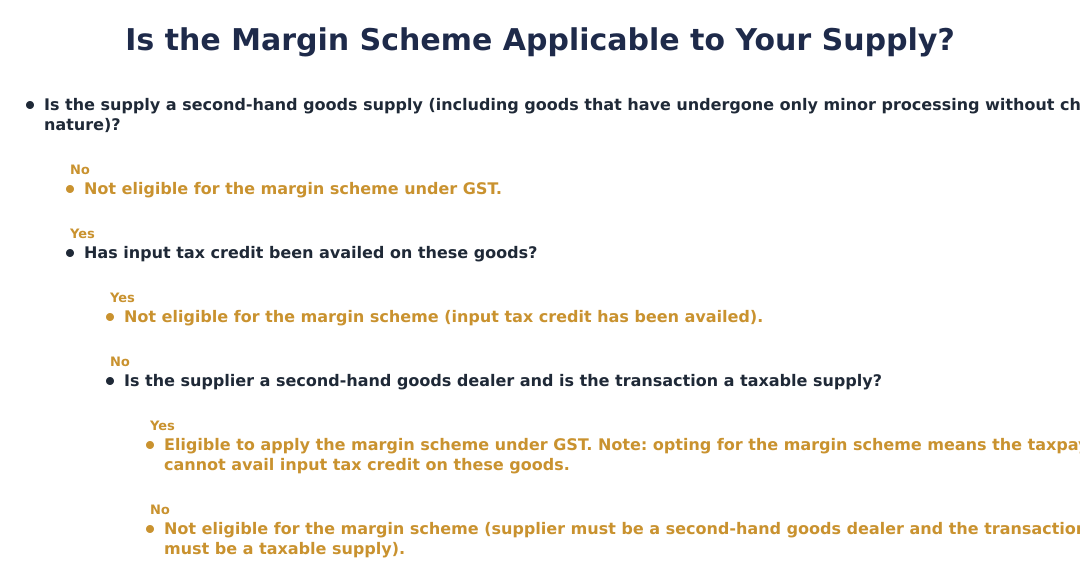
Generally, rules that permit margin valuation include eligibility conditions relating to the nature of the goods, the supplier’s status and the tax treatment of prior acquisitions. Businesses should consider whether the goods are second‑hand or only minimally processed, whether any input tax credit was claimed on their acquisition, and whether the supplier meets any status requirements set out in the applicable provisions. Meeting these conditions is usually necessary before a taxpayer can elect to use the margin approach.
From a compliance viewpoint, opting for margin valuation usually entails trade‑offs that should be carefully considered. For example, choosing margin valuation may affect a taxpayer’s ability to claim input tax credit on such supplies, and there may be recordkeeping and reporting implications. It is important to maintain clear purchase records, sales invoices showing how the margin was computed, and any other documentation that supports eligibility to use the margin scheme.
Illustrative example
An instructive way to understand margin valuation is to set up a simple ledger example that lists the acquisition cost of the goods, the sale consideration, and the resulting margin. Instead of applying tax to the entire sale consideration, the calculation focuses on the margin figure, the difference between sale and purchase, and determines tax liability accordingly. Constructing the example in this way highlights how much of the sale price represents prior value and how much is newly added by the seller.
When building such an example for internal use or training, ensure that each number is supported by source documents: purchase invoices for the acquisition cost and sales invoices showing the selling price. Use the example to test recordkeeping procedures and to ensure that your accounting systems can produce the information necessary to apply margin valuation consistently across similar transactions.
Margin valuation is a valuation option that can materially affect tax liability and compliance processes for transactions in second‑hand or minimally processed goods. Businesses considering this approach should assess eligibility carefully, maintain robust documentation, and run illustrative examples through their accounting systems to ensure consistent application. When in doubt, seek professional advice tailored to the specific facts and the applicable law.
Frequently asked questions
What is the margin scheme under GST in simple terms?
The margin scheme under GST is a valuation method where GST is charged on the seller’s margin (the difference between the selling price and the purchase price) rather than the full transaction value for certain second‑hand goods. It is mainly applicable to second‑hand goods or goods that have undergone only minor processing that does not change their nature, and it requires that input tax credit (ITC) was not availed on those goods when originally purchased. The scheme is intended to avoid double taxation on used goods and is available only when the supply is taxable and the dealer has opted to apply the margin scheme. If a taxpayer opts for the margin scheme they cannot claim ITC on that supply, and the supplier should be a second‑hand goods dealer to use this provision.
How is GST calculated under the margin scheme?
GST under the margin scheme is calculated on the margin, which is the selling price minus the purchase price of the second‑hand goods. For example, if a dealer buys a used item for Rs. 20,000 and sells it for Rs. 30,000, GST is applied only on the Rs. 10,000 margin (not on the full Rs. 30,000), subject to the applicable GST rate. The scheme applies only when no input tax credit was availed on the goods and the goods have not undergone processing that changes their nature. Once a taxpayer opts to use the margin scheme for that supply, they cannot claim ITC for that transaction.
Which goods are eligible for the margin scheme under GST?
Goods eligible for the margin scheme are second‑hand goods or goods that have undergone only minor processing where the processing has not changed the nature of the goods. Additionally, the goods must be ones on which input tax credit was not availed at the time of original purchase. The supply must be a taxable supply and the supplier is typically a second‑hand goods dealer who opts to apply the margin scheme. If the goods have been substantially processed such that their nature changes, they do not qualify for the margin scheme.
What conditions must be met to use the margin scheme under GST?
To use the margin scheme under GST the goods must be used or only slightly processed without a change in nature, input tax credit must not have been availed on those goods, the supplier should be a second‑hand goods dealer, and the supply must be a taxable supply. Also, once a dealer opts for the margin scheme for a supply they forfeit the right to claim input tax credit related to that supply. These conditions ensure the margin scheme is used only to prevent double taxation on used goods and not to circumvent ITC rules.
Who can opt for the margin scheme, the seller or the buyer?
The supplier (seller) of the second‑hand goods is the one who opts to apply the margin scheme under GST. When the supplier elects the margin scheme, GST is calculated on the margin and the supplier cannot claim input tax credit for that supply. The buyer does not opt for the scheme; they simply receive the goods with GST charged on the margin by the supplier. The option must be chosen for the taxable supply of eligible second‑hand goods and should comply with documentation requirements.
If input tax credit was taken on a used good earlier, can I still use the margin scheme?
No, you cannot use the margin scheme if input tax credit was availed on the goods earlier; one of the core conditions for the margin scheme is that ITC must not have been claimed on those goods. The margin scheme is expressly intended for goods where no GST credit was taken to avoid double taxation on second‑hand supplies. If ITC was claimed earlier, the taxable value must be the full transaction value and normal valuation rules apply. Therefore dealers should verify past ITC status before applying the margin scheme.
Does applying the margin scheme affect my ability to claim input tax credit?
Yes, opting for the margin scheme disqualifies you from claiming input tax credit on that supply. When a supplier chooses the margin scheme for eligible second‑hand goods, GST is charged on the margin and any associated ITC for those goods cannot be claimed. This is a trade‑off designed to prevent double taxation: you pay GST only on the margin but you surrender the ability to recover GST through ITC. Make sure to evaluate which approach (full valuation with ITC or margin scheme without ITC) is tax‑efficient before opting.
Can goods that are further processed after purchase still be covered under the margin scheme?
Goods that undergo further processing can still be covered under the margin scheme only if the processing does not change the nature of the goods; substantial change in nature disqualifies them. Minor processing that leaves the essential character of the goods intact is permitted under the scheme, but any processing that transforms the goods into a different kind of product will make them ineligible. The supplier must ensure that the processed goods still meet the definition of second‑hand or minorly processed goods and that no ITC was availed, otherwise normal valuation rules apply.
Can you give an illustrative example of how the margin scheme works?
Yes, for example, if a second‑hand goods dealer purchases a used machine for Rs. 50,000 (no ITC availed) and later sells it for Rs. 70,000, GST under the margin scheme is levied on the Rs. 20,000 margin (Rs. 70,000 – Rs. 50,000) at the applicable GST rate. The dealer cannot claim input tax credit for this supply because they elected the margin scheme, and the supply must be taxable for the scheme to apply. This approach reduces the tax base compared with charging GST on the full Rs. 70,000 sale price and prevents double taxation on the same goods.
Need help staying GST compliant?
MoneyGence's AI Finance OS tracks your compliance, wallet share, and finances in one place, built for agencies and growing businesses.
Get started with MoneyGence