MGT-7 annual return: Overview, Due Date, Format & Penalties
This guide explains the essentials of e-Form MGT-7, the statutory annual return form that companies registered in India must file. You will learn who is required to file MGT-7, the broad purpose of the form, what to expect in its format, and practical considerations for compliance. Although this guide does not list procedural timelines or penalties, it focuses on why the annual return matters operationally: it is a primary public record of a company’s statutory information and corporate governance position, and timely, accurate filing supports regulatory compliance, shareholder transparency and corporate record-keeping. Whether you are a director, company secretary, CFO or an advisor preparing annual compliance, this guide will help you understand the role of MGT-7 in the company’s statutory cycle and the practical steps to prepare for filing. The content is distilled to clarify obligations and the function of the form so you can plan internal workstreams, gather necessary information and coordinate with professional advisers for submission.
Who has to file the form?
Under the statutory scheme for corporate filings, every company that is registered in India has an annual return obligation. Practically, this means the requirement to file the e-Form MGT-7 applies across the board to companies incorporated in India, without distinction between public or private status.
This universal applicability places the responsibility on company directors and their compliance teams to ensure the annual return is prepared and filed. For companies of any size, understanding this baseline obligation is the first step in building an annual compliance calendar and allocating tasks, gathering records, obtaining board sign-offs and coordinating with a professional (such as a company secretary or practicing professional) to complete and submit the form.
What is the purpose of the e-Form MGT-7?
The primary purpose of e-Form MGT-7 is to serve as the company’s annual return, a structured, statutory declaration about the company’s position for the previous financial year. Filing the annual return enables regulators, members and other stakeholders to have an up-to-date, consolidated record of the company’s statutory details.
From a practical standpoint, preparing the annual return encourages companies to review corporate records and confirm that registers, board and shareholder information, and other statutory disclosures are current and consistent. Accurate completion of the annual return supports corporate governance, helps maintain transparency with shareholders, and forms part of the compliance trail that auditors and advisors rely upon during statutory reviews.
Format
MGT-7 is an electronic form used to capture a company’s annual return information in a prescribed structure. While the specific fields and layout are determined by the filing system, the form functions as a standardised template so that returns across companies are comparable and machine-readable for regulatory processing.
When preparing the form, companies should ensure that the data entered reflects their statutory records. Cross-checking information with board resolutions, statutory registers and accounts (where applicable) reduces the risk of discrepancies and follow-up queries from regulators or stakeholders.
Practical steps to prepare for filing
Assign internal owners such as directors, company secretary or compliance officer to coordinate collection of records and oversee the filing process.
Collect corporate registers, board and shareholder information, and any documents required to support the entries in the annual return.
Cross-check information against statutory registers and prior filings to ensure consistency and accuracy before submission.
Engage a professional (company secretary, practicing professional, or authorised representative) to finalise the form and complete the electronic filing.
Consequences and compliance considerations
Filing the annual return is a routine statutory obligation. From a governance perspective, regular filing demonstrates that the company maintains its corporate records and meets its disclosure responsibilities to members and regulators. Non-compliance can lead to administrative follow-ups and may complicate other statutory processes that depend on up-to-date filings.
Because the annual return is an official record, companies should adopt internal controls, such as checklists, review sign-offs and retention of supporting documents, to minimise errors. Timely engagement with professional advisers helps resolve any ambiguities and ensures that the company’s statutory position is accurately reflected in the return.
In summary, e-Form MGT-7 is the statutory vehicle for a company’s annual return and must be filed by all companies registered in India. Treating the annual return as a compliance milestone, backed by systematic record-keeping and adviser coordination, will help ensure accurate submissions and support the company’s broader governance and transparency objectives. For specific procedural questions, timelines or penalties, consult the official regulatory authority or a qualified professional.
Frequently asked questions
Who has to file Form MGT-7 every year in India?
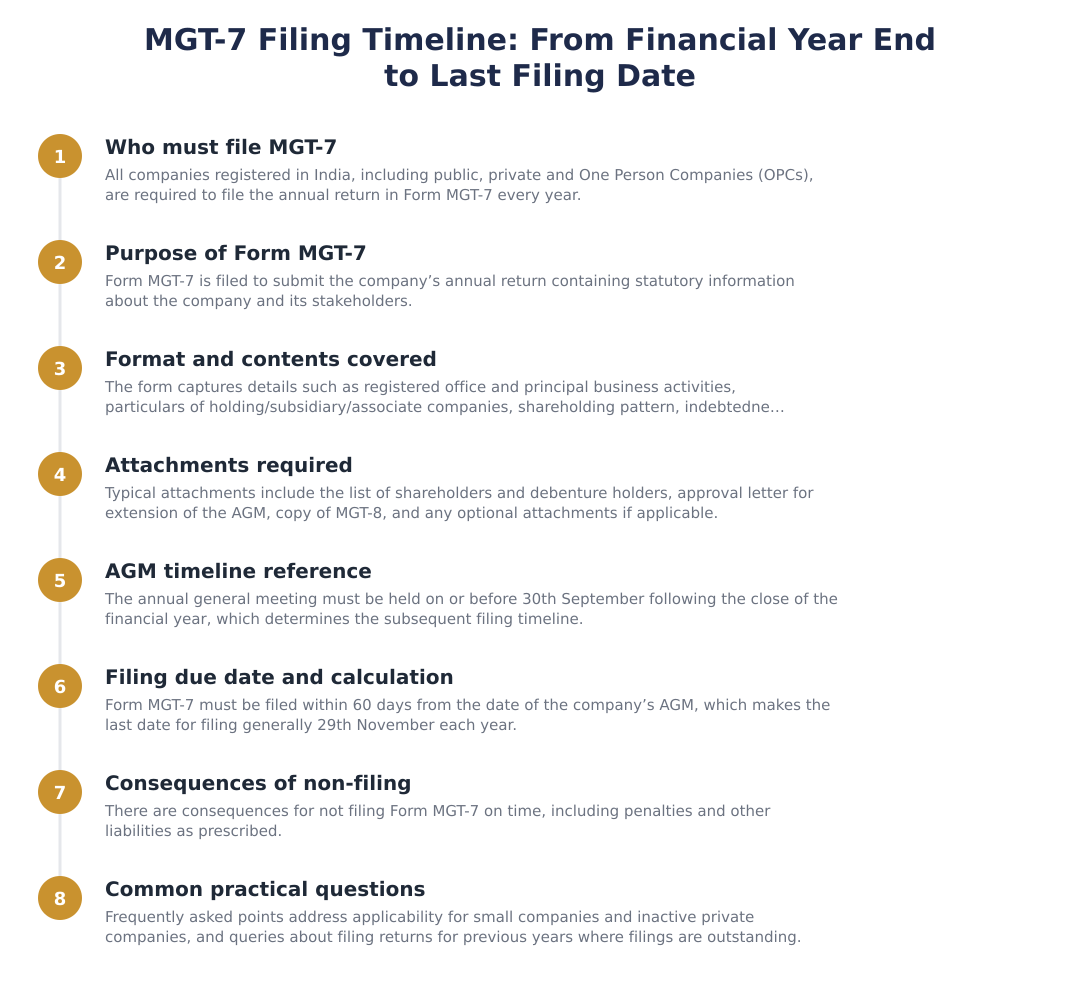
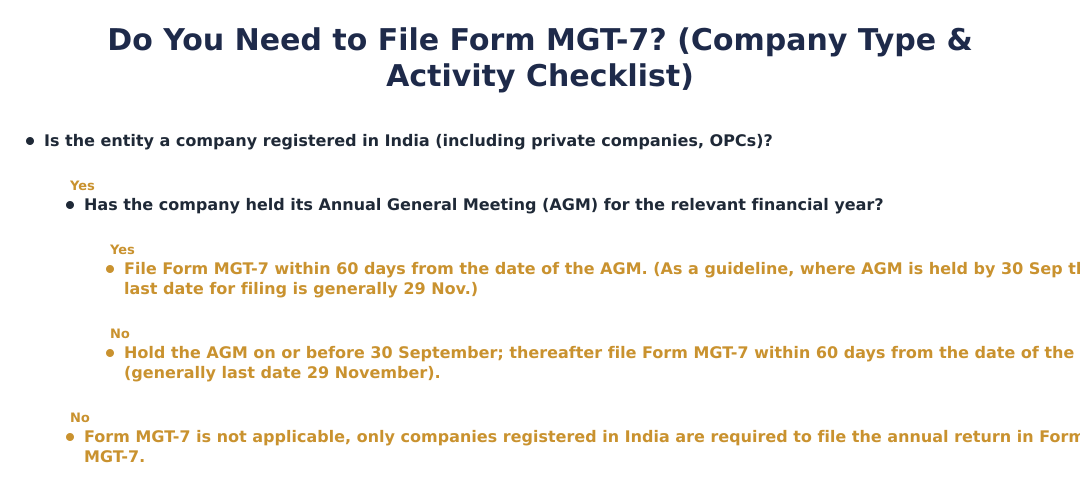
All companies registered in India, public, private and One Person Companies (OPCs), must file Form MGT-7 every year. This requirement applies to every company regardless of turnover or whether it is carrying on business, with OPCs specifically made mandatory to file after the Finance Act, 2021. The form captures the annual return particulars as on the close of the financial year and is filed with the Registrar of Companies electronically. Failure to file attracts penalties under the Companies Act, so even dormant or non-operational companies should comply.
What is the purpose of the e-Form MGT-7?
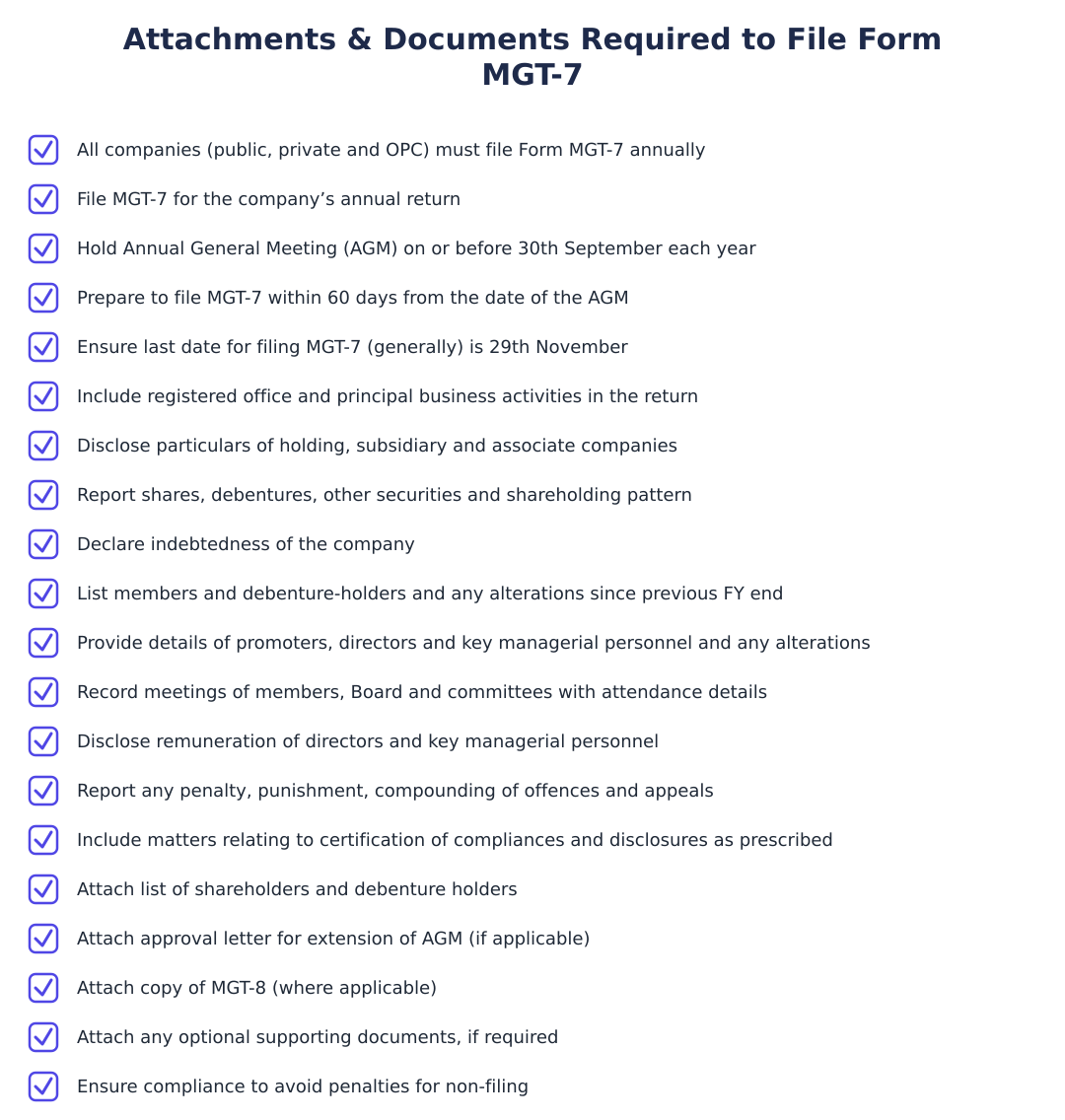
The purpose of e-Form MGT-7 is to file the company’s annual return containing the particulars of the company as they stood at the close of the financial year. It records the registered office, principal business activities, details of holding/subsidiary/associate companies, share capital and shareholding pattern, indebtedness, changes in members, promoters, directors and key managerial personnel, meetings and attendance, and remuneration and penalties, among other prescribed matters. The form creates an official yearly snapshot for public record and regulatory compliance with the Companies Act, 2013. Accurate and timely filing ensures transparency of corporate structure and ownership and avoids statutory penalties.
What is the due date for filing Form MGT-7?
Form MGT-7 must be filed within 60 days from the date of the company’s Annual General Meeting (AGM). Since the AGM must be held on or before 30th September following the end of the financial year, the practical last date for filing MGT-7 is generally 29th November each year. For example, for the financial year ending 31st March, the AGM should be by 30th September and MGT-7 filed by 29th November. If the AGM is held earlier, the 60-day filing clock runs from that AGM date, so companies holding an early AGM must still file within 60 days of that date.
What attachments are required when filing Form MGT-7?
When filing Form MGT-7, companies must attach supporting documents such as the list of shareholders and debenture-holders, the approval letter for any extension of the AGM (if applicable), and a copy of MGT-8 (certificate of compliance), along with any optional attachments if applicable. These attachments are uploaded as scanned copies in the attachments section of the electronic form to substantiate the annual return details. The precise set of documents depends on the specific disclosures in the form, for example, an extension approval is only required if AGM was extended. Keeping these documents ready helps ensure a smooth and complete e-filing.
What are the consequences or penalties for not filing Form MGT-7 on time?
Failure to file Form MGT-7 on time attracts a penalty of Rs. 100 per day of default under the Companies Act, with this increased rate applicable since 2018. The penalty accumulates from the date of default until the form is filed, which can lead to significant liability over time, and non-compliance may also invite prosecution or additional regulatory scrutiny. Timely filing within the 60-day window after the AGM is therefore important to minimize cost and legal exposure. Companies should file as soon as possible if they miss the deadline to stop ongoing daily penalties.
What is the format or structure of Form MGT-7?
Form MGT-7 is an electronic annual return format that captures company particulars as of the financial year-end in structured sections covering registered office and business activities, holding/subsidiary/associate details, share capital and shareholding pattern, indebtedness, members and debenture-holders, promoters, directors and key managerial personnel changes, meetings and attendance, remuneration, penalties and certifications. The e-form requires specific declarations and prescribed fields to be completed and allows attachments for supporting documents like lists of shareholders and MGT-8. The standardised format ensures the Registrar of Companies receives uniform, comparable annual data across companies. Companies must file the form online through the MCA portal using authorised signatories and digital signatures where required.
If my company is small, do we still have to file Form MGT-7?
Yes, small companies registered in India are still required to file Form MGT-7 annually. The statutory obligation to prepare and file the annual return in MGT-7 applies to all companies irrespective of their size, turnover or profit status. The small company must therefore furnish the same set of particulars and attachments as applicable and file within 60 days of the AGM to avoid penalties. Certain disclosure exemptions that apply to small companies in other filings do not remove the MGT-7 filing requirement under the Companies Act, 2013 unless specifically exempted by law.
If my private limited company has been inactive for years, do we still need to file MGT-7?
Yes, even if a private limited company is dormant or has not carried on any business for years, it is still required to file the annual return in Form MGT-7. The filing obligation is on the company’s legal status (registered in India), not on business activity, and non-filing will attract the daily penalty of Rs. 100 per day. If a company intends to remain inactive long-term, it should consider striking off or applying for dormant company status where eligible, but until such formal steps are completed, annual returns must be filed. Continuing to file keeps the company compliant and avoids increasing statutory liabilities.
My company missed filing MGT-7 for the last two years, can we file for both years now?
Yes, a company can file belated MGT-7 returns for past years, but each delayed filing will attract a penalty of Rs. 100 per day of default for each year until the form is filed. You should prepare separate MGT-7 filings for each financial year missed and attach the relevant supporting documents and certifications for those years; the Registrar accepts belated filings though penalties and possible scrutiny apply. Prompt filing of all outstanding annual returns is advisable to stop further penalty accrual and to reduce the risk of prosecution or additional compliance action. Consider consulting a company secretary or professional to ensure correct retroactive disclosures and calculation of penalties before filing.
Need help staying Compliance compliant?
MoneyGence's AI Finance OS tracks your compliance, wallet share, and finances in one place, built for agencies and growing businesses.
Get started with MoneyGence