Mutual Fund Taxation India: How Mutual Funds Are Taxed
This guide explains how mutual funds are taxed in India in straightforward, practical language. You will learn the different kinds of taxable income that arise from mutual fund investing (capital gains and dividends), what influences which tax rules apply, how taxation differs for resident and non-resident investors, and what to watch for when you redeem units or receive distributions. The guide also highlights a government change referenced from April 1, 2023 and explains an important compliance option available to NRIs, the DTAA route, that can reduce double taxation. Understanding these points helps investors plan redemptions, choose the right mutual fund type for their goals, and prepare for tax filings so they don’t face surprises at year‑end. The information here focuses on concepts, practical implications, and the few verified legal touchpoints available, so you can make tax-aware decisions without getting lost in headline rates. If you are an NRI or plan systematic investments or withdrawals (SIP/SWP), the outline will help you identify the tax-sensitive moments in your mutual fund lifecycle and the documentation or relief mechanisms to consider.
What is the Tax on Mutual Funds?
Mutual fund taxation typically surrounds two principal kinds of investor income: capital gains (the profit when you sell fund units for more than you paid) and income distributed by the fund, commonly called dividends. Each stream is treated differently under the tax code and by tax administration practices.
In practice, investors need to determine whether a gain is short‑term or long‑term because different tax treatments and reporting rules apply to each. Dividends or distributions from mutual funds are treated as income when received and must be reported in your tax return. Beyond the headline classifications, other levies and collection mechanisms (for example, tax deducted at source or transaction taxes) may interact with the investor’s final tax liability.
What Factors Determine Tax on Mutual Funds?
Several practical factors determine how a given mutual fund investment will be taxed. The fund’s asset composition (equity, debt, gold, international holdings or hybrid mixes) influences which tax category applies. How long you hold the units before selling, the holding period, also matters because it typically decides whether gains are treated as short‑term or long‑term for tax purposes.
Other considerations include whether you are a resident or a non‑resident investor, whether any tax has already been deducted at source when you received proceeds, and whether you are eligible to use international tax treaties to reduce double taxation. It is also important to bear in mind that statutory updates can change the tax treatment for transactions executed after specific effective dates.
Ways to Earn Returns from Mutual Funds
Mutual funds generate returns in two main ways: appreciation in unit value (capital gains) and periodic or occasional distributions (dividends or income payouts). Capital gains accrue when you sell units at a price higher than your purchase cost; the timing of the sale relative to the purchase date determines whether a gain is treated under the short‑term or long‑term category.
Dividends or income distributions are paid out of the fund’s realised income and must be included in the recipient’s taxable income. Depending on investor circumstances, receiving distributions versus allowing the fund to reinvest them can have different tax consequences and cash‑flow implications.
NRI Mutual Fund Taxation in India (use of DTAA relief)
Non‑resident Indians (NRIs) investing in Indian mutual funds face potential taxation both in India and in their country of residence. To avoid or reduce double taxation, NRIs can rely on Double Taxation Avoidance Agreements (DTAAs) between India and their country of tax residency.
A practical route to claim relief under a DTAA is to obtain a valid Tax Residency Certificate (TRC) from the country of residence and present it when claiming treaty benefits. Using a TRC to claim treaty relief may lower or eliminate Indian tax on certain items of mutual fund income, depending on the treaty text and the investor’s personal circumstances.
Note that government changes affecting mutual fund taxation have an effective date referenced as April 1, 2023; investors and advisors should review which transactions fall on either side of any such effective date when assessing tax consequences and treaty interactions.
Taxation of Dividends and Transaction Levies
Dividend income from mutual funds is treated as part of the investor’s taxable income and should be reported accordingly. Depending on collection rules, tax may be deducted at source on certain distributions or redemptions before you receive proceeds; you can claim that deduction when you file your return.
Separately, transaction‑level levies (for example, market or securities transaction levies) and the headline tax rates quoted by authorities or advisers are typically reported exclusive of surcharge and cess. That means when you see a published rate, additional statutory surcharges or health and education cess may still apply and change the effective tax burden.
How NRIs Claim DTAA Relief (high level)
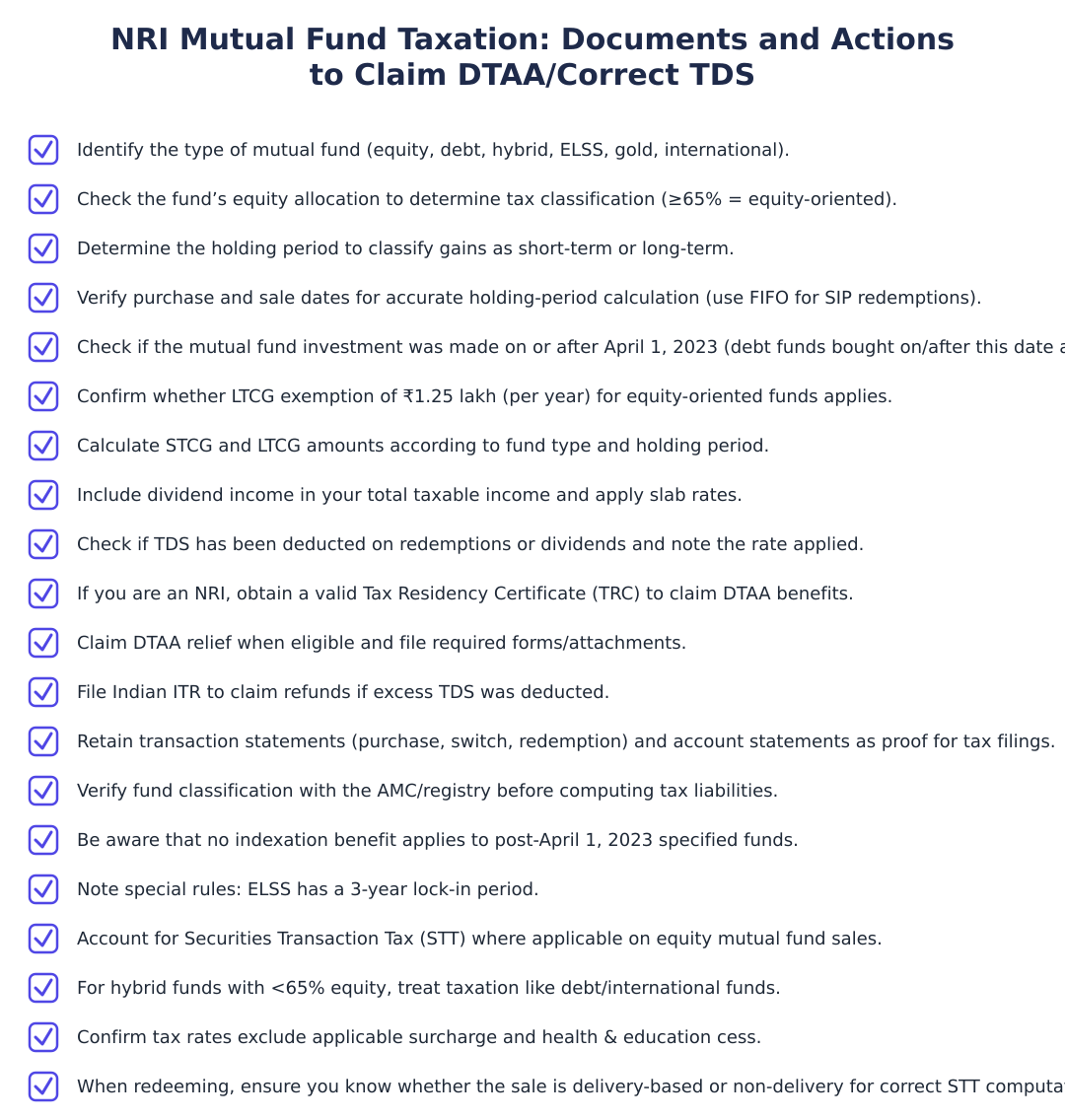
Secure a valid TRC from the tax authority of your country of residence to establish your status for treaty purposes.
Provide the TRC along with any required forms or declarations to the Indian payer or tax authority to invoke applicable DTAA provisions.
If tax is deducted at source at a higher rate than treaty‑based entitlement, file the Indian income tax return to claim a refund or correct the tax position.
Mutual fund taxation combines several moving parts: the nature of the fund, the holding period, residency status, and statutory updates with effective dates. NRIs have a clear compliance and relief pathway through DTAAs by using a valid Tax Residency Certificate, and all investors should remember that published rates are normally shown excluding surcharge and cess. For concrete tax planning and to understand the effect of any legislative changes around specified effective dates, consult a qualified tax advisor or chartered accountant who can apply the current law to your personal facts.
Frequently asked questions
How are equity mutual funds taxed in India?
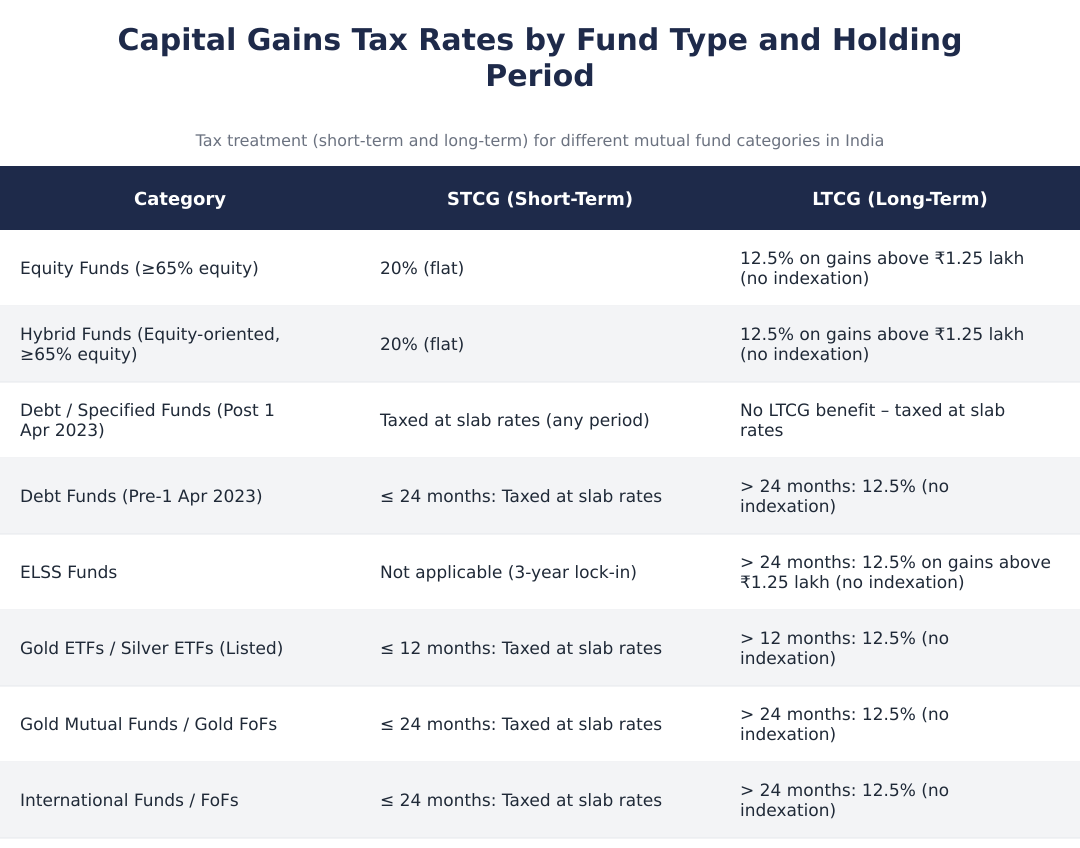
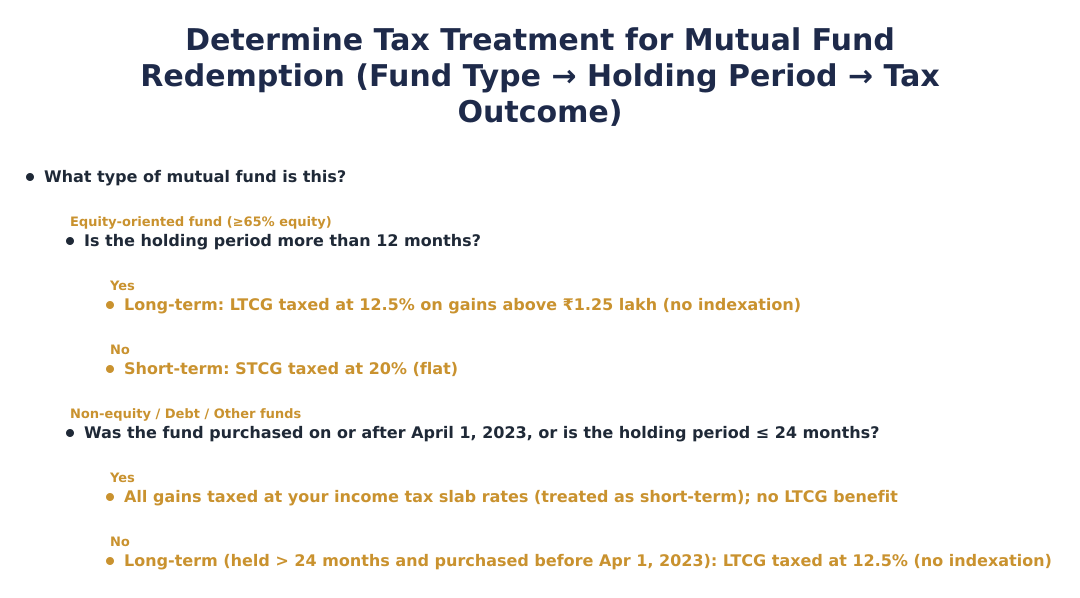
Equity mutual funds are taxed as capital gains: short-term gains (sold within 12 months) are taxed at a flat 20% and long-term gains (held over 12 months) are taxed at 12.5% on gains above ₹1.25 lakh in a financial year, with no indexation benefit. Short-term gains are treated as STCG and long-term gains as LTCG under Section 112A rules; the first ₹1.25 lakh of LTCG from equity-oriented funds in a year is tax-free. Securities Transaction Tax (STT) applies on the sale of listed equity mutual fund units (delivery-based) at 0.001% of the selling value. Note that hybrid funds that are equity-oriented (≥65% equity) follow the same equity taxation rules.
How are debt mutual funds taxed after April 1, 2023?
From April 1, 2023, gains from debt mutual funds purchased on or after that date are taxed entirely at the investor's income-tax slab rates, regardless of holding period (no long-term benefit). There is no indexation benefit for debt funds bought on or after April 1, 2023, so both short-term and long-term gains are taxed as regular income. Debt funds purchased before April 1, 2023 retain the older rules: gains held beyond 24 months were taxed as LTCG at 12.5% (no indexation) while gains within 24 months were taxed at slab rates. Confirm the purchase date and fund classification before computing tax.
Are dividends from mutual funds taxable and how are they taxed now?
Yes, dividend income from mutual funds is taxable in the investor's hands at their applicable income-tax slab rate and may be subject to TDS if applicable. Dividends are added to your total income for the year and taxed as per slab rates; previously dividends were tax-free in the hands of investors but that exemption has been removed. TDS is deducted by the fund house where applicable (for example on certain payments to NRIs or resident investors above thresholds), but you should report the full dividend in your ITR and claim credit for TDS.
What is Securities Transaction Tax (STT) on mutual fund redemptions?
Securities Transaction Tax (STT) applies on the sale of delivery-based equity mutual fund units at 0.001% of the selling value and is paid by the seller. Other non-delivery transactions (e.g., some non-delivery equity share/unit sales) attract higher STT rates like 0.025% as per transaction type; purchases of equity-oriented mutual fund units generally have no STT. STT paid is a statutory levy and forms part of your transaction costs, it does not substitute capital gains tax but is required to be considered when computing net proceeds.
How are SIP redemptions taxed, how does FIFO work for SIPs?
SIP units are taxed using FIFO (first-in, first-out): the earliest purchased units are treated as sold first, and capital gains are calculated based on those purchase dates. This means each SIP instalment's holding period determines whether the gain is short-term or long-term (for equity funds, ≤12 months is STCG, >12 months LTCG). When you redeem partially, the fund house will typically redeem units bought in the oldest tranche first, so plan redemptions if you want to capture LTCG benefits or manage tax liability. Always verify the actual allotment dates on your account statement when computing tax on SIP redemptions.
How is tax calculated for a Systematic Withdrawal Plan (SWP)?
Tax on SWP withdrawals is treated as capital gains based on the holding period and original purchase dates of the units withdrawn, usually following FIFO rules. For equity-oriented funds, each withdrawal may trigger STCG if units sold were held ≤12 months (taxed at 20%) or LTCG if >12 months (12.5% on gains above ₹1.25 lakh). For debt or non-equity funds, post-April 1, 2023 purchases will have gains taxed at slab rates irrespective of holding period; hence every SWP instalment can be fully taxable at slab rates for such units. Keep records of allotment dates and capital gains statements from the registrar to compute tax correctly for SWPs.
What are the tax rules for NRIs investing in Indian mutual funds?
NRIs are taxed on mutual fund gains in India similarly to residents but with TDS applied at source and the ability to claim DTAA benefits using a Tax Residency Certificate (TRC) where applicable. Equity-oriented mutual fund LTCG and STCG rules apply as for residents, but NRIs often face TDS on redemption/dividend payments which may be higher than actual tax liability, you can file an Indian ITR to claim refunds or apply DTAA lower rates if eligible. Ensure you provide correct KYC, PAN, and Form 10F/TRC to the fund house to avoid higher withholding under domestic rules, and check the relevant double taxation treaty between India and your country of residence.
Is indexation allowed for mutual fund capital gains?
No, indexation benefit is not allowed for any mutual funds under the current rules, so you cannot adjust cost for inflation when computing capital gains for mutual funds. Specifically, for equity and equity-oriented funds the LTCG rate is fixed at 12.5% on gains above ₹1.25 lakh with no indexation; debt funds purchased on or after April 1, 2023 are taxed at slab rates without indexation, and debt funds bought before that date had separate rules but still no indexation. Because indexation is unavailable, the effective tax burden can be higher for long-term holdings compared with other asset classes that allow indexation.
What are the key differences in tax treatment between equity, hybrid, and gold funds?
Tax treatment depends on whether the fund is equity-oriented (≥65% equity), hybrid with ≥65% equity, or non-equity (including certain gold funds): equity and equity-oriented hybrid funds follow equity tax rules (STCG 20% ≤12 months, LTCG 12.5% above ₹1.25 lakh >12 months); many gold and non-equity funds follow debt/commodity rules with shorter/longer holding periods and slab-rate taxation depending on the fund and purchase date. For listed gold ETFs, units held ≤12 months are taxed at slab rates and >12 months at 12.5% (no indexation), while gold mutual funds or FoFs typically use a 24-month threshold with similar 12.5% LTCG beyond that. Always confirm the fund classification (equity percentage and whether ETF/Mutual Fund) and the purchase date to determine applicable holding period and rates.
Need help staying Income Tax compliant?
MoneyGence's AI Finance OS tracks your compliance, wallet share, and finances in one place, built for agencies and growing businesses.
Get started with MoneyGence