New Income Tax Act 2025: Key Changes, What Stayed & Impact
This guide explains, in plain language, what to expect from the new Income Tax Act presented as a comprehensive rewrite of the existing law and what core elements are likely to remain the same. You will learn how the redrafted law aims to simplify compliance, where key concepts such as tax year, digital assets, and undisclosed income are being reframed for a contemporary economy, and how administrative tools like electronic access to data and dispute-resolution mechanisms are being reorganised. The guide is written for taxpayers, tax professionals, and business owners who want a practical sense of the scope of change, what will become easier, what will require new systems or controls, and how ordinary compliance and litigation pathways may be affected. Because this is a structural rewrite rather than an entirely new tax system, many familiar features of income taxation continue to guide how tax is assessed and collected. This article will help you separate headline reforms from enduring principles, consider the likely operational impact on different stakeholder groups, and identify practical next steps businesses and individuals can take to prepare. The goal is to give you an actionable overview you can use to prioritise compliance improvements, technology investments, and conversations with your tax advisor.
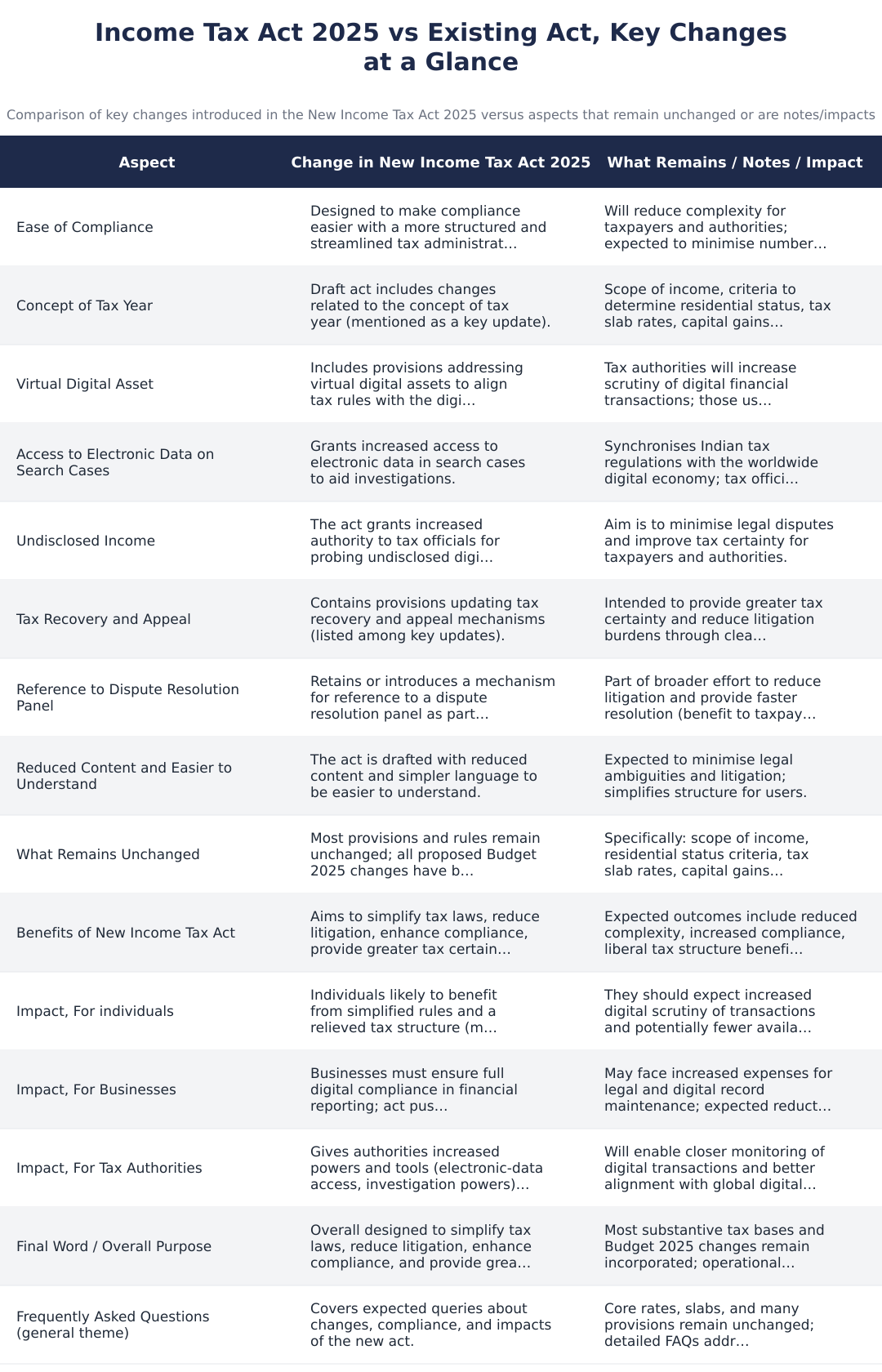
Key updates, comparing the new act with the current law
The new act is presented as a modernised, streamlined statute intended to reduce complexity in day-to-day tax compliance and administration. Revisions emphasise clearer structuring of provisions, consolidation of related rules, and removal of unnecessary procedural duplication. For taxpayers this usually means forms and reporting expectations are reorganised to match contemporary digital filing environments.
Alongside structural changes, the act refocuses attention on areas driven by the digital economy, for example, how digital transactions are reported and the mechanisms tax authorities may use to obtain electronic information. The rewrite also clarifies provisions that previously led to frequent interpretive disputes, with the aim of reducing litigation and speeding up resolution of cases.
Ease of compliance
One stated objective of the rewrite is to make compliance simpler for taxpayers without diluting enforcement capability. Simplification typically involves grouping related obligations, harmonising reporting timelines, and providing clearer guidance on how returns and withholding requirements must be completed. For businesses this reduces the time spent reconciling multiple, overlapping rules.
Practically, easier compliance often translates into more user-friendly filing interfaces, standardised data formats for electronic submissions, and consolidated sections that bring together previously scattered provisions. Taxpayers should anticipate changes to internal procedures and to the documentation they maintain so filings align with the reorganised legal text.
Concept of tax year and other foundational terms
Rewrites typically restate foundational definitions, such as the tax period concept, who counts as a resident for tax purposes, and what constitutes taxable income, to ensure they are coherent with the new structure. Even when definitions remain substantively similar, placing them together in the new act should make them easier to find and apply.
For practitioners, the immediate effect is improved navigability of the law. It becomes simpler to trace how a definition affects multiple provisions (for instance, how residence interacts with source rules), which reduces interpretive uncertainty when preparing returns or advising clients.
Virtual digital assets and electronic data access
The rewritten law addresses the treatment and reporting of digital assets and the increasing role of electronic information in tax administration. Modern tax statutes commonly create clearer pathways for treating new forms of value and for obtaining digital records that support audits and assessments.
At the same time, the act clarifies procedures surrounding access to electronic data in the context of investigations and searches. For taxpayers, this heightens the importance of robust digital recordkeeping and of understanding how electronic evidence may be used in examinations or disputes.
Undisclosed income, recovery and appeal mechanisms
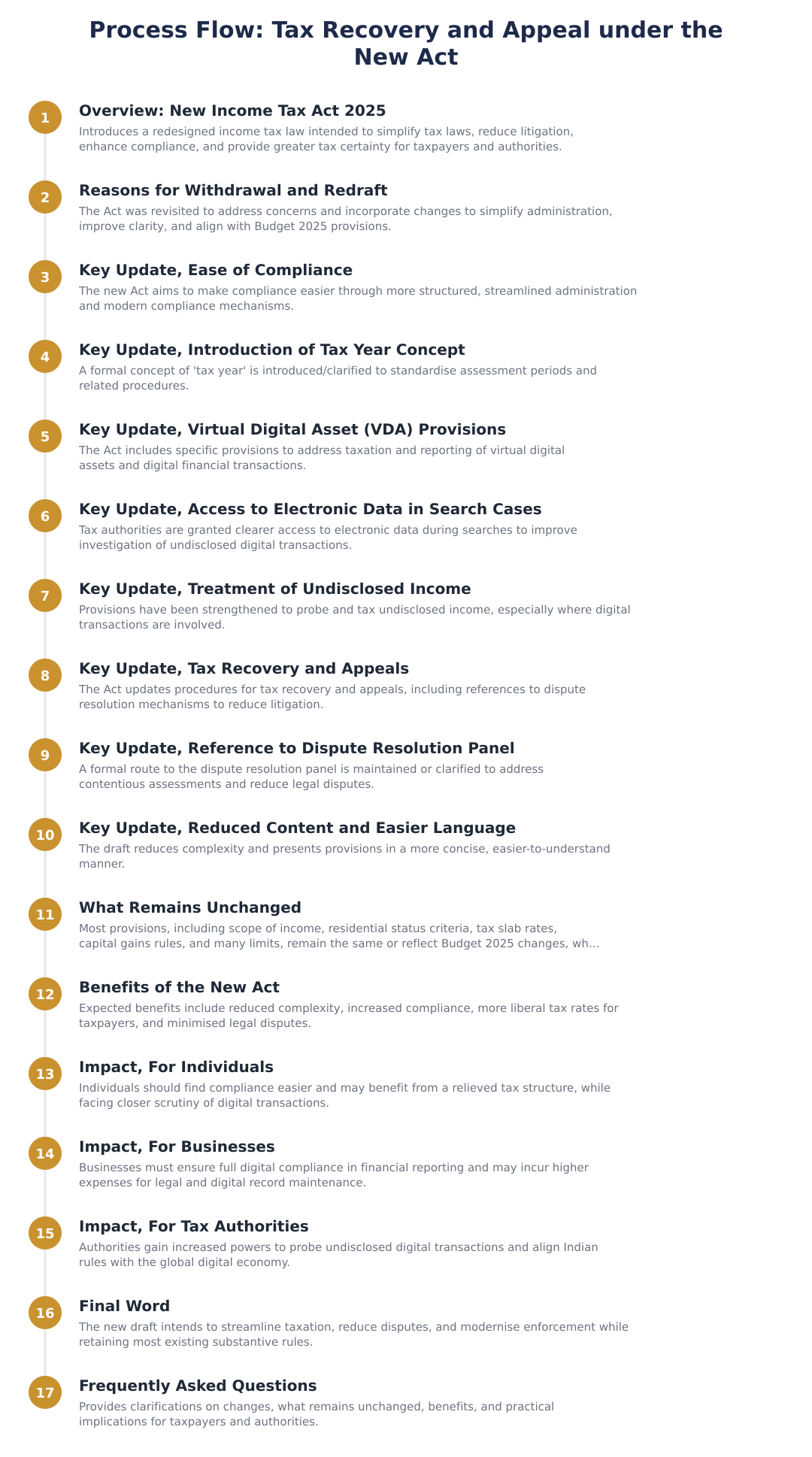
The new act revises the framework for dealing with undisclosed income and strengthens procedural clarity around recovery of disputed taxes, and the appeal process. By reorganising these provisions the statute aims to make timelines, taxpayer rights, and collector powers more transparent.
For taxpayers this means a recheck of compliance controls, particularly where underreporting risks can arise. For tax administrators it creates a clearer enforcement pathway that balances collection efficiency with procedural safeguards for taxpayers.
What remains unchanged
A substantial number of core concepts, substantive liabilities and long-standing principles of income taxation remain in force despite the rewrite. While the statute reorganises and clarifies text, many of the familiar rules that determine how income is computed and taxed, the basic filing responsibilities of taxpayers, and the overall compliance ecosystem continue to operate in a recognisable way.
This continuity means taxpayers can prioritise changes that affect process and reporting first, while relying on established tax planning and compliance frameworks until specific substantive changes are highlighted and implemented through rules and guidance.
Benefits of the new act
A clearer, more concise statute can reduce legal ambiguity and lower the frequency of disputes, which benefits both taxpayers and tax administrations. Simplified compliance reduces administrative burden and can free up resources for more productive business activities or for targeted enforcement by authorities.
From an administrative viewpoint, the reorganisation permits better alignment between law and modern digital filing and analytics systems. For taxpayers, the key benefit is predictability: clearer laws make planning and compliance less costly and less risky.
Impact, for individuals, businesses and tax authorities
Individuals should expect changes primarily in reporting formats and in how digital forms of income are disclosed. The rewrite emphasises transparency and electronic reporting, so personal tax compliance will increasingly be data-driven and automated.
Businesses will face the operational task of mapping existing reporting processes to the reorganised provisions. This can require updates to accounting systems, payroll processes, withholding regimes, and documentation controls to ensure filings reflect the new structure.
Tax authorities benefit from a law that better integrates with digital enforcement tools and clearer investigative procedures. That typically leads to more efficient case management, but it also means taxpayers may experience closer, faster scrutiny of digital transactions.
Practical next steps
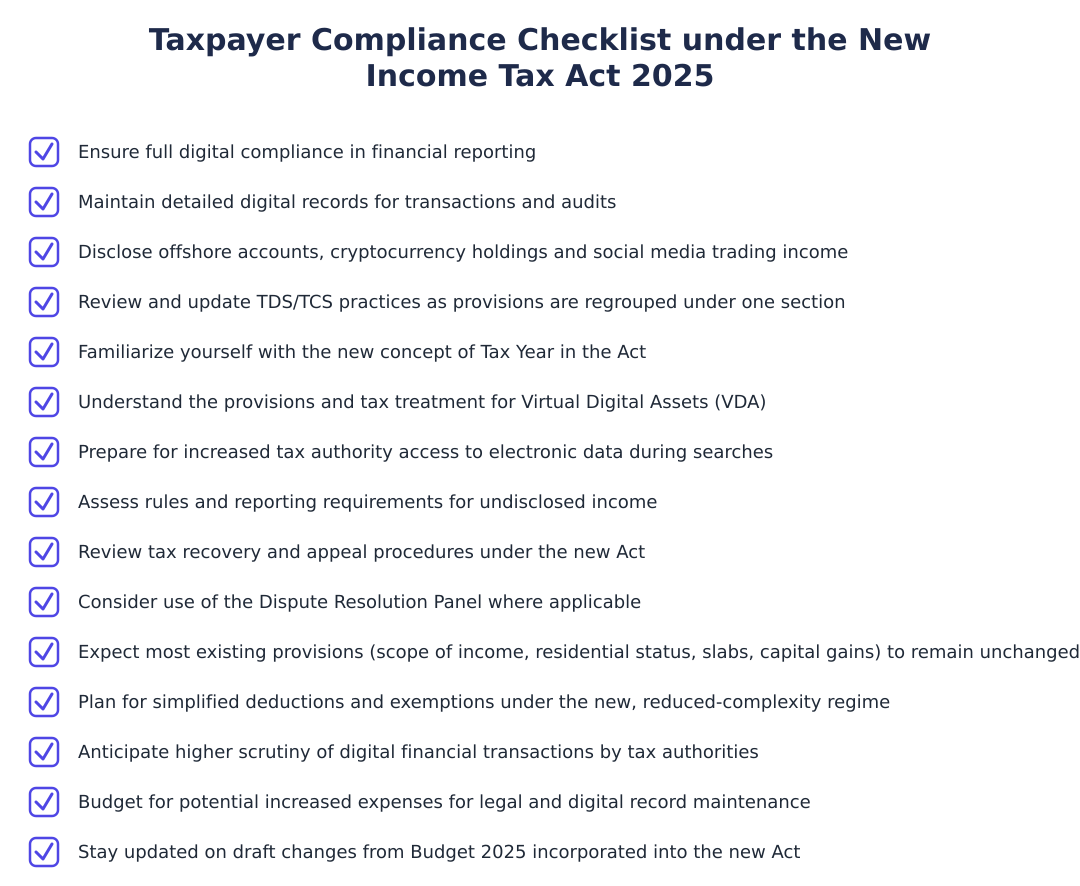
Review internal reporting and recordkeeping to ensure systems capture the data items emphasised by the new structure, especially electronic transaction records. Early alignment reduces the risk of last-minute fixes at filing time and supports smoother responses to queries from tax authorities.
Engage with your tax advisor to map existing compliance checklists to the revised statute. A focussed gap analysis will identify which processes need immediate change and which can continue under legacy procedures until detailed rules or guidance are issued.
The rewritten Income Tax Act aims to modernise and simplify tax law while preserving core principles of taxation. Taxpayers should prioritise aligning recordkeeping, digital reporting, and internal controls with the revised structure, and consult advisors to translate structural changes into practical compliance steps. As detailed rules and administrative guidance are issued, stakeholders can refine their processes further to take full advantage of the new framework.
Frequently asked questions
Why was the New Income Tax Act 2025 withdrawn and re-drafted?
The New Income Tax Act 2025 was withdrawn to address stakeholder concerns and improve clarity before final enactment. Key reasons included feedback on procedural gaps, the need to better balance taxpayer rights with enforcement powers, and requests to refine provisions around digital transactions and search-related data access. The government pulled the draft to rework ambiguous language, reduce potential litigation, and incorporate more stakeholder inputs so the final act would be simpler and more workable. This step aimed to enhance tax certainty and minimise unintended compliance burdens when reintroduced.
How does the new draft simplify compliance compared with the existing Income Tax Act?
The new draft simplifies compliance by streamlining administrative procedures and grouping related provisions to reduce complexity. It consolidates provisions such as tax deductions at source under coherent sections, introduces modern electronic compliance mechanisms, and shortens language to make rules easier to understand. These changes are expected to reduce paperwork, lower disputes arising from interpretation differences, and make filing and assessment processes faster for both taxpayers and tax authorities.
What is the ‘tax year’ concept change in the New Income Tax Act 2025?
The draft formalises a clearer concept of the tax year to reduce ambiguity around income recognition and assessment timelines. It defines how income is attributed to a particular tax year, which helps taxpayers determine the correct reporting period for salary, business income, capital gains and other receipts. Clearer tax year rules aim to reduce disputes over timing of income and make assessments and appeals more predictable for both taxpayers and the department.
How does the new act treat Virtual Digital Assets (VDA) differently from the existing law?
The new act recognises and tightens rules around Virtual Digital Assets by granting specific powers to tax authorities and clarifying tax treatment of such assets. It aligns domestic rules with global practices by improving reporting and compliance requirements for crypto transactions and exchanges, increasing scrutiny on offshore crypto holdings, and enabling better tracing of digital transactions. These changes are intended to improve taxation of VDA gains and reduce tax evasion while giving clearer compliance guidance to taxpayers and platforms.
What new powers do tax officers have to access electronic data during search cases?
Under the draft act, tax officers have enhanced authority to access electronic data obtained during search proceedings, subject to safeguards in law. The provisions allow more structured use of seized digital records and clarify admissibility and retention, aiming to improve evidence-based assessments while maintaining procedural checks. This is intended to help authorities trace undisclosed digital income, but taxpayers retain legal remedies and limits on arbitrary use of electronic data.
How does the new draft deal with undisclosed income and unexplained sources?
The draft strengthens rules on undisclosed income by expanding powers to treat unexplained digital transactions as income unless satisfactorily explained. It provides clearer criteria for attributing undisclosed receipts to a taxpayer and tightens thresholds for presumptive assessments, especially involving digital payments and offshore transfers. While this increases scrutiny on unaccounted digital flows, it also sets procedural standards for notice, explanation, and opportunity to be heard to reduce arbitrary assessments.
What changes have been proposed for tax recovery and appeal procedures?
The draft proposes faster, more structured tax recovery and appeal procedures to reduce delays and litigation. It simplifies appeal timelines, clarifies conditions for interim stays and attachment of assets, and aims to streamline the role of the dispute resolution panel to divert straightforward cases away from long litigations. These changes are designed to give quicker closure to disputes while preserving taxpayers’ right to appeal through defined steps.
Which major provisions remain unchanged in the New Income Tax Act 2025?
Major substantive elements like scope of income, residential status criteria, tax slab rates, capital gains rules, and many limits remain unchanged or only updated to reflect Budget 2025 changes. The draft retains core principles of income taxation while reorganising and rewording provisions for clarity and administrative ease. In short, while structure and procedures are modernised, taxpayers should expect their basic tax liabilities and rates to be largely consistent with existing law and Budget amendments.
What are the main benefits and likely impacts of the new act for individuals, businesses and tax authorities?
The new draft aims to reduce complexity, increase compliance and provide greater tax certainty, which benefits individuals by simplifying filing and potentially lowering litigation; for businesses by requiring stronger digital record-keeping and clearer rules on transactions; and for tax authorities by improving capabilities to monitor digital economy flows. Individuals may see fewer ambiguous provisions and easier compliance, businesses should expect higher digital compliance costs but less dispute risk, and authorities will get better tools to detect undisclosed digital transactions. Overall, the act seeks a balance between eased compliance and stronger enforcement of digital and offshore transactions.
Need help staying Income Tax compliant?
MoneyGence's AI Finance OS tracks your compliance, wallet share, and finances in one place, built for agencies and growing businesses.
Get started with MoneyGence