New Labour Codes 2025: Highlights, Key Changes & Benefits
In 2025 India implemented a major consolidation of its labour law architecture. Employers, HR leaders, payroll teams, compliance officers and advisers need to understand what changed, which groups of workers are newly covered, how different Codes interact, and what immediate actions businesses should plan. This guide explains the high-level highlights of the new framework, walks through each of the four Codes, and gives a practical step-by-step roadmap companies can follow to prepare operationally and contractually. You will also get a concise summary of who is newly brought within statutory social-security scope and what that implies for employer responsibilities. Reading this will help you prioritise compliance tasks, anticipate conversations with employees and vendors, and set a timetable for policy and payroll updates so your organisation can transition with minimal disruption.
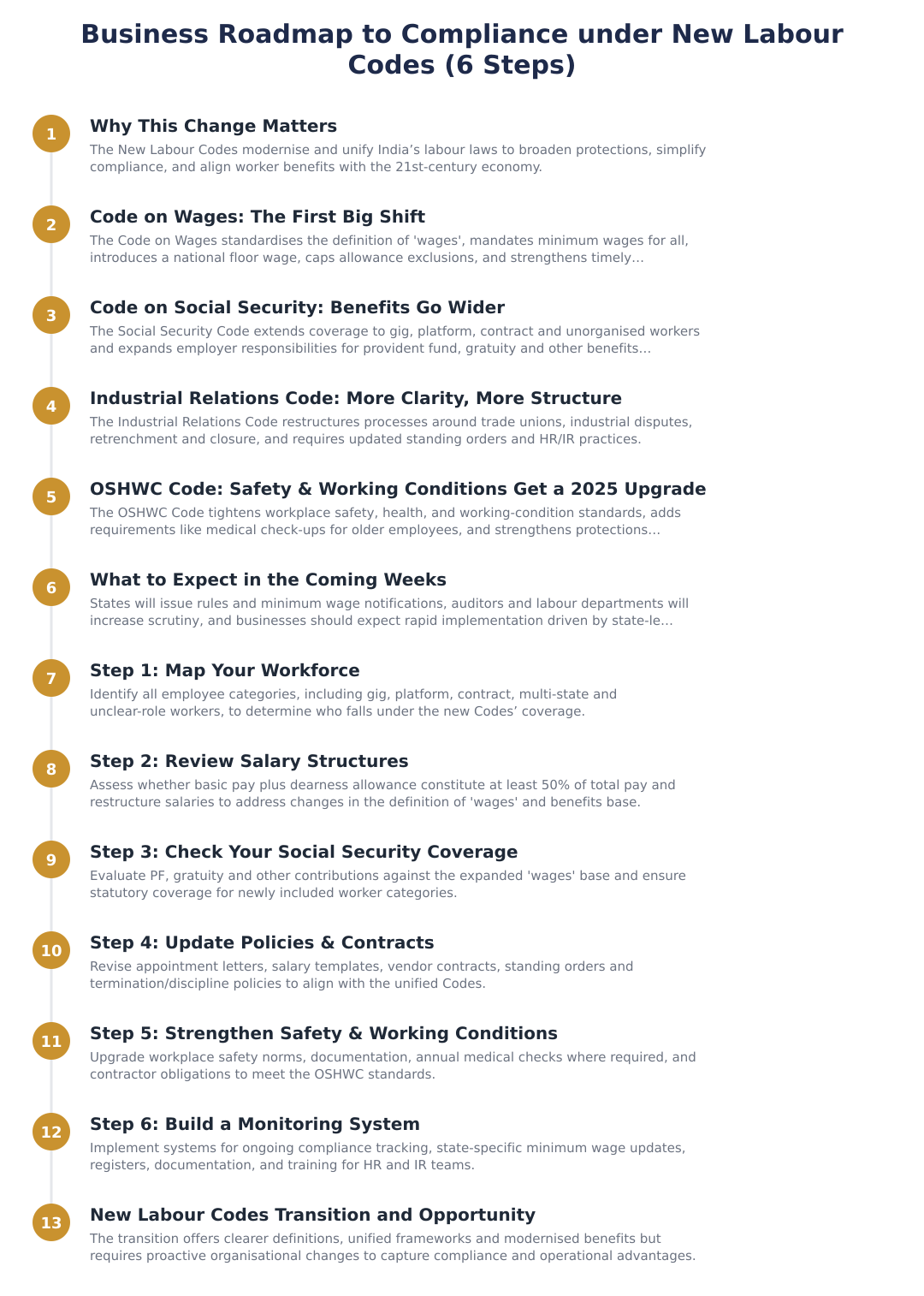
Why This Change Matters
The 2025 overhaul unifies a fragmented set of labour laws into a compact structure. By consolidating multiple statutes into four Codes, the intent is to simplify compliance architecture, reduce overlaps in regulatory obligations and create a more coherent set of labour rules that apply consistently across sectors.
For businesses this matters because a changed legal framework affects how you draft contracts, structure pay and benefits, manage industrial relations and run workplace health and safety programmes. Even where operational details are later set by implementing rules or state notifications, the new Codes create a fresh baseline that organisations must understand and accommodate.
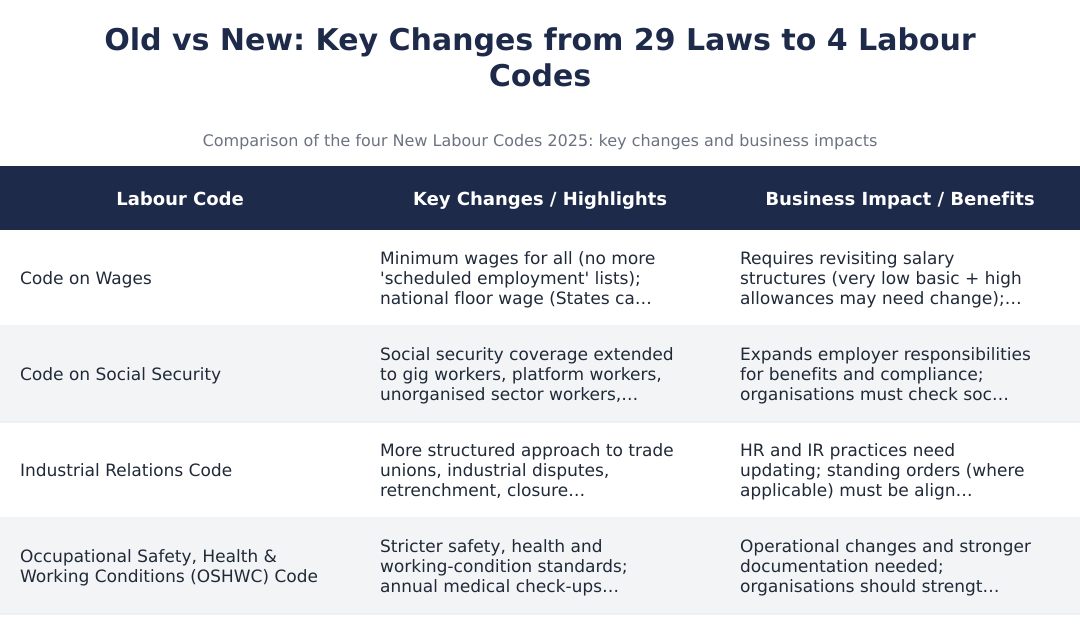
1. Code on Wages: The First Big Shift
The Code on Wages is one of the four consolidated laws and governs wage-related matters. Its consolidation aims to bring uniformity to wage definitions and payment practices across establishments, prompting many organisations to revisit salary structures and payroll processes.
Practically, employers should expect to examine pay components, payroll calculations and timing of payments to ensure they align with the Code’s standards. HR and payroll teams will need to work closely to update templates and stakeholder communications so employees understand any changes in pay presentation or recording.
2. Code on Social Security: Benefits Go Wider
The Code on Social Security is another of the four unified statutes and broadens the statutory approach to social-protection coverage. Notably, it extends social security coverage to new categories of workers who previously fell outside many formal schemes.
One verified change under this Code is that social security coverage now expressly extends to gig, platform and contract workers, expanding employer responsibilities for these categories. Organisations that engage such workers should assess which benefits and compliance obligations arise under the new Code and plan how to operationalise contributions, record-keeping and enrolment where applicable.
3. Industrial Relations Code: More Clarity, More Structure
The Industrial Relations Code is part of the four-Code package and consolidates rules related to trade unions, dispute resolution and employer-employee relations. Its overall aim is to streamline processes for collective matters and industrial adjudication, offering clearer procedures for handling disputes and workplace changes.
Employers should review their industrial-relations practices, dispute-resolution clauses and standing orders (where applicable) to ensure they align with the Code’s requirements. Updating internal grievance channels and training managers in the updated procedures will help reduce friction when disputes arise.
4. OSHWC Code: Safety & Working Conditions Get a 2025 Upgrade
The Occupational Safety, Health & Working Conditions (OSHWC) Code consolidates multiple laws governing workplace safety, health services and working conditions into a single instrument. This Code emphasises systematic safety management and clearer employer duties around working hours and welfare measures.
Operational teams should anticipate updates to safety protocols, documentation and compliance registers. Health & safety improvements often require coordination across facilities, contractors and HR, for example, updating standard operating procedures, medical-check schedules and contractor oversight to reflect the new Code’s approach.
What to Expect in the Coming Weeks
The consolidated Codes set the legal framework, but many operational specifics will appear through rules, state-level notifications and implementing guidelines. Expect a phase where authorities release clarifications, and courts or tribunals begin interpreting the new provisions.
During this transitional period, regulators and labour departments may issue advisory circulars and businesses should be ready to adapt quickly. Staying informed will be critical: assign an internal owner to track notifications and collate legal updates relevant to your locations and workforce types.
How Businesses Can Gear Up - A Practical Roadmap
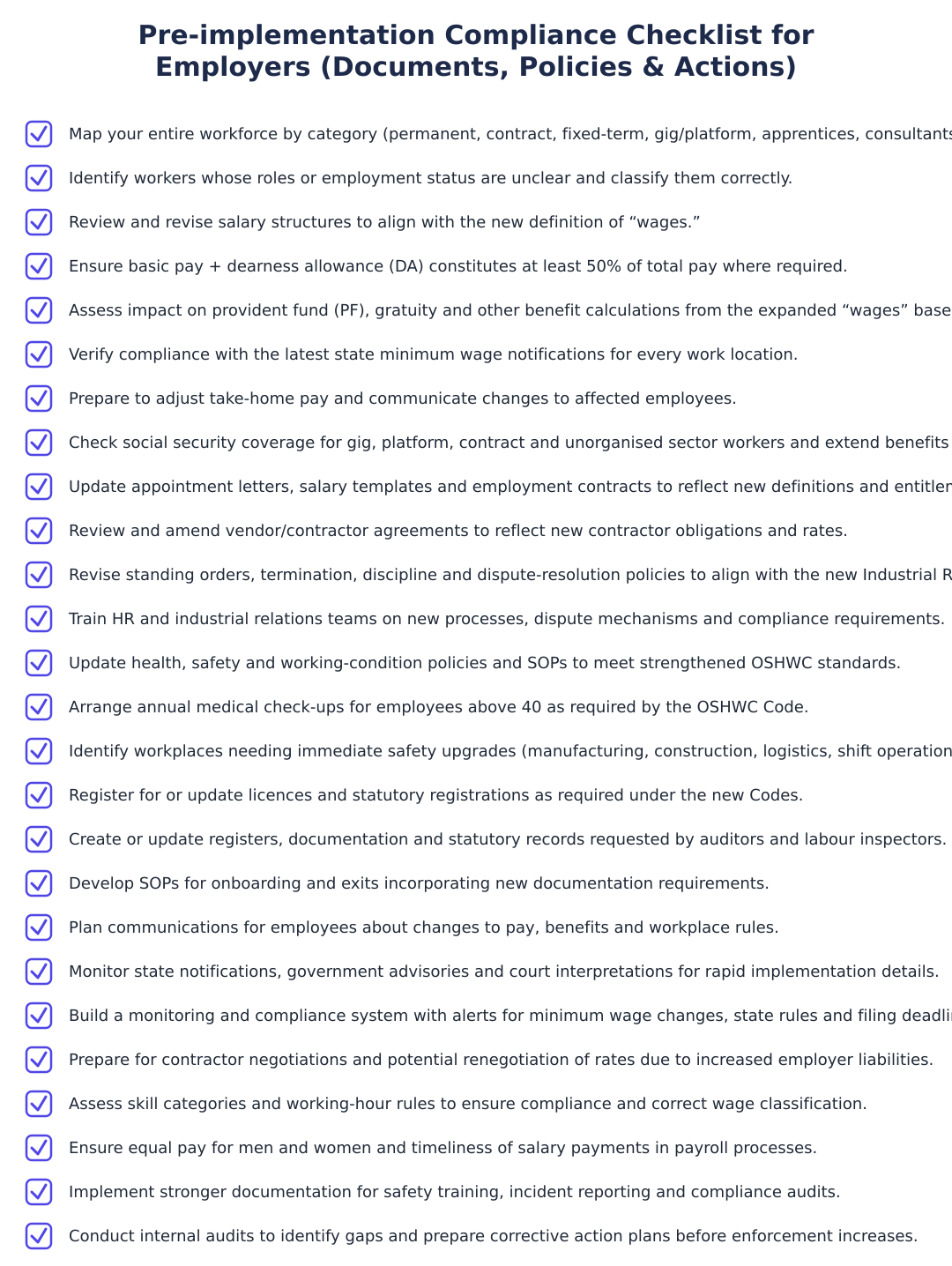
Create a detailed roster of all workers, including regular employees, gig and platform workers, contractors and apprentices, so you can identify which groups are now covered under the new Codes.
Examine pay components and payroll templates to ensure they meet the Code on Wages’ standards; involve payroll and compensation teams to model the operational impact of any reclassification of pay elements.
Assess whether gig, platform or contract workers engaged by your organisation are subject to social security obligations under the new Code and plan contribution, enrolment and record-keeping processes accordingly.
Revise employment contracts, vendor agreements and internal policies to reflect the consolidated Codes, ensure termination, grievance and dispute-resolution clauses are reviewed for alignment.
Audit existing safety systems and working-condition arrangements against the OSHWC Code’s expectations and prioritise upgrades where gaps are identified, including contractor management.
Set up an internal monitoring and notification mechanism to track rule-making, state notifications and legal interpretations so your compliance roadmap can be updated promptly.
New Labour Codes Transition and Opportunity
Although the Codes represent a major shift, they also present an opportunity for businesses to modernise HR, payroll and safety practices. Consolidation can reduce ambiguity and, with proactive planning, organisations can convert compliance work into clearer processes that support scalability.
Begin with small, high-impact actions, mapping the workforce, reviewing contracts and establishing an internal tracking system, and iterate as implementing rules and notifications arrive. Early preparation will make the transition smoother and help you engage constructively with employees, vendors and regulators.
The 2025 labour Codes reshape India’s statutory landscape by consolidating 29 laws into four comprehensive Codes. Careful assessment, targeted updates to contracts and payroll, and a robust monitoring plan will help organisations manage the transition effectively. Start now with workforce mapping and policy reviews so you are ready for the detailed rules and notifications that will follow.
Frequently asked questions
What are the New Labour Codes 2025 and which laws do they replace?
The New Labour Codes 2025 consolidate and replace 29 old labour laws by creating four unified codes: the Code on Wages, the Code on Social Security, the Industrial Relations Code, and the Occupational Safety, Health & Working Conditions (OSHWC) Code. These codes modernise rules on pay, social security, dispute resolution, and workplace safety to provide a single, clearer regulatory framework. They standardise definitions (for example, a new definition of “wages”), set a national floor wage mechanism, and simplify compliance and registrations across states. Businesses should expect state-level notifications and rules to operationalise many of the provisions, so implementation will be a mix of central principles and state-specific details.
How does the Code on Wages change the definition of wages and impact pay structures?
The Code on Wages introduces a tighter, standard definition of “wages” and limits exclusions so allowances cannot exceed 50% of total pay in many cases, forcing a recalibration of pay structures. This means salary packages with very low basic pay and high allowances must be restructured so that basic pay plus dearness allowance (DA) is closer to the required proportion, affecting PF, gratuity and other wage-linked benefits. Employers may see higher statutory contributions (PF/gratuity) and a potential reduction in take-home pay for some employees until allowances are adjusted. Businesses should immediately review salary templates and prepare for revised minimum wage notifications from states, including the newly envisaged national floor wage.
Who is covered under the new Code on Social Security 2025 and what new responsibilities do employers have?
The Code on Social Security 2025 extends social security coverage to gig workers, platform workers, contract staff, and a wider segment of the unorganised sector, increasing employer responsibilities for contributions and benefits. Employers will have to factor in expanded PF-like contributions, insurance and welfare schemes for previously excluded categories, and comply with new registration and contribution processes when notified. This expansion may increase payroll costs and documentation obligations, especially for organisations relying on gig/platform or contract labour. Employers should audit their workforce types, update vendor contracts, and be ready to register and contribute under state/central rules once rolled out.
What are the key changes under the Industrial Relations Code that affect layoffs and dispute resolution?
The Industrial Relations Code 2025 provides clearer, more structured rules on trade unions, industrial disputes, retrenchment, and closure, standardising processes and enhancing predictability. Employers will face updated procedures for standing orders, retrenchment/closure approvals, and more formalised dispute resolution paths, requiring HR and IR teams to revise policies and upskill. The code aims to reduce ad-hoc litigation by setting out defined timelines and institutional mechanisms, but state-level rules will determine operational details. Organisations should review their standing orders, update termination and disciplinary policies, and prepare documentation to comply with the new frameworks.
What safety and working-condition changes does the OSHWC Code introduce that employers must implement?
The OSHWC Code 2025 tightens workplace safety, health and working-condition norms, including requirements like annual medical check-ups for employees above 40 years and stronger protections for migrant and contract workers. Employers must upgrade safety systems, maintain enhanced registers and documentation, follow stricter contractor obligations, and ensure compliance with new working-hour and shift rules. High-risk sectors, manufacturing, construction, logistics and large shift-based offices, will need immediate operational and infrastructural changes and training programmes. Businesses should conduct safety audits, update SOPs, and plan for certifications or licensing where applicable under state rules.
What should businesses do first to prepare for the new codes, how do I map my workforce?
Start by mapping your workforce to identify categories like regular employees, contract staff, fixed-term employees, gig/platform workers, apprentices and consultants, since the new codes place different obligations on each category. Create a detailed roster that captures role, location, salary breakdown, contract type, working hours, and social security status to spot gaps in coverage and probable cost impacts. This mapping will reveal groups that need immediate action, e.g., contract labour requiring social security registration or employees with salary structures needing revision under the wages code. Use this as the foundation for the other steps: salary review, social security checks, policy updates, and safety improvements.
How should I review salary structures to comply with the new wages rules?
You should review salary structures immediately to ensure basic pay (plus DA where applicable) is not disproportionately low compared with allowances and to comply with the 50% cap on exclusions and the new definition of ‘wages’. Recalculate PF, gratuity and other statutory liabilities based on the updated wages definition, and model the net take-home impact on employees to decide on restructuring. Communicate changes transparently to employees and prepare revised appointment letters and salary templates to reflect compliant pay components. Also track state minimum wage updates and the national floor wage to ensure location-specific compliance.
What practical steps should HR take to update policies, contracts and safety systems under the new codes?
HR should update appointment letters, vendor/contractor agreements, standing orders, termination and discipline policies, health & safety policies, and SOPs for onboarding and exits to reflect the new codes’ definitions and obligations. Ensure contracts with staffing agencies include social security and safety compliance clauses, and align standing orders with revised industrial relations procedures. Strengthen safety systems by conducting audits, arranging mandatory medical checks where required, updating registers, and training supervisors on new OSHWC norms. Finally, implement a monitoring system for state notifications, minimum wage updates and compliance registers so the organisation stays audit-ready.
What timeline and risks should businesses expect as the New Labour Codes are implemented?
Businesses should expect rapid implementation driven by state-level notifications, with risks including increased statutory costs (PF/gratuity/social security), vendor renegotiations, more frequent inspections, and initial adjustments to take-home pay for some employees. Key milestones will be state notifications on minimum wages, registration processes for social security, and specific rules for industrial relations and OSHWC compliance, these will determine precise timelines for each region. Organisations must monitor government advisories, court interpretations and state rules closely, keep documentation ready, and budget for transitional costs to reduce compliance shocks. Proactive engagement with employees, vendors and legal counsel will mitigate most operational and litigation risks.
Need help staying Payroll compliant?
MoneyGence's AI Finance OS tracks your compliance, wallet share, and finances in one place, built for agencies and growing businesses.
Get started with MoneyGence