New Labour Codes 2025: Key Changes Effective 21 Nov 2025
This guide explains the core changes and practical implications of India’s new labour code framework, which consolidates multiple labour laws into a single, more uniform regime. You will learn what the unification means for the legal definitions of wages and employees, how payment timelines will be standardised, and how existing central enactments relate to the new code. Understanding these points matters for employers, HR professionals, payroll teams and workers because clearer, uniform definitions reduce ambiguity in compliance, payroll calculation and dispute resolution. The consolidation also affects how legacy statutes are referenced in everyday HR and legal practice: since long‑standing laws such as the Payment of Wages Act, 1936, the Payment of Bonus Act, 1965, the Minimum Wages Act, 1948 and the Equal Remuneration Act, 1976 continue to be relevant, organisations must reconcile legacy provisions with the new, unified framework. This article lays out the core changes, highlights practical steps employers should take to align policies and payroll, and explains why a single code can simplify administration while requiring careful review of existing contracts and internal rules.
What the new labour code does
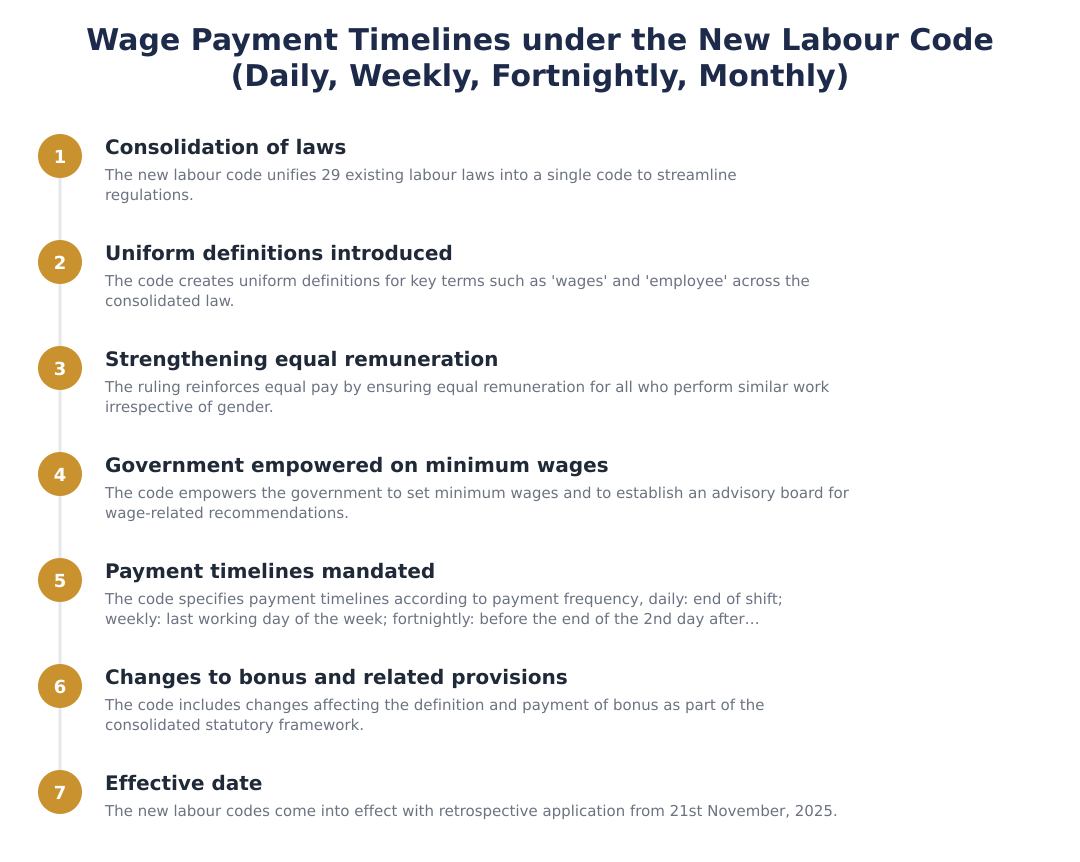
At the heart of the reform is consolidation: the new labour code brings together 29 earlier laws into a single statutory framework. The objective of this unification is to create consistent legal standards across subjects that were previously governed by separate enactments, reducing contradictions and interpretive differences that arose when similar terms were defined differently by multiple statutes.
One immediate practical outcome of the consolidation is the creation of uniform definitions for key terms. By standardising how terms such as "wages" and "employee" are defined, the code aims to make application of labour rules more predictable across sectors and jurisdictions. Another core element addressed by the code is the timing and manner of wage payments, by prescribing consistent payment timelines it seeks to bring clarity for employers and workers alike.
Unifying disparate laws into one code also simplifies reference and compliance: employers, advisers and courts will consult the single consolidated text rather than navigating overlapping provisions spread across many statutes. That said, the code functions alongside existing central enactments and does not remove the need to understand how legacy Acts interact with the new framework.
Implications for wages, employees and payment timelines
A principal feature of the code is uniformity in definitions that affect payroll and employment classification. When a central statutory definition of "wages" is applied consistently, it changes how various pay components, deductions and employer liabilities are interpreted across different statutes and schemes.
Similarly, a standard definition of "employee" reduces uncertainty over who is covered by statutory protections and entitlements. For businesses this affects classification, eligibility for benefits and the applicability of employer obligations that hinge on whether a person is treated as an employee or not.
The code’s emphasis on payment timelines means employers will need to align payroll cycles and internal processes with the unified expectations. Consistent timelines help workers know when they will be paid and help employers reduce disputes and penalties arising from delayed payments.
Key existing Acts referenced alongside the new code
| Act |
|---|
| Payment of Wages Act, 1936 |
| Payment of Bonus Act, 1965 |
| Minimum Wages Act, 1948 |
| Equal Remuneration Act, 1976 |
Practical steps employers and payroll teams should take
Compare existing contracts and internal policies against the code’s uniform definitions to identify areas where language or classifications need updating.
Ensure payroll cycles, pay components and deduction practices comply with the single framework for payment timelines and wages.
Provide focused training so teams understand the code’s definitions and how they affect eligibility, calculations and record‑keeping.
Seek legal input to reconcile any conflicts between legacy Acts and the new code, particularly where older statutes remain relevant.
Why unification matters for businesses and workers
Consolidating many labour laws into one code aims to reduce compliance complexity and make rights and obligations clearer. For businesses, this can lower administrative costs and legal uncertainty; for workers, clearer rules mean easier enforcement of entitlements.
However, unification also requires careful change management. Employers must translate the code’s uniform definitions into operational payroll and HR practices. Because several historic central enactments remain part of the legal landscape, organisations should interpret the new code in context and maintain compliant practices across all applicable laws.
The new labour code’s consolidation of 29 laws into a single framework and its focus on uniform definitions for wages, employees and payment timelines are intended to simplify and harmonise labour law application. Employers should proactively review contracts, payroll processes and compliance controls, and keep the continued relevance of legacy central enactments such as the Payment of Wages Act, 1936, the Payment of Bonus Act, 1965, the Minimum Wages Act, 1948 and the Equal Remuneration Act, 1976 in mind when aligning to the new regime.
Frequently asked questions
When do the new Labour Codes come into effect?
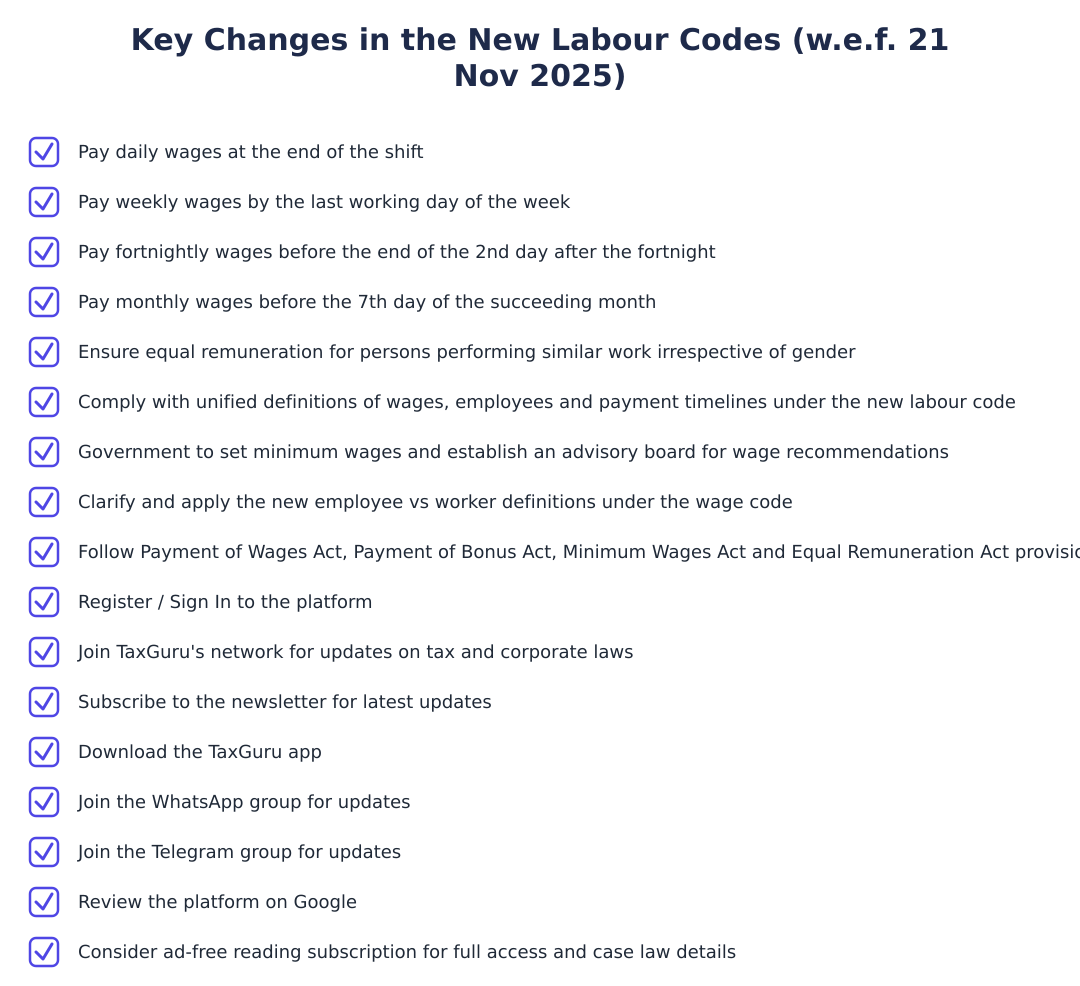
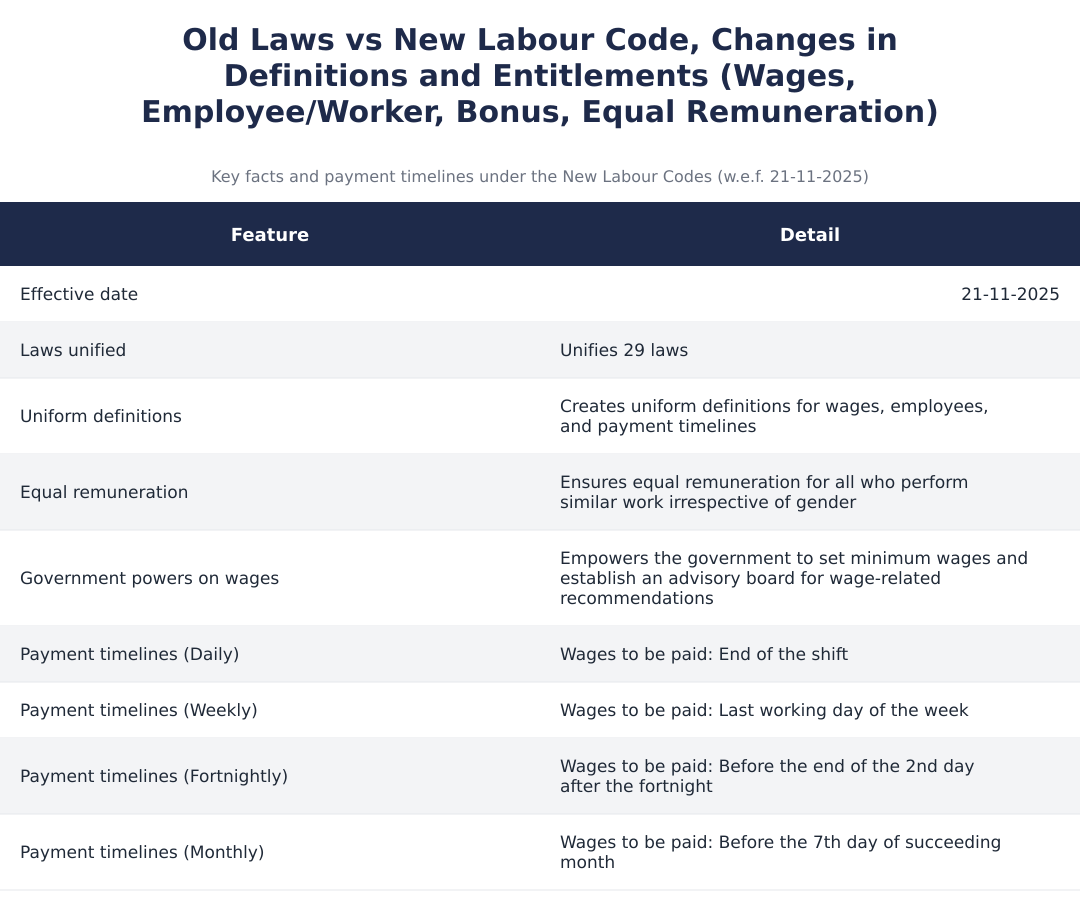
The new Labour Codes come into effect w.e.f. 21st November, 2025. These Codes unify 29 existing laws into a single framework and introduce uniform definitions for wages and employees, as well as standardized payment timelines. They also strengthen equal remuneration provisions and give the government power to set minimum wages and establish an advisory board for wage-related recommendations.
What are the new rules on when wages must be paid?
The new Labour Codes set specific timelines for wage payment depending on pay frequency: daily wages must be paid at the end of the shift; weekly wages by the last working day of the week; fortnightly wages before the end of the 2nd day after the fortnight; and monthly wages before the 7th day of the succeeding month. These timelines standardize payment across establishments to reduce delay and ambiguity. Employers must align payroll operations to these deadlines to remain compliant.
Does the new code change the legal definition of wages?
Yes, the new Labour Code provides a revised and uniform definition of 'wages' across the consolidated laws. The updated definition is intended to create consistency in what components are treated as wages for purposes such as minimum wages, bonus calculations, and equal remuneration. This change will affect statutory calculations where the term 'wages' is used unless specific exceptions are provided elsewhere in the code.
How does the new code strengthen equal pay protections?
The new Labour Code explicitly ensures equal remuneration for all who perform similar work irrespective of gender. It mandates equal pay for like work and gives a clearer statutory basis to challenge discriminatory pay practices. Employers will need to review pay structures and job classifications to ensure parity and avoid compliance issues under the strengthened equal remuneration provision.
Who is considered an 'employee' under the new Labour Code?
The new Labour Code provides a uniform definition of 'employee' to replace disparate definitions across earlier statutes, aiming to clarify coverage for various labour protections. While the page indicates a change in the employee definition, it means more consistent application of rights such as wages, bonuses, and other statutory benefits across categories like workers and employees. Employers should examine the revised definition to determine which of their workforce segments fall within the code's protections.
Will the government be able to set minimum wages under the new code?
Yes, the new Labour Code empowers the government to set minimum wages and to establish an advisory board for wage-related recommendations. This central provision is intended to harmonize minimum wage-setting and provide expert input through the advisory board. The change aims to standardize wage floors while allowing periodic updates based on economic and social considerations.
Has the payment of bonus been changed by the new Labour Code?
The new Labour Code includes changes related to payment of bonus, as part of consolidating previous laws like the Payment of Bonus Act, 1965. While the page flags 'Payment of Bonus' as a nature-of-change area, employers should expect revised rules on eligibility, computation, and timelines consistent with the unified definitions of wages and employees. Businesses will need to revisit their bonus policies to ensure compliance with the amended provisions.
Do the new timelines for wage payment apply to all establishments equally?
The new timelines for wage payment, end of shift for daily, last working day for weekly, before end of 2nd day after fortnight for fortnightly, and before 7th day of succeeding month for monthly, are set as standard requirements under the consolidated code. These timelines are intended to apply broadly to establishments covered by the code, promoting timely payment across sectors. Employers in specific sectors should check any sectoral exemptions or rules that the code or subsequent notifications might provide.
How will the unified Labour Code affect state-level labour laws?
The unified Labour Code harmonizes definitions and core provisions at the national level by consolidating 29 laws, but implementation details and certain rules may still involve state-level notifications or adaptations. The code centralizes key concepts like wages, employees, equal remuneration, and payment timelines while allowing government mechanisms, such as minimum wage setting and advisory boards, to operate within the new framework. Stakeholders should monitor state rules and notifications that operationalize the code locally.
Need help staying Compliance compliant?
MoneyGence's AI Finance OS tracks your compliance, wallet share, and finances in one place, built for agencies and growing businesses.
Get started with MoneyGence