NPS vs PPF: Which Is Better for Retirement Investing?
This guide compares the Public Provident Fund (PPF) and the National Pension System (NPS) to help you decide which instrument better fits your long-term objectives. You will learn how each scheme works, who can invest, key product features such as tenure, withdrawal rules and tax treatment, and the practical trade-offs between a government-determined, long-dated savings vehicle (PPF) and a market-linked pension solution (NPS). Understanding these differences matters because PPF and NPS serve distinct goals: PPF is a long-standing government-backed savings scheme focused on tax-efficient accumulation, while NPS is a dedicated pension architecture designed to generate a retirement corpus and provide periodic income after exit. By the end of this guide you will be able to map your time horizon, liquidity needs, and preference for guarantees versus market participation to the scheme that aligns best with your financial plan.
Understanding PPF
PPF is an age-old government-funded investment scheme designed for long-term savings. It runs on a fixed-duration model where the standard tenure is 15 years, after which the account holder can extend in blocks of five years if they wish to continue the investment.
Interest on PPF is compounded annually and credited to the account on 31 March each year. The government sets the PPF interest rate, and that rate determines the effective return on the accumulated balance.
PPF has structured partial withdrawal provisions: partial withdrawals are allowed after the fifth year with certain limitations. There are specific circumstances under which premature withdrawal can be permitted, such as paying for higher education, meeting medical expenses in life-threatening situations (supported by documentation), or on change of residency status (also supported by documentation). Additionally, account holders can take a loan against their PPF account subject to the scheme rules.
Who can invest in PPF?
PPF is targeted at Indian residents seeking a government-backed, long-term savings vehicle. The scheme’s 15-year duration and rules on partial withdrawal and loans make it suitable for investors who prioritise capital preservation and tax-efficient accumulation over market-linked growth.
Note that PPF is not available to non-resident Indians (NRIs). This restriction affects individuals who change residency during the life of the account and is also one of the permitted grounds, with documentation, for making premature withdrawals.
Understanding NPS
The National Pension System (NPS) is a government-sponsored pension programme that targets retirement savings for employees across the public, private and unorganised sectors, excluding the armed forces. It is structured to allow subscribers to accumulate a retirement corpus over their working life and then convert part of that corpus into an annuity at exit.
NPS operates with subscriber-level portability and record-keeping: after opening an NPS account, the investor receives a unique Permanent Retirement Account Number (PRAN). All fund management activities and contributions are linked to and carried out through the subscriber’s PRAN, and subscribers can choose how to allocate their contributions across permissible asset classes such as equity funds, government securities funds and fixed-income instruments.
At maturity, NPS requires that subscribers use at least 40% of their accumulated corpus to purchase an annuity, with the remainder available as a lump sum as per the scheme rules. The returns under NPS are market-linked, reflecting performance of the chosen asset mix rather than a government-declared interest rate.
Who can invest in NPS?
NPS is open to employees from the public, private and unorganised sectors, with the explicit exclusion of the armed forces. The scheme provides two account types, Tier-1 and Tier-2, which together offer flexibility for retirement accumulation and optional additional savings once a Tier-1 account is active.
Because NPS is built around a PRAN for each subscriber and active fund management through that PRAN, it is particularly suited to people who want a dedicated retirement account with the option to choose asset allocation and participate in market returns during the accumulation phase.
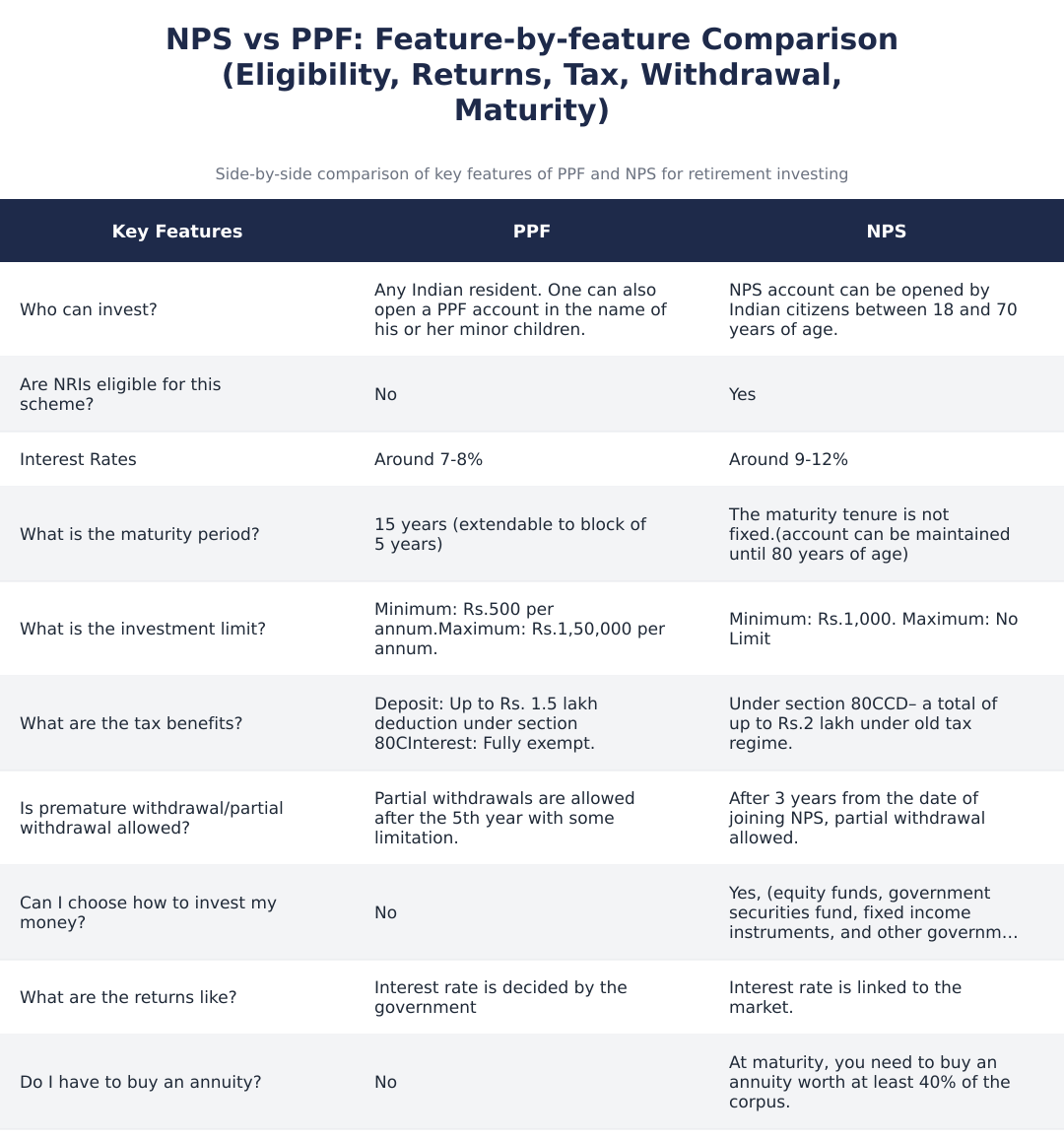
NPS vs PPF, side-by-side at a glance
| Key Features | PPF | NPS |
|---|---|---|
| Who can invest? | Any Indian resident; PPF can also be opened in the name of minor children (subject to scheme rules). | Open to employees in public, private and unorganised sectors (except armed forces). |
| Are NRIs eligible? | No | , |
| Returns | Interest rate is decided by the government; interest is compounded annually. | Returns are linked to the market. |
| Maturity / Tenure | 15 years (extendable in blocks of 5 years). | Maturity tenure is not fixed; subscriber uses corpus at retirement with annuity requirement. |
| Withdrawal rules / premature exit | Partial withdrawals allowed after the 5th year with limitations; specific premature withdrawal grounds include higher education, certain medical expenses, and change in residency (with documentation). | At maturity, subscribers must use at least 40% of the corpus to buy an annuity; other withdrawal rules vary by account type and scheme provisions. |
| Investment choice | No active choice of asset allocation, the scheme follows government-set terms. | Subscribers can choose asset allocation among equity, government securities and fixed-income instruments. |
| Tax treatment | Deposits: deduction under section 80C up to Rs.1.5 lakh; interest: fully exempt. | Relevant tax provision reference: section 80CCD (for certain NPS deductions). |
| Account identifier and administration | , | Each subscriber is assigned a PRAN; all fund management activities are carried out through the PRAN. |
| Loan facility | Loan against PPF account is permitted subject to scheme rules. | , |
Frequently Asked Questions
Can I get a loan against my PPF? Yes, you can take a loan against your PPF account subject to the scheme rules that govern such loans.
When is PPF interest credited? Interest for PPF is compounded annually and credited to the account on 31 March each year; to maximise interest credit, deposits are typically made between the 1st and 5th of the month because interest is calculated on the lowest balance held on the 5th.
Do I have flexibility over investments in NPS? Yes, NPS subscribers can choose how to allocate their contributions across permitted asset classes such as equity funds, government securities funds and fixed-income instruments.
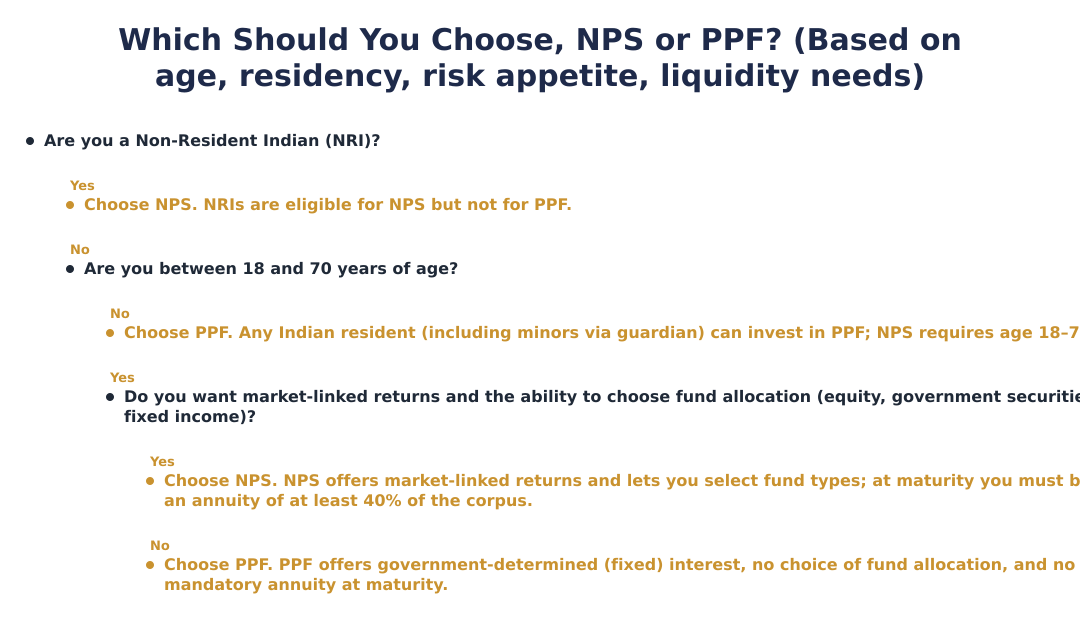
Choosing between PPF and NPS depends on your priorities: choose PPF if you want a government-determined interest scheme with long-term tax-free accumulation and loan/limited withdrawal features; choose NPS if you need a retirement-focused, market-linked solution with active asset allocation and mandatory annuitisation at exit. Use the comparisons above to align each product’s rules with your horizon, risk appetite and liquidity needs.
Frequently asked questions
Which is better for retirement savings, NPS or PPF?
There is no one-size-fits-all answer; NPS is better if you want potentially higher market-linked returns and flexibility to choose asset allocation, while PPF is better if you want a guaranteed government-backed return and full tax exemption on interest. NPS typically offers higher returns (historically around 9–12% depending on equity exposure and market performance) but is market-linked and requires you to buy an annuity of at least 40% of the corpus at retirement. PPF pays a government-declared interest rate (around 7–8% currently, compounded annually) with the entire maturity and interest being tax-exempt under Section 10, and has a fixed 15-year lock-in (extendable). Choose NPS if you can tolerate market volatility and want higher long-term growth; choose PPF if you prefer capital protection and simpler tax-free maturity.
Who is eligible to open a PPF account?
Any Indian resident individual can open a PPF account, and one person may open one additional PPF account for a minor child, but NRIs and Hindu Undivided Families (HUFs) are not eligible. A single citizen cannot have multiple PPF accounts in their own name beyond the one allowed; joint accounts are not permitted. The PPF account has a minimum annual deposit requirement of Rs. 500 and a maximum contribution limit of Rs. 1,50,000 per financial year for tax benefits under Section 80C.
Who can open an NPS account and what are Tier-1 and Tier-2 accounts?
Any Indian citizen aged between 18 and 70 years can open an NPS account and will be assigned a PRAN (Permanent Retirement Account Number); NPS has two account types, Tier-1 and Tier-2. Tier-1 is the primary pension account with a minimum contribution of Rs. 500 and restrictions on premature withdrawals but offers tax benefits (up to Rs. 2 lakh under certain provisions), whereas Tier-2 is a voluntary savings account with a minimum contribution of Rs. 250 that can be opened only if the subscriber has an active Tier-1 account and has no special tax benefits. NPS is open to employees from public, private and unorganised sectors (excluding armed forces) and requires compliance with KYC norms.
Are NRIs eligible for PPF or NPS?
NRIs are not eligible to open a new PPF account, but NRIs are eligible to open and contribute to an NPS account. PPF is restricted to resident Indian individuals and HUFs cannot open it; while NPS accepts Indian citizens (including NRIs) within the age limits of 18–70 years. Note that if a resident account holder becomes an NRI, specific rules govern continuation or closure of existing PPF accounts, and NPS accounts can be maintained subject to scheme rules and KYC.
How do tax benefits differ between NPS and PPF?
PPF contributions qualify for deduction under Section 80C up to Rs. 1.5 lakh per financial year and the interest and maturity proceeds are fully tax-exempt, while NPS contributions have separate benefits under Section 80CCD, overall deductions can go up to Rs. 2 lakh under the old tax regime (subject to limits including 80C) and additional employer contributions may also be deductible under certain conditions. At maturity, PPF corpus and interest are tax-free, but NPS requires purchase of an annuity for at least 40% of the corpus which is taxable as pension income; only a portion of lump-sum withdrawals from NPS may be tax-free depending on prevailing rules. Thus PPF gives EEE (exempt-exempt-exempt) status, whereas NPS offers partial exemptions (EET type) with tax on pension in many cases.
Can I choose how my NPS contributions are invested?
Yes, NPS allows subscribers to choose their asset allocation across equity, government securities, and corporate fixed-income instruments, giving the investor flexibility to select a pension fund manager and active or auto-choice strategies. You can allocate funds to equity funds (E), government securities (G), and corporate bonds (C) in proportions you prefer within regulatory limits, and returns will therefore be linked to market performance which can yield higher returns than fixed-rate schemes. PPF, by contrast, does not allow choice of investment, all funds are invested by the government and earn the declared PPF interest rate.
What are the lock-in, maturity and withdrawal rules for PPF and NPS?
PPF has a fixed maturity of 15 years which can be extended in blocks of 5 years; partial withdrawals are permitted from the 5th year subject to limits and specific conditions such as education or medical needs, and loans can be taken against the PPF balance after a certain period. NPS has no fixed maturity age and the account can be maintained until 80 years of age; partial withdrawal is allowed after 3 years with certain restrictions, and at retirement you must use at least 40% of the corpus to buy an annuity while the remaining portion may be withdrawn (tax treatment varies). Therefore PPF has a long fixed lock-in with defined extension options, while NPS focuses on phased retirement access and mandated annuitisation.
What are the returns like on PPF compared to NPS?
PPF offers a government-declared fixed interest rate (currently about 7–8% per annum, compounded annually and credited on March 31), providing predictable but moderate returns, whereas NPS returns are market-linked and have historically tended to be higher (roughly around 9–12% depending on equity exposure and market cycles) but are subject to volatility. Because PPF interest is guaranteed and tax-free on maturity, it suits risk-averse investors seeking certainty; NPS suits investors willing to accept market risk for potentially higher retirement corpus. Remember that actual NPS returns depend on your fund choices (equity vs debt) and the performance of selected pension fund managers.
Do I have to buy an annuity with the NPS corpus at retirement?
Yes, at the time of maturity or exit from NPS you are required to purchase an annuity with at least 40% of your accumulated corpus, while the remaining up to 60% can typically be withdrawn as a lump sum subject to tax rules. The annuity provides a regular pension income and the rules mandate annuitisation to ensure income security in retirement; the exact taxability of the annuity and the lump sum depends on prevailing tax laws. PPF does not impose annuity purchase at maturity, PPF corpus and interest are paid as a lump sum and are fully tax-exempt.
Need help staying Calculators compliant?
MoneyGence's AI Finance OS tracks your compliance, wallet share, and finances in one place, built for agencies and growing businesses.
Get started with MoneyGence