NRI Income Tax India 2026: Slabs, ITR Forms & Capital Gains
This guide explains how income tax rules apply to Non-Resident Indians (NRIs) for the assessment year 2026, who is taxable in India, which heads of income are taxed, available deductions, key forms and documents required for ITR filing, capital gains treatment, TDS and surcharge applicability, and important dates you must know. You will learn how to determine your residential status for tax purposes (the 182-day and 60 + 365 tests), which types of India-source income are always taxable, how long-term and short-term capital gains are taxed for NRIs, what deductions NRIs can claim (and which investments they cannot newly open), and the ITR forms typically used by NRIs. The guide also summarises practical compliance points, TDS rates that commonly apply to NRIs, the basic exemption limits under the old and new regimes for FY 2025-26/AY 2026-27, and the due dates for filing returns (including the relaxed due date for non-residents with business income). Whether you are an Indian citizen working abroad, an NRI with rental property or capital gains in India, or a foreign national with India-source income, this article will help you identify your tax obligations and the documents you should keep ready before you file your return.
What is NRI Income Tax in India?
For income-tax purposes an NRI is a taxpayer whose residential status for the financial year is non-resident. The core practical consequence is straightforward: if you are an NRI, only income arising or received in India (or income deemed to accrue or arise in India) is taxable in India; foreign-source income is generally not taxable in India for NRIs.
Common India-source incomes that are taxable for NRIs include salary for services rendered in India, rental income from property located in India, capital gains from transfer of assets situated in India, and interest on NRO accounts or other India-based investments. Understanding what counts as India-source income is the first step to correct tax compliance and to avoid unexpected TDS or tax liabilities.
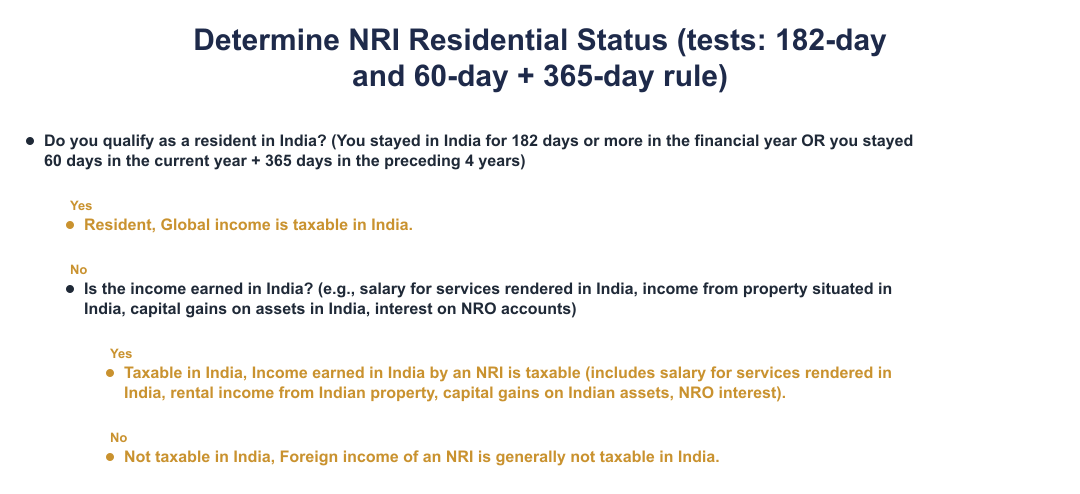
How to Determine Residential Status of an NRI?
You are treated as resident if you stayed in India for 182 days or more in the financial year; if you do not meet this, you may be non-resident.
Alternatively, you become resident if you stayed in India for at least 60 days in the current year and 365 days in the four preceding years combined; failing both tests generally results in NRI status.
Tax Rates for Non-Residents (Individual slab summaries)
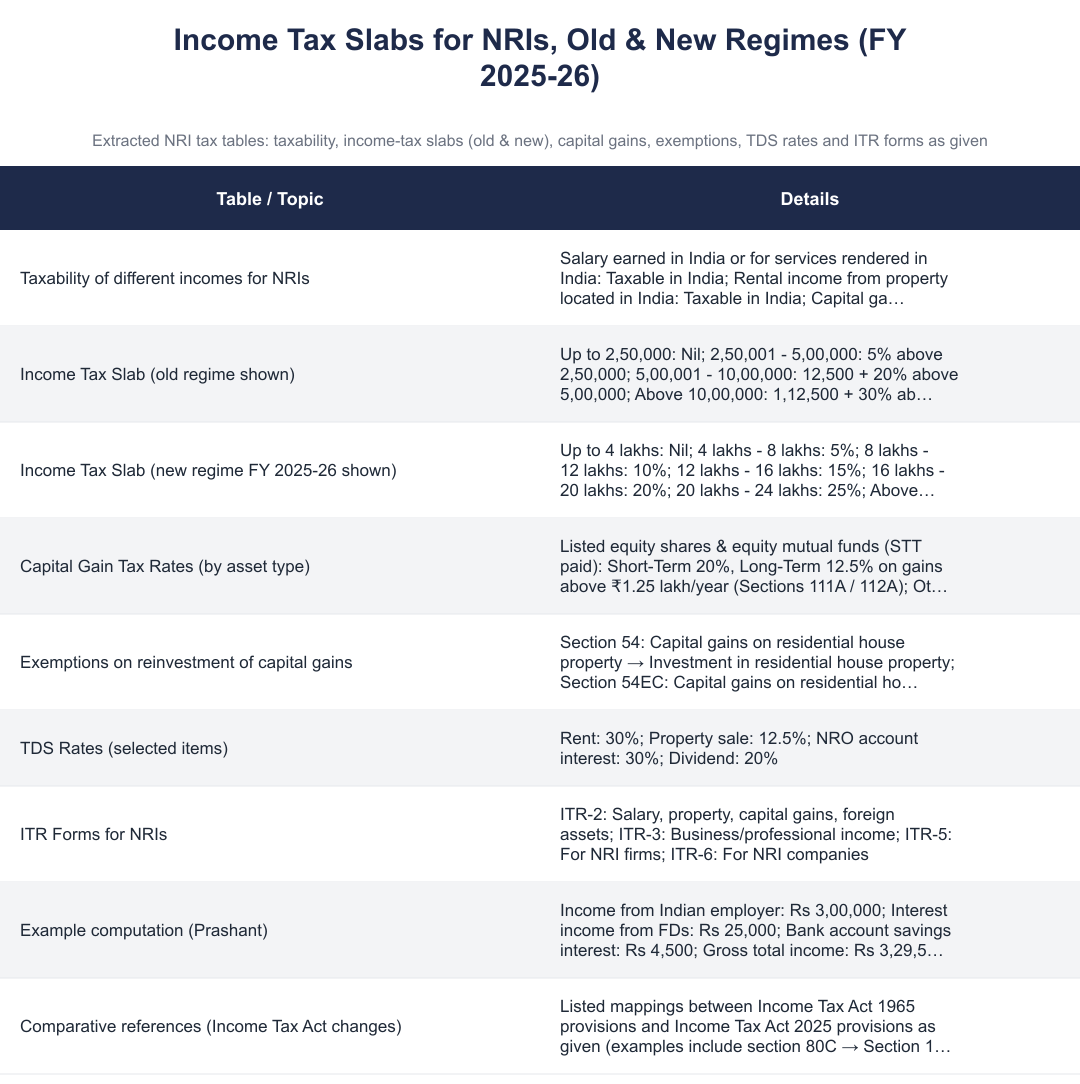
| Income Tax Slab | Income Tax Rate (old regime example) | Income Tax Rate (new regime FY 2025-26 example) |
|---|---|---|
| Up to Rs. 2,50,000 | Nil | |
| Rs. 2,50,001 - Rs. 5,00,000 | 5% above 2,50,000 | |
| Rs. 5,00,001 - Rs. 10,00,000 | Rs. 12,500 + 20% above 5,00,000 | |
| Above Rs. 10,00,000 | Rs. 1,12,500 + 30% above 10,00,000 | |
| New regime FY 2025-26: Up to Rs. 4,00,000 | Nil | |
| New regime FY 2025-26: Rs. 4,00,000 - Rs. 8,00,000 | 5% | |
| New regime FY 2025-26: Rs. 8,00,000 - Rs. 12,00,000 | 10% | |
| New regime FY 2025-26: Rs. 12,00,000 - Rs. 16,00,000 | 15% | |
| New regime FY 2025-26: Rs. 16,00,000 - Rs. 20,00,000 | 20% | |
| New regime FY 2025-26: Rs. 20,00,000 - Rs. 24,00,000 | 25% | |
| New regime FY 2025-26: Above Rs. 24,00,000 | 30% |
Capital Gain Tax Rates for NRIs (summary)
| Asset / Income Type | Short-Term | Long-Term | Governing Section |
|---|---|---|---|
| Listed equity shares & equity mutual funds (STT paid) | 20% | 12.5% on gains above 75,000? (verified fact lists 75,000 or 1.25 lakh?) | 111A / 112A |
| Other assets (immovable property, gold, unlisted shares, debt) | Slab rates | 12.5% without indexation | 112 |
| FPIs / specified funds (Category III AIF) | Per 115AD | Per 115AD | 115AD |
Is Foreign Income of NRIs Taxable in India?
Foreign-source income of an NRI is generally not taxable in India. The core rule for NRIs is that only income earned in India (or deemed to accrue or arise in India) is subject to Indian tax. Consequently, salary earned abroad, foreign investment income arising outside India, and similar foreign-source receipts typically fall outside Indian tax for NRIs.
However, the residential status test controls this outcome: if a taxpayer becomes a resident for tax purposes, global income becomes taxable in India. Therefore, NRIs should track their days in India carefully and be aware that income types such as salary for services rendered in India, rent from property situated in India, capital gains on assets located in India, and interest on NRO accounts remain taxable irrespective of where the taxpayer lives.
Common Heads of Taxable Income for NRIs
Salary income: Salary is taxable in India if the services are rendered in India. Even if you receive payment abroad, salary for services provided in India is taxable; an exception exists for diplomats and ambassadors whose income is exempt.
House property: Income from property situated in India is taxable for NRIs and is computed similarly to residents, including standard deductions and interest deductions where applicable. Tenants paying rent to non-resident owners may need to deduct TDS and follow remittance documentation requirements.
Other sources and business income: Interest on NRO accounts and interest from Indian fixed deposits are taxable in India. NRIs with business or professional income in India follow the same taxability principles as residents; due dates for filing may be relaxed for non-residents with business income.
What are the Investments that qualify for Special Treatment?
Certain Indian assets and investments receive special capital-gains treatment or are specifically listed for tax purposes. Examples include shares in Indian companies (public or private), debentures issued by publicly-listed Indian companies, deposits with banks and public companies, and securities of the Central Government. These categories are relevant when determining whether gains are taxable in India and which sections of the tax law apply.
NRIs should note that some small savings schemes and account types have restrictions: NRIs cannot open new PPF accounts (accounts opened while resident may be continued), and certain post-office schemes and deposit schemes intended for residents are not available for fresh investment by NRIs.
Deductions and Exemptions Commonly Available to NRIs
| Deduction / Exemption | Key point / Limit (verified fact) |
|---|---|
| Section 80C (principal repayment, LIC etc.) | Standard deduction avenues available; note: some investments like new PPF accounts are not permitted for NRIs |
| Section 80D (health insurance) | Deduction up to Rs. 25,000 for self/spouse/children; additional Rs. 25,000 for parents; limit Rs. 50,000 if parents are resident senior citizens |
| Section 80E (education loan interest) | Deduction for interest on education loans for self/spouse/children/legal wards; no monetary cap; available for up to 8 years or until interest paid |
| Section 80TTA (saving account interest) | Deduction on savings bank interest up to Rs. 10,000 |
| Capital gains exemptions (Sections 54, 54EC, 54F) | NRIs can claim these exemptions by reinvesting long-term capital gains as specified |
Deductions Not Allowed to NRIs
NRIs face limitations on opening or investing in certain small-savings schemes. Specifically, NRIs are not allowed to open new Public Provident Fund (PPF) accounts; however, PPF accounts opened while a person was resident may be maintained. Other resident-only schemes such as certain post-office term schemes and senior citizen schemes are not available for fresh investment by NRIs.
Because these product restrictions affect what you can invest in to claim particular deductions or exemptions, NRIs should confirm eligibility of each investment before relying on it for tax planning.
When Should NRIs File Income Tax Return in India?
Filing obligations for NRIs depend on whether total taxable income in India exceeds the basic exemption limit. For FY 2025-26/AY 2026-27, the basic exemption under the old regime is Rs. 2.5 lakh and under the new regime it is Rs. 4 lakh. If your India-source income is within these limits, there is generally no requirement to file an ITR, though you may file to claim refunds of TDS.
Due dates for filing returns were set as 31 July 2026 for most taxpayers for FY 2025-26; for non-residents having business income earned in India, the due date is relaxed to 31 August 2026. The relaxed due date for business income is a permanent change applicable to the current assessment year.
TDS and Surcharge, Common Rates and Applicability
| Income Type / Threshold | Tax / TDS / Surcharge |
|---|---|
| Rent paid to non-resident | TDS 30% |
| Property sale (buyer deducts tax) | TDS 12.5% |
| NRO account interest | TDS 30% |
| Dividend | TDS 20% |
| Surcharge: Total income > Rs. 50 lakh to Rs. 1 crore | 10% of income tax payable |
| Surcharge: Total income > Rs. 1 crore to Rs. 2 crore | 15% of income tax payable |
| Surcharge: Total income > Rs. 2 crore to Rs. 5 crore | 25% of income tax payable |
| Surcharge: Total income > Rs. 5 crore | 37% of income tax payable |
ITR Forms & Key Documents for NRIs
| Item | Details (from verified facts) |
|---|---|
| Common ITR Forms | ITR-2 (salary, property, capital gains, foreign assets); ITR-3 (business/professional income); ITR-5 (for NRI firms); ITR-6 (for NRI companies) |
| Identity and residency docs | Passport; PAN card or Tax Identification Number |
| Income documents | Form 16 (salary), Form 16A (TDS on non-salary), Form 26AS (tax credit statement), AIS (Annual Information Statement) |
| Bank account statements | NRO account statement; NRE account statement; FCNR(B) statement |
| Capital gains documents | Contracts, purchase and sale proofs, computation of capital gains (as applicable) |
How to File ITR as an NRI: Step by Step Guide
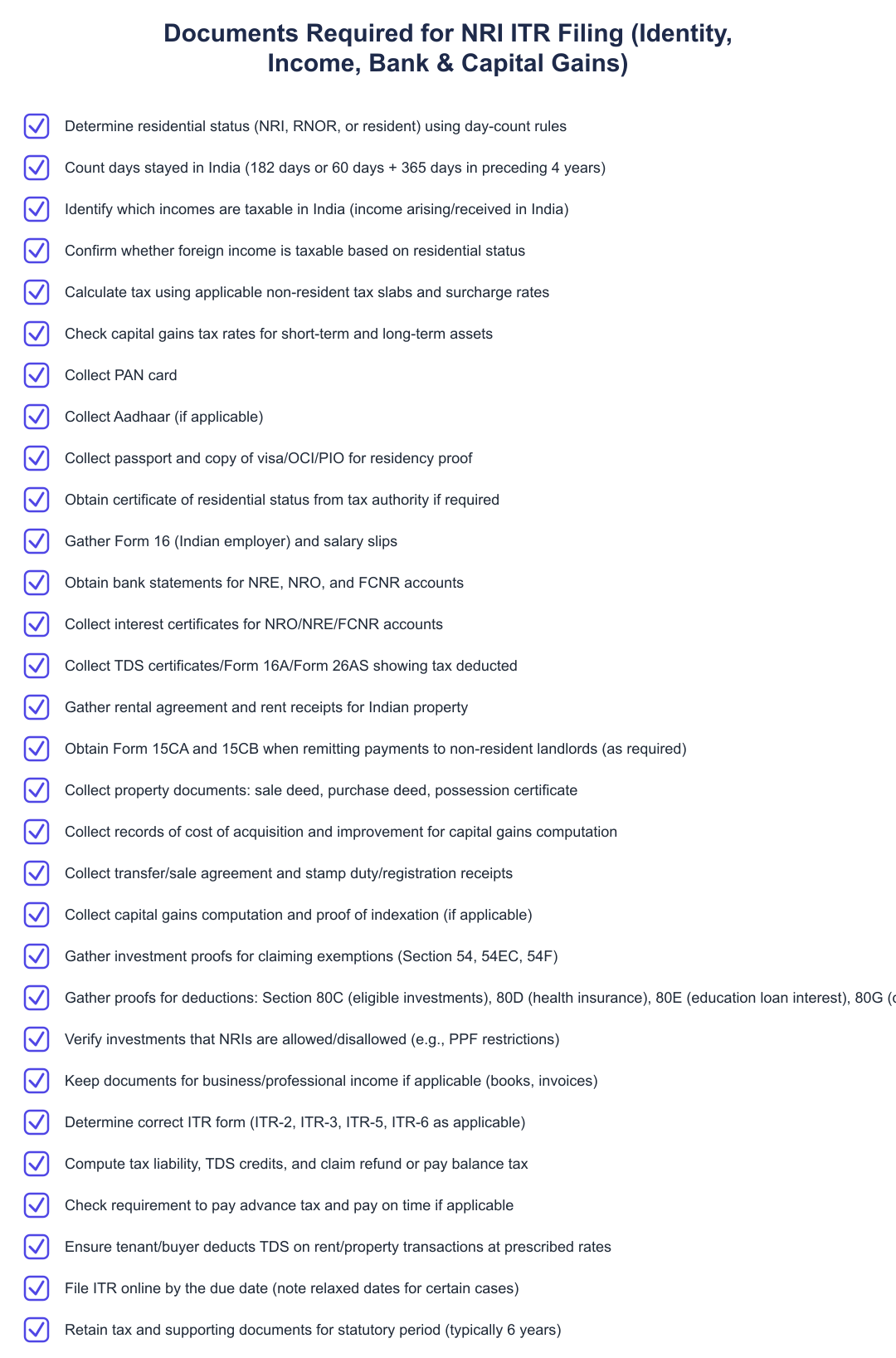
Keep passport and PAN (or TIN) ready; these are mandatory identity proofs for filing.
Collect Form 16/Form 16A, Form 26AS, bank statements for NRO/NRE/FCNR(B), and capital-gains papers to compute taxable income and credits.
Select ITR-2 for salary/property/capital gains; ITR-3 if you have business or professional income; ITR-5/ITR-6 for firms/companies as applicable.
File by 31 July 2026 for most taxpayers; if you are a non-resident with business income in India, use the relaxed due date of 31 August 2026.
How can NRIs Avoid Double Taxation?
NRIs should rely on the residential status rule to understand India taxation (India-source income taxable). To avoid double taxation, NRIs typically look to the provisions of Double Taxation Avoidance Agreements (DTAAs) between India and their country of residence and to tax credits available for taxes paid abroad. While this guide does not reproduce DTAA provisions, NRIs should consult the applicable DTAA text or a tax adviser to determine relief mechanisms.
Practical steps to reduce double taxation include claiming foreign tax credits where law permits, restructuring timing of receipts or sales to change the character or timing of income, and ensuring correct TDS certificates and documentation for claiming credit or refund in either jurisdiction.
Frequently Asked Practical Points
If your total India income is within basic exemption limits (Rs. 2.5 lakh under old regime or Rs. 4 lakh under new regime for FY 2025-26), filing is not required although you may file to claim refunds where TDS has been deducted.
TDS is often deducted at source on payments to NRIs, for rent, property sale, interest and dividends, and these rates are relatively high, so NRIs should check withholding and claim refunds or credits by filing the return if excess tax has been withheld.
NRIs must focus on two things: correctly determine residential status and identify whether income is India-source. Keep accurate records (PAN, passport, Form 16/16A, bank statements, capital gains documents) and pick the correct ITR form. Watch TDS on Indian receipts, use available deductions such as 80D, 80E and 80TTA where applicable, and note the filing due dates (including the relaxed deadline for business income). For complex cross-border situations or to claim DTAA benefits, consult a tax professional to ensure correct treatment and avoid double taxation.
Frequently asked questions
How do I know if I'm an NRI for Indian income tax purposes?
You are an NRI (non-resident Indian) for income tax purposes if you did not stay in India for 182 days or more in the relevant financial year, or if you stayed in India for fewer than 182 days but for at least 60 days in the current year and 365 days in the preceding four years combined. These two tests determine residential status under the Income Tax Act and distinguish NRIs from residents and resident-but-not-ordinarily-resident (RNOR) categories. Your residential status decides whether only India-sourced income (for NRIs) or global income (for residents) is taxable in India, so check your physical presence days carefully when filing ITR.
Is my foreign income taxable in India if I'm an NRI?
No, as an NRI, only income that arises or is received in India is taxable in India; foreign-sourced income (income earned and received outside India) is generally not taxable in India. Examples of taxable India-sourced income include salary for services rendered in India, rent from property situated in India, capital gains on transfer of assets situated in India, and interest on NRO accounts. However, if you become a resident (or RNOR under certain conditions), your global income may become taxable; also double taxation avoidance agreements (DTAA) or foreign tax credits may apply to avoid being taxed twice.
What income tax slab rates apply to NRIs in India for 2026?
NRIs are taxed at the same slab rates as resident individuals; under the old/regular slab the rates are: nil up to ₹2,50,000, 5% for ₹2,50,001–₹5,00,000, 20% for ₹5,00,001–₹10,00,000 (plus ₹12,500), and 30% above ₹10,00,000 (plus ₹1,12,500). The new tax regime (FY 2025-26 onward) provides alternate slabs with a higher basic exemption, nil up to ₹4,00,000, then 5% (₹4–8 lakh), 10% (8–12 lakh), 15% (12–16 lakh), 20% (16–20 lakh), 25% (20–24 lakh), and 30% above ₹24 lakh, which NRIs can opt for subject to conditions. Surcharge and cess (4% health and education cess) apply in addition, and the choice between old and new regimes affects available deductions.
How are capital gains taxed for NRIs on sale of Indian assets?
Capital gains arising from transfer of assets located in India are taxable in India for NRIs; long-term capital gains (LTCG) and short-term capital gains (STCG) have different rates depending on the asset. Listed equity shares and equity mutual funds (where STT is paid) have STCG taxed at slab rates and LTCG taxed at 12.5% on gains above ₹1.25 lakh per year (per sections 111A/112A), while other assets such as immovable property or gold follow slab rates for STCG and special LTCG rules (section 112) with different computations including indexation or prescribed rates. Buyers of property from NRIs must deduct TDS (12.5% for property sale) at time of purchase, and NRIs can claim exemptions under Sections 54, 54EC and 54F by reinvesting capital gains in specified assets or bonds.
Which deductions and exemptions can NRIs claim in their Indian ITR?
NRIs can claim many standard deductions available to resident taxpayers, including Section 80C deductions (subject to permitted investment types and limits), deduction for interest on house property under Section 24, health insurance premium deduction under Section 80D (up to ₹25,000 for self/spouse/children and additional limits for parents), education loan interest under Section 80E, donation deductions under Section 80G, and Section 80TTA deduction on savings interest up to ₹10,000. Some exemptions specific to capital gains, Sections 54, 54EC and 54F, allow reinvestment-based relief on long-term capital gains from property sales. Note that certain instruments (like new PPF subscriptions, NSCs, post office small savings schemes) are not available to NRIs, and eligibility for 80C investments may be restricted.
Do NRIs have to pay TDS on Indian income and what are the common TDS rates?
Yes, tax is often collected at source for NRI incomes: common TDS rates include 30% on rent paid to NRIs, 12.5% on property sale (buyer’s TDS on acquisition from a non-resident), 30% on interest credited to NRO accounts, and 20% on dividend payments to non-residents as per the published table. Actual rates can vary by nature of income, presence of DTAA relief, or lower withholding certificate; NRIs should furnish PAN/Aadhaar and submit relevant forms (such as 15CA/15CB where applicable) to reduce or obtain credit for TDS, and the TDS deducted can be claimed while filing the final ITR.
Which ITR form should an NRI file in India?
The appropriate ITR form for an NRI depends on the nature of income: ITR-2 is used by NRIs with salary, house property, capital gains, and foreign assets (but no business income), ITR-3 is for those having business or professional income, ITR-5/ITR-6 apply to firms and companies respectively. Choose the form that matches your income profile, for example, NRIs with only salary and capital gains should use ITR-2, and attach required documents like Form 16, bank statements, and capital gains statements when filing online. Filing correctly ensures correct computation of tax, TDS credit, and eligibility for refunds.
When must an NRI file income tax return and do NRIs need to pay advance tax?
An NRI must file an income tax return in India if taxable income arises or if TDS has been deducted and a refund is to be claimed; the standard due date (for FY 2025-26) is 31st July 2026 for most taxpayers, with a relaxed due date of 31st August 2026 for non-residents having business income; these dates may be extended by the government. NRIs have to pay advance tax if their tax liability (after TDS) exceeds ₹10,000 in a financial year; however, tax withheld at source (TDS) and specific thresholds may reduce or eliminate the need for advance tax payments. Late filing can attract interest and penalties, so NRIs should estimate payable tax, pay advance installments if applicable, and reconcile TDS while filing ITR.
How can NRIs avoid double taxation on the same income?
NRIs can avoid double taxation through Double Taxation Avoidance Agreements (DTAAs) India has with many countries, and by claiming foreign tax credit for taxes paid abroad against Indian tax payable on the same income, subject to DTAA provisions and documentation. To claim relief, NRIs must disclose foreign taxes paid and the nature of income in the Indian ITR, provide tax residency certificates and proof of tax paid abroad when required, and choose the most beneficial method of relief (exemption or credit) as per the DTAA. It’s important to check the specific DTAA between India and the country of residence because rates, tie-breaker rules and methods of relief vary by treaty.
Need help staying Income Tax compliant?
MoneyGence's AI Finance OS tracks your compliance, wallet share, and finances in one place, built for agencies and growing businesses.
Get started with MoneyGence