Old vs New Tax Regime 2025-26: Which Regime Is Better?
This guide explains how to decide between the older income tax regime (which allows many deductions and exemptions) and the newer simplified tax regime (which offers lower slab rates but significantly restricts deductions). You will learn the practical differences between the two approaches, the types of income and expenses that matter in each regime, and a framework to estimate which option is likely to save you more tax. Rather than focusing on exact rates or thresholds, this article emphasises decision-making: how to weigh your eligible deductions, how standard deductions and exemptions change the calculus, and the common scenarios where one regime tends to be more beneficial than the other. The aim is to equip salaried taxpayers, investors and non-resident Indians with the reasoning and checklist needed to pick the right regime for their circumstances for the financial year in question.
Old v/s New Tax Regime - Income Tax Slabs
The two regimes differ primarily in how taxable income is computed and taxed. The new regime generally offers a simplified slab structure with more tax-free income bands at lower rates, while the old regime follows a more traditional slab system but permits a wide set of deductions and exemptions that reduce taxable income.
Because the numeric slab breakpoints and rates are not discussed here, focus instead on the behavioural difference: under the new regime you get lower nominal tax at the cost of losing many deductions; under the old regime you accept higher nominal slab rates but can reduce taxable income substantially by claiming eligible exemptions and deductions. This trade-off determines which regime yields lower final tax for any taxpayer.
In practice, the correct choice depends on the taxpayer’s income composition and the quantum of deductible items they can legitimately claim. Someone with few deductible investments or allowances will often find the new regime convenient, whereas a taxpayer with significant deductible investments, home loan interest, or other allowable exemptions may find the old regime more tax-efficient.
Old v/s New Tax Regime Calculator
A side-by-side calculation is the most reliable way to pick the better regime. Build a simple worksheet that starts from gross income and then computes taxable income under each regime: for the old regime subtract all applicable deductions and exemptions, and for the new regime apply the permitted standard deduction (if any) and restricted allowances.
When comparing results, include all relevant employer-provided allowances, deductible investments, insurance premiums, home loan interest where allowed, and any other deductible items. Also add cess or surcharge components to the computed tax so you compare total tax outflow under both regimes.
If you do not have a ready calculator, many tax portals and payroll software provide an old-vs-new comparison tool where you can input income and deduction details to get an instant recommendation. Use such a tool to validate your worksheet, and always cross-check inputs for accuracy because small differences in claimed deductions can flip which regime is preferable.
Old v/s New Tax Regime - Deductions and Exemptions
The distinguishing feature of the old regime is availability of a wide set of deductions and exemptions. These include commonly claimed investment-linked deductions, medical premium deductions, interest deductions on eligible home loans, specific allowances linked to employment, and reliefs available for retirement and certain specified incomes. Each of these reduces taxable income and therefore the tax liability under the old regime.
The new regime, by contrast, restricts or disallows many of these benefits. It keeps only a narrow set of exemptions and standard allowances, making compliance simpler and reducing the need for maintenance of proof for many types of expenses. The trade-off is that taxpayers who routinely use the old-regime deductions to lower taxable income may end up paying more tax if they switch to the new regime.
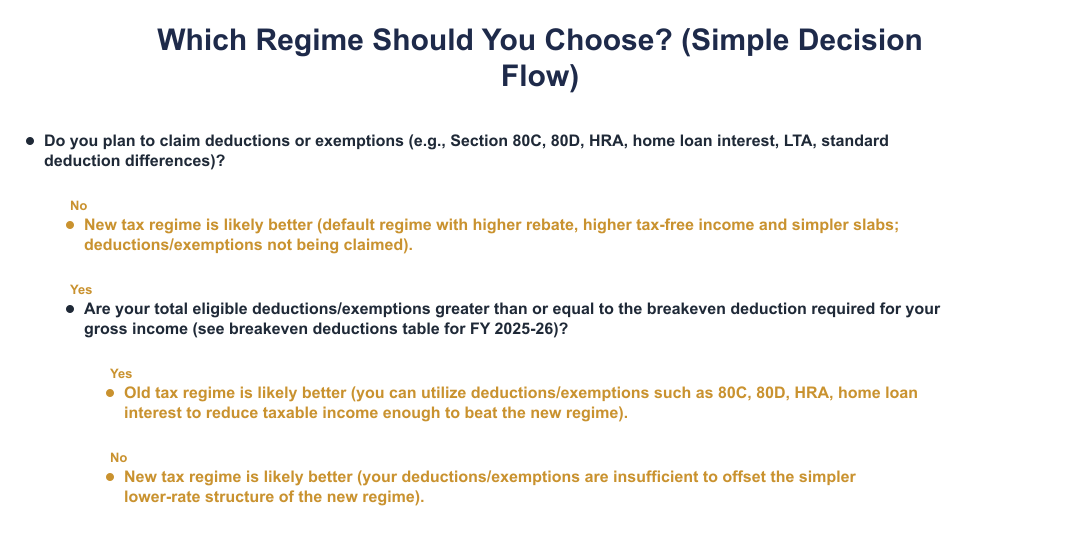
In deciding, list all deductions and exemptions you currently claim or could claim legitimately. Add up their impact on taxable income and then assess whether the aggregate benefit outweighs the lower nominal rates of the new regime. For many taxpayers the breakeven point is determined by the total value of such deductions; if the total deductible value is substantial, the old regime often remains preferable.
New Tax Regime vs Old Tax Regime – Which Is Better?
There is no universal answer; the better regime depends on individual circumstances. Key factors to consider are: the total of your tax-deductible investments and expenses, your salary structure (how much of your compensation is in allowances that are taxable or exempt), and specific items such as home loan interest or large medical expenses that can be claimed under the old regime.
A practical approach is to run two parallel computations for the same financial year. If the tax saved by claiming deductions under the old regime exceeds the additional tax you would pay under its higher slabs, then the old regime is preferable. Conversely, if you have few allowable deductions and you prefer simplicity, the new regime will often be better.
Remember also to consider non-tax factors: some taxpayers prefer the behavioural nudges of tax-saving investments, while others prioritise liquidity and simpler compliance. For employees who frequently change jobs or have variable allowances, the simplified new regime can reduce paperwork and year-end reconciling between employer and employee disclosures.
Examples
Example scenarios are useful to illustrate the mechanics without absolute numbers. Consider a salaried individual with relatively modest non-housing deductions: under the new regime the taxpayer benefits from simpler slabs and limited allowances; under the old regime the taxpayer would need significant deductible investments or expenses for the old regime to yield lower tax.
Conversely, an individual with heavy deductible outlays, such as long-term investments eligible under investment-linked deduction provisions, health insurance premiums, and interest on eligible housing loans, typically finds the old regime more attractive because those deductions meaningfully reduce taxable income and offset the higher marginal rates.
Breakeven Deductions When Old Tax Regime Will Be Better
The breakeven concept asks: what minimum total deduction amount makes the old regime as attractive as the new regime? To find this, compute tax under the new regime and then determine the deduction amount under the old regime that reduces taxable income until the two taxes are equal. That deduction threshold is the breakeven point.
In practice, compute this threshold by trial: incrementally add deductible amounts (investments, premiums, interest) in your old-regime worksheet until the resulting tax equals the new-regime tax. If your realistic deduction total exceeds that threshold, the old regime is likely the better choice. If not, stick with the new regime for simplicity.
Which Tax Regime is Better for Investors?
Investors who channel funds into tax-saving instruments or who have significant deductible financial outgo generally find the old regime advantageous because it rewards such behaviour with reductions in taxable income. If your portfolio strategy already aligns with available deductions, the old regime can amplify the tax benefit of those investments.
However, if your investments are driven solely by return considerations and you do not use tax-oriented instruments, the new regime’s lower nominal slabs and simpler compliance can be more attractive. Evaluate whether the tax benefit from dedicating capital to eligible instruments compensates for any perceived opportunity cost from choosing those instruments over potentially higher-return alternatives.
Which Tax Regime is Better for NRIs?
Non-resident taxpayers should weigh the nature of their India-sourced income and the availability of deductions. If NRIs have limited scope to claim domestic deductions or their Indian income mainly comprises salary and investment income without large deductible outlays, the new regime’s simplicity often wins.
If an NRI has substantial deductible items in India, such as certain qualifying investments, insurance premiums, or housing interest where allowed, the old regime can still be preferable. NRIs should also consider reporting and proof requirements in their country of residence when claiming domestic deductions, since compliance complexity can offset tax savings.
Choosing between the old and new tax regimes requires a comparison of your personal income composition and the total value of deductions you can legitimately claim. Build a simple two-column calculation, find the breakeven deduction level, and factor in compliance convenience. Where deductions are substantial, the old regime often wins; where they are scarce, the new regime’s simplicity may be preferable. Run both computations before finalising your decision for the year.
Frequently asked questions
Which tax slabs apply under the new tax regime for FY 2025-26?
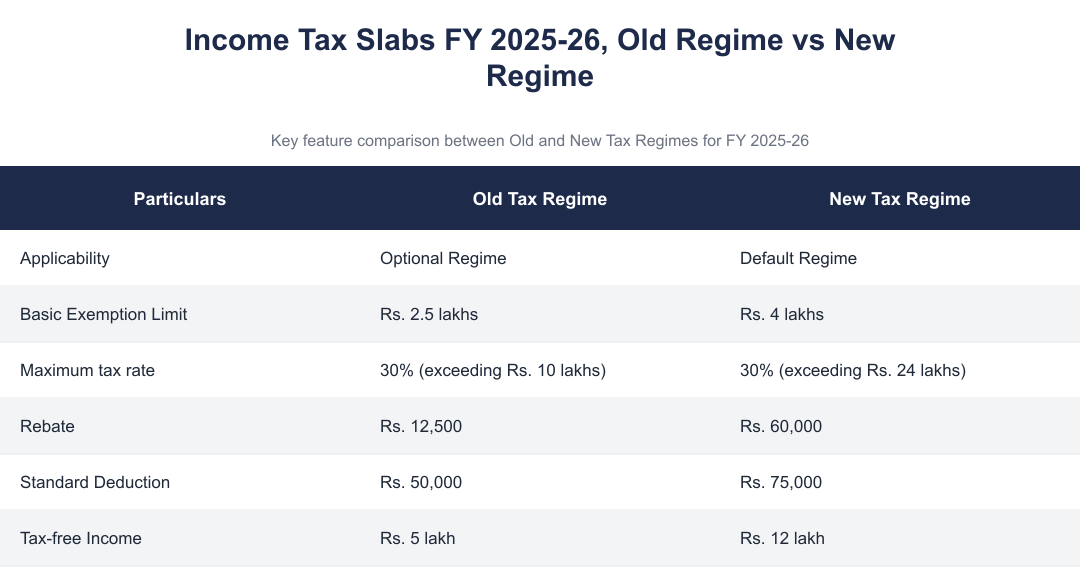
Under the new tax regime for FY 2025-26, income up to Rs. 4 lakh is tax-free and rates then progress from 5% to 30% with slabs: Rs. 4–8 lakh at 5%, Rs. 8–12 lakh at 10%, Rs. 12–16 lakh at 15%, Rs. 16–20 lakh at 20%, Rs. 20–24 lakh at 25%, and above Rs. 24 lakh at 30%. The basic exemption limit is Rs. 4 lakh (higher for senior citizens: Rs. 3 lakh for 60–80 years and Rs. 5 lakh for above 80), and the new regime’s maximum marginal rate is 30% for income above Rs. 24 lakh. The regime also offers a higher rebate (Rs. 60,000) and a larger standard deduction (Rs. 75,000) compared with the old regime.
What are the tax slabs under the old tax regime for FY 2025-26?
Under the old tax regime for FY 2025-26, the basic exemption is Rs. 2.5 lakh and tax rates are: Nil up to Rs. 2.5 lakh, 5% from Rs. 2.5–5 lakh, 20% from Rs. 5–10 lakh and 30% above Rs. 10 lakh. The old regime’s maximum marginal rate is 30% for income exceeding Rs. 10 lakh, and the tax rebate available is Rs. 12,500 which phases out above certain incomes. It also provides a standard deduction of Rs. 50,000 and allows common deductions and exemptions such as HRA, Section 80C, 80D, and home loan interest up to specified limits.
Can I claim HRA in the new tax regime?
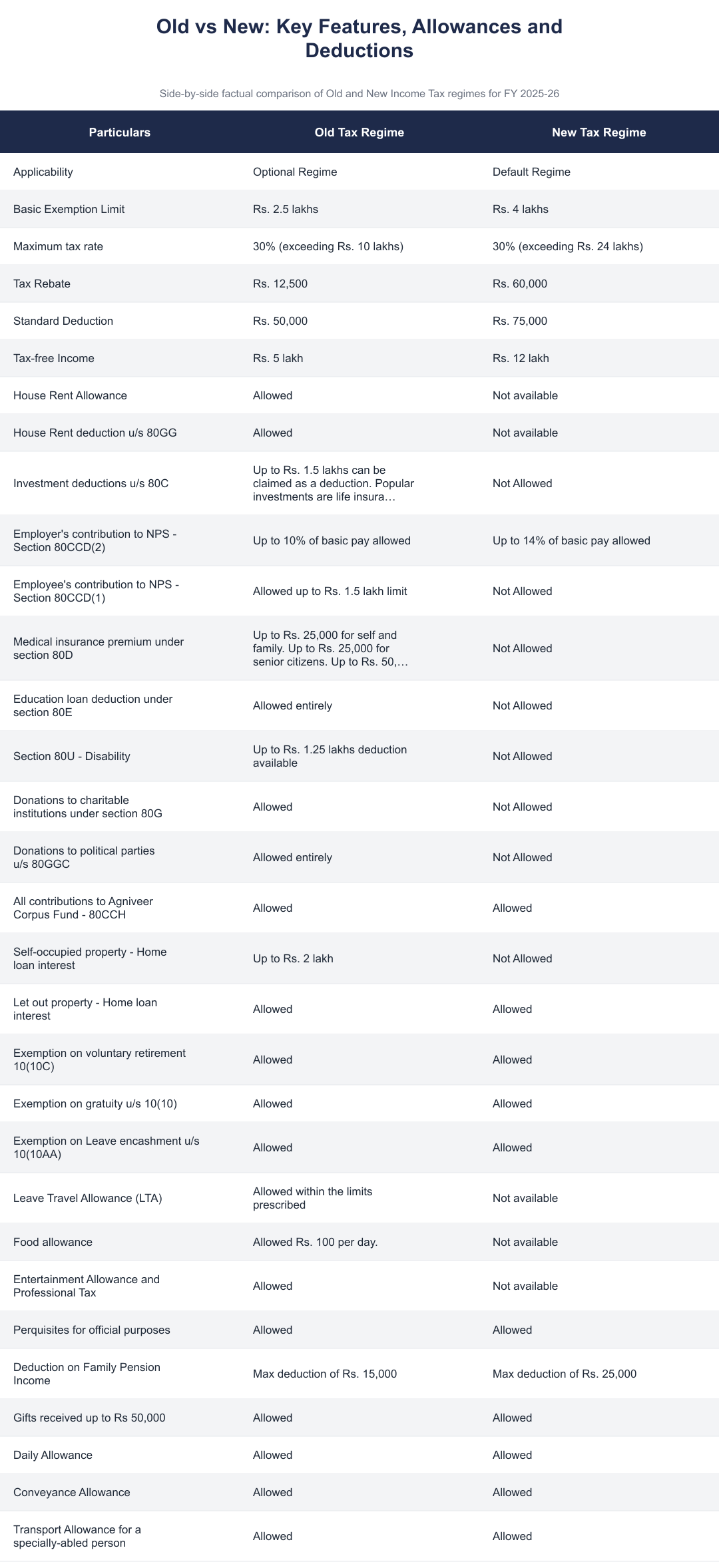
No, House Rent Allowance (HRA) exemption is not available under the new tax regime. HRA is allowed only in the old regime where salaried taxpayers who live in rented accommodation can claim HRA subject to prescribed limits. If you want to claim HRA along with other common exemptions (like 80C or home loan interest), you must opt for the old regime; otherwise the new regime disallows HRA and many other exemptions.
How does home loan interest treatment differ between old and new regimes?
Home loan interest for a self-occupied property is deductible up to Rs. 2 lakh under the old tax regime but is not allowed under the new tax regime for self-occupied homes. Interest for let-out property is allowed in both regimes (subject to normal rules), and other home-loan linked deductions such as principal repayment under Section 80C remain available only in the old regime. Therefore, borrowers with significant self-occupied home loan interest (up to Rs. 2 lakh) will generally benefit from the old regime if other deductions also apply.
How much can I claim under Section 80C and is it allowed in the new regime?
Under Section 80C you can claim up to Rs. 1.5 lakh in the old tax regime for investments such as life insurance, ELSS, and fixed deposits; this deduction is not available in the new tax regime. Popular 80C investments (up to Rs. 1.5 lakh) significantly reduce taxable income under the old regime, making it preferable for taxpayers who use these tax-saving instruments. Employer contributions to NPS (Section 80CCD(2)) remain allowed with different limits (up to 10% basic pay in old and up to 14% in the new), but employee NPS contributions under 80CCD(1) fall under the old regime’s 1.5 lakh cap and are not available under the new regime.
What is the standard deduction under both regimes for FY 2025-26?
For FY 2025-26 the standard deduction is Rs. 75,000 in the new tax regime and Rs. 50,000 in the old tax regime. This higher standard deduction in the new regime reduces taxable salary income directly but may not offset the loss of other exemptions and deductions you could claim under the old regime. When deciding between regimes, compare the benefit of the larger standard deduction in the new regime against the total value of deductions and exemptions (like 80C, 80D, HRA, home loan interest) you would give up.
How do I know which regime (old or new) is better for me for FY 2025-26?
The better regime depends on your total taxable income and the amount of deductions/exemptions you can claim; the new regime favors taxpayers with few deductions while the old regime benefits those with substantial deductions like 80C, 80D, HRA, or home-loan interest. Use the breakeven deduction table: for example, if your gross income is up to Rs. 12 lakh, the new regime is generally better (breakeven deduction = 0), but at Rs. 20 lakh gross you need roughly Rs. 7.08 lakh of deductions/exemptions for the old regime to be beneficial. Practical approach: compute tax under both regimes (there are calculators available) using your specific deductions, whichever gives lower tax payable is the preferable regime for FY 2025-26.
How do rebates differ between the old and new regimes for FY 2025-26?
For FY 2025-26 the new tax regime provides a larger tax rebate of Rs. 60,000 (effectively making income up to Rs. 12 lakh tax-free under certain conditions), while the old regime’s rebate is Rs. 12,500 (applicable for lower incomes up to its threshold). The new regime’s higher rebate plus wider tax-free income band (Rs. 12 lakh treated as tax-free in some contexts) makes it attractive for taxpayers with moderate incomes and few deductions. Keep in mind that rebate applicability depends on taxable income thresholds and the specific provisions for FY 2025-26.
Are NRIs treated differently under old and new tax regimes for FY 2025-26?
NRIs can choose between the old and new tax regimes and most common tax-saving deductions available to residents under the old regime (like 80C investments) are also available to NRIs, so the choice depends on their income and deduction profile similar to residents. A few exceptions apply to NRIs, certain deductions like section 80TTB (senior citizen interest deduction) are not available to NRIs, but broadly the calculation principle and breakeven deductions are the same. Therefore, if an NRI has substantial eligible deductions (80C, 80D, home loan interest where allowed), the old regime may be better; otherwise the new regime’s relaxed slabs and larger standard deduction might be preferable.
Need help staying Income Tax compliant?
MoneyGence's AI Finance OS tracks your compliance, wallet share, and finances in one place, built for agencies and growing businesses.
Get started with MoneyGence