One Person Company vs Sole Proprietorship India, Key Differences
Choosing the right business form is one of the first and most important decisions for entrepreneurs in India. This guide compares two common structures for single-owner businesses: Sole Proprietorship and One Person Company (OPC). You will learn how they differ in legal identity, registration requirements, liability exposure, continuity, management, and compliance obligations. Understanding these differences matters because they affect personal risk, ease of starting and running the business, and long-term suitability as the business grows. This article focuses strictly on the legal and compliance distinctions defined under Indian company and tax law so you can make a practical choice that aligns with your risk appetite and plans for scale. Read on to get a clear, factual comparison that highlights what each structure means in practice for a small business owner.
Sole Proprietorship
A sole proprietorship is the simplest business form in which one individual owns and operates the business. There is no compulsory registration required to start and run a sole proprietorship in India, which makes it straightforward to begin operations.
Legally, a sole proprietorship does not have a separate existence from its owner, the proprietor and the business are the same legal entity. Because of this, the proprietor bears unlimited liability for business debts and obligations.
Another practical implication of the lack of separate legal status is that the business does not continue independently when the proprietor dies or retires; the business comes to an end on the proprietor’s death or retirement.
Advantages of Sole Proprietorship
A key practical advantage is the simplicity of setup: with no compulsory registration, a sole proprietor can commence trade quickly without company incorporation formalities. This lower entry barrier often makes sole proprietorship attractive for micro and small-scale operations.
Decision-making and management are concentrated in a single person, enabling quick choices and direct control over business affairs. For many owners, this clear control and operational ease are decisive benefits compared with corporate forms that require formalities and multiple officeholders.
Disadvantages of Sole Proprietorship
Unlimited liability is the major downside: the sole proprietor is personally responsible for business liabilities, which puts personal assets at risk in case of business debts. This exposure can be significant for businesses with higher liability or credit needs.
Because the business does not have perpetual succession, it ends when the proprietor dies or retires. That lack of continuity can make long-term contracts, succession planning, or external investment more difficult compared with entities that survive changes in membership.
One Person Company
An OPC is a corporate form created to allow a single person to enjoy the benefits of limited liability while running a company structure. An OPC must be registered under the Companies Act, 2013 on the MCA website; it cannot be set up without formal incorporation.
Unlike a sole proprietorship, an OPC has a separate legal status distinct from its member. This separate legal entity status limits the member’s liability to the extent of shares held, protecting personal assets from company liabilities within that limit.
OPC also provides continuity: it has perpetual succession and continues to exist independent of the member, because a nominee or director steps in on the member’s death. For single-owner ventures seeking corporate continuity, this is a key structural advantage.
Advantages of OPC
Limited liability is the primary advantage, the member’s liability is limited to the shares of the company. This separation reduces personal financial exposure compared with a sole proprietorship.
OPC is also easy to incorporate relative to multi-member companies because only one member and one nominee are required at incorporation. The single-member structure combined with corporate status gives small business owners an accessible pathway to formal company benefits such as continuity and recognized legal personality.
Disadvantages of OPC
An OPC is suitable only for small business structures since the maximum number of members it can have is one; growth that requires multiple members will necessitate conversion to another company form. This structural limit can constrain businesses planning rapid expansion or multiple owners.
Certain business activities are restricted for OPCs: an OPC cannot conduct a Non-Banking Financial Investment activity, including investment in securities of any other company. Also, because the sole member often serves as director, there may be limited separation between ownership and management.
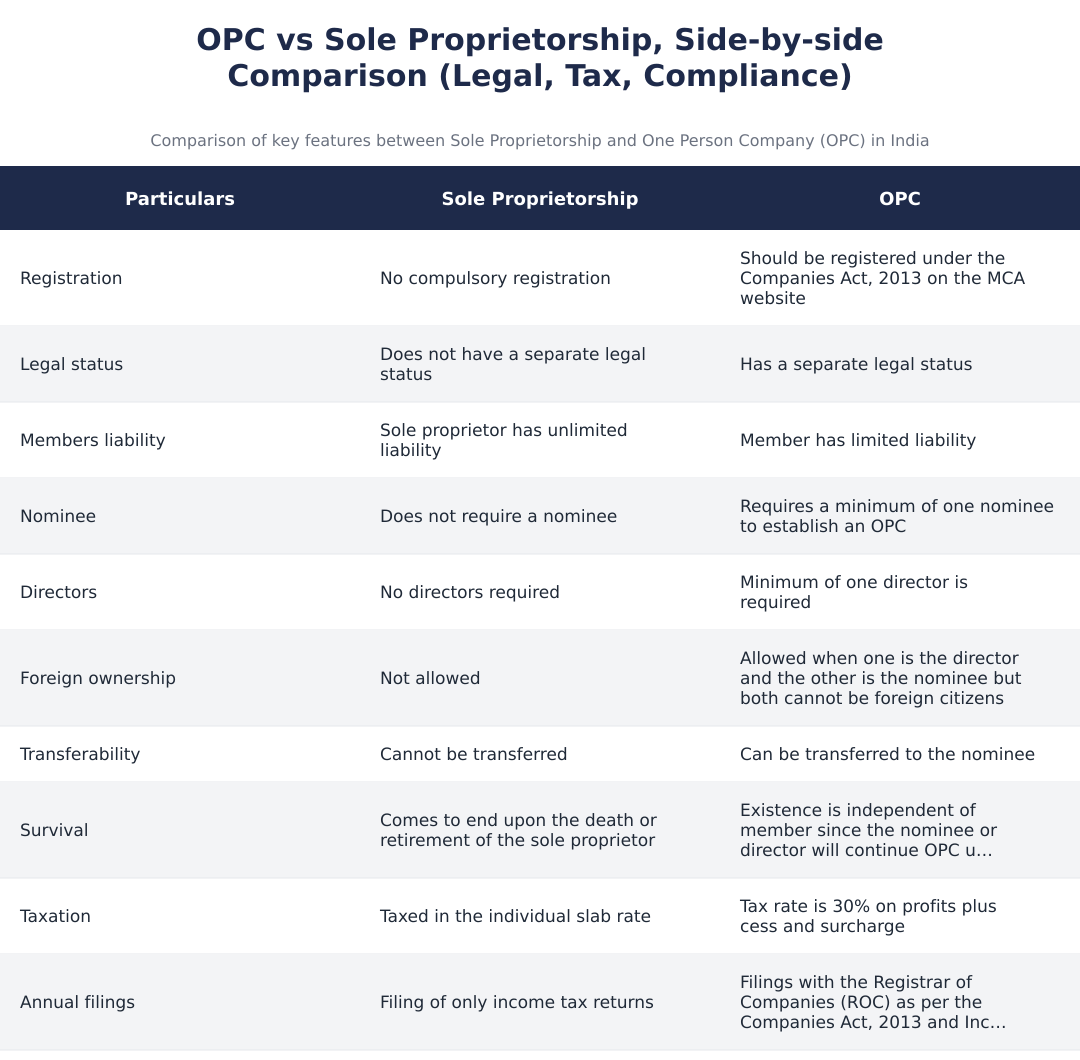
Difference between Sole Proprietorship and OPC
| Particulars | Sole Proprietorship | OPC |
|---|---|---|
| Registration | No compulsory registration | Should be registered under the Companies Act, 2013 on the MCA website |
| Legal status | Does not have a separate legal status (the proprietor and business are same) | Has a separate legal status (separate legal entity) |
| Members liability | Sole proprietor has unlimited liability | Member has limited liability (liability limited to shares) |
| Nominee | Not required | Requires a minimum of one nominee to be appointed at the time of incorporation |
| Directors | No directors required | Minimum of one director is required |
| Perpetual succession | Comes to end upon the death or retirement of the sole proprietor (no perpetual succession) | Has perpetual succession and continues to exist independent of the member (nominee/director steps in on member’s death) |
| Restrictions | No specific restriction stated | Cannot conduct a Non-Banking Financial Investment activity, including investment in securities of any other company |
| Suitability | Suitable for individuals preferring simple setup and direct control | Suitable only for small business structures since the maximum number of members an OPC can have is one |
| Ownership vs Management | Ownership and management are the same person | When the sole member is also the director, there may be no clear distinction between ownership and management |
| Annual filings | Filing of only income tax returns | Filings with the Registrar of Companies (ROC) as per the Companies Act, 2013 and Income Tax Act |
| Taxation | Taxed in the individual slab rate (business income taxed as owner’s personal income) | No specific corporate tax figure provided in the verified facts |
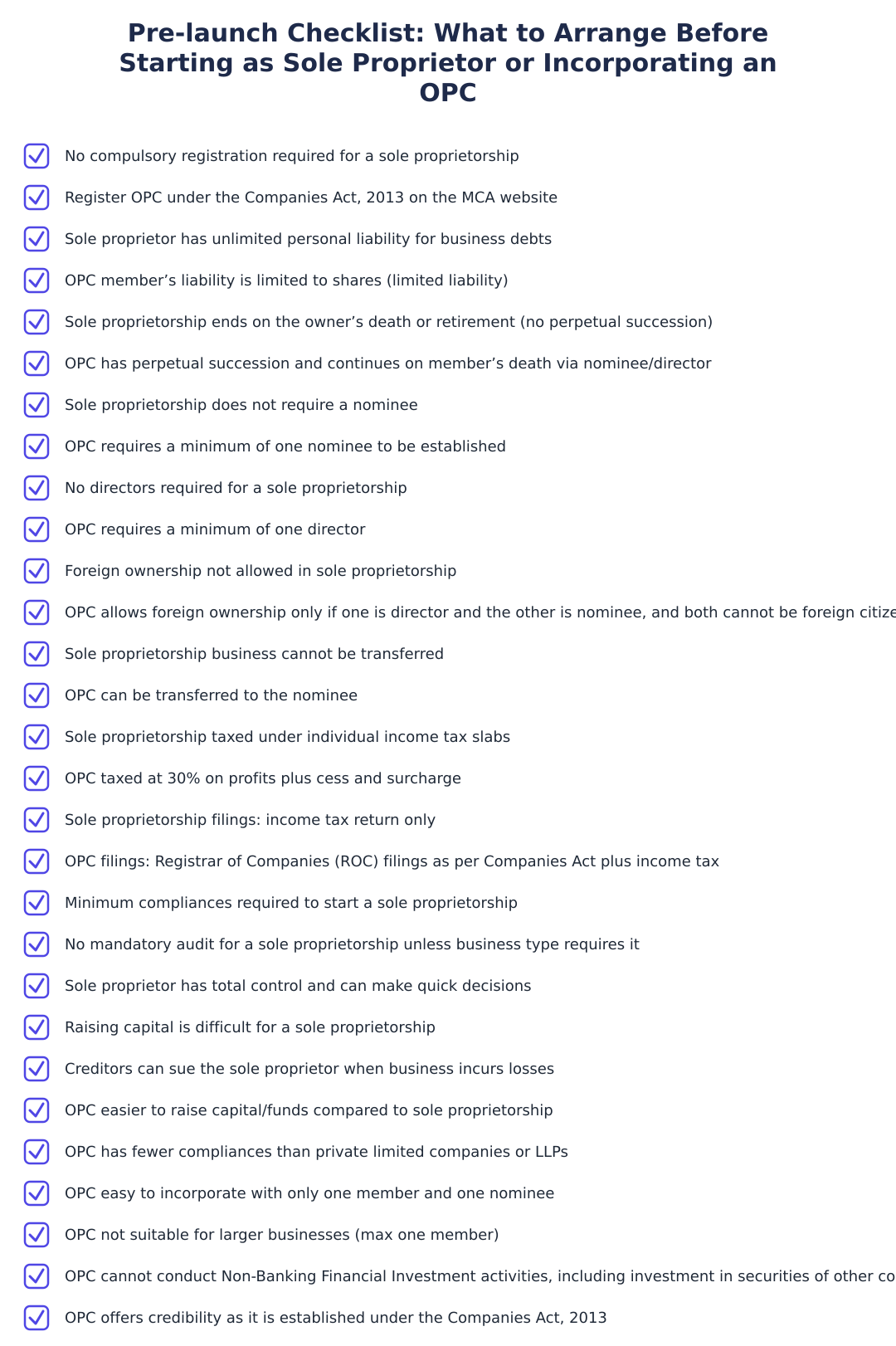
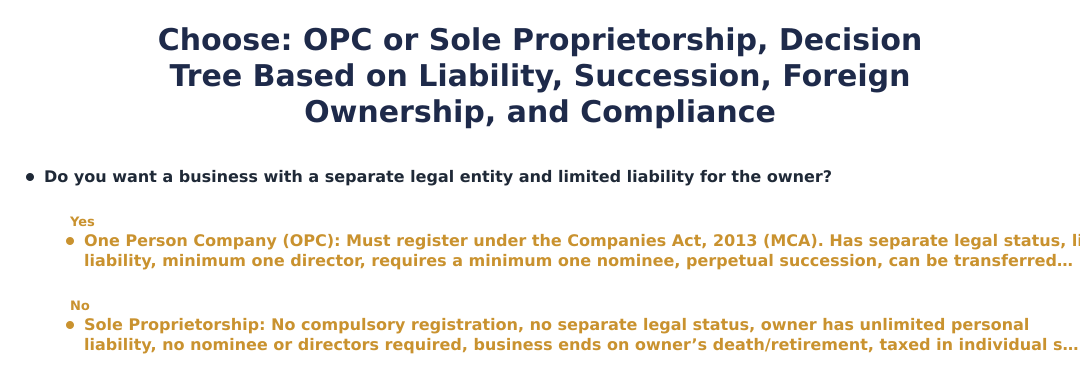
Selecting between a sole proprietorship and an OPC depends on your priorities: simplicity and full control with personal liability (sole proprietorship), or corporate status, limited liability and continuity with incorporation and compliance (OPC). Use the points above to weigh risk exposure, ease of setup, and long-term plans for your business before deciding. If you plan to limit personal liability or require business continuity beyond your own tenure, OPC is the clearer fit; if you value minimal formalities and direct control, a sole proprietorship may be appropriate.
Frequently asked questions
What is the main difference between a One Person Company (OPC) and a sole proprietorship in India?
The main difference is that an OPC is a separate legal entity while a sole proprietorship is not. An OPC is registered under the Companies Act, 2013 on the MCA portal and has perpetual succession and limited liability for its single member, whereas a sole proprietorship has unlimited liability, ends on the proprietor's death and has no separate legal status. OPCs require at least one nominee and one director and must file returns with the Registrar of Companies (ROC), while sole proprietorships need only income tax filings. Taxation also differs: OPC profits are taxed at company rates (around 30% plus cess and surcharge) while a sole proprietor's business income is taxed under individual slab rates.
Do I need to register a sole proprietorship in India?
No, there is no compulsory registration required to start a sole proprietorship in India. A sole proprietorship can commence operations with minimal compliances, making it economical to start, though certain licenses or registrations (GST, local trade license, or industry-specific permits) may still be required depending on the business activity. There is no requirement for directors or nominee, and the proprietor has full control and can make quick decisions without board approvals. However, lack of formal registration means the business has no separate legal identity and the proprietor bears unlimited liability.
How do taxes differ for an OPC and a sole proprietorship?
An OPC is taxed as a company, generally around 30% on profits plus cess and surcharge, while a sole proprietorship is taxed at the proprietor's individual slab rates. This means a sole proprietor may pay progressive personal tax rates based on total income, whereas OPC profits attract corporate tax rates and company compliance requirements. Additionally, OPCs must comply with filings under the Companies Act and Income Tax Act, while sole proprietorships mainly file income tax returns and any other applicable returns like GST. Choice of structure can therefore affect overall tax liability and compliance burden.
Can an OPC be started by a foreign citizen or include foreign ownership?
Foreign ownership in an OPC is restricted: one person can be a director and the other a nominee, but both director and nominee cannot be foreign citizens at the same time. This means OPCs allow limited foreign participation only if at least one of the required persons is an Indian citizen. Sole proprietorships generally do not have formal foreign ownership rules because they are not separate legal entities but practical limitations on foreigners starting sole proprietorships may apply depending on regulatory and visa rules. Always check sector-specific FDI rules and seek professional advice before planning cross-border ownership.
Does a sole proprietorship have limited liability protection?
No, a sole proprietorship does not provide limited liability protection; the sole proprietor has unlimited liability for business debts and obligations. This means the proprietor's personal assets can be used to settle business liabilities, and creditors can file suits against the individual if the business cannot pay. In contrast, an OPC limits the member’s liability to the amount unpaid on shares, shielding personal assets from company creditors except in cases of fraud or personal guarantees. The unlimited liability aspect makes sole proprietorships riskier for businesses with significant financial exposure.
What are the annual compliance differences between OPC and sole proprietorship?
An OPC must file statutory returns with the Registrar of Companies (ROC) under the Companies Act, 2013 in addition to income-tax filings, whereas a sole proprietorship typically only needs to file income tax returns and sector-specific returns like GST. OPCs are required to maintain company records, hold statutory meetings as applicable, and meet company law compliance even though they have fewer compliances than larger private limited companies. Sole proprietorships have simpler record-keeping and fewer formalities, but may still need audits if statutory limits are crossed or specific business types require it. The higher compliance for OPCs increases credibility but also administrative cost.
Can an OPC be transferred or continue after the owner's death?
Yes, an OPC offers transferability and perpetual succession: the company can be transferred to the nominee and its existence continues independent of the member’s death. A nominee must be appointed at the time of incorporation so that the nominee or director can continue the OPC upon the member’s death, unlike a sole proprietorship which ceases on the proprietor's death or retirement. This feature ensures business continuity and easier succession planning for family or designated successors. Transferability and continuity make OPCs more suitable where long-term survival of the business is desired.
What are the advantages of running a business as an OPC rather than a sole proprietorship?
The advantages of an OPC include separate legal entity status, limited liability for the member, easier access to capital, perpetual succession, and greater credibility since it is formed under the Companies Act, 2013. OPCs have fewer compliances compared to private limited companies or LLPs and are simpler to manage because only one member and one nominee are required, making incorporation straightforward. The limited liability protects the member's personal assets from company debts, and the company structure can improve trust with banks and investors. However, OPCs are best suited to small businesses because membership is limited to one person and some activities like NBFC services are restricted.
What are the disadvantages or limitations of an OPC compared to a sole proprietorship?
Disadvantages of an OPC include restrictions on certain activities (like non-banking financial investment activities), suitability only for very small businesses since membership is limited to one person, and less clear separation between ownership and management when the sole member also serves as director. OPCs also involve registration costs and ongoing ROC compliance which a sole proprietorship typically avoids, and they cannot expand membership beyond one without converting to another form of company. While OPCs provide limited liability and credibility, these limitations make them less flexible than other company structures for growth or multi-person ownership.
Need help staying Company Registration compliant?
MoneyGence's AI Finance OS tracks your compliance, wallet share, and finances in one place, built for agencies and growing businesses.
Get started with MoneyGence