Online ESI Return Filing: Process & Penalty for Late Filing
This guide explains how employers handle online Employees’ State Insurance (ESI) return filing and what happens if contributions are not paid on time. You will learn the broad sequence of actions an employer must follow to register and file returns online, practical tips for keeping records and ensuring accurate filings, and the typical consequences businesses face when contributions are delayed or missed. While specific form names, rates, and time‑limits can change with notifications from ESIC or the government, this article focuses on the practical workflow and compliance risks so you can prepare better and avoid common pitfalls. Knowing the process is important because ESI compliance affects payroll operations, employee benefits, and your organisation’s legal standing; lapses can trigger financial charges and enforcement steps that disrupt business operations. This guide is aimed at HR, payroll teams, and business owners who want a clear, non-technical overview of online filing and the general implications of late payment.
Registration and filing overview
Before an employer can file any ESI returns online, the organisation must complete the statutory registration process with the ESI authority. Registration is the starting point: it establishes the employer’s account in the ESI system and links employees to the employer for contribution and benefit purposes. Employers should plan registration well ahead of the first payroll cycle that will be subject to ESI so that there is no gap in coverage or reporting.
After registration, employers use the ESIC online portal to submit periodic returns and keep employee records updated. The official ESIC website for these activities is www.esic.nic.in, and employers must log in there to file returns. Maintaining accurate employee and wage information in the portal is essential because returns and any contribution calculations are based on the data recorded in the account.
Practical steps employers typically follow
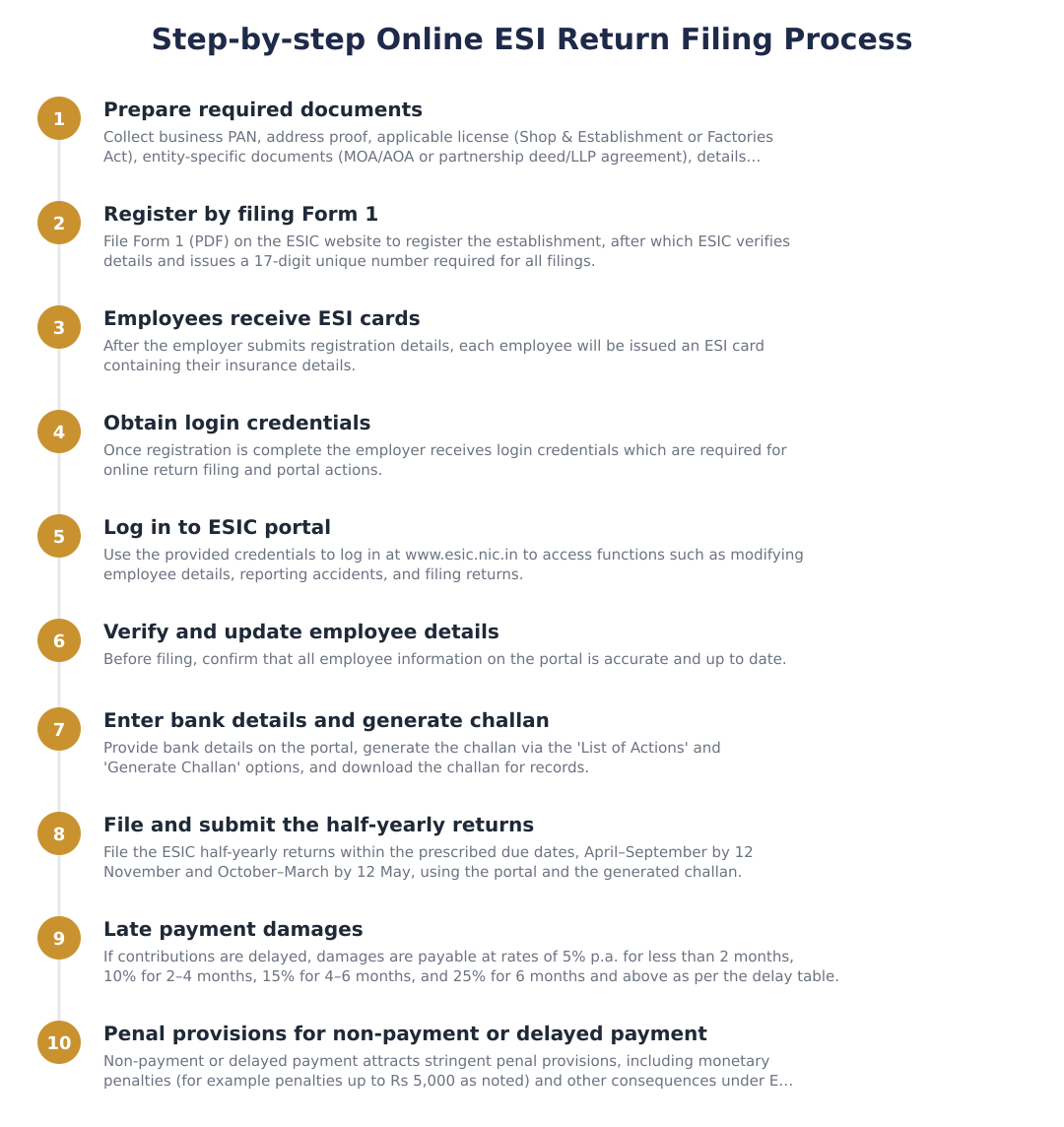
In practice, employers follow a sequence: gather and verify company and employee information; complete online registration; obtain login credentials; update employee details as changes occur; prepare and review the periodic return; and make the required payment through the portal. Keeping a checklist of the records referenced during registration and filing reduces errors and makes subsequent audits or inspections easier to handle.
It is good compliance practice to reconcile payroll records with the entries in the ESIC account each period. Reconciliation helps identify mismatches early, for example, missing employee entries or incorrect wage figures, so they can be corrected before submitting the return. Timely reconciliations reduce the risk of downstream notices or queries from the authorities.
Consequences of non-payment or late payment of employees’ contribution
Failure to pay employee contributions or delays in payment attract adverse consequences under the ESI framework. These can include financial charges such as interest or damages, administrative penalties, and potential legal action depending on the severity and duration of non-compliance. Such consequences are intended to encourage timely compliance and to protect the solvency of the insurance fund that provides employee benefits.
Beyond monetary charges, non-payment can affect employees’ access to ESI benefits until the matter is remedied. For employers, persistent non-compliance may lead to inspections, notices from the authority, and potential reputational damage. Treating contribution obligations as a recurring statutory commitment in the payroll calendar helps prevent inadvertent breaches.
Consequences of delayed payment
When payments are delayed, the statutory framework typically provides for levy of additional financial charges that increase with the length of delay. These charges compensate the fund for late receipts and create an incentive for timely remittance. Employers should expect their payroll teams to monitor due dates and make payments in advance of deadlines to avoid escalation of charges.
Delays also complicate accounting and payroll administration because they require adjustments, late payment computations, and possibly communication with the authority to regularise the account. Prompt resolution, making the outstanding payment and correcting any reporting errors, is usually the fastest way to restore normal operations and limit additional costs.
Penal provisions for non-payment or delayed payment of contribution
The ESI scheme includes penal provisions that can be applied when employers fail to pay or delay paying contributions. These provisions are part of the broader enforcement toolkit and may include monetary penalties and other sanctions available to the authority. Understanding that penalties are a real possibility underscores the importance of compliance processes and internal controls.
Employers should ensure clear internal ownership for ESI filings and payments, document approvals for each payroll run, and keep evidence of payments and filings. If a dispute arises regarding liability or the amount payable, engaging with the ESI authority promptly and maintaining transparent records will help in resolving the issue with minimal escalation.
Staying compliant with ESI filing and payment requirements is primarily about disciplined processes: register early, keep employee records updated, reconcile regularly, and use the ESIC portal (www.esic.nic.in) for submissions. Although specific rates, deadlines and penalties change over time, the practical approach, treat contributions as routine statutory payments and maintain clear records, will minimise the risk of charges and enforcement action.
Frequently asked questions
How do I register my business for ESI online?
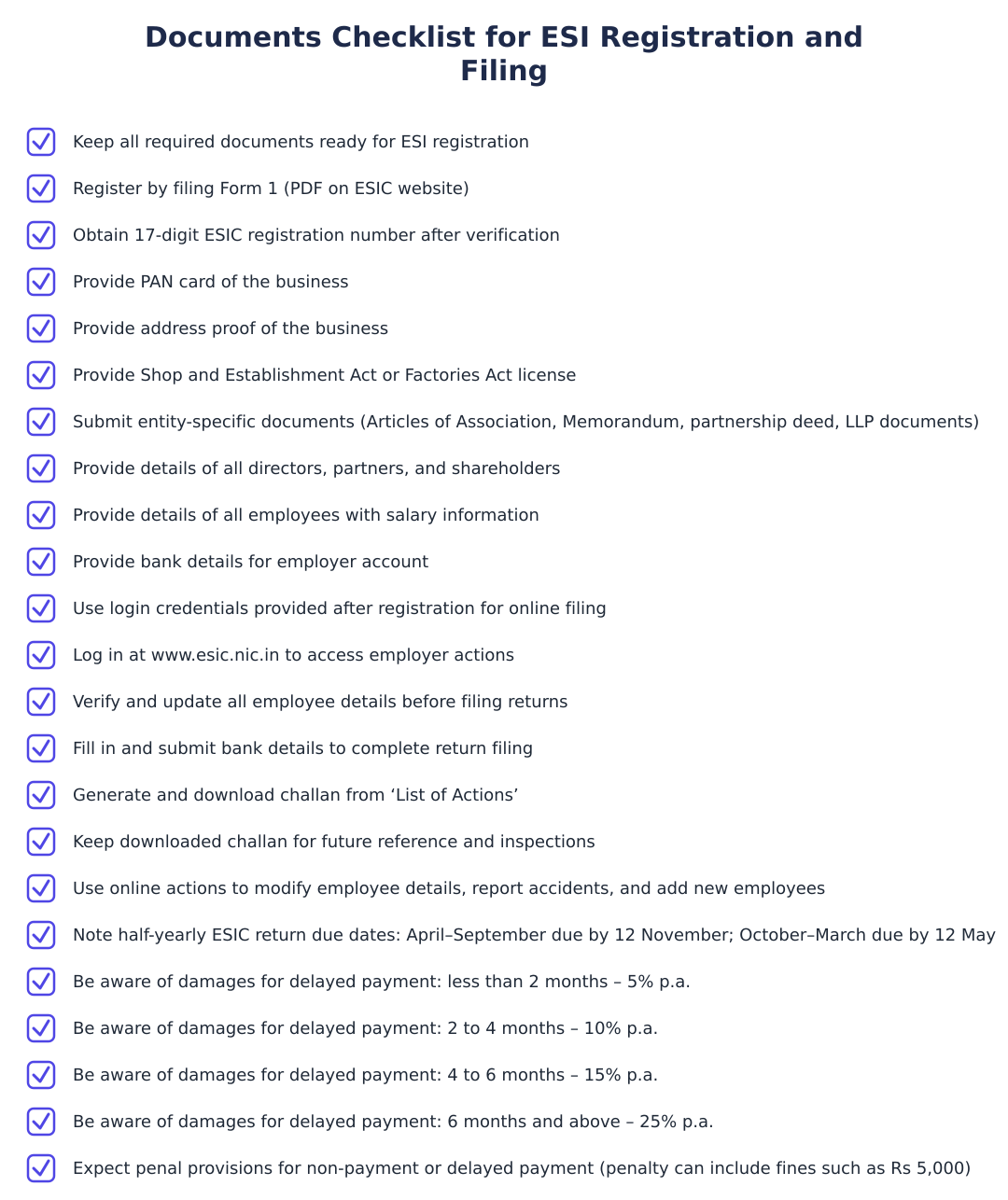
You register for ESI online by filling Form 1 on the ESIC website and submitting the required company and employee documents. After filing Form 1 (available in PDF on www.esic.nic.in) ESIC verifies the details and issues a 17‑digit unique number that will be required for all future filings. Required documents include the business PAN, address proof, applicable Shop and Establishment or Factories Act license, entity documents (AoA/MoA, partnership deed or LLP papers), details of directors/partners/shareholders, details of all employees with salary information, and bank details. Once registration is complete each employee is issued an ESI card based on the employer’s submissions.
What login credentials do I get after ESI registration and how do I file returns online?
After successful registration you receive login credentials which you must use to access the employer services on the ESIC portal (www.esic.nic.in). Using those credentials you can modify employee details, report accidents, add employees and most importantly file returns by first verifying employee details, entering bank details and then generating a challan. You must download and keep the generated challan for record and inspections, and the portal lists actions such as ‘Generate Challan’ and ‘List of Actions’ to complete the filing. The portal workflow requires checking employee information is up to date before submitting contributions and challans are needed to show payment.
When are ESIC half‑yearly returns due?
ESIC half‑yearly returns are due twice a year: for the period April to September the due date is 12 November, and for October to March the due date is 12 May. Employers must ensure all employee data and contributions for the relevant half‑year are reconciled and filed by these dates to avoid late filing issues. The return filing process on the ESIC portal includes verifying employee details, filling bank details and generating the challan before final submission. Late filing can attract damages and other penal consequences if contributions are unpaid or delayed.
What is the penalty for delayed payment of ESI contributions?
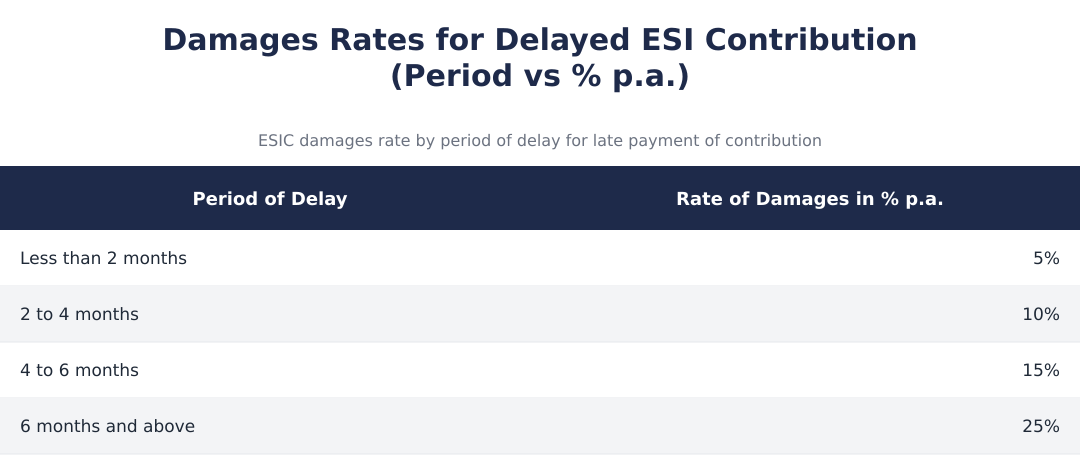
The penalty for delayed payment is charged as damages at rates that increase with the length of delay: less than 2 months, 5% p.a., 2 to 4 months, 10% p.a., 4 to 6 months, 15% p.a., and 6 months and above, 25% p.a. These percentages are applied as damages on the overdue contribution amount and rise steeply if the contribution remains unpaid for six months or longer. The ESIC takes non‑payment seriously because ESI benefits are for employees, so employers should pay on time to avoid substantial additional costs. Recovery proceedings and other penal actions may follow persistent non‑payment or delays.
What happens if I don’t pay the employee’s ESI contribution on time?
If you don’t pay the employee’s ESI contribution on time you will incur damages at the prescribed rates depending on the delay and ESIC may initiate recovery or other penal proceedings. The law treats non‑payment seriously because ESI funds provide important employee benefits, and the employer remains liable for both the contribution and statutory penalties. In practice this means additional financial liability (5%–25% p.a. depending on delay) and potential administrative or legal action by ESIC for persistent defaults. Employers should reconcile and pay both employer and employee shares through the challan generated on the ESIC portal to avoid these consequences.
What documents should I keep ready before starting online ESI registration?
You should keep PAN of the business, business address proof, the applicable Shop and Establishment Act or Factories Act license, entity formation documents (Articles/Memorandum, partnership deed or LLP documents), details of directors/partners/shareholders, details and salary information of all employees, and bank details ready before registration. These documents are required to accurately complete Form 1 and support the employer’s registration on the ESIC portal so ESIC can verify details and issue the 17‑digit unique number. Having these documents ready speeds up registration and reduces errors that could delay issuance of employee ESI cards. Maintain copies for future audits and to upload when prompted during online filing.
How do I generate and use the ESIC challan for payment?
You generate the ESIC challan from the employer’s dashboard on the ESIC portal after verifying employee details and entering bank information; this challan is then used to make the contribution payment. Once generated you must download and retain the challan as proof of payment and for future inspections because the portal does not replace physical record‑keeping. The challan reflects the contribution amounts for employer and employee shares and is necessary to complete the return filing process for the half‑yearly period. Keep a copy of the challan and the transaction receipt to reconcile with ESIC records and avoid disputes.
Can I modify employee details after registration on the ESIC portal?
Yes, you can modify employee details after registration by logging into the ESIC portal with your credentials and using the available actions such as modify employee details and add or remove employees. It is important to keep employee information and salary details up to date before filing the half‑yearly return, because mismatched data can lead to filing errors or benefit issues for employees. Any changes should be completed and reconciled prior to generating the challan and filing the return to avoid penalties or processing delays. The portal also allows reporting of accidents and other employer actions related to employees.
What are the broader consequences of non‑payment or delayed payment of ESI contributions?
Beyond the immediate damages, non‑payment or delayed payment of ESI contributions can trigger strict administrative and legal consequences because contributions fund employee benefits and ESIC enforces compliance stringently. ESIC can pursue recovery proceedings, levy increasing damages (from 5% to 25% p.a. depending on delay), and may initiate penal actions for persistent defaults which can include prosecution or other enforcement measures. Employers who fail to file returns or pay contributions also risk employees being unable to access ESI benefits and may face inspections or penalties during audits. To avoid these outcomes, employers should file half‑yearly returns by 12 November and 12 May and ensure timely payment of contributions through the portal challan mechanism.
Need help staying Payroll compliant?
MoneyGence's AI Finance OS tracks your compliance, wallet share, and finances in one place, built for agencies and growing businesses.
Get started with MoneyGence