Partnership Firm Registration in India – Procedure & Documents
This guide explains the registration procedure for partnership firms under the Indian Partnership Act and why registration matters for partners. You will learn who can form a partnership, what information a partnership deed must contain, which documents are commonly required for registration, and the practical benefits of registering versus remaining unregistered. The guide also walks through the procedural steps, starting from name selection to filing the registration application (Form 1), and provides checklists to prepare the firm for registration with the Registrar of Firms in the state where the firm is located. Understanding these points helps partners decide whether to register their firm at formation or later, and ensures they include the right clauses in the partnership deed to govern capital, profit sharing, responsibilities, and contingencies such as retirement or death of a partner. The information here is framed to help small businesses and professionals comply with statutory expectations, avoid common pitfalls in name selection, and preserve legal rights such as suing to enforce contractual claims or claiming set-off in proceedings, benefits that attach to a registered partnership firm.
Advantages of Partnership Firm
A partnership firm is a business where two or more persons come together and share profits in an agreed ratio. The basic structure allows for relatively simple formation and straightforward decision-making among partners, which is attractive to small businesses and professional practices.
Registration confers specific legal advantages. A registered firm (and its partners) can sue to enforce rights arising from contracts against the firm or its partners, and can also file suits against third parties to enforce contractual rights. Additionally, a registered firm can claim set-off in proceedings brought against it, protections that an unregistered firm does not enjoy.
Disadvantages of Partnership Firm
Partnerships require at least two members and may have up to twenty partners, which makes them suitable for small to medium groups but limits growth through additional partners beyond that cap.
Because partners are generally bound by the partnership structure, issues such as unlimited liability, lack of perpetual succession, or limitations in raising large amounts of capital can be practical disadvantages compared with corporate forms. These structural limitations mean partners should carefully draft the partnership deed to address duties, rights and contingencies.
What is Partnership Registration?
Partnership registration is the process by which partners file details of their firm with the Registrar of Firms in the state where the principal place of business is located. It is carried out by submitting the prescribed application and supporting documents to the Registrar.
Registration is not compulsory; partners may choose to register their firm at formation or subsequently. However, because registration provides important legal rights, such as the ability to sue to enforce contractual rights and to claim set-off, many partnerships opt for registration to protect their legal position.
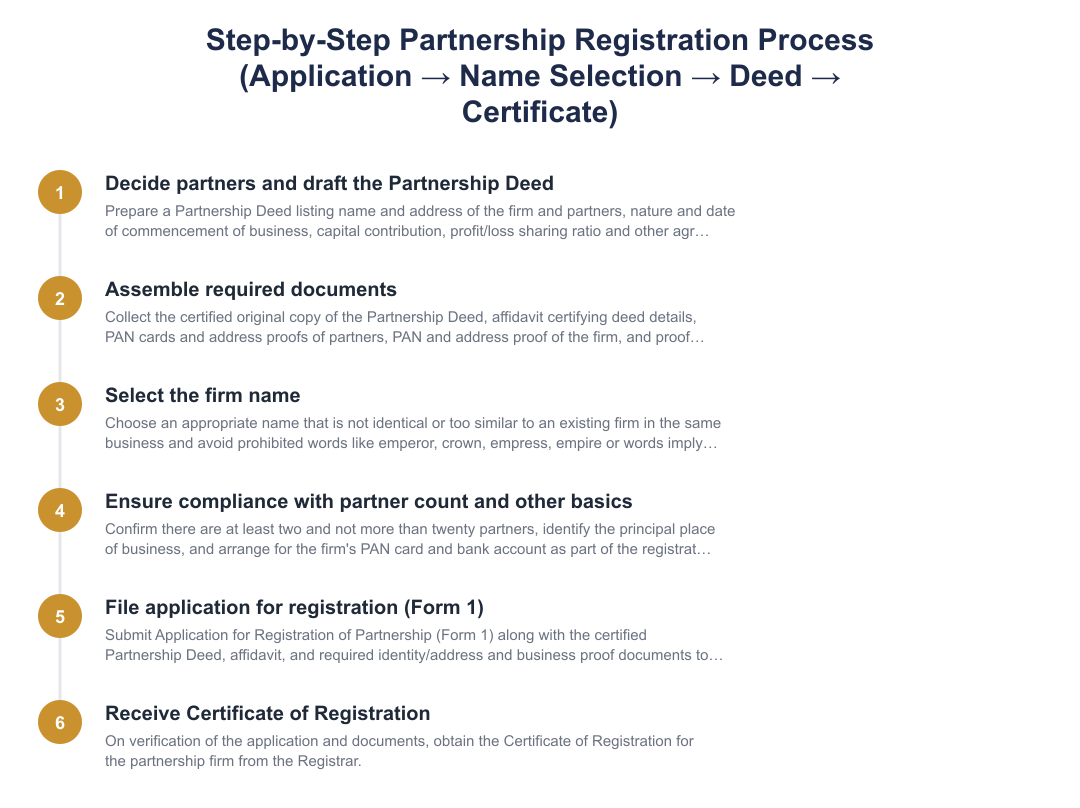
Procedure for Registering a Partnership Firm
Choose a firm name that is not too similar or identical to an existing firm carrying on the same business and does not include words implying government sanction or approval (for example: emperor, crown, empress, empire).
Prepare a partnership deed that contains mandatory information such as the name of the firm, principal place of business, locations of other business places, date of joining of each partner, names and permanent addresses of all partners, and the duration of the firm.
Assemble commonly required documents: certified original copy of the partnership deed; an affidavit certifying the deed details; PAN and address proofs of partners; PAN and address of the firm; and proof of the principal place of business (ownership or rental/lease agreement).
Submit Application for registration of partnership (Form 1) along with the certified deed and the supporting documents to the Registrar of Firms of the state where the firm is located.
On successful scrutiny, the Registrar issues the certificate of registration, after which the firm can exercise rights available to registered firms such as suing to enforce contractual rights and claiming set-off.
Documents for Registration of Partnership
| Document | Purpose / Notes |
|---|---|
| Certified original copy of Partnership Deed | Primary record of terms; must contain firm name, addresses, partners, dates and duration |
| Affidavit certifying deed details | Confirms correctness of information in the deed |
| PAN card and address proof of partners | Identity and address evidence for each partner |
| PAN card and address of the firm | Tax identity and registered address of the firm |
| Proof of principal place of business (ownership/rental/lease) | Establishes the state jurisdiction for registration |
| Application for registration of partnership (Form 1) | Prescribed form for filing with the Registrar of Firms |
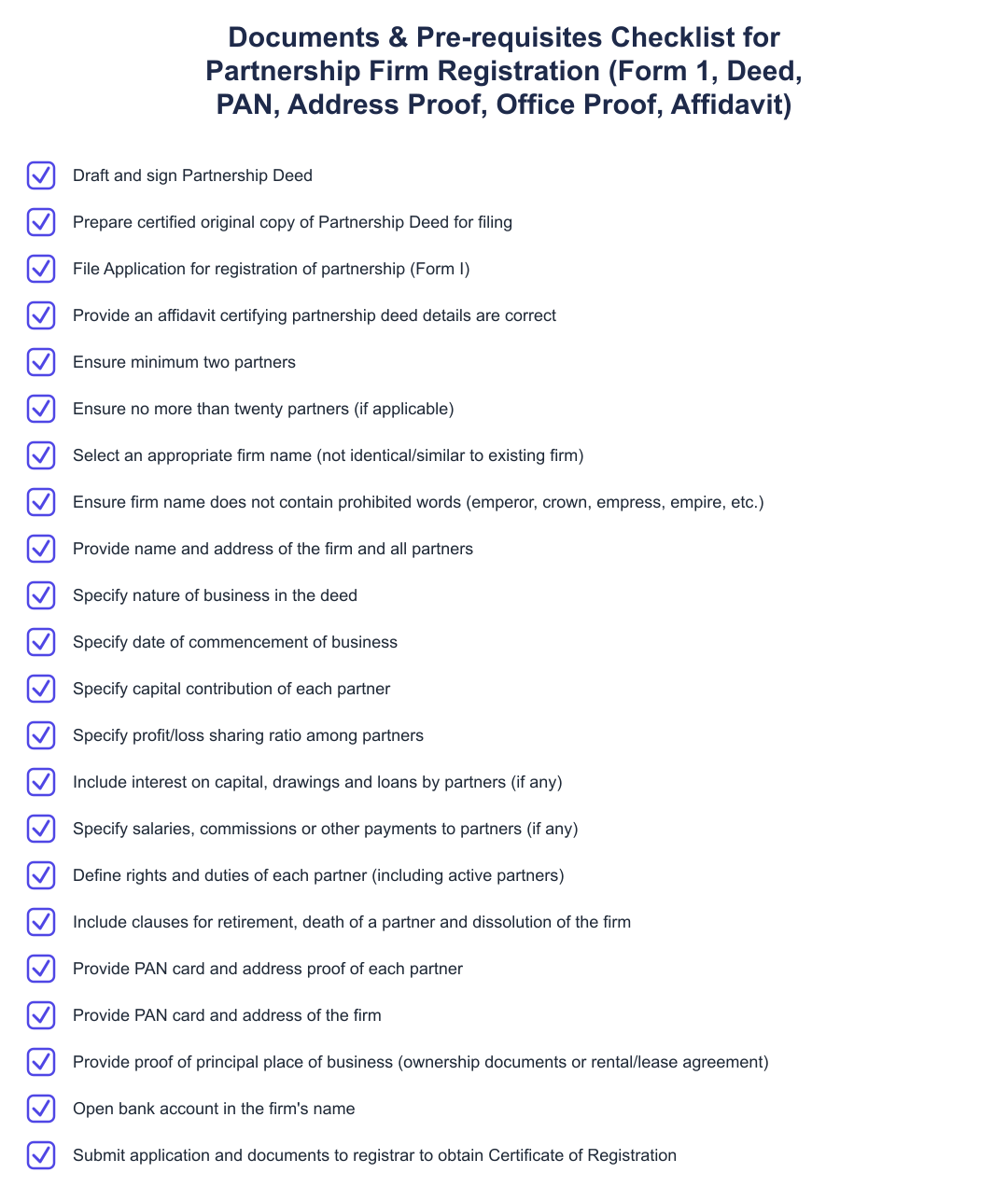
Checklist for Partnership Firm Registration
| Checklist Item | Requirement / Detail |
|---|---|
| Minimum number of partners | Minimum two members are required to form a partnership |
| Maximum number of partners | Maximum equal to or less than twenty |
| Drafted partnership deed | Deed prepared and certified for filing |
| Name selected | Name not similar to existing firm and free of government-approval words |
| Principal place of business identified | Determines the state Registrar with whom to register |
| PAN and bank account of the firm | Firm PAN and bank account details available |
Details Required in a Partnership Deed
A partnership deed must set out the essentials that govern the relationship among partners and between the firm and third parties. At a minimum it should state the firm name, principal place of business, locations of other business places, the dates when each partner joined, the names and permanent addresses of all partners, and the duration of the firm.
Beyond these mandatory items, a practical deed commonly records financial and operational arrangements: interest on capital, treatment of drawings, any loans by partners, salaries or commissions payable to partners, allocation of rights and duties among partners, and agreed procedures for retirement, death of a partner or dissolution. Partners may also include any other clauses they consider necessary by mutual agreement.
Registering a partnership firm is optional but provides clear legal benefits, especially the ability to enforce contractual rights and claim set-off. Ensure you meet the basic thresholds for number of partners, choose a compliant name, draft a comprehensive partnership deed, gather the commonly required documents and file Form 1 with the Registrar of Firms in the state of the firm’s principal place of business. A careful approach to registration and deed drafting protects partners and clarifies governance for the business.
Frequently asked questions
What is partnership firm registration and do I have to register my partnership in India?
Partnership firm registration is the process of registering a partnership with the Registrar of Firms in the state where the firm’s principal place of business is located. Registration is not mandatory under the Indian Partnership Act, 1932, but registering gives statutory advantages such as the ability to sue and be sued on behalf of the firm, claim set-off in legal proceedings, and enforce contract rights against third parties; an unregistered firm and its partners face restrictions in these matters. Any two or more persons who can legally enter into a contract may form a partnership and later register it at formation or any time during its operation. For registration the partners should prepare a partnership deed, select a name, and file Form 1 along with required documents with the Registrar of Firms.
What are the main advantages of registering a partnership firm?
Registering a partnership firm gives key legal protections such as the right to sue third parties and other partners to enforce contractual rights and to claim set-off in proceedings. Registered firms also benefit from easier bank account opening, credibility with suppliers and creditors, and clearer documentation of profit-sharing and partner rights through a partnership deed. Additionally, registration helps avoid disputes by recording the principal place of business, partner details, dates of joining, and duration of the firm. These advantages make registration practically important despite it not being legally compulsory.
What documents do I need to register a partnership firm in India?
To register a partnership firm you need Form 1 (Application for registration), the original certified copy of the Partnership Deed, an affidavit certifying the correctness of deed details and documents, PAN cards and address proofs of all partners, PAN of the firm, and proof of the principal place of business (ownership documents or rental/lease agreement). The Partnership Deed should be properly signed and witnessed and must contain required details such as names and addresses of partners, capital contributions, profit-sharing ratio and business nature. Additional state-specific documents may be required by the Registrar of Firms, so confirm local checklist before filing.
What must be included in a partnership deed for registration?
A partnership deed must include the name and address of the firm and all partners, nature of business, date of commencement, capital contributed by each partner, and profit and loss sharing ratio. It should also provide provisions on interest on capital or drawings, salaries or commissions payable to partners, rights and duties of each partner (including special rights for active partners), and procedures on retirement, death or dissolution of the firm. Other mutually agreed clauses such as dispute resolution, admission of new partners and restrictions on competition can be added to avoid future conflicts. The deed should be certified or notarised and attached to the registration application.
How do I choose an appropriate name for my partnership firm?
Choose a firm name that is not identical or too similar to an existing firm carrying on the same business and avoid restricted words like emperor, crown, empress, or empire which imply government sanction. The name must also be suitable for the nature of business and not misleading to the public; similarity checks should be done before filing to prevent objections from the Registrar. If the name is acceptable, include it in the application and the partnership deed and ensure it is used consistently in all firm documents and bank accounts. Some states may have additional naming guidelines, so verify local rules before finalising the name.
What is the step-by-step procedure to register a partnership firm?
The procedure to register a partnership firm involves drafting a partnership deed and completing Form 1 (Application for registration) to the state Registrar of Firms, choosing and verifying the firm name, and submitting the deed plus supporting documents like PANs and proof of business address. After submission, the Registrar examines the application and, if satisfied, issues a Certificate of Registration which records the firm’s name, principal place of business, partners’ names and other particulars. Registration can be done at formation or later; however, timely registration is advisable to secure the statutory rights that registered firms enjoy. Keep copies of the Certificate and deed for bank accounts, tax registration and contractual use.
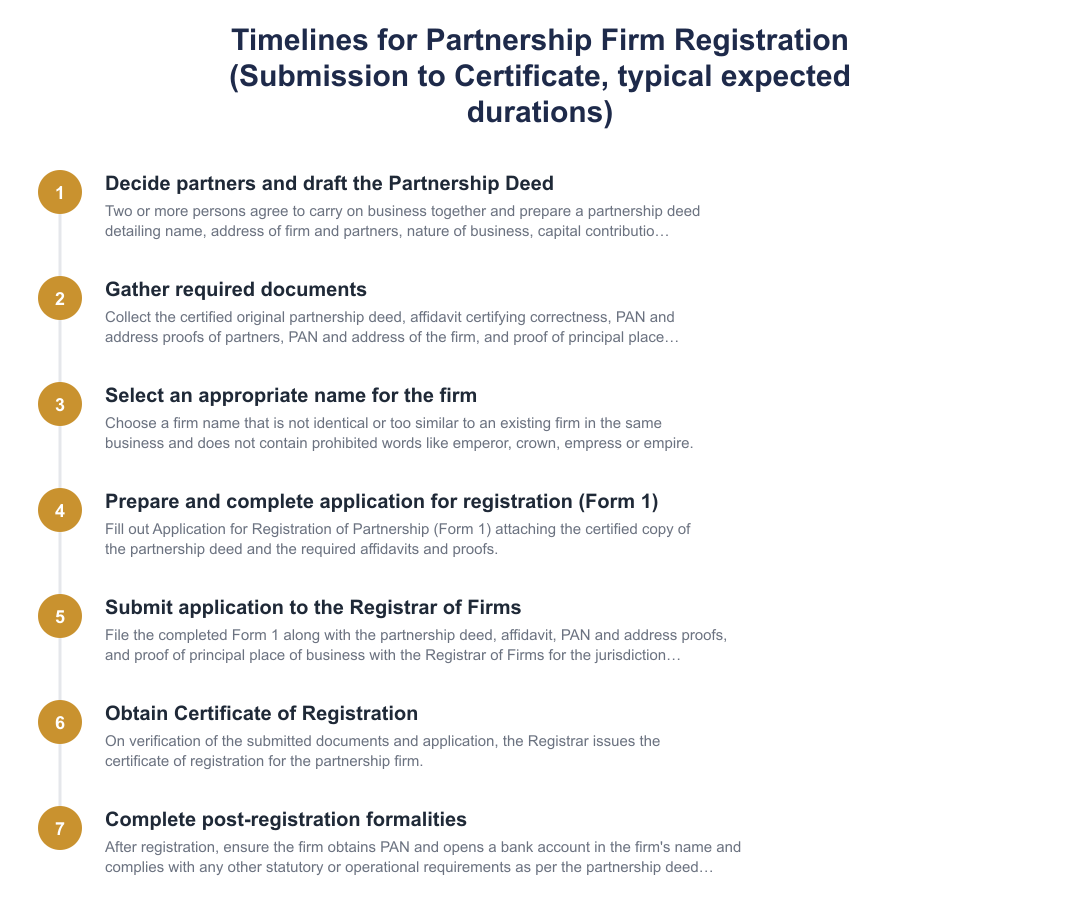
How long does partnership firm registration take and are there any timelines I should know?
Timelines for partnership firm registration vary by state and completeness of documents, but typically the Registrar issues the Certificate of Registration within a few weeks if the application and deed are in order. Delays can occur due to name objections, incomplete affidavits, mismatched PAN or address proofs, or queries from the Registrar requiring amendments. Since registration is not time-barred, partners can register anytime, but for legal advantages like suing or claiming set-off it is best to register before disputes arise. Always follow up with the Registrar promptly and ensure all partners’ details are accurate to avoid processing delays.
What are the main disadvantages and risks of running a partnership firm?
The principal disadvantages of a partnership firm include unlimited liability of partners, meaning personal assets can be used to meet firm liabilities, and lack of perpetual succession because the firm may dissolve on retirement, death or insolvency of a partner. Partnerships also typically face limited resources and difficulties raising large funds compared to companies, and decision-making can be hindered if partners disagree. These risks make clear partnership deed clauses on liabilities, retirement, dispute resolution and capital contributions critical to protect partners and provide continuity.
What is the registration checklist I should follow before applying to the Registrar of Firms?
Before applying for registration, ensure you have a properly drafted and signed Partnership Deed, at least two partners (and no more than twenty except for specific professions), selection of an appropriate name, proof of the principal place of business, PAN of the firm and partners, and a bank account in the firm’s name. Also prepare Form 1, an affidavit certifying the correctness of all details and certified copy of the deed, and verify each partner’s PAN and address proofs to avoid discrepancies. Following this checklist will speed up processing and reduce the chance of objections or rejections by the Registrar.
Need help staying Company Registration compliant?
MoneyGence's AI Finance OS tracks your compliance, wallet share, and finances in one place, built for agencies and growing businesses.
Get started with MoneyGence