Payment of Bonus Act 1965 Applicability – Key Provisions & Who's Cover
This guide explains the Payment of Bonus Act in concise, practical terms so employers, HR professionals and employees can understand how statutory bonus schemes operate and why they matter for payroll and employee relations. You will learn what kinds of employers and workers are typically brought under a bonus law, the broad principles used to determine eligibility and the usual payroll considerations employers must keep in mind. The guide focuses on conceptual clarity, what “bonus” means under labour law, how it differs from discretionary or contractual incentives, and why timely and correct payment matters for compliance, morale and litigation risk. Practical tips will help payroll teams prepare for bonus processing, document decisions and respond to employee queries. Finally, the guide outlines common workplace scenarios, joining or leaving during a bonus period, partial-year service and handling disputes, so readers can anticipate issues and adopt sensible internal policies. This overview is intended as a clear starting point for businesses and workers who need to know the operational and compliance implications of statutory bonus rules, without getting into technical legal citations. Use it to frame your payroll procedures, internal communications and queries to your legal or labour-advisory counsel.
What the law aims to achieve
Statutory bonus legislation is generally designed to ensure that employees share in an employer’s profits or productivity gains through a regular, non-discretionary payment. The policy purpose is social and economic: to provide a baseline additional payment that supports worker income and industrial harmony, and to prevent arbitrary denial of bonuses.
From a practical standpoint, such laws create minimum entitlements and predictable obligations for employers. That clarity reduces conflicts, encourages fair distribution of surplus, and sets expectations for payroll planning. Employers should view statutory bonus rules as mandatory payroll items rather than optional perks.
Who is typically covered and who is not
Coverage under statutory bonus frameworks usually depends on the nature of the employer and the employment relationship. Large organized employers and many establishments in the formal sector are commonly brought within scope, while some categories of small establishments or particular types of workers may be excluded by design in various implementations.
Employers should review whether their workforce falls within coverage and keep clear records of which employees are eligible. For HR teams, the key operational task is identifying eligible employees and ensuring consistent treatment across similar roles and pay structures.
Basic principles for computing bonus (conceptual)
Computation under bonus laws is typically based on an employee’s emoluments, basic pay and certain other components, averaged over a specified reference period. The objective is to produce a fair, easily calculable amount that relates to an employee’s regular earnings rather than exceptional payouts.
Practically, payroll teams should document the pay elements used in calculations, handle part-year service by applying proportionate rules where appropriate, and treat any contractual or company-pay bonuses separately from statutory entitlements to avoid double counting.
Timing, recordkeeping and payroll implementation
Timely payment and accurate recordkeeping are central to compliance. Employers should adopt a clear internal timeline for computing and disbursing bonus payments, integrate calculations into payroll software, and retain documentation that shows how amounts were arrived at and who was paid what and when.
Good practice also includes clear employee communication about eligibility criteria, the reference period used for computation, and how absences, joining or leaving part-way through the period affect entitlements. These steps reduce disputes and make it easier to respond if questions arise.
Handling disputes and practical scenarios
Disagreements often stem from differing interpretations of eligibility, treatment of variable pay elements, or timing of employment. Employers should aim to resolve queries internally through HR and, if available, internal grievance procedures, relying on documented policies and records.
In common scenarios, such as employees joining or leaving during the bonus reference period, long-term absences, or contract workers, consistency is critical. Where policy language is unclear or contested, seek specialist labour-law advice to avoid escalation and to align company practices with applicable statutory expectations.
Statutory bonus regimes create enforceable employee entitlements that employers must factor into payroll planning and HR policy. By understanding coverage, computation principles, timing and recordkeeping obligations, and by documenting transparent internal policies, employers can reduce disputes and ensure fair treatment. When in doubt about specific legal thresholds or technical provisions, consult labour-law specialists to align practice with the applicable statutory framework.
Frequently asked questions
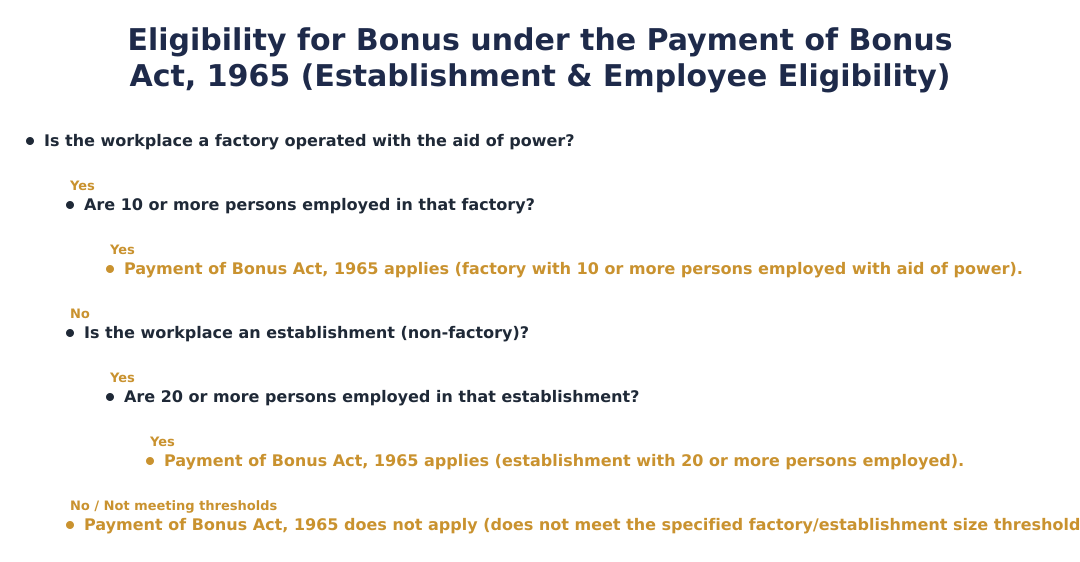
Who is covered under the Payment of Bonus Act, 1965, which factories or establishments does it apply to?
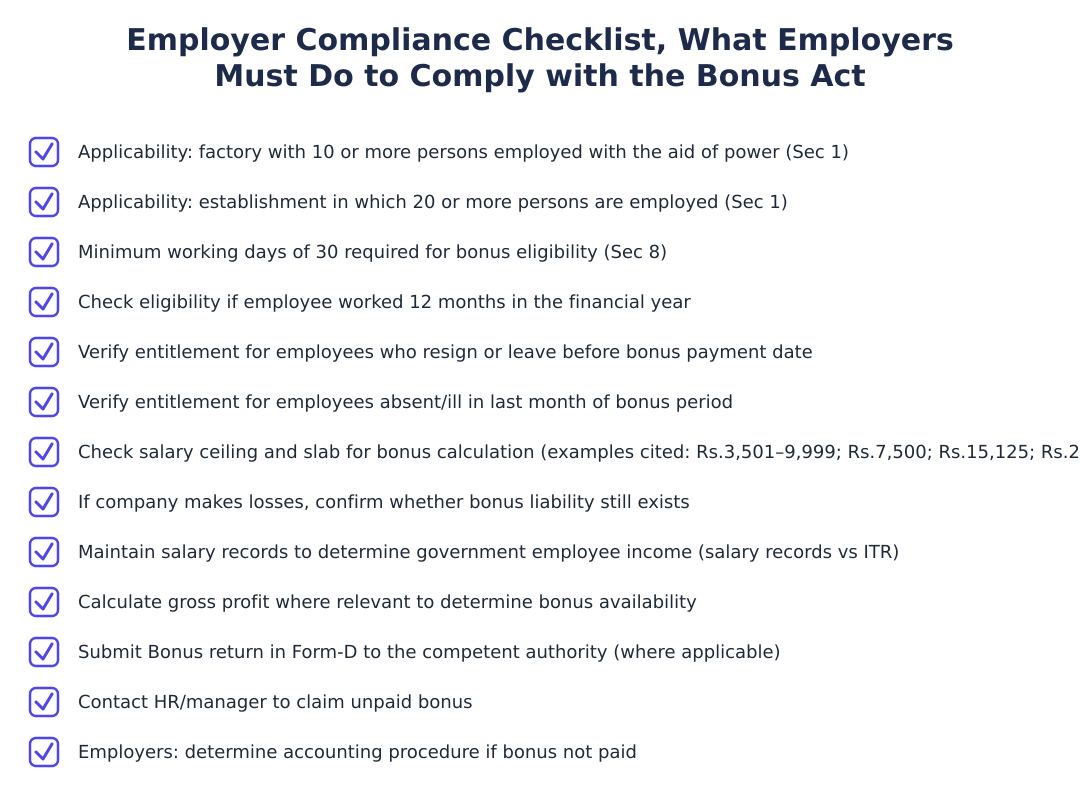
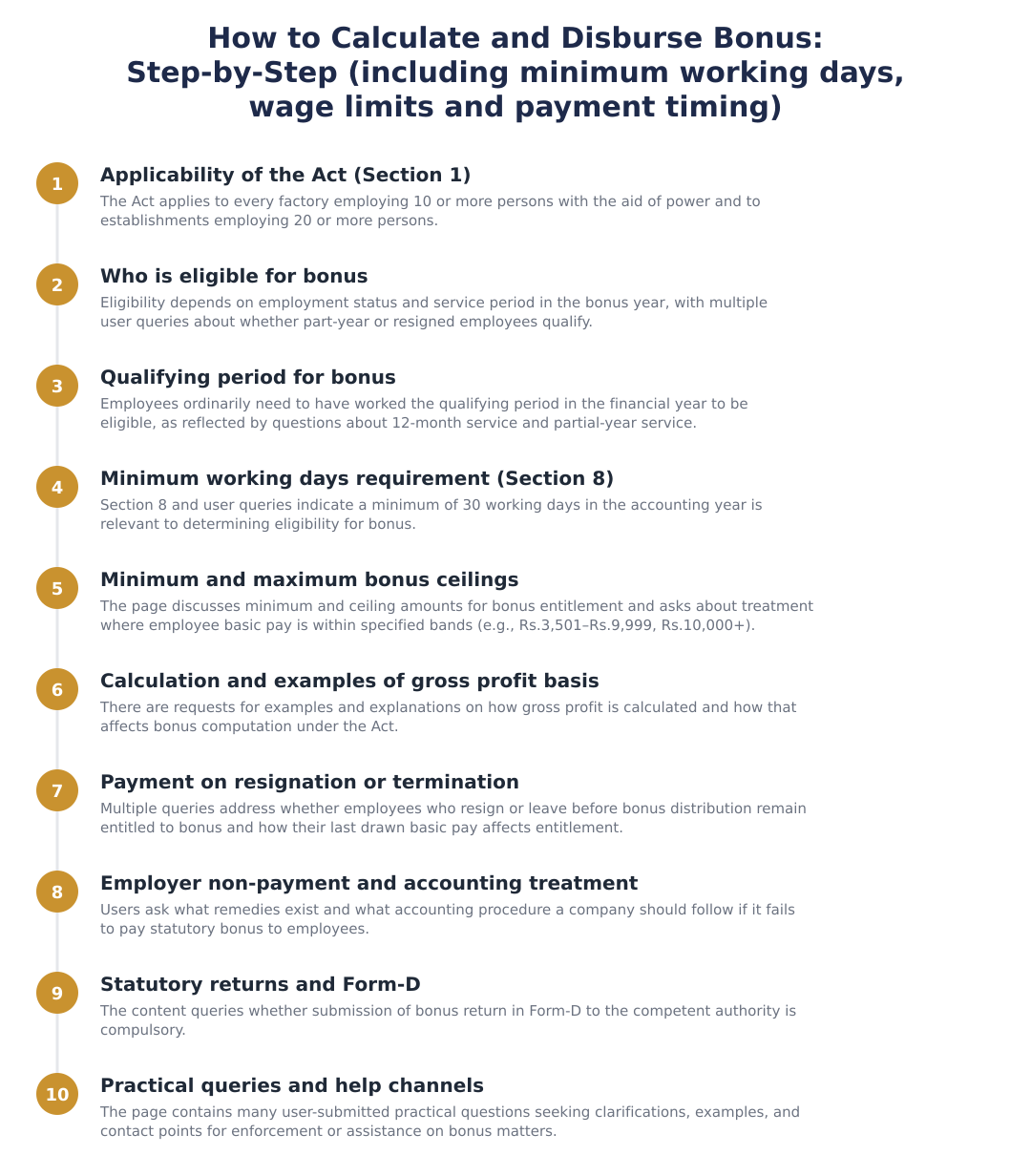
The Payment of Bonus Act, 1965 applies to every factory in which 10 or more persons are employed with the aid of power and to establishments in which 20 or more persons are employed without the aid of power. In other words, an industrial unit running with power is covered if it has at least 10 employees and non-powered establishments are covered when they regularly employ 20 or more persons; the employee count is ordinarily determined by average employment during a prescribed period. Small units below these thresholds are not covered by the Act, although state rules or other labour laws may still apply to them.
Who is eligible to receive bonus under the Act, what service must an employee have rendered?
An employee becomes eligible for bonus under the Act if they have worked for at least 30 days in the accounting year for which bonus is payable. The Act uses this minimum working-days test (commonly referred to in Section 8 queries) as the basic qualifying condition; there are additional conditions such as the nature of employment and exclusions in the Act for certain classes of employees (e.g., those already covered by other statutory schemes). For practical purposes, casual breaks, authorised leave and specified interruptions are treated as per rules when computing the 30-day threshold, so an employee who served 30 or more days during the year is entitled to claim bonus subject to other Act limits.
What is the minimum and maximum bonus payable under the Payment of Bonus Act?
The Act prescribes a statutory minimum bonus of 8.33% of an eligible employee’s salary/wages and a maximum bonus of 20% of salary/wages for a year. This means every eligible employee must receive at least 8.33% of their relevant salary for the bonus accounting year, while the employer cannot pay more than 20% as per the Act’s ceiling; the actual payable amount within this band depends on the employer’s allocable surplus and prescribed computation rules. Note that the ‘salary or wages’ used for calculation is subject to the Act’s definition and any statutory ceiling applicable at the time, which affects high-salaried employees.
How do you calculate bonus for an employee who had different basic salaries during the year?
Bonus is calculated on the basis of the employee’s salary/wages as defined by the Act for the accounting year, using the actual salary/wages payable during the period in which the employee worked; if pay changed during the year, the calculation considers the wages paid during the period of employment in that accounting year. Practically, you prorate or aggregate the wages for the full year and then apply the applicable bonus percentage (subject to minimum 8.33% and maximum 20%) and the statutory ceiling if any; examples and worked illustrations under the Act help show how monthly changes are handled. Employers commonly compute bonus by first confirming eligibility (30 days), determining annual wages up to the salary ceiling, computing the percentage, and then adjusting for any partial-year service.
Is an employee who resigns or is terminated eligible for bonus for the accounting year in which they left?
Yes, an employee who has worked at least 30 days in the accounting year and otherwise satisfies the Act’s conditions remains eligible for bonus even if they resign or are terminated before bonus payment, subject to prescribed cut-offs. The entitlement is determined by service during that accounting year; employers cannot deny bonus solely because the employee left later, though recovery or set-off rules (for advances or dues) may apply. In disputed cases employers often pay pro rata bonus and the employee can pursue statutory remedies if denied unlawfully.
When must employers pay bonus under the Act, is there a time limit after the accounting year ends?
Employers must pay the annual bonus within eight months from the close of the accounting year to which the bonus relates, in accordance with the Act’s timelines. If the accounting year ends on March 31, for example, the bonus should be paid by November 30 of that year; failure to pay on time can attract interest and penalties under labour law and entitle employees to approach labour authorities or courts for recovery. Employers should therefore compute, notify and disburse bonus within this statutory window to avoid disputes and statutory consequences.
What happens if the employer’s business makes a loss, are employees still entitled to bonus?
Employees can still be entitled to bonus even if the employer’s business shows a loss, subject to how the allocable surplus is computed under the Act; the statutory minimum of 8.33% applies if there is sufficient allocable surplus, but where no distributable surplus exists the payable bonus may be affected. The Act requires a specific computation of allocable surplus from profits which can be reduced by prescribed deductions, and in years with insufficient surplus the bonus payable can be lower or nil, although employees cannot be arbitrarily deprived of the minimum if the statutory tests are met. Disputes over surplus calculations commonly arise and are resolved by labour authorities or courts based on the Act’s formulae.
What can an employee do if the employer refuses to pay bonus or pays less than the statutory minimum?
If an employer refuses to pay bonus or pays less than the statutory minimum, the employee can file a claim before the designated labour authority or the civil court/industrial tribunal as per the Act and pursue recovery of the unpaid amount along with interest and penalties. The Act provides complaint and adjudication mechanisms, employees should first raise the grievance internally and then approach the Competent Authority under the Payment of Bonus Act or labour court if unresolved; timely documentation of service, salary and correspondence strengthens the claim. Many employees also use statutory notices, labour departments or legal representation to enforce bonus rights, especially where employers dispute eligibility or surplus calculations.
Need help staying Payroll compliant?
MoneyGence's AI Finance OS tracks your compliance, wallet share, and finances in one place, built for agencies and growing businesses.
Get started with MoneyGence