Payment of Wages Act 1936: Objectives, Features & Benefits
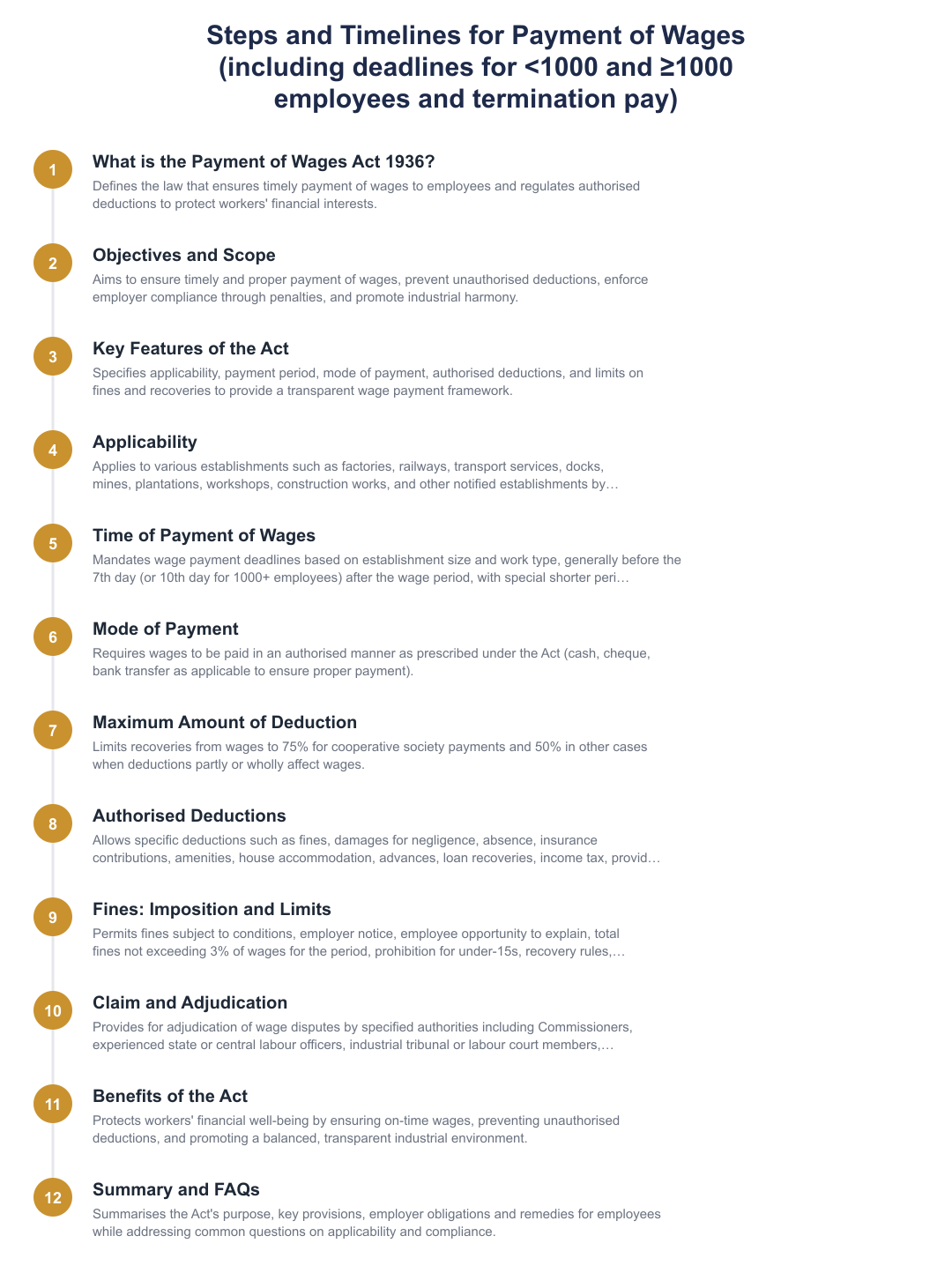
This guide explains the Payment of Wages Act, 1936: what it is, why it was enacted, its main features, who it covers, how wage payments are governed, and the practical benefits for employers and employees. You will learn the Act’s objectives, including protection from unauthorised deductions and preventing delay in wage payment, and how it seeks to balance workers’ financial well‑being with industrial efficiency. The guide also summarises how the Act treats authorised deductions and fines, the safeguards that must be followed before fines are imposed, and the broader role of the Act in promoting industrial harmony. This is a practical primer for HR professionals, payroll teams, small-business owners, and workers who want a clear, concise understanding of the statutory framework that governs wage payment in India under the Payment of Wages Act, 1936.
What is the Payment of Wages Act 1936?
The Payment of Wages Act, 1936 is a central labour law enacted to regulate the payment of wages to employees. Its core purpose is to ensure that workers receive timely payment of their wages and to protect them from unlawful or unauthorised deductions that could reduce their take‑home pay.
The Act sets out legal obligations for employers in areas such as when wages must be paid, the permitted modes of payment, and the limits and procedures regarding deductions and fines. By creating a statutory framework, the Act aims to provide predictability and enforceable rights for employees while guiding employers on compliant wage administration.
Objectives and Scope of Payment of Wages Act 1936?
The Act has several interrelated objectives. It aims to ensure timely and proper payment of wages and to protect employees against unauthorised deductions. It also provides for penalties where employers fail to comply, thereby incentivising adherence to wage rules.
Beyond protection of individual workers, the Act is intended to promote industrial harmony by making wage payment transparent and predictable. The government describes the law as pursuing a balanced approach that prioritises workers’ financial well‑being while also supporting an effective industrial environment.
Features of Payment of Wages Act 1936
The Act covers the principal operational elements of wage administration: its applicability to establishments and employees, the time period within which wages must be paid, the acceptable modes of payment, and the nature and limits of authorised deductions. These features form the backbone of statutory wage protections and provide a framework employers must follow.
A notable feature concerns fines and recovery: the Act permits imposition and recovery of fines only subject to conditions designed to safeguard employees, such as requirements on notice, the opportunity to explain, and rules about how collected fines should be used for employees’ benefit. While employers may take disciplinary actions like demotion or suspension, the Act specifically regulates monetary fines rather than non‑monetary disciplinary measures.
Applicability of Payment of Wages Act 1936
The Act applies to employers and employees in establishments and occupations specified under the law. It provides a statutory baseline that applies where the Act is applicable, while other labour laws and rules may operate alongside it depending on the nature and classification of the establishment.
Applicability determines which employers must follow the Act’s rules on the timing, mode of payment, and authorised deductions. Where an employer is subject to the Act, payroll policies and systems should be aligned to ensure compliance with its provisions to avoid penalties and disputes.
Time of Payment of Wages
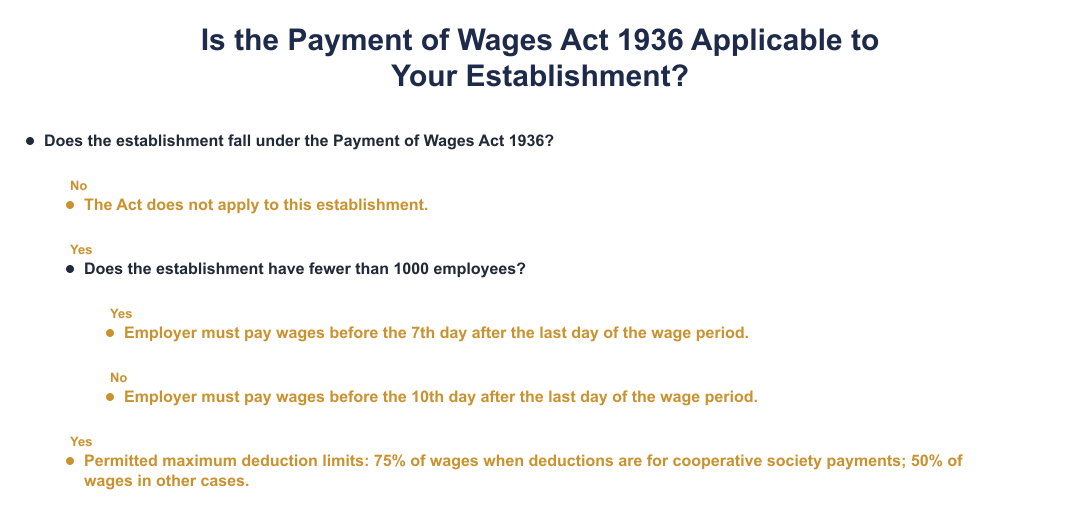
One of the central requirements under the Act is that wages must be paid within specified timeframes for each wage period. This provision prevents employers from unduly delaying wages and gives employees certainty about when they will receive pay.
The exact timelines and any different deadlines for particular kinds of establishments or large employers are specified in the Act and subordinate rules. Employers should be aware of the applicable deadlines for their establishments and ensure payroll calendars and cash flows are managed to meet those statutory payment dates.
Maximum Amount of Deduction Under Payment of Wages Act 1936
The Act restricts the nature and extent of deductions that an employer may make from an employee’s wages. Only authorised deductions are permissible; the law therefore protects employees from arbitrary or excessive withholding of pay.
Where deductions are permitted, employers must follow the statutory conditions and limits. These restrictions are intended to preserve the majority of an employee’s wage while still allowing reasonable deductions for clearly specified purposes under the Act.
Deduction Under the Payment of Wages Act
The Act identifies categories of authorised deductions and sets conditions for when and how they may be recovered from wages. Authorised deductions are those recognised by the statute; employers cannot make other deductions except with the employee’s consent and in accordance with law.
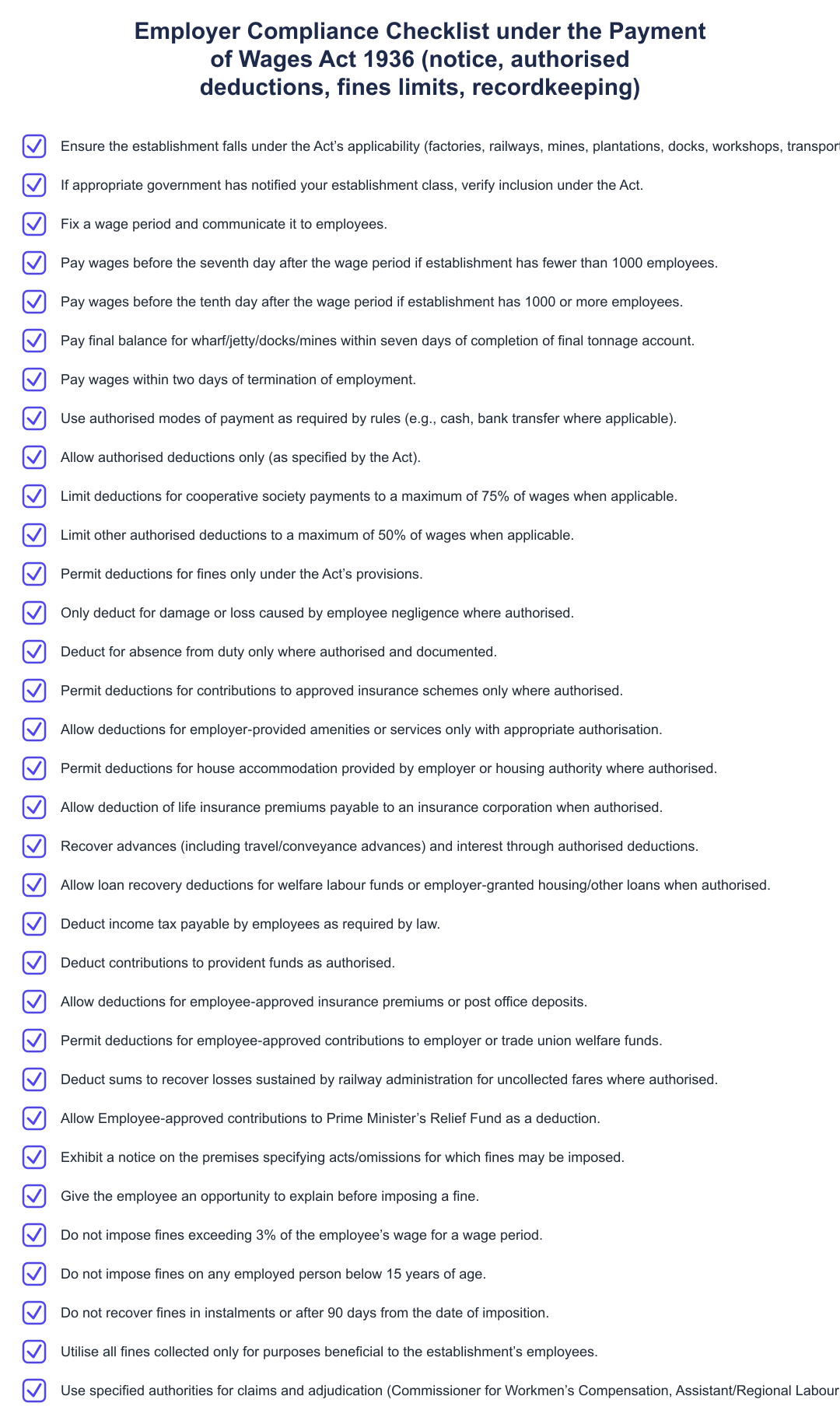
Practically, this means payroll teams must document the legal basis for any deduction and ensure compliance with procedural safeguards. Unauthorized deductions can give rise to claims by employees and potential penalties for employers under the Act.
Fines Under Payment of Wages Act 1936
The Act permits the imposition of fines by employers but only subject to specified safeguards. Before imposing a fine, the employer must comply with procedural requirements such as issuing notice and providing the employee an opportunity to explain the alleged act or omission.
Another important safeguard is the obligation regarding utilisation of fines: sums recovered as fines must be used for purposes beneficial to the employees, the Act regulates both how fines are imposed and how they are to be applied for the workforce’s benefit. The Act does not deal with other non‑monetary disciplinary measures except that such measures (like demotion or suspension) are typical employer actions outside the Act’s specific monetary regulation.
Claim and Adjudication Under the Payment of Wages Act 1936
The Act provides mechanisms for employees to raise claims where wages are unpaid or unlawful deductions are made, and for those claims to be adjudicated under the statutory procedure. This judicial or quasi‑judicial route provides an enforcement pathway outside of ordinary civil suits.
Adjudication under the Act enables an independent officer or authority to examine disputes about wage payments, determine whether deductions were lawful, and order remedies as provided by the law. Employers should therefore maintain clear records and follow the Act’s requirements to withstand scrutiny in any adjudication.
Benefits of Payment of Wages Act 1936
For employees, the Act provides essential protections: assured timing of wage payments, limitation on arbitrary deductions, and a statutory route to claim unpaid wages. These protections enhance workers’ financial security and reduce vulnerability to wage exploitation.
For employers and industries, the Act fosters transparency and predictability in wage administration which helps maintain industrial harmony. By setting clear rules and penalties, the law reduces disputes and helps create a stable environment for labour relations and business operations.
Summary
The Payment of Wages Act, 1936 establishes a statutory framework to ensure timely payment of wages and to protect employees from unauthorised deductions, while permitting authorised deductions and fines subject to safeguards. It balances employee protections with the needs of employers and seeks to promote industrial harmony through clear, enforceable rules.
Employers covered by the Act should align payroll processes to the Act’s requirements, on timing, mode of payment, and deductions, and be mindful of procedural safeguards when imposing fines. Employees should know their rights under the Act and the remedies available if wages are delayed or wrongly withheld.
Frequently Asked Questions
Q: What is the main purpose of the Payment of Wages Act, 1936? A: The Act’s main purpose is to regulate payment of wages to employees so they receive timely payment and are protected from unlawful deductions, with penalties for non‑compliance.
Q: Can an employer impose fines on employees? A: Yes, the Act permits imposition of fines but only subject to required safeguards such as notice, an opportunity to explain, and rules on how collected fines are used for employees’ benefit.
Q: Does the Act cover deductions? A: The Act covers authorised deductions and restricts unauthorised deductions; employers must follow the statutory categories and conditions for making deductions.
The Payment of Wages Act, 1936 is a foundational labour statute that protects workers’ right to timely and lawful payment while providing a clear compliance framework for employers. Understanding its objectives, key features, and safeguards, especially around deductions and fines, helps both employers and employees navigate wage‑related issues and supports stable industrial relations.
Frequently asked questions
What is the Payment of Wages Act, 1936 and what does it do?
The Payment of Wages Act, 1936 is a law that regulates timely payment of wages and prevents unauthorised deductions from workers’ pay. It applies to specified employed persons in factories, railways, docks, mines, plantations, transport services and other notified establishments and ensures employers pay wages on time, limits permissible deductions, and provides penalties for non‑compliance. The Act protects employees’ financial well‑being by prescribing wage periods, payment timelines, modes of payment, maximum deduction limits and procedures for imposing fines and recovering disputed amounts. Overall, it aims to promote industrial harmony by making wage payment transparent and fair.
Which establishments and employees are covered under the Payment of Wages Act, 1936?
The Act applies to employees in factories, railways (including sub‑contracted staff), industries, tramway and motor transport services, air transport (except defence or Civil Aviation Department exclusive services), docks, mechanically propelled inland vessels, mines, oilfields, quarries, plantations, workshops, construction and other notified establishments. The appropriate Government may also notify additional classes of establishments in the Official Gazette, so coverage can vary by state or central notification. Coverage is based on the nature of the establishment and not solely on the income or role of the worker, but a class of establishments may be specified or exempted by notification. Employers should check the relevant state or central notifications to confirm applicability for a particular workplace.
When must employers pay wages under the Payment of Wages Act, 1936?
Employers must pay wages before the seventh day after the wage period ends if the establishment has fewer than 1,000 employees, and before the tenth day if it has 1,000 or more employees. If an employee is terminated, the employer must pay the wages within two days of termination; for wharf, jetty, dock or mine workers the balance after final tonnage accounts must be paid within seven days of completion. Wage periods, mode of payment and specific timelines must be fixed by the employer but must comply with these statutory maximums, otherwise the employer may face penalties. These time limits ensure workers receive timely access to earned wages and reduce hardship from delayed payments.
What modes of payment are permitted under the Payment of Wages Act, 1936?
The Act allows payment of wages in cash or by bank transfer or other modes prescribed by the appropriate government, provided payments are made on time and in a manner authorised by law. Employers must comply with any state or central rules about mode of payment and may be required to display notices about wage payment particulars at the workplace. The key requirement is that the employee actually receives the wage in full (subject to authorised deductions) and that payment records are maintained; failure to do so can attract penalties. Employers often use bank transfers or cheques, but must ensure accessibility for workers who may not have bank accounts unless alternative arrangements are prescribed.
What deductions are allowed from wages under the Payment of Wages Act, 1936 and what are the limits?
Authorised deductions include fines, recovery for damage or loss caused by the employee, absence from duty, insurance contributions prescribed by government, amenities provided by the employer, house accommodation charges, life insurance premiums, recovery of advances or wage overpayments, provident fund and income tax, contributions to authorised welfare funds and other items approved by the employee or government. When deductions are made toward cooperative society payments the maximum recoverable is 75% of wages; for other authorised deductions the maximum recoverable is 50% of wages. These limits apply when deductions would leave the employee with insufficient take‑home pay, and certain deductions require prior approval from the employee or the appropriate authority. Employers must not make unauthorised or excessive deductions and must follow statutory limits to avoid liability.
How do fines work under the Payment of Wages Act, 1936 and what safeguards exist for employees?
Fines can be imposed for specified acts or omissions but the employer must exhibit a notice listing offences attracting fines, give the employee an opportunity to explain, and ensure the total fines do not exceed 3% of the employee’s wage for a wage period. Fines cannot be levied on persons under 15 years of age, cannot be recovered in instalments or after 90 days from imposition, and all fines collected must be used for the welfare of employees of the establishment. These safeguards are designed to prevent arbitrary or excessive penal deductions and to ensure transparency and due process before imposing financial penalties. Employers who fail to follow the procedure or exceed limits may face adjudication and penalties under the Act.
What remedies and authorities are available for claims and adjudication under the Payment of Wages Act, 1936?
Affected employees can file claims before designated authorities such as a Commissioner for Workmen’s Compensation, an Assistant Labour Commissioner (State or Central) with at least two years’ experience, a Regional Labour Commissioner, a presiding officer of an Industrial Tribunal or Labour Court, or any officer with experience equivalent to a Civil Court Judge or Judicial Magistrate. These authorities investigate wage payment disputes, unauthorised deductions, fines and late payments and can order recovery of wages, penalties and payment of interest where applicable. The appropriate authority is specified by the State or Central rules for the area, and employees should follow the prescribed claim procedure and timelines to seek relief. Successful claimants may obtain wage recovery as well as enforcement action against non‑compliant employers.
What are the main benefits of the Payment of Wages Act, 1936 for workers?
The Act benefits workers by ensuring timely payment of wages, protecting them from unauthorised or excessive deductions, limiting the amount recoverable for loans and cooperative payments, and providing a transparent process for imposing fines with safeguards. It also prescribes quick payment on termination and specific timelines for various classes of workers (for example, within two days of termination or seven/tenth day after the wage period), thereby reducing financial hardship from delayed wages. Additionally, the Act provides a legal mechanism for workers to claim unpaid wages and obtain adjudication through labour authorities, which promotes industrial harmony and protects employees’ basic financial rights. Employers who comply with the Act maintain better trust, lower disputes and improved workforce stability.
What are the employer’s obligations and penalties for non‑compliance under the Payment of Wages Act, 1936?
Employers must display notices specifying fines, maintain wage records, pay wages within prescribed time limits, restrict deductions to authorised categories and observe deduction limits; failure to comply can result in claims, adjudication, fines and other penalties as prescribed by the Act. Non‑compliance can lead to orders for recovery of withheld wages, payment of penalties and directions to rectify record‑keeping and payment procedures, and repeated violations may attract higher sanctions or prosecution under labour laws. Employers should implement transparent payroll processes, obtain employee approvals where required, and follow statutory modes and timelines of payment to avoid disputes and legal action. Proactive compliance also reduces industrial unrest and protects the employer’s reputation and business continuity.
Need help staying Payroll compliant?
MoneyGence's AI Finance OS tracks your compliance, wallet share, and finances in one place, built for agencies and growing businesses.
Get started with MoneyGence