Payroll for Startups India: Hiring & Payroll Process Guide
This guide explains how early-stage startups should approach hiring employees and running payroll in a practical, compliance-minded way. You'll learn common pitfalls founders make when moving from a founder-only operation to a payroll-driven organisation, how to set up hiring and onboarding processes that scale, and the fundamentals of running a reliable payroll cycle. The goal is to help you create predictable monthly cashflows for employees, reduce legal and reputational risk, and make payroll an asset rather than a headache, so you can focus on product and growth. The guidance is framed to be applicable across sectors and sizes of small startups: it emphasises principles, workflow design, and best practices that founders and small HR/payroll teams can implement quickly. Whether you plan to keep payroll in-house or use a vendor, understanding these basics will help you choose the right tools, avoid common errors, and build documentation and controls that support future fundraising and hiring.
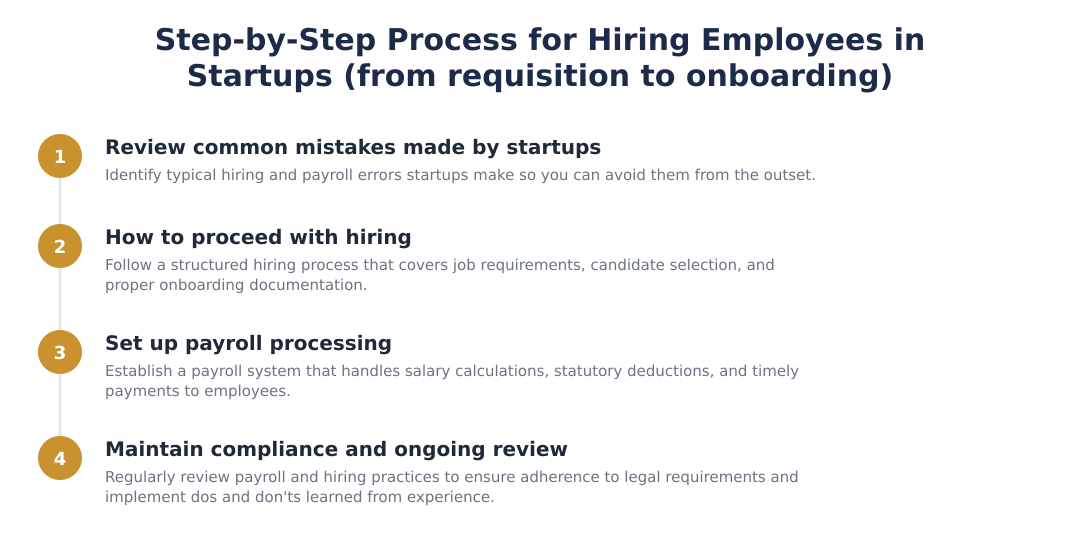
Hiring Employees and Processing Payroll for Startups
Hiring your first employees changes how the business operates: payroll introduces recurring liabilities, compliance obligations, and expectations around timeliness and confidentiality. Before making offers, founders should clarify the roles, reporting lines, and compensation philosophy so hires understand short- and long-term incentives. Consider whether the role is full-time, part-time, contractual, or remote, each choice affects onboarding, benefits expectations, and how you will manage attendance and payments.
Startups should document the full cost of hiring a person, not just the headline salary. Total cost includes employer-side costs, any benefits or reimbursements, equipment and workspace expenses, and the time required for recruiting and training. Building clear employment agreements and an employee handbook from the outset reduces ambiguity and avoids disputes later. Even simple, consistently applied policies for probation, leaves, and notice periods go a long way toward smooth operations.
Common Mistakes Made by Startups
A frequent error is underestimating payroll-related administrative work. Running payroll is not just transferring salaries; it involves maintaining accurate records, applying standardised policies, and ensuring timely payments. When startups treat payroll as an afterthought, they risk late payments, incorrect deductions, and frustrated employees, outcomes that are harder to fix as headcount grows.
Another common mistake is inconsistent documentation. Verbal understandings about salary components, bonuses, or stock-linked incentives often lead to disputes. Startups that lack written offer letters, clear salary breakup, and documented performance review cycles find it hard to justify pay changes or terminate employment if needed. Consistency in recordkeeping also supports fundraising and due diligence, where investors expect neat personnel and payroll records.
Founders also often delay putting basic HR processes in place until problems arise. Simple preventive steps, like defining approval flows for salary changes, setting payroll dates, and deciding who has access to payroll data, prevent many issues. Finally, failing to choose between an in-house or outsourced payroll model early can create friction; switching models later becomes routine but entails effort and transitional risk.
How To Proceed
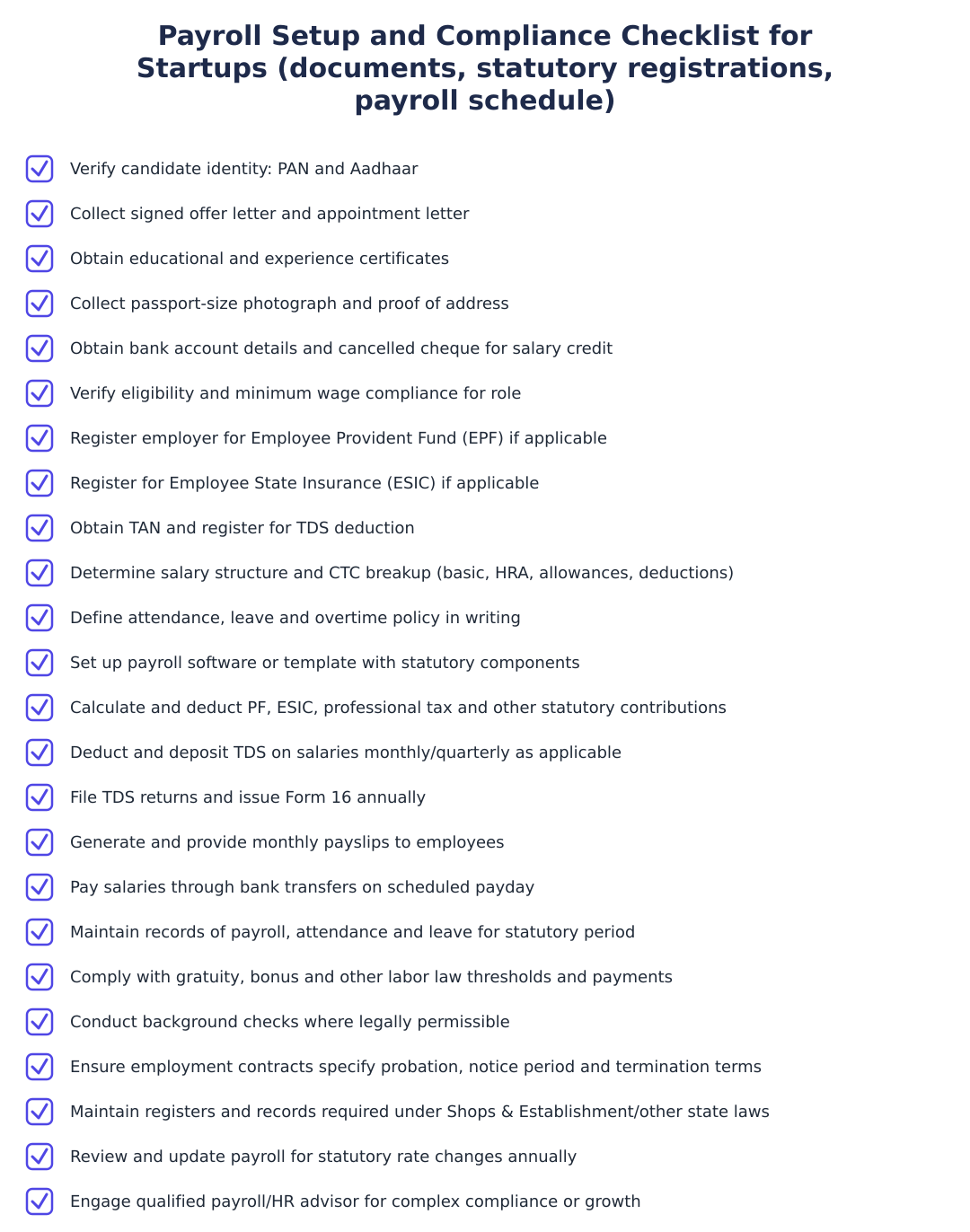
Start with a hiring and payroll checklist that covers offer letters, employment agreements, bank details, and any declarations or forms the company requires. Create a standard offer template that outlines gross compensation, pay frequency, notice period, probation terms, and any variable pay elements. Standardising offers reduces negotiation time and ensures equal treatment across hires.
Decide early whether payroll will be managed in-house or outsourced. In-house payroll gives you direct control but requires investing in a payroll tool and internal controls. Outsourcing reduces administrative burden and leverages external expertise, which can be valuable for a small team; however, choose vendors carefully and get clear service-level commitments about accuracy and timeliness.
Implement basic payroll controls: define who reviews and approves salary runs, restrict access to payroll data, and reconcile payroll expenses against bank statements each month. Regular reconciliations and an approval trail help catch errors quickly and create audit-ready records. Also document a payroll calendar with cut-off dates for attendance inputs, salary calculation, and payment execution so expectations are clear to employees and managers.
Processing Payrolls
A reliable payroll process has repeatable stages: collection of timesheets and attendance, computation of gross pay and deductions, approvals, payment execution, and record retention. Automate as much as possible: use payroll or HR software to calculate pay components, generate payslips, and store records. Automation reduces arithmetic errors and speeds up approvals, which is especially helpful as employee count increases.
Be systematic about deductions and reimbursements. Ensure that any pre-agreed deductions are documented in employment agreements and that reimbursements have clear submission and approval rules supported by receipts. Communicate payslips promptly and make them available to employees in a secure manner so queries can be raised early.
Test your payroll run before the payment date for the first few cycles: run a mock payroll to check calculations, approvals, and bank transfer files. After payments, reconcile net payroll amounts and employer costs against bank debits and accounting records. Keep a version-controlled archive of payroll runs and approvals to simplify future audits or investor reviews.
Good payroll practices start small but scale well: clear offers, documented policies, reliable tools, and basic controls prevent common problems and protect both employees and founders. Whether you handle payroll internally or use a vendor, invest time early to standardise processes, communicate clearly with employees, and set up simple reconciliations, this creates predictability, reduces risk, and lets the startup focus on growth.
Frequently asked questions
What are the first legal steps a startup should take when hiring its first employee?
Registering your business for required labour and tax registrations and issuing a proper offer letter are the first legal steps when hiring your first employee. Specifically, you should confirm which statutory registrations apply to your entity (such as Professional Tax, Shops & Establishment registration, Employee Provident Fund (EPF) and Employee State Insurance (ESI) registrations where applicable) and obtain a PAN and bank details from the employee for payroll and TDS purposes. Prepare a written offer/appointment letter that states role, start date, salary breakup, probation period, notice period and any stock-option or confidentiality terms to avoid disputes later. Keep copies of identity/address proofs, educational certificates and signed acceptance in the employee file for compliance and audit readiness.
How should a startup structure an employee's salary for payroll processing?
A startup should structure salary into clear, standard components, basic salary, allowances, reimbursements, and deductions, so payroll calculation and statutory compliances are straightforward. Typical components include Basic (usually a fixed percentage of CTC), House Rent Allowance (HRA), conveyance/fixed allowances, performance/incentive components, and reimbursements for actual expenses; deductions include employee contributions to PF/ESI, professional tax and TDS as applicable. Define the Cost to Company (CTC) versus in-hand pay to avoid confusion, and document the breakup in the offer letter so employees know taxable versus non-taxable components. Keep variable pay or ESOPs clearly governed by policy to ensure correct payment and taxation treatment during payroll.
How often should startups run payroll and what’s the best payroll frequency?
Startups should run payroll at least monthly, which is the common and recommended frequency for employee salary payments and statutory filings. Monthly payroll aligns with tax deduction and contribution cycles, simplifies monthly reconciliations, and meets employee expectations for regular pay. For hourly or contract workers you may run weekly or biweekly payrolls, but ensure payroll frequency is documented in contracts and that statutory contributions and TDS are calculated appropriately for each pay cycle. Use a reliable payroll calendar to lock cut-off dates for attendance, approvals and salary disbursement to avoid delays and compliance issues.
What common payroll mistakes should startups avoid?
Startups often make mistakes such as not maintaining accurate attendance and leave records, misclassifying workers, failing to register for or correctly calculate statutory deductions (PF/ESI/Professional Tax/TDS), and issuing unclear salary offers. These errors lead to compliance penalties, employee disputes and inaccurate cost accounting; for example, missing PF/ESI registration timely can attract interest and fines. Avoid ad-hoc salary increases without documentation, mixing reimbursements and taxable allowances without proof, and delaying payslips, issue monthly payslips showing gross pay, deductions and net pay for transparency. Implement basic payroll controls and reconciliation processes from the start to prevent escalations.
How do I handle probation, notice periods and termination in payroll?
Handle probation and notice periods by documenting their duration and impact on salary, benefits and gratuity eligibility in the appointment letter and HR policy; payroll must reflect any prorated salary during probation or notice. If an employee serves notice, settle final pay components including outstanding salary, accrued but unpaid leave encashment, unpaid reimbursements and tax adjustments; apply statutory deductions and obtain a resignation acceptance and relieving letter to close records. For terminations, ensure statutory dues like gratuity (if eligible), provident fund settlement and final TDS reconciliation are processed timely and provide a clear full-and-final settlement statement to the employee.
What payroll documentation should I maintain for compliance and audits?
Maintain complete payroll documentation including appointment letters, signed attendance/leave records, salary registers, payslips, bank pay-orders or NEFT/UTR details, statutory challans for PF/ESI/TDS payments and returns, and employee tax declarations (Form 12BB or investment proofs). Keep monthly salary registers that itemize gross pay, each deduction and net pay, and store copies of all statutory filings and payment receipts for the prescribed retention period to support audits or labour inspections. Maintain confidential personnel files with identity proofs, PAN, bank account details and signed policies; these records help during TDS assessments, PF/ESI audits and employee disputes.
How should startups calculate and deduct TDS on salaries?
Startups must calculate TDS on salary based on the employee's estimated taxable income and available declarations, and deduct it each payroll month under relevant income tax provisions. Collect Form 12BB or investment proofs to compute exemptions and deductions (like Section 80C) before estimating annual taxable income, apply applicable slab rates or applicable TDS sections, and spread the tax deduction across months to reflect monthly pay. Deposit TDS to the government within prescribed timelines and issue Form 16 annually evidencing tax deducted; failure to deduct or deposit TDS correctly can lead to interest and penalties for the employer.
Should a startup outsource payroll or manage it in-house?
Whether to outsource payroll or manage it in-house depends on your cost, headcount, compliance capacity and internal controls; small startups often outsource initially to specialised payroll providers to reduce compliance risk. Outsourcing ensures timely statutory filings, reconciliations and keeps you updated on changing labour laws, while in-house payroll gives more control and may be cost-effective once you have stable processes and trained staff. If you outsource, choose a vendor that provides payslips, statutory filings, payroll reconciliation and secure data handling; if doing payroll internally, invest in payroll software and documented procedures to maintain accuracy and audit trails.
How do startups process final settlements and statutory dues when an employee leaves?
Process final settlement by computing all earned salary up to the last working day, paying out accrued but unpaid leaves, unpaid reimbursements, adjusting advances, and settling statutory dues like PF withdrawal and gratuity if applicable. Ensure proper TDS on the final payment if applicable, prepare a full-and-final settlement statement showing calculations and obtain a signed receipt and relieving letter from the employee. Complete statutory formalities such as PF final settlements/transfer and issuing Form 16B or other required certificates in a timely manner to avoid disputes and to help the employee with their future tax filings.
Need help staying Payroll compliant?
MoneyGence's AI Finance OS tracks your compliance, wallet share, and finances in one place, built for agencies and growing businesses.
Get started with MoneyGence